Walk into a supermarket anywhere in the world, and you think you know the drill. Aisles of produce, rows of refrigerated goods, the familiar hum of freezers. I thought I knew the game, coming from Tokyo where convenience is king and supermarkets are slick, efficient machines for fueling a fast-paced life. But my first trip to an Osaka supermarket felt like stepping into a different dimension. It wasn’t just a store; it was a theater of local life, a boisterous, unapologetic celebration of the city’s stomach. The energy was different, the priorities were skewed, and the sheer volume of certain items told a story I was only beginning to understand. This isn’t just about groceries. This is about decoding the very essence of Osaka, the `kuidaore` (eat until you drop) philosophy, not in a fancy Dotonbori restaurant, but right here, under the fluorescent lights of a neighborhood Mandai or Life. Forget the guidebooks for a moment. If you truly want to grasp the Osaka mindset, your education begins in the supermarket aisle.
The dynamic energy of Osaka continues to inspire, as evidenced by the lively seller-customer banter thriving in the city’s shotengai.
The Sacred Chant of “Yasui!”: More Than Just a Price Tag

In Tokyo, shopping often revolves around quality, presentation, or brand. In Osaka, the key principle—the word whispered with reverence and shouted with excitement—is “yasui!”—cheap. But this is where foreigners, and even I as a Tokyo native, often misunderstand. It’s not about being frugal or compromising quality. It’s a sport. Scoring the best product at the lowest price is a victory, a proof of your shopping skill. This is the merchant DNA of Osaka in action. A good deal is more than just a discount; it’s a badge of honor. You see it in how shoppers clutch their weekly flyers, the `chirashi`, poring over them like scholars interpreting ancient texts. They know which day vegetables are cheapest at Mandai and when Life runs its egg specials. This is not passive buying; it’s active participation.
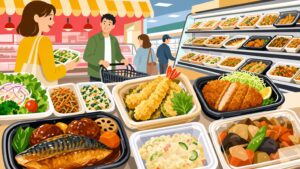
This is most evident during a `time sale`. As the clock nears 7 PM, a distinct energy shift happens in the prepared foods section. An employee appears with a roll of discount stickers, and a quiet crowd forms. It’s not chaos. It’s a group of experienced hunters, eyes locked on their targets: bento boxes, fried chicken, sushi packs. They move with calm, focused precision, fully aware of what they want. Securing a 50% off `tonkatsu` bento is a small, perfect victory that completes the day. The supermarket chains themselves embody this spirit. You have your dependable Life and Mandai for everyday needs. Then there’s Gyomu Super, the wholesale giant where you can buy a kilogram of frozen gyoza or a giant bottle of soy sauce, perfect for feeding a family on a budget. And then there’s the legendary Super Tamade. Bathed in gaudy neon that screams “PACHINKO PARLOR,” Tamade is known for its almost absurd 1-yen sales and its chaotic, treasure-hunt vibe. Shopping there is an experience, a plunge into the heart of Osaka’s price-savvy spirit. For the Osaka shopper, value isn’t just an aspect; it’s the whole point.
The Konamon Kingdom: Where Flour is Sacred Ground
If you want to grasp the essence of Osaka cuisine, skip the fancy ingredients and head straight to the flour aisle. This is the heart of `konamon` culture—literally “flour things”—the soul food that defines the city: okonomiyaki and takoyaki. In a Tokyo supermarket, the flour section serves a practical purpose. You’ll find all-purpose flour, cake flour, maybe some bread flour. In Osaka, it’s almost a shrine. You’ll encounter a whole world of specialized blends. There’s okonomiyaki flour, carefully mixed with `yamaimo` (mountain yam) for fluffiness and dashi for depth of flavor. Right beside it is takoyaki flour, formulated differently to create a crispy outer shell and a molten, gooey interior. This isn’t just a convenience; it’s a mark of respect for the craft. It shows that these dishes are not novelties but weekly, if not daily, staples of home cooking.
The Wall of Sauce
Once you’ve picked your flour, you must face the Wall of Sauce. A whole aisle section—sometimes more—is devoted to the thick, sweet, savory brown sauces that are the lifeblood of `konamon`. The national brand, Otafuku, is naturally present. But surrounding it are dozens of local Osaka brands, each with its own devoted following. Some are sweeter; others spicier; some have fruitier bases. A household’s choice of okonomiyaki sauce is a statement of identity. And it doesn’t stop there. You need Japanese mayonnaise (Kewpie reigns supreme), as well as `aonori` (green seaweed powder), and `katsuobushi` (bonito flakes), which come in much larger bags than what you’d find in Tokyo. The most revealing item is `tenkasu` (crunchy tempura scraps). In Osaka, the bags are huge because `tenkasu` isn’t just a topping—it’s a core ingredient, mixed into okonomiyaki batter for texture and flavor, and generously sprinkled on udon.
The Tools of the Trade
The final proof lies in the appliances. Hidden in the housewares section of any decent-sized Osaka supermarket, you’ll find electric takoyaki grills sold as standard household items, right alongside rice cookers and toasters. It’s an unspoken expectation that every Osaka family either owns one or is about to get one. Hosting a “takoyaki party,” or `takopa`, is a fundamental social ritual. This simple fact elevates takoyaki from street snack to a cornerstone of home life. The supermarket isn’t merely selling you food; it’s providing you with the tools to take part in the city’s most cherished culinary traditions right in your own kitchen.
It All Starts with Dashi: The Unspoken Flavor of Osaka
Every cuisine has its fundamental flavor, the subtle base note upon which all else is built. For Osaka and the wider Kansai region, that flavor is dashi. However, it is a particular kind of dashi that distinguishes it from Tokyo and the Kanto region. While Kanto-style dashi often has a strong, sharp taste from dark soy sauce and `katsuobushi`, Kansai dashi is lighter, more delicate, and richly umami, based on high-quality `kombu` (kelp) and gentle fish notes from `urume iwashi` (round herring) or `niboshi` (sardines). This golden, fragrant broth is the heart of Osaka’s udon, and its influence is evident throughout the supermarket.
The dashi section is extensive and diverse. You’ll find the common instant dashi powders and teabags, naturally, but the true story lies in the raw ingredients. There are impressive selections of dried kombu from various parts of Hokkaido, each offering a unique flavor profile. And there are bags of different dried fish to create a more layered broth. This reflects a community that continues to appreciate and uphold the tradition of making dashi from scratch. This flavor profile is most exquisitely represented in `Kitsune Udon`, a dish of thick, soft udon noodles swimming in a delicate dashi broth, topped with a large piece of `aburaage` (fried tofu) simmered in a sweet and savory sauce. This dish originated in Osaka and stands as the city’s ultimate comfort food. In the supermarket, this culture is also visible in the refrigerated section, where you will find packages of pre-simmered, sweet `o-age` made specifically to top a bowl of udon. It’s a shortcut, yes, but a shortcut to an authentic and deeply loved local flavor.
The Aisles of Distinction: What You’ll Find Here (and Not in Tokyo)
Beyond the major staples of `konamon` and dashi, the finer details found in an Osaka supermarket offer an even deeper insight into the local palate. Some sections are more expansive, certain products more prominent, each narrating a story about the city’s history and its straightforward, hearty appetite.
Horumon and Offal: The Butcher’s Pride
Look inside the butcher’s case in a Tokyo supermarket, and you’ll see neatly packaged, familiar cuts of meat. In contrast, Osaka’s meat section has a grittier, more comprehensive feel. The `horumon` (offal/variety meats) section is often surprisingly large and varied. You’ll find everything from heart (`hatsu`) and liver (`rebā`) to various intestines (`tecchan`, `marucho`) and tripe (`senmai`). This isn’t niche; it’s mainstream. This comes from Osaka’s history as a major hub for the meat industry and reflects a deeply rooted, no-waste food culture. These cuts are destined for home hotpots like `motsunabe` or weekend yakiniku sessions on the balcony. It reveals an earthy, pragmatic approach to eating that prioritizes flavor and texture over delicate presentation.
The Ubiquitous Udon-dama
While Tokyoites might choose fresh ramen or soba, Osaka shoppers favor the humble `udon-dama`. These are single-serving, pre-boiled packets of fresh udon noodles sold very inexpensively. The amount of shelf space devoted to `udon-dama` is remarkable. They serve as the perfect base for a quick, affordable, and satisfying meal. You can drop one into hot dashi broth for a simple `kake udon`, stir-fry it with pork and cabbage for `yaki-udon`, or even transform it into a carbonara-style dish. The `udon-dama` embodies Osaka’s practical, comforting, and udon-focused food culture.
A Note on Bread: The Thick-Cut Obsession
Even the bread aisle reveals a Kansai story. The standard loaf of `shokupan` (fluffy white bread) in Japan is usually sliced into six or eight thin pieces. In Osaka, the preference strongly favors `atsugiri`, or thick-cut bread. Four-slice and five-slice loaves dominate the shelves. Why? It’s all about creating the ideal `kissaten` (old-school coffee shop) style toast at home. A thick slice can hold a generous slab of butter that melts into the fluffy interior, offering a substantial and satisfying foundation for a proper breakfast. It’s a small detail, yet it reflects a taste for hearty substance over delicate portions—a consistent theme in Osaka’s food culture.
Beyond the Bento: The Sozai Counter as the Neighborhood Kitchen
The `sozai` (prepared foods) section in any Japanese supermarket is a saving grace for busy individuals. However, in Osaka, it serves less as a last-minute dinner fix and more as an extension of the family kitchen. The variety and quality offered are carefully tailored to suit the local tastes and lifestyle. While a Tokyo `sozai` counter might showcase elegant salads and grilled fish, the Osaka counterpart is a celebration of fried, hearty, and flavorful dishes.
Naturally, you’ll find freshly made okonomiyaki and takoyaki, ready to be taken home for dinner. But if you look closer, you’ll notice trays loaded with `kushikatsu`—deep-fried skewers of meat, seafood, and vegetables. There are tubs of `doteyaki`, a rich, slow-cooked stew of beef sinew and konjac in a sweet miso broth, a classic izakaya favorite served by the scoop. The variety of `korokke` (croquettes) and `menchi katsu` (minced meat cutlets) is always extensive and incredibly affordable. This isn’t just for single office workers—it’s for families. It’s entirely normal and socially accepted for a parent to purchase the main fried dish from the supermarket and complement it with homemade rice, miso soup, and a simple salad. This isn’t seen as cheating or laziness; rather, it’s admired as smart, economical, and resourceful—core values in the Osaka mindset. The `sozai` counter acts as a communal kitchen, helping the whole neighborhood serve a hot, satisfying, and distinctively Osakan meal, night after night.
The Supermarket as a Social Map
A supermarket in Osaka is much more than just a place to purchase food. It serves as a living museum of local culture, a daily gauge of the city’s preferences, and a tangible reflection of its core values. The focus on value goes beyond saving money; it captures the excitement of the hunt, a legacy from a city shaped by merchants. The respect for flour and sauce extends beyond dinner; it upholds a tradition of communal cooking and shared identity. The appreciation for dashi, offal, and thick-cut toast highlights a palate that is both refined and unpretentious, favoring rich umami and hearty satisfaction instead of passing fads.
To live in Osaka is to attune yourself to its rhythms, many of which are determined by the local supermarket’s opening hours and daily deals. It’s here that you’ll witness the renowned Osaka friendliness—not through loud greetings, but through the quiet, mutual understanding as you and another shopper reach for the last half-priced pack of sashimi. So next time you enter, pause for a moment. Listen for the time sale announcements, notice the enormous tenkasu bags, and admire the extensive wall of okonomiyaki sauce. You’re not merely grocery shopping; you’re navigating a roadmap to the heart and soul of this remarkable city.