Ever been in a conversation in Osaka and felt like you missed a beat? Like the rhythm was just… off? Maybe you asked a simple question and got a completely absurd answer, followed by a sharp retort from someone else, and then a wave of laughter. You’re standing there, puzzled, wondering if you were just insulted, complimented, or initiated into a secret club. The truth is, you probably just witnessed a live-action performance of Osaka’s most fundamental social syntax: the dynamic duo of ‘boke’ and ‘tsukkomi’.
Forget what you learned in your Japanese textbook about polite, deferential conversation. Here in Osaka, communication is a full-contact sport, a collaborative performance where the goal isn’t just to exchange information, but to create a shared moment of levity. It’s a dance, and boke and tsukkomi are the two essential steps. At its heart, ‘boke’ (ボケ) is the act of playing the fool, saying something silly, fuzzy, or completely out of left field. ‘Tsukkomi’ (ツッコミ) is the sharp, witty comeback from the straight man, pointing out the absurdity and bringing the conversation back to reality. This isn’t just the stuff of comedians on stage in Namba; it’s the lifeblood of daily interaction, the code that runs in the background of a chat with your landlord, the cashier at FamilyMart, or your boss. It’s the reason why a simple transaction can feel like a piece of improv theater. Understanding this rhythm is the key to unlocking the true personality of Japan’s kitchen, a city that communicates through laughter.
For more practical insights into how Osaka turns everyday exchanges into a lively performance, check out this perspective on comedy as a social Swiss Army knife.
The Unspoken Rules of the Osaka Comedy Duet
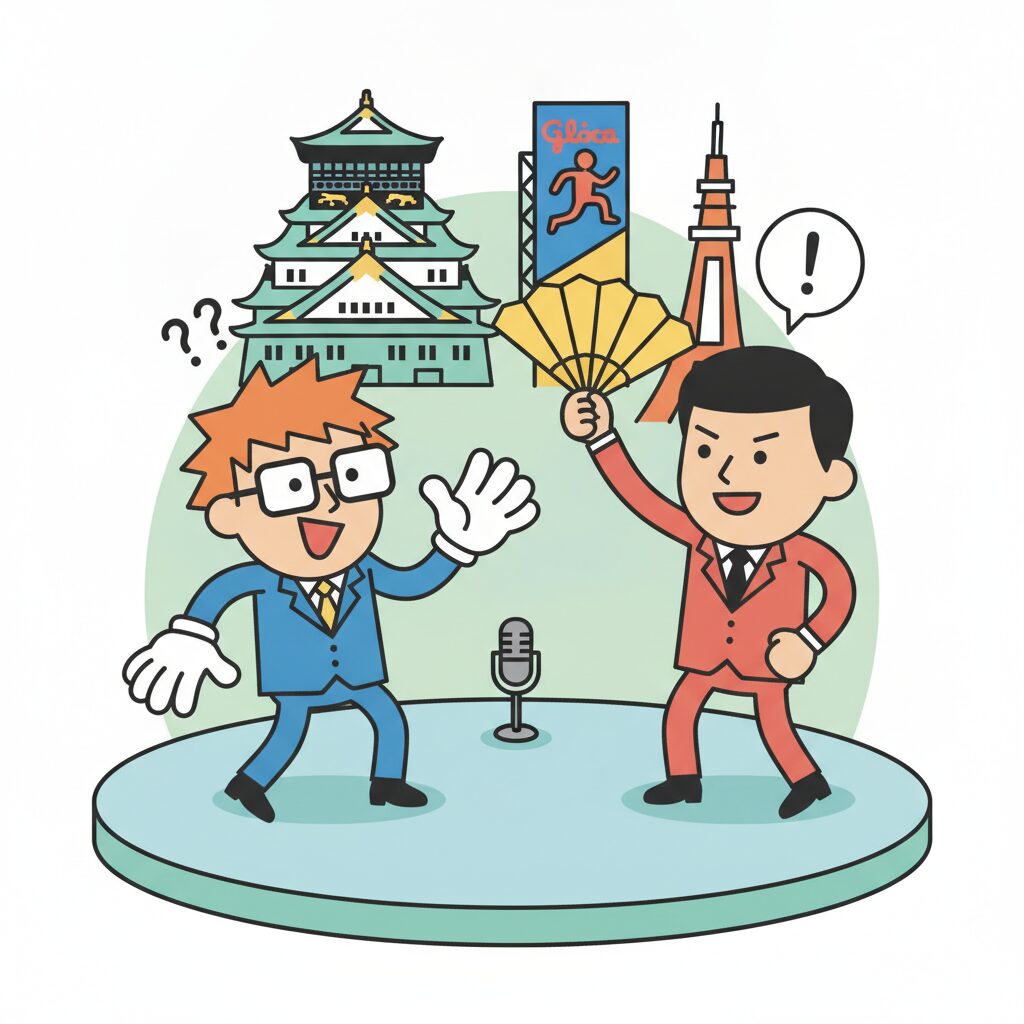
Before you can truly appreciate the art, you need to understand the mechanics behind it. This isn’t just random joking around; it’s a structured, almost ritualistic exchange. Think of it like a conversational serve and volley. The boke is the serve—intentionally lobbed high and a bit silly, just waiting to be spiked. The tsukkomi is the powerful, satisfying spike that clinches the point, with everyone’s laughter acting as the crowd’s roar. It’s a game everyone knows how to play, even if they’ve never consciously considered the rules.
What is ‘Boke’? More Than Just a Joke
At its core, the boke involves feigned ignorance. It’s a deliberate misinterpretation, an exaggeration, or a surreal observation inserted into an otherwise ordinary situation. It acts as the spark that ignites the interaction. The person delivering the boke isn’t necessarily foolish; in fact, crafting a good boke requires intelligence and precise timing. They intentionally create a comedic gap between reality and their statement, inviting someone else to close the gap.
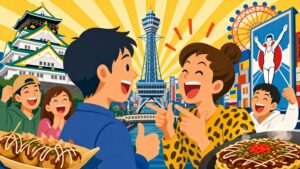
Picture this: You’re at a takoyaki stand in Tenjinbashisuji Shotengai. The vendor, a cheerful man with a towel around his head, hands you your steaming tray of octopus balls. You pay with a 1,000 yen note. He takes it, looks at it mock-seriously, and says, “A 10,000 yen note! Thanks for the big tip!” That’s a boke. He knows it’s 1,000 yen. You know it’s 1,000 yen. But for a brief moment, he’s created a ridiculous alternate reality.
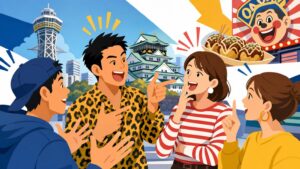
Or maybe you’re with a friend, and you point out the Tsutenkaku Tower. “Look at Tokyo Tower,” your friend says with a straight face. “It looks so different up close.” That’s a boke. It’s wrong, it’s obvious, and it’s a direct pass to you. A weak boke is just a bad joke or a lie. A great boke playfully distorts the truth, inviting a shared game. It signals comfort and trust—a way of saying, “I’m relaxed enough with you to be silly.”
What is ‘Tsukkomi’? The Art of the Straight Man
If the boke is the setup, the tsukkomi is the punchline—but one delivered by another person. The tsukkomi’s role is to restore order by calling out the absurdity with lightning speed and precision. The most famous tsukkomi phrase, almost Osaka’s motto, is “Nande ya nen!” (なんでやねん!). It roughly translates to “Why?!” or “What the heck?!” but carries a deeper meaning. It mixes exasperation, affection, and perfect comedic timing.
Back to our examples: at the takoyaki stand, the ideal tsukkomi reply to the “10,000 yen” comment wouldn’t be a polite correction. It would be a sharp, “It’s 1,000 yen! Stop dreaming and give me my change!” said with a grin. To your friend calling Tsutenkaku “Tokyo Tower,” you’d shoot back, “This is Osaka! Have you been drinking?” often paired with a light, playful tap on their arm or shoulder. This physical gesture matters; it conveys, “I’m correcting you, but we’re on the same team.”
A good tsukkomi isn’t mean-spirited. This is often misunderstood by foreigners. Though it may seem like an interruption or insult, it’s quite the opposite. It validates the boke. A sharp tsukkomi shows respect, proving you were paying attention, that you got the joke, and that you’re clever enough to join in. The worst thing you can do to a boke is ignore it, or worse, take it seriously and agree. That kills the rhythm instantly and leaves the boke-player stranded. The tsukkomi closes the loop, and the laughter that follows is the release of that energy.
A City of Performers: Boke and Tsukkomi in the Wild
Once you learn to recognize the pattern, you’ll notice it everywhere. It’s not limited to pubs or comedy clubs; it’s the ambient background of life in Osaka. The city is a vast stage, and its residents are all participants in an ongoing, unscripted improv show. This constant performance marks one of the most notable cultural differences between Osaka and other parts of Japan, especially Tokyo.
At the Supermarket, the Izakaya, and the Office
Visit any supermarket in the evening, and you’ll hear it. An `obachan` (older lady) might pick up two daikon radishes, glance at a complete stranger, and ask, “Which one of these looks more like my husband’s legs?” The stranger, without hesitation, will point to the shorter one and reply, “Definitely this one. The other is too handsome.” This is a full interaction between strangers—a brief social contract based on a boke and tsukkomi exchange.
At an izakaya in Umeda, you’ll observe it between staff and customers. You order a beer, and the server brings it saying, “Here’s your water.” You’re expected to answer, “Great, I was thirsty! Where’s my beer?” This playful exchange instantly creates an informal connection. It’s more effective than polite, formal speech at fostering a friendly mood.
Even in the workplace, which tends to be more conservative, Osaka’s spirit emerges. During a meeting, when addressing a minor logistical matter, someone may suggest an absurdly complicated solution involving helicopters and a parade. This is a tension-reliever. The manager responds by dismissing it with a tired “Stop talking nonsense and get back to work,” but with a knowing smile in their eyes. It’s a way to build camaraderie and make mundane tasks more enjoyable.
The Tokyo Contrast: Reading the Air vs. Making the Air
Here, the cultural divide with Tokyo becomes especially clear. In Tokyo, the essential social skill is `kuuki wo yomu` (空気を読む), or “reading the air.” This means sensing the mood, understanding unspoken intentions, and acting to preserve group harmony. It’s about blending in, not standing out. Disrupting the flow is considered impolite.
In Osaka, people are more inclined to practice `kuuki wo tsukuru` (空気を作る), or “making the air.” They shape the atmosphere themselves, often by introducing humor. They prefer breaking an awkward or dull silence with a bold boke rather than enduring it silently. An Osakan might find a typically reserved Tokyo conversation cold, distant, or lacking warmth. Conversely, a Tokyoite might view an Osaka conversation as loud, chaotic, and perhaps a bit intrusive. They are simply operating with different linguistic and social codes.
For foreigners, this difference can be puzzling. You might be used to the more restrained Tokyo style, which aligns more closely with Western ideas of politeness in Japan. Then you visit Osaka, and a shopkeeper starts teasing you about your Japanese or your choice of t-shirt. It’s not hostility; it’s an invitation. They’re tossing you a conversational ball, hoping you’ll play along.
Why Does Osaka Talk This Way? A Peek into the Mindset
This distinctive conversational style didn’t emerge spontaneously. It’s deeply embedded in the city’s identity, shaped by its history as a thriving commercial center and its current status as the undeniable capital of Japanese comedy. The way people speak reflects the city’s fundamental values: pragmatism, efficiency, and a firm belief that a good laugh is the quickest way to connect two people.
The Merchant’s Legacy: Building Rapport Through Laughter
For centuries, Osaka served as Japan’s commercial powerhouse, known as the `tenka no daidokoro` (天下の台所), or the Nation’s Kitchen. It was a hub for merchants, traders, and artisans. In a competitive market, success relied not just on the quality of goods, but on the ability to forge relationships swiftly. You had to negotiate, persuade, and gain your customers’ trust within minutes.
Formal, rigid language doesn’t build rapport. Laughter does. Humor was a crucial tool. A well-timed joke could disarm a difficult customer, break the ice, and transform a transaction into a relationship. This mindset, called `akindo seishin` (商人精神) or the merchant spirit, prioritizes directness, practicality, and human connection over strict formality. The boke-tsukkomi dynamic exemplifies this perfectly. It’s an efficient method to gauge someone’s personality, establish a friendly tone, and leave a lasting impression — all in one exchange. This historical background explains why conversation in Osaka often feels less about hierarchy and more about a level field of wit.
Comedy as a Cultural Pillar: Yoshimoto Kogyo and Manzai
If history laid the groundwork, modern entertainment built the skyscraper. Osaka is home to Yoshimoto Kogyo, the entertainment giant dominating Japanese comedy for over a century. The company’s signature style is `manzai` (漫才), a stand-up comedy performed by a duo consisting of a boke and a tsukkomi. From childhood, people in Osaka and the broader Kansai region grow up watching manzai daily on television. It’s as essential to their cultural diet as rice and miso soup.
This constant exposure means the boke-tsukkomi style is more than mere entertainment; it’s a language to be learned and spoken. The rhythms, timing, and classic phrases of manzai comedians become ingrained in the collective consciousness. People learn to interpret the world through this comedic perspective, always seeking chances to play the boke or deliver the tsukkomi in everyday life. When your cultural idols are comedians, it’s natural for humor to become a highly valued social skill.
Navigating the Game: A Foreigner’s Guide to Participation (or Not)
So you understand the theory. But how do you put it into practice? You’re at a bar, and the owner hands you a glass of water, saying, “Here’s your whiskey.” What do you do? The pressure is on. Here’s the good news: you’re not expected to be a manzai master. However, understanding the game changes everything.
Your Role in the Conversation
You don’t need to deliver a perfect, snappy tsukkomi in flawless Kansai-ben. No one expects that. The most important thing is to recognize the boke for what it is: an invitation. Simply laughing and shaking your head is a perfectly valid reaction. It shows that you got the joke and appreciate the effort. You’ve closed the loop. You could also try a simple English tsukkomi. In response to the “whiskey” comment, a simple “Oh, you!” or “Nice try!” with a big smile works just fine. The exact words matter less than the spirit behind the reply. You’re signaling your willingness to participate.
As you grow more comfortable, you can begin with small, basic tsukkomi. Learning “Nande ya nen!” is essential. Even if your accent is off, using it at the right moment will almost certainly be met with delight. It shows you’re making an effort to speak the local language—not just Japanese, but the language of Osaka.
The Pitfalls: When Humor Doesn’t Land
A word of caution: be careful about initiating the boke yourself, especially when you’re new to the culture. A good boke requires a deep understanding of context, nuance, and what’s considered funny. A failed boke—one that’s just awkward or makes no sense—won’t get a tsukkomi. It will be met with polite, confused silence. It’s often better to start as the tsukkomi, the responder, rather than the boke, the initiator.
Similarly, watch your tone when you tsukkomi. The line between playful teasing and an actual insult can be thin. The teasing almost always carries an undercurrent of warmth. It’s a verbal poke, not a punch. Without the right smile, tone, and context, your sharp comeback might come across as rude. Observe first. Listen to the rhythm. Feel the energy of the exchange before jumping in.
The Reward: Cracking the Code of Osaka’s Warmth
This brings us back to that often-repeated cliché: “Osaka people are friendly.” It’s not wrong, but it’s incomplete. The friendliness isn’t a passive, polite smile. It’s an active, engaging warmth. It’s the friendliness of someone who invites you to join in a game.
When a stranger in Osaka teases you, they’re not pushing you away. They’re pulling you in. They treat you not as a fragile foreigner to be handled with formal care, but as a potential player, an equal on the conversational stage. Successfully navigating even a small boke-tsukkomi exchange feels incredibly rewarding. It’s a moment of genuine connection that breaks through cultural and linguistic barriers. In that moment, you’re not just a tourist or resident; you’re part of the show. And that, truly, is what it feels like to live in Osaka.