You unpack the last cardboard box. You flatten it, slide it against the wall, and wipe the sweat from your forehead. You step out onto your new balcony, looking down at the narrow, winding streets of your Osaka neighborhood. The city hums with a distinct energy. Bicycles rattle over uneven pavement. The distant, unmistakable scent of dashi broth and fried takoyaki drifts from a local corner shop. You are finally here. You are living in Japan. You are living in Osaka. You breathe in the reality of your new life, ready to enjoy the legendary food, the vibrant nightlife, and the warm, boisterous culture that separates the Kansai region from the stoic streets of Tokyo.
Then, the doorbell rings. You open the door. Standing there is an elderly woman in a floral blouse, holding a battered clipboard. She smiles broadly, firing off a rapid string of Kansai dialect that your textbook Japanese did not prepare you for. She points to the clipboard. She points to you. She hands you a small, wrapped towel. Welcome to the neighborhood. Welcome to the invisible framework that holds Japanese society together. Welcome to the Chonaikai.
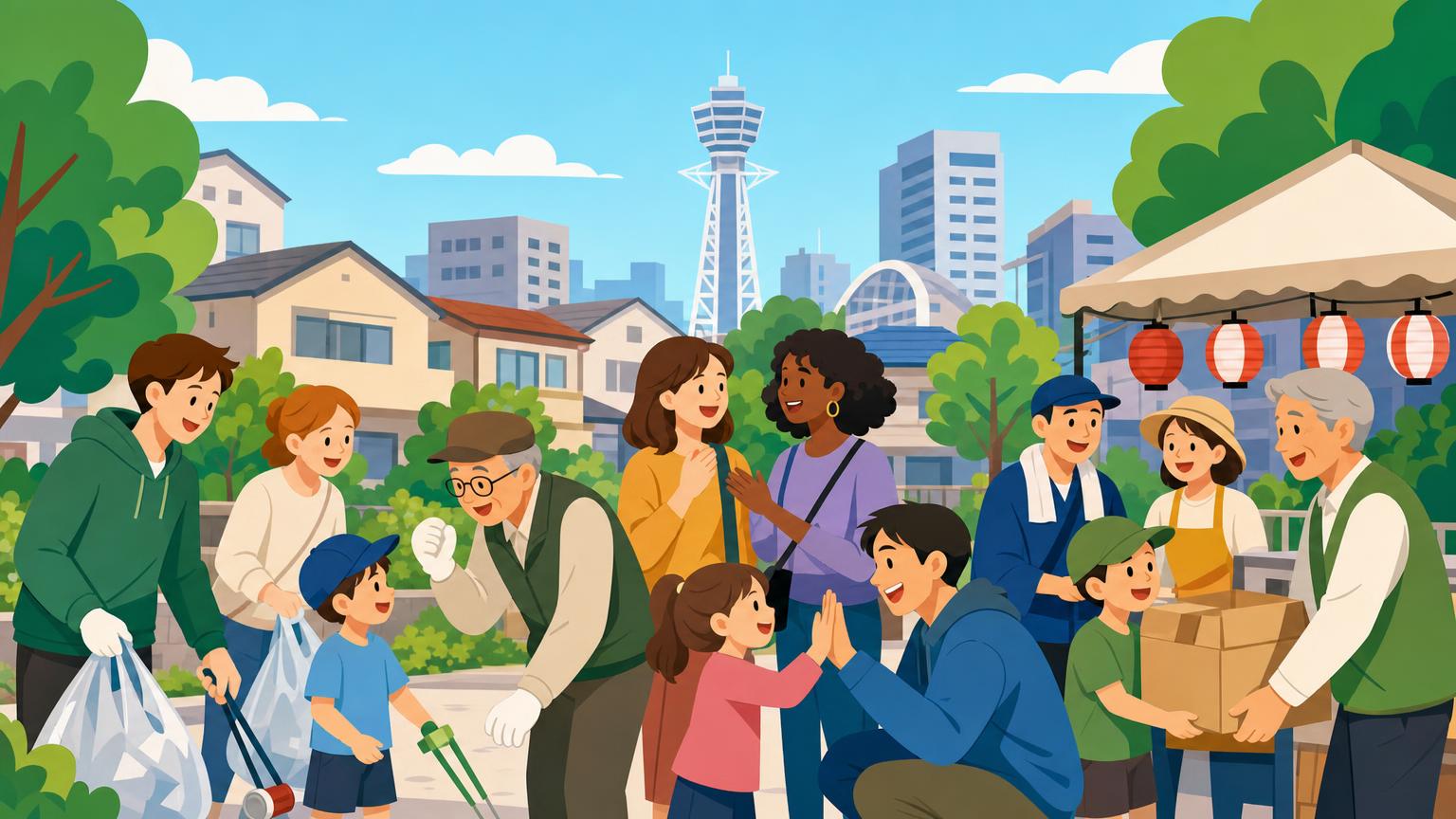
For many foreign residents, this is the first profound moment of cultural confusion. You thought you were simply renting an apartment. You thought your relationship with the building began and ended with your landlord and your monthly rent transfer. But in Japan, and especially in a city as deeply interconnected and fiercely local as Osaka, you do not just move into an apartment. You move into a community. You move into a web of social obligations, shared responsibilities, and mutual surveillance that dates back centuries. The Chonaikai, or neighborhood association, is the beating heart of local Japanese life. It is the organization that cleans the local park, organizes the summer festivals, manages the garbage stations, and checks on the elderly when the typhoons hit.
Understanding the Chonaikai is the master key to understanding daily life in Japan. To truly grasp the mindset of the people of Osaka, you have to look beyond the neon lights of Dotonbori and the tourist crowds of Osaka Castle. You have to look at the people. You have to understand how they organize themselves. You have to understand their deep-seated belief in community resilience, practical cooperation, and the unspoken rules of neighborhood harmony. Coming from a perspective grounded in East Asian cultural traditions, I have always been fascinated by how different societies balance the needs of the collective with the desires of the individual. In Chinese culture, we have similar neighborhood committees, yet the Japanese execution of this concept is uniquely meticulous, deeply rooted in local Shinto traditions, and, particularly in Osaka, driven by an unpretentious, pragmatic warmth.
This is not a glossy tourist brochure. This is a practical, honest, and comprehensive guide to the reality of the Japanese neighborhood association. We are going to break down exactly what the Chonaikai is. We are going to explore the critical differences between Chonaikai and Jichikai. We are going to walk through the core activities, from the dreaded Sunday morning park cleaning to the intricate social dance of the circulating notice board. We will answer the question every expat eventually asks: Do I actually have to join? We will weigh the pros and the cons. We will discuss the specific ways Osaka communities differ from those in Tokyo, exploring the psychology, the unspoken rules, and the everyday behaviors that define life in this incredible city. By the end of this guide, you will not just know what a Chonaikai is. You will understand the people of Osaka much, much better.
What is Chonaikai? (Japan’s Neighborhood Associations)
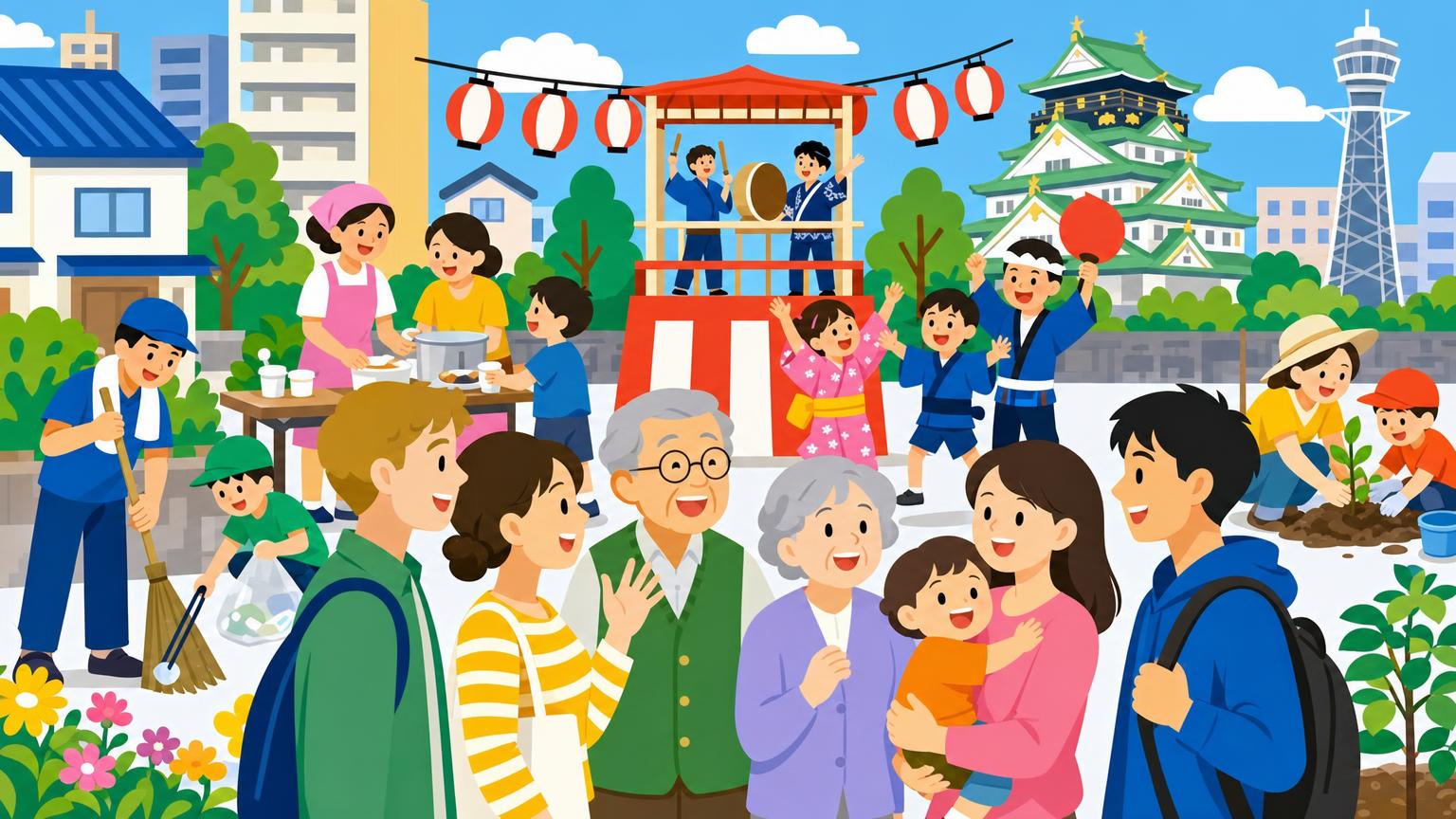
To understand how a Japanese city functions, you first need to uncover its micro-societies. The term Chonaikai consists of three Japanese characters: Cho means town or neighborhood, Nai means inside or within, and Kai means association or meeting. Together, it translates as the association within the neighborhood. However, this direct translation does not fully convey the significant social importance of the institution. A Chonaikai is a localized, self-governing group made up of residents from a specific geographic area. While it operates independently from the formal city government, it collaborates closely with local municipal offices, fire departments, and police stations.
The Chonaikai serves as the invisible framework of Japanese civil society. When a street lamp goes out in a narrow alley, it is often a Chonaikai representative who reports the issue. If an elderly resident living alone hasn’t been seen for several days, the Chonaikai network notices accumulated newspapers and visits to check on them. When the local shrine holds its autumn festival, the men and women carrying the portable shrine and shouting rhythmically into the night are organized, funded, and mobilized entirely by the Chonaikai.
Foreign residents frequently move to Japan assuming the government manages everything. In many Western countries, you pay taxes, and the city handles street cleaning, park maintenance, and disaster relief. Japan operates under a fundamentally different social contract. While the government provides major infrastructure, the micro-level maintenance and daily care of the living environment are directly entrusted to citizens. You do not simply live in a neighborhood; you are expected to maintain and steward it. This expectation is deeply embedded in Japanese culture, born from centuries of residing in densely packed, disaster-prone wooden villages where a single unextinguished cooking fire could destroy an entire community within hours. Survival demanded absolute cooperation.
Chonaikai vs. Jichikai: What’s the Difference?
Once you begin researching life in Japan, you will quickly encounter a confusing mix of bureaucratic terms. The two neighborhood group terms you’ll hear most often are Chonaikai and Jichikai. So, what’s the difference? The short, practical answer is: there is virtually no difference.
Jichikai translates as self-governing association. In everyday speech, both terms are used interchangeably. The distinction is more regional and historical than functional. In some areas of Japan, especially older and more established urban centers, Chonaikai is preferred. In newer suburban developments, apartment complexes, or rural regions, Jichikai is more common. In Osaka, you’ll frequently hear both terms, sometimes even within the same sentence.
If you live in a large, modern condominium, you might also come across the term Kanrikumiai, which refers to the building’s management association, similar to a Homeowners Association (HOA) in the U.S. The Kanrikumiai handles the physical upkeep of the building—elevator maintenance, lobby cleaning, and security. However, the entire condo complex might then be part of the wider geographic Chonaikai of that street or district. Thus, you could be paying dues to both the building management and the local neighborhood association. It’s a layered structure of civic responsibilities. Don’t let the terminology overwhelm you. Whether called Chonaikai or Jichikai, the core expectations, social dynamics, and clipboard-wielding local leaders remain the same.
The Historical Roots of Community Organization
The neighborhood association isn’t a recent invention. To truly understand why your Osaka neighbors care so much about how you sort your plastic bottles, you need to look back in history. The origins of the Chonaikai trace to the Edo period under the Tokugawa shogunate. At that time, there was a system called Goningumi, or five-household groups.
The Goningumi system grouped citizens into clusters of five families. These families were collectively responsible for one another’s behavior, tax payments, and crime prevention. If one member committed a crime, the entire group faced punishment. If one family failed to pay their rice tax, the others had to cover the shortfall. It was a clever yet harsh form of social control, enforcing relentless neighbor monitoring and fostering a culture of deep mutual reliance and social pressure. You couldn’t ignore your neighbors because their actions affected your survival.
Though the punitive elements of Goningumi were eliminated in modern times, the underlying psychological framework remained. The concept of a neighborhood as a collective entity—rather than just individuals living near each other—was deeply ingrained in Japanese culture. During World War II, the government revived and formalized these groups as Tonarigumi, using them for rationing, air raid drills, and spreading government propaganda. After the war, the Allied occupation temporarily banned these associations, seeing them as instruments of totalitarian control. However, once the occupation ended, neighborhoods naturally reformed themselves into the modern Chonaikai. They discarded militaristic roles but retained core activities like community support, festival organization, and local maintenance.
Viewed through an East Asian cultural lens, the similarities are striking. China’s Juweihui (Residents’ Committee) functions similarly as the lowest administrative unit, heavily involved in dispute mediation and organizing local welfare. Yet the Japanese Chonaikai feels distinct—less overtly political and more deeply entwined with local Shinto religious traditions and meticulous daily cleanliness management.
The Osaka Flavor: How Kansai Communities Differ from Tokyo
This is where the story becomes uniquely local. Neighborhood associations exist throughout Japan, but their operation, social dynamics, and participant experience vary widely by region. To understand Osaka’s Chonaikai, you must grasp Osaka’s cultural psychology.
Tokyo is a city shaped by samurai. It has historically been top-down, defined by strict hierarchies, unspoken rules for polite distance, and a strong respect for privacy. In Tokyo, you could live next door to someone for a decade without knowing their name. The Tokyo Chonaikai still functions but often with a cool, detached efficiency. Notices are quietly slipped into mailboxes; duties are fulfilled silently. Interactions are polite, brief, and highly formal.
Osaka, on the other hand, is a city of merchants. It grew from trade, negotiation, pragmatism, and lively social interaction. Generally, Osaka residents are louder, faster, and more intrusive than their Tokyo counterparts. Kansai culture has a term for this: Osekkai, meaning meddlesome, nosey, or interfering. But in Osaka, Osekkai is mostly seen as positive—it signifies people care and pay attention to you.
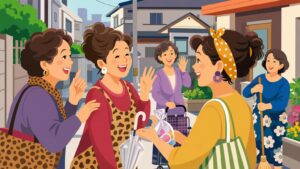
If you miss garbage day in Tokyo, you might receive a polite, anonymous note referencing municipal regulations. Skip garbage day in Osaka, and an elderly neighbor might stop you on the street, lightly tap your arm, ask if you overslept, complain about the crows’ mess, and hand you candy while reminding you that Tuesday is burnable trash day. This interaction is direct, spoken with a thick Kansai dialect, free from Tokyo’s icy formality, and surprisingly warm.
This merchant spirit profoundly influences Osaka’s Chonaikai. They are practical, less fixated on rigid rules, and more focused on what actually works. They converse openly, bicker, and joke. For foreign residents, Osaka’s neighborhood association might initially feel overwhelming due to its directness. But beneath the loud, rapid Kansai-ben lies a community that is welcoming, fiercely loyal, and far more forgiving of cultural missteps than the silent, judgmental streets of the capital.
Core Activities and Responsibilities of Chonaikai
So, what precisely does a Chonaikai do? If you agree to pay the monthly fee and have your name added to the local roster, what exactly are you signing up for? The activities of a neighborhood association are the foundation of daily civic life in Japan. They range from the mundane to the essential, from mildly annoying to culturally profound. Grasping these core responsibilities is vital for any foreigner wishing to integrate or at least coexist peacefully in an Osaka neighborhood.
Kairanban: The Traditional Information Network
Before the internet, smartphones, or neighborhood WhatsApp groups, there was the Kairanban. Impressively, in a country that produces some of the most advanced technology globally, the Kairanban remains the main method of localized communication. The term literally means circulating notice board.
Here’s how it functions. The head of the Chonaikai receives information from city officials, local police, or the fire department. This could include warnings about recent bicycle thefts in the area, schedules for upcoming health checkups for the elderly, summer festival details, or changes to garbage collection due to a national holiday. The Chonaikai head places these printed flyers into a sturdy, often brightly colored clipboard or a clear plastic folder. Attached to the folder is a routing slip featuring a grid with the names of all households in that subdivision, known as a Han (a small group of roughly five to fifteen homes).
The head of the Han drops the clipboard into the mailbox or hands it directly to the first house on the list. The resident reads the notices, then uses their personal Hanko (name stamp) to mark their name on the routing slip as proof of receipt. If they don’t have a stamp, a quick signature or a hand-drawn circle works equally well. Then, that resident personally delivers the clipboard to the next house on the list. This chain continues until the last house receives it, after which the final resident returns it to the Han head.
For foreign residents, the Kairanban often causes confusion and anxiety. Why are we passing around a physical board in the 21st century? Why not just email? The answer lies in the core philosophy of Japanese community life. The Kairanban is more than an information delivery system; it’s a wellness check. It’s a social tool compelling neighbors to interact. When you hand the clipboard to the elderly man next door, you greet him, comment on the weather, notice if he looks unwell or hasn’t emptied his mailbox in days.
In Osaka, passing the Kairanban becomes prime time for local gossip and small talk—a moment of connection. Yet, it comes with unspoken rules. You mustn’t hold onto the Kairanban for too long. If you forget it in your apartment for three days, you delay the entire communication chain and quickly gain a reputation as an irresponsible foreigner. The implied rule is to review, stamp, and pass it on within 24 hours. If your neighbor isn’t home, you don’t simply leave it on the ground—you carefully place it in their mailbox or wedge it securely in their doorframe. Mastering the Kairanban is your first test of neighborhood reliability.
Gomi-Toban: Managing Local Garbage Stations
To understand Japanese society, observe how they manage trash. Waste disposal in Japan is famously intricate, requiring meticulous sorting of burnable waste, non-burnable waste, plastics, PET bottles, glass, and paper. Trash cannot be discarded whenever you want; specific items must be brought to designated neighborhood collection points on prescribed days, usually between six and eight in the morning.
However, city garbage trucks only collect the trash—they don’t manage the collection points. The collection points, often just a corner of a sidewalk or a small fenced area, are entirely overseen by the Chonaikai. This leads to one of the most significant, and often dreaded, neighborhood duties: the Gomi-toban.
Gomi means garbage, and Toban means duty or shift. The Gomi-toban is a rotating roster of residents responsible for maintaining the garbage station. When it’s your turn, your mornings change drastically.
In many Osaka neighborhoods, the biggest challenge for a clean garbage station is the local crow population. Japanese crows are large, smart, and aggressive—they can tear open plastic bags in seconds, scattering food waste. To prevent this, neighborhoods use heavy, weighted yellow or blue mesh nets. The Gomi-toban’s main job is to rise early, go to the collection point, unfold the net, and ensure everyone places their trash properly under it. After the garbage truck arrives, the Gomi-toban must return to the station, sweep up any debris, wash away spilled liquids with water, fold the net, and store it until the next collection day.
In Osaka, garbage rules are enforced with a mix of strictness and pragmatic flexibility. If you put out an unwashed plastic bento box on burnable trash day, your Gomi-toban neighbor likely won’t leave a passive-aggressive note—they will knock on your door, hold up the offending bento, and loudly explain what you did wrong. It can be humiliating but effective. They aren’t trying to be cruel; a messy garbage station reflects poorly on the block and might cause city collectors to refuse pickup.
Participating in Gomi-toban is the ultimate act of community integration. It shows willingness to get your hands dirty for the collective good. When foreigners actively take part in the garbage rotation, sweeping alongside local grandmothers, they break the stereotype that foreigners are transient and careless residents, building immense social capital.
Disaster Prevention and Safety Patrols (Bousai)
Japan is one of the most seismically active countries globally. Earthquakes and typhoons are constant threats. When a major disaster hits, fire departments and rescue services become overwhelmed. The government can’t save everyone immediately. The frontline of disaster response is the neighborhood.
Disaster prevention, or Bousai, is arguably the Chonaikai’s most critical modern role. Neighborhood associations stockpile emergency supplies—bottled water, hardtack biscuits, flashlights, portable toilets, and first-aid kits—often kept near local parks or shrines. They map the neighborhood, identifying houses with elderly residents needing evacuation help or foreign residents who might not understand emergency broadcasts.
Throughout the year, the Chonaikai holds Bousai drills, usually on Sunday mornings at a schoolyard or park. These well-organized events include practicing fire extinguisher use, setting up emergency water filtration, and carrying injured people on makeshift stretchers. In Osaka, drills often have a festive feel. After practicing CPR on dummies, neighbors share emergency rations boiled in large pots, blending survival practice with community bonding.
Besides disaster prep, the Chonaikai is deeply involved in daily crime prevention. Groups of older men and women patrol the neighborhood early evening, wearing matching brightly colored windbreakers and carrying glowing wands. This Bohan Patrol (crime prevention patrol) claps wooden blocks together, producing a sharp “clack-clack” sound. This traditional noise alerts residents the patrol is active, urging fire checks and warning potential thieves the neighborhood is watchful. When foreign residents join these patrols, it powerfully signifies community belonging.
Organizing Local Matsuri (Festivals) and Events
If garbage duty and fire drills represent Chonaikai obligations, local festivals—or Matsuri—are the rewards. Japanese festivals are renowned worldwide for their color, energy, and deep spiritual meaning. But these festivals don’t happen spontaneously. They result from grueling year-round planning by the Chonaikai alongside the local Shinto shrine.
In Osaka, festivals are intensely passionate. The famed Danjiri Matsuri in Kishiwada, southern Osaka, involves teams pulling massive, intricately carved wooden floats through narrow streets at high speed, drifting corners in a spectacular display of danger, teamwork, and masculine pride. Though the Kishiwada Danjiri is extreme, nearly every Osaka neighborhood has a local shrine and annual festival.
The Chonaikai manages every facet of these events: collecting festival donations from businesses and residents, organizing schedules, building temporary stages for taiko drummers, setting up paper lanterns lining the streets, and most importantly, orchestrating the carrying of the Mikoshi—a portable shrine housing the local deity during the festival.
Carrying the Mikoshi is both an incredible honor and a physically demanding task. Dozens of people in traditional Happi coats hoist the heavy, gilded shrine onto their shoulders, bouncing it rhythmically to amuse the deity inside, chanting as they march through the neighborhood. For a foreign resident, being invited to carry the Mikoshi marks a monumental milestone—acceptance as part of the community’s core spirit.
Beyond major religious festivals, the Chonaikai hosts numerous smaller events: summer Bon Odori dance festivals with stalls selling shaved ice and yakisoba, sports days for children, and winter mochi-pounding gatherings. In a huge, sometimes isolating city like Osaka, these Chonaikai events serve as vital social glue, preventing urban life from becoming lonely and disconnected.
Park Cleaning and Sunday Morning Realities
Though festivals are glamorous, much of Chonaikai life is more mundane. One of the most common and often grumbled-about activities is periodic neighborhood cleaning, focused on local parks or drainage ditches (called Mizokojiki in Kansai dialect).
Several times a year, usually Sunday mornings at an early hour like 7:00 AM, the neighborhood gathers. Armed with brooms, dustpans, garbage bags, and small sickles for weeds, residents descend on the park. The work is tedious. Summer brings brutal heat and relentless mosquitoes; winter mornings cut through jackets with cold air as you sweep fallen leaves.
For a busy foreign professional who worked late Friday and stayed out in Namba Saturday night, waking early Sunday to weed is the last thing they want. It’s understandable many expats try to skip these duties.
However, skipping park cleaning has consequences. In an Osaka neighborhood, showing up matters above all else. Even if tired or performing poorly, participation counts. The cleaning isn’t really about the park—the city could hire landscapers to do a better job faster. The act is a performative display of community solidarity—a shared struggle. Sweating alongside the local dry cleaner or retired schoolteacher builds an invisible goodwill bank. Later, if you mistakenly break a trash rule or need a favor, that goodwill is cashed in. They’ll remember you showed up Sunday morning.
Do You Have to Join a Chonaikai in Japan?
We have reached the most important question. You have signed your lease and received your keys. Now, a Chonaikai representative is at your door with a membership form. Are you actually required to sign it? Is participation legally mandatory?
The Legal Stance: Voluntary or Mandatory?
The legal answer is absolutely clear: No. Joining a Chonaikai is completely voluntary.
The Japanese constitution guarantees freedom of association. You cannot be compelled to join a private organization against your will. This principle was firmly established in a landmark 2005 Supreme Court ruling, which confirmed that a neighborhood association cannot force a resident to join, pay dues, or penalize them for leaving. The law strongly protects individual choice.
However, living in Japan quickly reveals a vast, often insurmountable gap between legal obligations and social expectations. The concepts of Tatemae (the official facade) and Honne (the true feelings) are very relevant here. Legally, joining is optional. Socially, refusing can carry serious consequences for daily life.
Social Expectations in Rural vs. Urban Areas
The pressure to join a Chonaikai largely depends on where you live. Your neighborhood’s geography shapes the social reality.
If you reside in the heart of urban Osaka—areas like Umeda in Kita-ku, or the busy districts of Namba and Shinsaibashi in Chuo-ku—the pressure to join is minimal. These neighborhoods consist mostly of high-rise apartments, transient populations, young singles, and busy professionals. In many modern tower buildings, the Kanrikumiai (building management) takes care of trash and maintenance, while traditional geographic Chonaikai presence is virtually nonexistent. You could live in a Fukushima ward high-rise for five years without ever encountering a Kairanban. The anonymity of central urban life shields you from traditional community duties.
However, once you move beyond the central business districts into residential wards—such as Tennoji, Abeno, Sumiyoshi, or suburban cities like Toyonaka, Suita, or Sakai—the situation changes significantly. These neighborhoods have deep roots, with older houses and families who have lived there for generations. Here, joining the Chonaikai is not considered optional; it is simply expected as part of belonging to the community.
In traditional neighborhoods, it’s assumed you will join. When the representative knocks, they don’t ask if you want to join. They say, “Here is the association information, the fee is 500 yen monthly, please fill this out.” Refusing is possible but causes immediate tension. You mark yourself as an outsider and someone unwilling to contribute.
The Foreign Resident Dilemma
For foreign residents, this presents a difficult dilemma. Many move to Japan on short-term contracts without plans to stay long-term. They often do not speak fluent Japanese, making the complex, bureaucratic language of Chonaikai meetings hard to understand. Plus, the rapid pace of the Osaka dialect can make neighborhood meetings feel like a foreign interrogation.
Many foreigners are also confused about paying fees for services they believe their taxes should cover. Paying a monthly contribution for maintaining streetlights or garbage nets seems illogical, especially if they come from countries with centralized municipal services.
Osaka locals tend to be pragmatic and often excuse foreigners. There is a general assumption that “Gaikokujin” (foreigners) don’t understand the system, won’t be here long, and would struggle with the language barrier. Often, the Chonaikai won’t even ask foreign residents to join, assuming explaining everything would be too difficult.
However, this “foreigner pass” has its downsides. While you avoid park cleaning and fees, you also remain excluded from the neighborhood’s true social fabric. You won’t know what’s happening, won’t build strong protective relationships, and will always be regarded as a guest rather than a resident. Deciding whether to join is essentially a choice about how deeply you want to integrate into Japanese society.
Pros and Cons of Joining a Japanese Neighborhood Association
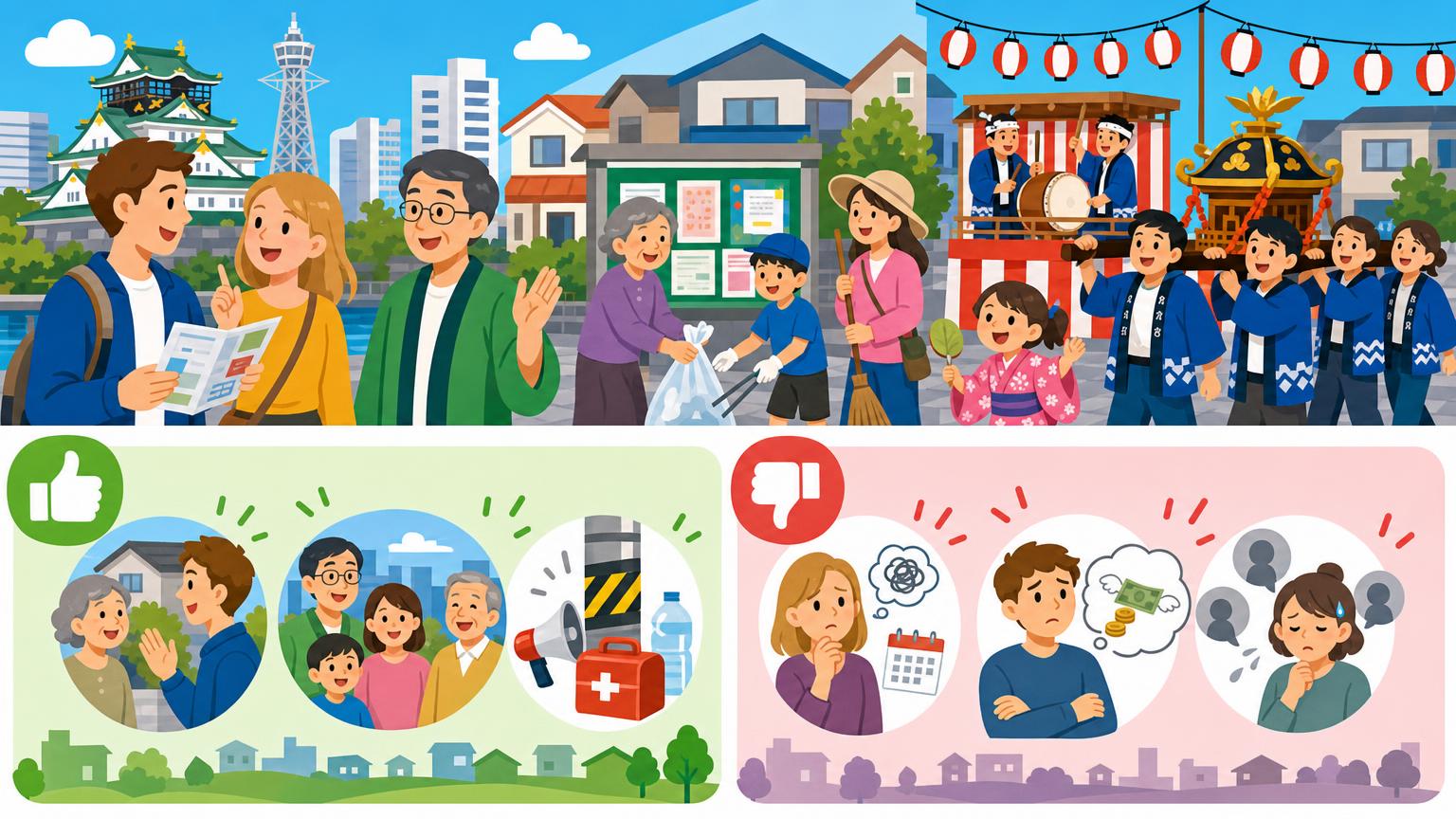
To make a well-informed decision, you need to carefully consider what participation entails. Joining a Chonaikai is not solely an altruistic act; it represents a transactional relationship with your surroundings. It carries both clear benefits and undeniable responsibilities.
Advantages of Becoming a Member
Deep Integration and Social Capital
The greatest benefit of joining is immediate integration. Once you pay your dues and accept the Kairanban, you transform from “that foreigner who just moved in” to “Li-san from the third block.” You gain an established identity within the community network. When you walk to the station, people acknowledge you. When you shop at the local supermarket, the cashier—who is likely also part of the association—treats you with a warmer attitude. In Osaka, where human connection is highly prized, this social capital is invaluable.
Vital Information Access
The Chonaikai serves as the main channel for hyper-local information. Without the Kairanban, you won’t know when the city will shut off the water for maintenance, about subsidized health screenings at the local clinic, or that a suspicious individual was spotted near the elementary school. Joining ensures you stay connected to your neighborhood’s information flow.
Disaster Preparedness and Safety
When the next major earthquake strikes, your neighbors—not city rescue workers—are the ones who will help pull you from the rubble. If you belong to the Chonaikai, they know who you are, where your bedroom is in the building, and that you might not understand Japanese evacuation broadcasts. Being registered ensures you are accounted for in emergencies.
Access to Cultural Events
If you enjoy Japanese culture, joining the Chonaikai offers you a behind-the-scenes experience. You’re not merely a spectator at the local Matsuri; you actively help organize it. You get invited to post-festival gatherings, sharing cold beer in the shrine courtyard with neighborhood elders. These are genuine cultural experiences that no tourist agency can ever provide.
Disadvantages and Common Challenges
The Time Commitment
This is the main reason many young Japanese are opting out of the system. The Chonaikai demands significant time—Sunday mornings for park cleaning, evening meetings, and if elected Han-cho (group leader), you’re responsible for collecting dues, distributing the Kairanban, and attending monthly community center meetings. For busy expats working long hours, this time demand can feel overwhelming.
The Language and Cultural Barrier
Chonaikai meetings pose a linguistic challenge for non-native speakers. Meetings often rely on unspoken consensus, reading the air (Kuuki wo yomu), and thick regional dialects. In Osaka, expect rapid-fire Kansai-ben, complex honorifics (Keigo), and highly specific local terms. It’s easy to unintentionally volunteer for major responsibilities simply by nodding at the wrong moment.
Social Pressure and Conformity
The Chonaikai enforces conformity. Traditions must be followed precisely—if the rule is to fold the blue garbage net into thirds, you have to fold it that way. Attempts to introduce “more efficient” Western methods usually meet resistance and silent frustration. You need to set your ego aside and conform to the group’s expectations.
The Financial Aspect: Chonaikai Fees
Participation isn’t free. Members pay a monthly or annual fee called Kaihi, which varies widely depending on the neighborhood and activity level but typically ranges from 200 yen to 1,000 yen per month. In some active areas, additional “donations” (Kifu) may be requested to support the local shrine or the grand summer festival.
While the amount is generally modest, some foreign residents take issue with the principle. Where does the money go? The funds are fully transparent within the association and cover expenses like new garbage nets, streetlight electricity bills, emergency water supplies, and children’s events. When the Han-cho collects fees—usually twice a year in cash—you’re expected to have exact change ready in a small envelope. It’s a minor financial obligation but a significant symbolic one.
How to Join or Respectfully Decline
If you have considered the advantages and disadvantages and reached a decision, you must now carry out that decision with cultural sensitivity. How you approach the initial interaction with the Chonaikai will set the tone for your entire time living in that neighborhood.
Steps to Active Participation
If you decide to fully immerse yourself in Osaka community life, the process is simple.
When the representative comes to your door, welcome them warmly. Introduce yourself clearly. In Osaka, a touch of self-deprecation is appreciated. You might say something like, “I am still learning Japanese, so I might make mistakes, but I want to contribute to the neighborhood.” (Nihongo wa mada benkyou-chuu desu ga, chiiki no tame ni kyouryoku shitai desu). This attitude will quickly endear you to an Osaka local. They don’t mind if your grammar isn’t perfect; they care that you show a willing spirit.
Complete the registration form. Pay your initial dues. Make sure you fully understand the garbage rules. Learn when the next park cleanup is and make sure to attend. When the Kairanban arrives, stamp it promptly and pass it on to the next house. Within a few months, you will no longer be seen as a foreigner; you will simply be a neighbor.
The Art of Declining in Osaka
If your work schedule, language skill, or personal preference makes joining impossible, you must decline respectfully. Don’t slam the door. Don’t ignore the buzzer. Don’t bring up the 2005 Supreme Court ruling on freedom of association. Using legal arguments in a Japanese social context is a serious cultural mistake.
Instead, employ the concept of Tsukiai, which refers to social obligations and relationships. Express deep regret that your circumstances prevent you from fulfilling the neighborhood’s important obligations.
In Osaka, you can be a bit more direct than in Tokyo, but it must always be done politely. A standard, respectful refusal might sound like this: “Thank you very much for coming. My work hours are very irregular, and I often work weekends and nights. I would not be able to participate in the cleaning duties or pass on the Kairanban in time, and I don’t want to cause trouble for the neighborhood. Therefore, I must politely decline joining the association.” (Shigoto no jikan ga fukisoku de, souji ya kairanban de gomeiwaku wo okake shite shimau no de, kanyuu wa hikaesasete itadakimasu).
By presenting your refusal as a wish to avoid causing them trouble (Meiwaku), you speak their cultural language perfectly. They may feel some disappointment but will respect your decision.
However, you must be aware of the consequences. If you decline, you should not expect to receive information about local events. You probably should not attend the local Chonaikai-funded festival either, as you have not contributed to it. Most importantly, you must be absolutely flawless in your garbage disposal. If you are not part of the association and leave a mess at the garbage station that association members have to clean up, you will become an outcast. Declining membership means you must live as a perfect, invisible citizen.
The Future of Chonaikai in Modern Japan
The Japanese neighborhood association is currently undergoing an existential crisis. The system that has sustained Japanese society for nearly a century is gradually faltering under the pressure of significant demographic changes and evolving cultural values.
Aging Populations and Shifting Demographics
Japan is aging faster than almost any other country in the world. The birth rate is rapidly declining. The generation that established the modern Chonaikai—the people who have diligently attended every meeting and cleaned every park for the past forty years—are now reaching their eighties and nineties. They are no longer physically able to carry the Mikoshi or easily go door-to-door to collect dues.
At the same time, younger generations of Japanese, even in traditionally community-oriented cities like Osaka, are increasingly opting out. Young professionals prioritize privacy over community connections. They communicate through Line and Instagram, rather than physical clipboards. They see the Chonaikai as a relic of the Showa era—a dated, inefficient system led by stubborn old men resistant to modernization. Membership rates across Japan are steadily declining, creating a vicious cycle. As fewer people join, the responsibility of maintaining the neighborhood falls on a smaller and aging group of residents, accelerating burnout.
Digitalization of the Kairanban
In an effort to survive, some progressive Chonaikai are striving to modernize. Various wards throughout Osaka have launched pilot programs that replace the physical Kairanban with localized smartphone apps. Residents are being encouraged to pay dues via digital payment methods like PayPay instead of cash envelopes. Line groups are being used for disaster alerts.
However, these digital changes are progressing painfully slowly. The elderly leadership often resists new technology, arguing that digital notifications lack the personal touch and “wellness check” that comes from physically handing a clipboard to a neighbor. The tension between digital innovation and the analog traditions of the Chonaikai represents a defining conflict in contemporary Japanese civic life.
A New Era for Foreign Residents in Osaka
Ironically, as young Japanese people withdraw from neighborhood associations, foreign residents are increasingly filling the gap. Osaka is becoming noticeably more international. Permanent foreign residents, naturalized citizens, and long-term expats are purchasing homes, raising families, and recognizing that to keep their neighborhoods clean and safe, they must get involved.
In certain Osaka wards with large foreign populations, such as Ikuno-ku and parts of Nishinari, foreign residents are not only joining the Chonaikai but assuming leadership roles. Vietnamese immigrants are organizing the Gomi-toban. Chinese residents help coordinate Bousai drills. American and European expats carry the Mikoshi.
This signals a profound transformation in Japanese society. The Chonaikai is gradually evolving from an exclusive, ethnically homogeneous club into a truly multicultural community organization. For foreign residents in Osaka today, joining a neighborhood association is no longer just about assimilating into old Japan—it is about actively contributing to the creation of a new Japan.
Living in Osaka is a vibrant, chaotic, and deeply rewarding experience. It is a city that demands your engagement. The people of Osaka don’t want you to merely observe their city from afar; they want you to dive into the hustle, complain about the heat, savor the takoyaki, and pull weeds in the park. The Chonaikai, with all its bureaucratic quirks, archaic clipboards, and early morning duties, is the purest expression of that spirit. It represents the raw, unfiltered reality of Japanese daily life. Whether you choose to politely decline or enthusiastically embrace it, understanding the neighborhood association is essential. It is the key to seeing Osaka not just as a city of bright lights and delicious food, but as a living, breathing community of people who, at heart, are simply trying to look out for one another.