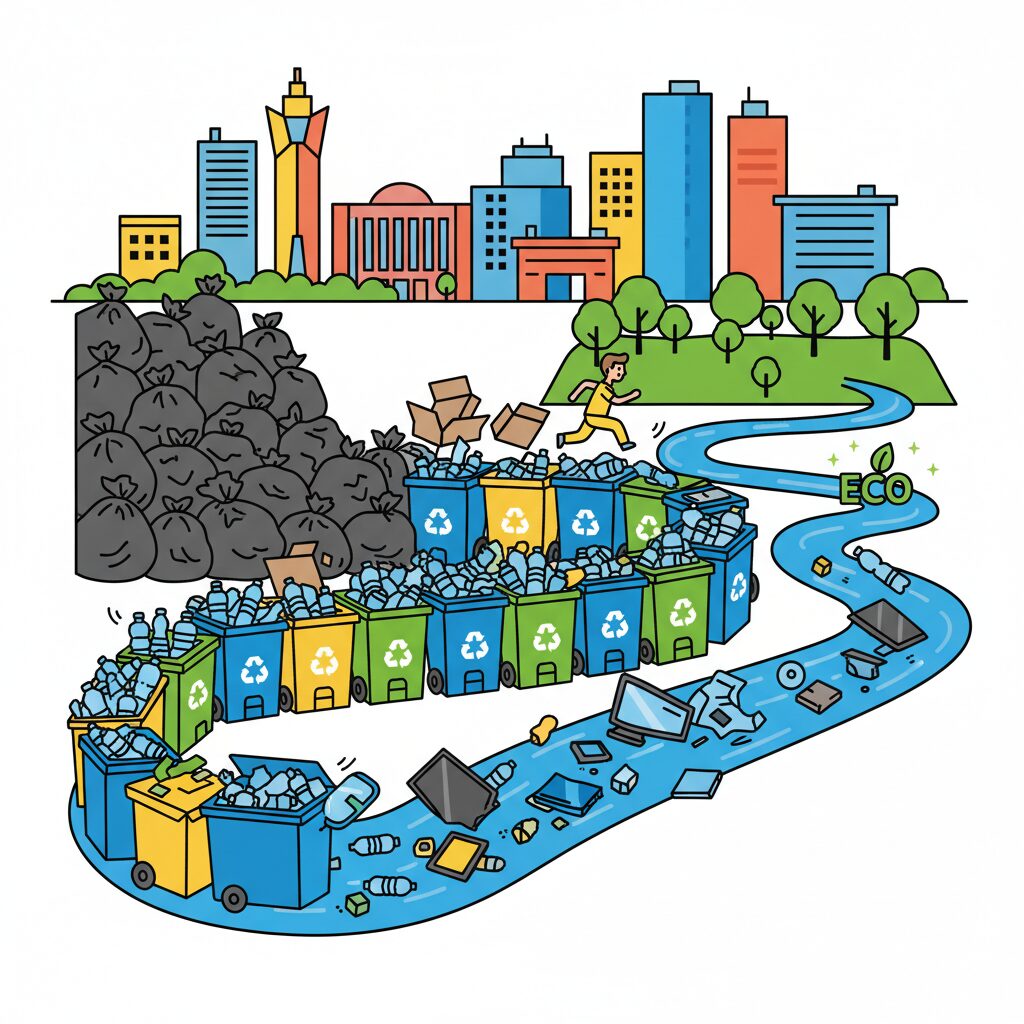
Welcome to Osaka. You’ve navigated the visa process, found an apartment, and maybe even figured out which train line doesn’t crush your soul during rush hour. You’re feeling good. You’re settling in. Then, you face your first true test of residency, a challenge more baffling than any kanji quiz: taking out the trash. You stand before a collection of colorful pamphlets, a flimsy plastic bag in hand, staring at a calendar that looks like a rejected Mondrian painting. This isn’t just about throwing things away. This is about understanding the very rhythm of neighborhood life in Osaka, a daily ritual that separates the newcomers from the true locals. Forget the tourist maps; your garbage collection schedule is the real key to the city.
In many places, garbage is an afterthought. You toss it in a big bin, and it magically disappears. In Osaka, your garbage is your public resume. It’s a transparent (literally, in the case of the bags) declaration to your neighbors that you understand the rules, that you respect the shared space, and that you’re a participating member of the community. It’s a system built on a foundation of unspoken social contracts, a complex dance of sorting, rinsing, and timing that, once mastered, offers a profound glimpse into the Osaka mindset. It’s less about rigid, top-down enforcement and more about a collective, grassroots effort to keep the city clean and orderly. This guide isn’t just about avoiding a passive-aggressive note on your door; it’s about earning your unofficial degree in urban living. It’s your deep dive into the practical, sometimes frustrating, but ultimately rewarding world of waste in the nation’s kitchen. Let’s get sorting.
Navigating Osaka’s complex waste routine not only prepares you for daily challenges but also offers a glimpse into the city’s blunt communication style that many foreign residents soon come to recognize.
The Unspoken Contract: Why Your Trash is Your Neighborhood ID

Before discussing what goes where, you first have to understand the why. In Osaka, the designated garbage spot—that corner of the street covered by a large green or blue net—is considered sacred ground. It’s a small area of communal space that depends on everyone’s cooperation to work properly. This differs from Tokyo, where the vast anonymity of the megacity can sometimes create distance between you and your neighbors. Despite its size, Osaka functions more like a village at the neighborhood level. People notice details. And they especially notice garbage.
Putting out a bag of unsorted trash is more than just breaking a rule; it’s viewed as a sign of disrespect. You’re creating extra work for the collection crews, who are often older and highly respected members of the community. You’re attracting crows, which are a real nuisance and can tear bags open, scattering your trash across the pavement for all to see. And you’re disrespecting the neighbors who took the time to rinse their yogurt containers and fold their newspapers into neat bundles. This embodies the concept of `meiwaku` (迷惑), or causing trouble for others, in its most everyday and visible form. An Osakan’s tolerance for a noisy party might be greater than their tolerance for a perpetually messy garbage spot. It’s a practical perspective. A party is temporary; a dirty garbage area is a constant problem for everyone.
You’ll see this attitude at work. An elderly woman might pause to straighten a bag that was placed incorrectly. The building manager might post a neatly printed, laminated sign reminding everyone to rinse their plastic containers. This isn’t scolding; it’s gentle course correction. It’s the community softly, and sometimes less softly, encouraging everyone to follow the shared standards. Your garbage is your daily, silent message to your neighbors. Keeping it clean and sorted says, “I’m one of you. I understand. I’m part of the team.”
Decoding the Rainbow: Osaka’s Core Garbage Categories
Alright, let’s dive into the details. Although each ward has its own specific schedule, the main categories in Osaka City remain fairly consistent. The first thing you should do is obtain your local garbage collection calendar from your ward office or real estate agent. This calendar is essential—it will indicate which days are designated for which types of waste. Unlike some municipalities, the city doesn’t require color-coded bags; instead, the rule is to use transparent or semi-transparent bags of 45 liters or less. The reasoning is straightforward: transparency fosters accountability. When everyone can see what’s inside your bag, you’re more likely to sort it properly.
Futsu Gomi (普通ごみ) – Combustible Garbage
This is the primary category, usually collected twice a week. Consider it the “everything else” bin, with some key exceptions. It mainly includes kitchen waste such as food scraps and items too dirty to recycle or made from composite materials.
- What it includes: Food waste, cooking oil (solidified with a coagulant or absorbed in paper), soiled paper or plastic that can’t be cleaned (like plastic film from a microwave meal), leather goods, rubber, small plastic products (such as a toothbrush or a broken toy), CDs, and wood scraps.
- The Golden Rule: If you’re unsure, and it’s not a bottle, can, or clean packaging, it probably belongs here. This category is the default, but relying on it too much will cause problems. The key is to first eliminate all other recycling options.
Yoki Hoso Plastic (容器包装プラスチック) – Containers and Packaging Plastics
This category often confuses foreigners in Japan. Collected once a week, it covers plastic items used to contain or wrap a product. Look for the プラ (Pura) mark, a triangular recycling symbol with “プラ” inside.
- What it includes: Clean plastic food trays, empty shampoo and detergent bottles, plastic bottle caps and labels (once removed from the PET bottle itself), plastic bags, candy wrappers, styrofoam, and plastic netting for fruits and vegetables.
- The Crucial Step: These items MUST be rinsed or wiped clean. A bento tray with leftover sauce is NOT packaging plastic; it’s combustible garbage. A quick rinse is sufficient. The aim is to remove food residue so it doesn’t become moldy or attract pests during recycling.
Shigen Gomi (資源ごみ) – Resource Garbage
Also collected once a week, this category includes high-value recyclables such as cans, glass bottles, PET bottles, and small metal items. Newspapers, cardboard, and textiles may sometimes be collected on the same day but must be bundled separately, not mixed in the same bag.
- What it includes: Drink cans (aluminum and steel), glass jars and bottles, PET bottles (look for the number 1 recycling symbol), and small metal items like pots, pans, or kettles.
- Preparation is Key: Everything must be empty and rinsed. PET bottles require special care: remove the cap and label (which go into Packaging Plastics), rinse the inside, and crush the bottle flat to save space. Newspapers and magazines should be stacked and tied with string. Cardboard boxes must be broken down and tied together.
Sodai Gomi (粗大ごみ) – Oversized Garbage
This category includes anything that won’t fit in your standard 45-liter bag—such as furniture, bicycles, microwaves, or rolled-up carpets. You are never allowed to simply leave these items at the collection site. Doing so is illegal dumping, which can lead to a visit from your landlord or even the police. There is a strict, multi-step procedure for disposing of oversized items, which we will explain in its own section. This system requires payment for disposing of large items you no longer need. It is organized, efficient, and absolutely non-negotiable.
The Plastic Predicament: A Deeper Dive into Confusion
Let’s focus on the single biggest challenge: the difference between combustible plastic and packaging plastic. This subtlety confuses everyone, including Japanese people. The key is to distinguish between a product and its packaging.
The Product vs. Packaging Test
- Is the item itself the product you purchased? If so, it is almost certainly Combustible Garbage.
- Examples: A plastic file folder, a cheap plastic umbrella, a videotape, a plastic coat hanger, a ballpoint pen. These are items you bought to use as they are. Once broken, they belong in the combustible pile.
- Was the item something you removed to access the product? If yes, and it has the プラ mark, it counts as Packaging Plastic.
- Examples: The plastic wrapper around a loaf of bread, the styrofoam tray holding your meat, the cleaned plastic cup from instant noodles, the cap from your soy sauce bottle. These items exist only to protect or contain the product itself.
The Cleanliness Clause
The second rule concerns cleanliness. The packaging plastic recycling process cannot process food residue. For instance, a toothpaste tube is a plastic container, but since it’s impractical to clean completely, it becomes Combustible Garbage. The same applies to sauce packets from your natto or an oily instant ramen bowl. If a quick rinse won’t clean it, it’s meant for incineration. This system is pragmatic—the aim is clean, high-quality recycling, not an impossible effort to recycle every trace of soiled material.
Mastering this distinction is like learning a new grammar rule. Initially, it’s confusing and requires conscious effort. But after a few weeks, you’ll be able to glance at an item and automatically know where it belongs. You’ll find yourself instinctively rinsing soy milk cartons and separating bottle caps without hesitation. That’s when you know you’ve truly adapted to life in Osaka.
The Practicalities: Mastering the Weekly Ritual

Understanding the categories is just half the challenge. Perfectly carrying out the process is what truly distinguishes you. The ritual of garbage day is a fundamental part of neighborhood life, governed by a strict set of unwritten rules.
The Collection Point (Gomi Suteba – ごみ捨て場)
This is not a dumpster. It’s a specific, often unenclosed, curbside location. The key feature is a large net, which must be securely placed over all the bags to keep crows and cats out. If you’re the first person there in the morning, it’s your duty to set your bag down neatly and unfold the net. If you’re the last, you have to ensure the net fully covers everything. Leaving a corner exposed is a rookie error. The area should be left as clean as you found it. This shared responsibility reflects a microcosm of Japanese society.
The Schedule is Law
Combustible garbage day is non-negotiable. If you miss the collection, you cannot leave your bag out until the next scheduled day; you must bring it back inside. Leaving a bag of rotting food out for three days is one of the quickest ways to become the neighborhood outcast. This is where a garbage collection app on your phone proves invaluable. Most municipalities, including Osaka, offer official apps that send push notifications the night before and the morning of each collection day, informing you precisely what to put out. It’s an essential tool for any resident.
The Time Window of Opportunity
Garbage must be set out on the morning of collection, never the night before. The usual window is sometime between dawn and 8:00 or 9:00 AM. Putting it out the previous evening is a significant taboo. It’s seen as unsightly, attracts nocturnal animals, and blocks the pavement for an unnecessarily long time. This strict timing demonstrates a broader cultural respect for order and minimizing public inconvenience. The streets are for people, not for your trash. Your garbage should occupy public space for the absolute minimum amount of time necessary.
The Final Bosses: Conquering Sodai Gomi and Special Items
Eventually, you’ll need to dispose of something larger than a bread bag. This is when you encounter the final hurdle in the garbage system: oversized and irregular items. Although the process is bureaucratic, it is surprisingly straightforward.
The Sodai Gomi Procedure
Suppose you want to get rid of a small bookshelf. Here’s how to proceed:
- Contact the Center: First, call the Oversized Garbage Reception Center or, more conveniently, apply via their website. You’ll need to provide your address, name, and a description of the item(s) you want to discard.
- Get Your Quote: They will inform you of the exact fee for your item. For example, a chair may cost 200 yen, while a sofa might be 1,000 yen. They will also give you a reception number and a scheduled collection date.
- Buy the Ticket: Next, visit a designated convenience store (Konbini) or post office to buy a “Garbage Disposal Fee Ticket” (粗大ごみ処理手数料券 – Sodai Gomi Shori Tesūryō Ken) for the quoted amount.
- Label and Deploy: Write your name or reception number on the sticker, peel off the backing, and attach it clearly to the item. On the morning of your scheduled collection day, place the item in the designated spot—this might be your usual garbage station or another location specified by the center. That’s all. A truck will come by and pick it up. This exemplifies Japan’s user-pays and highly organized public service system.
Other Oddities
- Cooking Oil: Never pour it down the drain. You can buy a special powder at the 100-yen shop that solidifies used oil into a jelly-like block, which can then be disposed of with combustible garbage.
- Batteries: Most supermarkets and electronics stores have small collection boxes for used batteries. Do not throw these in the regular trash.
- Used Clothing: Many neighborhoods hold special textile collection days once a month or so. Alternatively, stores like H&M or Uniqlo often have bins for recycling old clothes.
Osaka vs. The World (and Tokyo): The Subtle Differences
For many foreigners, this entire system feels worlds apart from the single-bin convenience they’re accustomed to. Initially, the idea of rinsing a milk carton or bundling newspapers seems like an unnecessary hassle. However, in a densely populated country like Japan, it is essential for hygiene and efficiency. This system has evolved out of the need to live closely together.
Even compared to Tokyo, Osaka has its own unique character. The rules are largely the same, but the enforcement and community attitude can feel quite different. Tokyo’s many sprawling wards tend to be more transient and anonymous, which sometimes results in a looser neighborhood-level approach (though the rules remain just as strict on paper). In Osaka, community ties are generally stronger and more direct. If you slip up, don’t be surprised if a local `obachan` (auntie-figure) cheerfully but firmly calls you out: “Hey sonny, that plastic bottle needs its cap taken off!”
This isn’t meant as criticism. It’s a moment to learn. It stems from a shared sense of responsibility for the neighborhood. In Tokyo, people might quietly correct your mistake or leave an anonymous note. In Osaka, the approach tends to be more direct and verbal. They aren’t trying to embarrass you; they want to help you become part of the local system. Embrace it. A quick lesson from a neighborhood expert is far more valuable than hours spent puzzling over a pamphlet.
When You Mess Up: A Guide to Garbage Diplomacy
It’s bound to happen. You’ll misunderstand a rule, forget a collection day, or quickly toss something into the wrong bag. One morning, you’ll pass by the collection spot and notice your bag sitting there alone, marked with a bright yellow sticker of shame (警告 – keikoku – warning).
Your initial reaction might be embarrassment or frustration. Resist that impulse. The worst thing you can do is leave the bag there. Doing so signals to your neighbors that you either don’t understand the rules or simply don’t care. The right response is what I call “garbage diplomacy.”
- The Walk of Atonement: Take a deep breath, go over, and pick up your bag. Yes, others might see you. That’s okay.
- Return and Re-sort: Bring it back inside your apartment. Check the sticker; it usually explains the violation (e.g., “Plastics mixed with combustibles”).
- Correct the Error: Carefully re-sort the bag’s contents according to the rules.
- Wait for the Next Cycle: Put the properly sorted garbage out on the next appropriate collection day.
This simple step demonstrates humility, respect, and a willingness to learn. It signals to your neighbors that you made an honest mistake and are dedicated to doing things right. If you’re truly unsure, take the bag to your landlord or building manager and ask for assistance. Showing that you’re making an effort to follow the rules will earn you much more respect than pretending you never slip up.
The Path to Mastery
Mastering Osaka’s garbage system is a rite of passage. It begins with confusion and frustration, shifts into a phase of diligent rule-following, and eventually grows into an intuitive, automatic habit. It’s the point when you stop viewing it as a list of tedious regulations and start recognizing it as your small, daily contribution to the functional, clean, and considerate society you’ve chosen to live in.
This system embodies the spirit of the city—a bit complex, highly practical, and deeply rooted in the belief that living together means caring for one another, even in the most ordinary ways. When you can confidently sort a post-hotpot-party mountain of waste into its respective parts without breaking a sweat, you’ll realize you’re no longer just a visitor. You’re a resident. You’ve earned your place in the neighborhood, one carefully rinsed PET bottle at a time.