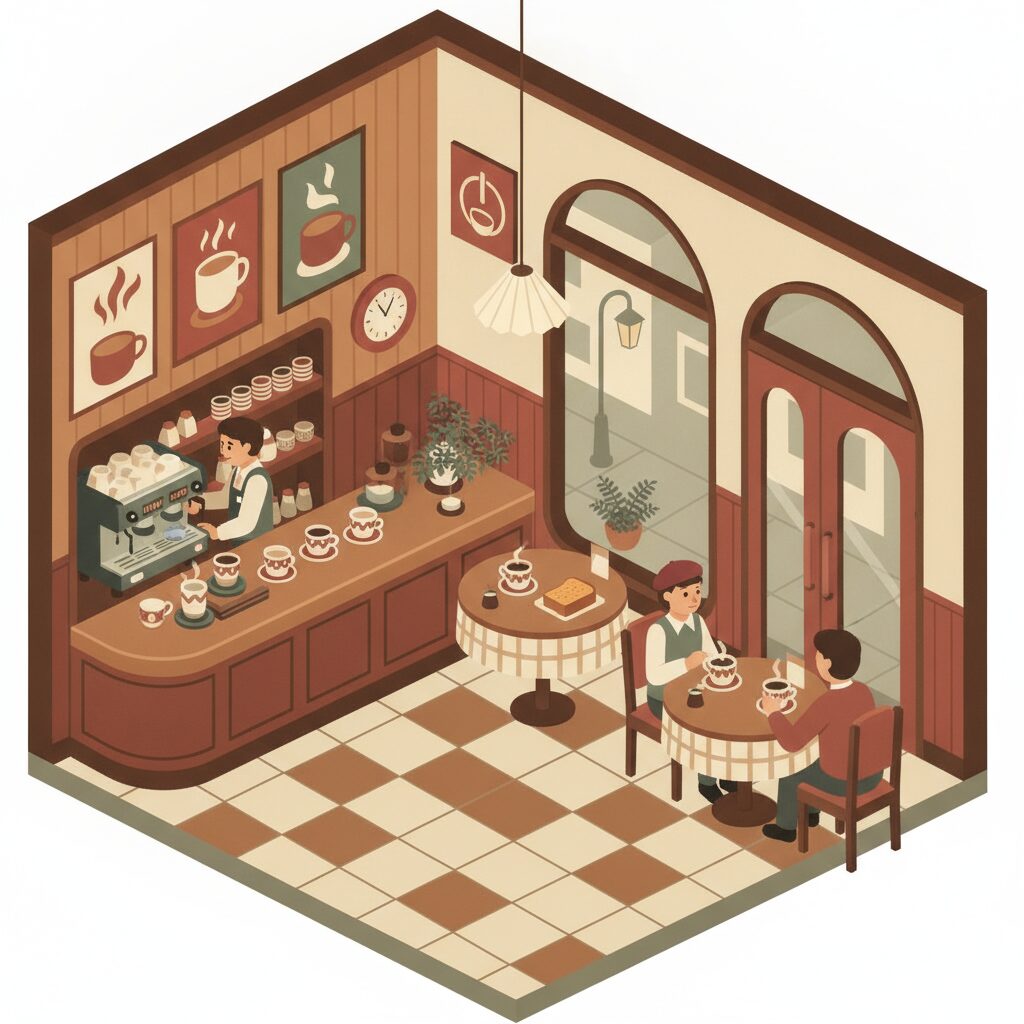
When you picture a coffee shop in Japan, your mind probably jumps to a familiar scene. Sleek interiors, minimalist design, the low hum of laptops, and a line of people grabbing a precisely crafted latte on their way somewhere else. It’s a picture of efficiency, of urban motion, of caffeinated fuel for a life lived at high speed. This image is accurate, especially in Tokyo, where time is a currency you can’t afford to waste. But if you’re trying to understand the rhythm of daily life in Osaka, you need to look elsewhere. You need to push past the glass-fronted chains and find the door to a neighborhood kissaten.
These are not just coffee shops. They are something closer to a public living room, a community anchor, a place that sociologists would call a “third place”—a space that is neither home (the first place) nor work (the second place). The kissaten is where the real, unscripted life of the city unfolds, slowly and without pretense. It’s a concept that feels increasingly rare in the modern world, yet in Osaka, it thrives. For anyone moving here, understanding the kissaten isn’t about finding a good cup of coffee; it’s about discovering the city’s heartbeat. It’s where you stop measuring time in minutes and start measuring it in conversations, in chapters read, in the simple act of being present. This is not a place you visit; it’s a place you inhabit.
The city’s unique ambiance is further enriched by the unexpected influence of community figures such as Osaka aunties, whose insights add a sweet layer to the urban tapestry.
The Unspoken Contract of the Kissaten
Step inside a classic kissaten, and the first thing you’ll notice is the atmosphere. It’s a sensory transition from the street outside. The air may be thick with the aroma of dark-roast coffee brewed in a siphon, the faint, sweet scent of toast, and perhaps the lingering trace of cigarette smoke from a bygone era. The lighting is dim, the chairs are plush velvet, and the wood is dark and worn. It doesn’t feel new or trendy; it feels enduring. This is deliberate. A kissaten isn’t selling novelty; it’s offering sanctuary.
This sanctuary operates under an unspoken agreement. A cup of coffee might cost 500 or 600 yen, a price that seems steep compared to a chain café. But you’re not just paying for the drink. You are renting the space, the time, and the quiet. That single coffee grants you the right to sit for an hour, two, or even three, undisturbed. You can read a book, write a letter, or simply watch the world go by. No one will rush you. No one will give you pointed looks to free up the table. The proprietor, known as the “Master,” understands this implicitly. They are the guardian of this space, a quiet facilitator of this urban retreat.
This is fundamentally different from the grab-and-go model. The transaction isn’t about the efficient delivery of a product. It’s about a relationship with the environment. The famous “morning set,” or mōningu setto, is a perfect example. For the price of a coffee, you receive a thick slice of toast, a hard-boiled egg, and perhaps a small salad. It’s a bargain, but its purpose isn’t just providing a cheap breakfast. It’s a ritual. It’s the anchor that begins the day for countless residents, a quiet, consistent moment before the chaos of the day begins. In Osaka, this ritual is less about fuel and more about centering yourself in a familiar place among familiar faces.
A Different Rhythm: Tokyo Speed vs. Osaka Time
Living in Tokyo, my encounters with cafés were marked by purposeful solitude. These spaces were designed for individuals to work quietly. You’d find rows of people facing the wall, laptops open, headphones on, immersed in their own worlds. Socializing occurred, but it was usually planned—a quick meeting slotted between appointments. The aim was turnover. A busy café was a successful café. Lingering felt like a minor offense, a subtle pressure to either order more or leave.
Osaka runs on a different rhythm. Time in a kissaten feels flexible. The worth of a seat is measured not by the number of customers it serves each hour, but by the quality of the time spent there. Here, the buzz of conversation blends into the background like music. Two older women, obachan, might spend an entire afternoon chatting over melon soda floats, their laughter filling the air. A salaryman may take a long lunch break, not buried in a laptop, but leisurely reading a newspaper from start to finish. No one gives it a second thought. This isn’t laziness; it’s a different approach to time.
This tempo reflects a fundamental aspect of the Osaka mindset. While the city is a major economic powerhouse, there’s a deeper respect for the human side of commerce. A transaction isn’t merely exchanging money for goods; it’s an interaction. The Master of the kissaten isn’t simply a service worker; they are a personality, a confidant, the guardian of the neighborhood’s stories. They’ll remember your usual order after a few visits and might inquire about your day. This intimate, small-scale connection is woven into the city’s commercial life, starkly contrasting Tokyo’s polite yet often impersonal efficiency.
Foreigners often misinterpret this. They see an old, slightly worn shop and wonder why anyone would choose it over a sleek, modern café. They confuse the slow pace with poor business. But they miss the point. The kissaten isn’t competing on speed or style. It’s competing on comfort, familiarity, and a sense of belonging. It’s a place where you don’t have to perform or rush. You can simply be.
The Kissaten as a Neighborhood Hub
More than just a personal refuge, the kissaten serves as the social nervous system of its neighborhood. In the vast urban expanse of Osaka, which can often feel impersonal and overwhelming, these small shops anchor you to a specific place. They are frequently hidden within a shotengai, a local covered shopping arcade, or nestled along a quiet residential street. Their presence reflects the city’s unique structure: Osaka feels less like a single sprawling metropolis and more like a network of interconnected villages, each with its own pace and central gathering spots.
Your neighborhood kissaten is where information circulates. It’s the place to hear about the upcoming summer festival, discover which local butcher offers the best korokke, or uncover the real story behind that new construction project down the road. It functions as an analog social network. The Master often serves as a welcoming gatekeeper to this network. For foreigners trying to find their way in a new life here, building a casual rapport with the Master can be far more valuable than any official guide. They provide practical advice, make introductions, and offer a friendly face in a city where you might know no one.
These spaces are also notably intergenerational. It’s common to see a group of high school students quietly working on homework in one booth while a pair of elderly men play a game of shogi (Japanese chess) in another. This effortless blending of generations is increasingly rare in modern, age-segmented societies. The kissaten offers a neutral ground where diverse lives coexist comfortably. It fosters a shared sense of community identity that transcends age and occupation. Becoming a regular, or jouren, at a local kissaten is a subtle rite of passage for long-term residents. It signals that you’re no longer just passing through—you have become part of the neighborhood’s fabric.
Decoding the Kissaten Menu and Atmosphere

To truly appreciate the kissaten, you need to release certain modern culinary expectations. This isn’t the spot for single-origin, pour-over coffee with intricate tasting notes. The coffee is typically a dark, strong, siphon-brewed blend that has tasted exactly the same for decades. Consistency is the whole point. It’s dependable. It’s familiar.
The menu serves as a time capsule of mid-century yōshoku, or Western-style Japanese cuisine. Picture Napolitan spaghetti, a comforting pasta dish with a ketchup-based sauce. Imagine mikkusu sando (mixed sandwiches) with their crusts neatly trimmed, or a towering parfait presented in a tall, elegant glass. For many, the highlight is the cream soda, a jewel-toned melon or strawberry soda crowned with a perfect scoop of vanilla ice cream. This isn’t fine dining. It’s comfort food, meant to evoke nostalgia, even for those who never experienced the era it recalls.
The décor is a vital part of the experience. The dark wood paneling, velvet seats in shades of burgundy or forest green, ornate light fixtures, and the ticking grandfather clock in the corner—all combine to create a sensation of stepping outside time. This aesthetic, rooted in the Showa period (1926-1989), is a conscious rejection of the fleeting trends that dominate modern design. It conveys stability. It says, “This place has been here for a long time, and it will remain here for many years to come.” For an Osaka resident, this sense of permanence is reassuring. It reflects a pragmatic culture that values things that endure, things proven to work, rather than what is simply new and fashionable.
Finding Your Third Place
For someone new to Osaka, the sheer number of kissaten can feel overwhelming. How do you choose the one that suits you best? Unlike chains, each kissaten uniquely reflects its Master’s personality. Finding “your” kissaten is a personal journey. It’s about more than just proximity to your home; it’s about discovering a place where the atmosphere truly resonates with you.
Begin by exploring your local neighborhood. Peek into those that catch your eye. Don’t be put off by a quiet interior or curious looks from regulars. A simple nod to the Master and quietly taking a seat is all that’s needed. Order a coffee. Stay a while. Notice the pace of the place. Does it feel comfortable? Is the music—often classical or jazz—something you enjoy? Does the Master seem inviting?
Try a few different spots. One may be a lively center of local conversation, another a peaceful haven for readers. There’s no right or wrong choice. Becoming a regular happens naturally. After several visits, the Master will begin to recognize you. They might start preparing your coffee as you enter. The other regulars will nod in acknowledgment. This is when you move from simply a customer to part of the place. You’ve found your third place.
In the end, the kissaten offers a deep lesson in how to live in Osaka. It encourages you to slow down and reveals the true value of community, quiet observation, and relationships formed not by networking or utility, but through shared space and time. Tourists might take a photo of a retro cream soda for their social media and then leave, but a resident knows the real worth of the kissaten lies beyond its photogenic appeal. It’s in its endurance. It’s the living, breathing heart of the neighborhood, and being welcomed into it is one of the clearest signs you’ve begun to build a life here.