Hey there, fellow explorers of this vibrant city! Sofia here. When I first moved to Osaka, I thought I had a pretty good handle on Japanese culture. I knew the bows, the polite phrases, the importance of harmony. Then, I went to buy groceries. I picked up a perfectly normal daikon radish, and the elderly woman at the checkout counter looked at it, then at me, and said with a perfectly straight face, “That’ll be your weapon for tonight’s battle?” I just stood there, blinking, my carefully rehearsed Japanese pleasantries dissolving on my tongue. She winked, laughed, and rang it up. That was my first lesson: in Osaka, communication isn’t just a transaction. It’s a performance. It’s a dance. And you’d better learn the steps, or you’ll be standing on the sidelines wondering why everyone else is laughing.
Forget everything you think you know about reserved Japanese interactions. Here, the social currency is wit, and the goal of any conversation—from a business meeting to ordering takoyaki—is to land a punchline. This city breathes a rhythm of humor that’s completely unique, a constant back-and-forth that can feel baffling to outsiders. It’s not just about telling jokes; it’s a fundamental way of connecting with people, a deeply ingrained cultural code that values a shared laugh over polite silence. To understand Osaka is to understand its comedy. So grab a seat, because class is in session, and we’re diving deep into the hilarious, chaotic, and heartwarming world of Osaka’s conversational stand-up.
For those looking to extend their understanding beyond casual banter, exploring professional Osaka-ben communication insights can offer a fresh perspective on navigating Osaka’s dynamic social interactions.
The Unspoken Rules of the ‘Boke’ and ‘Tsukkomi’ Duet
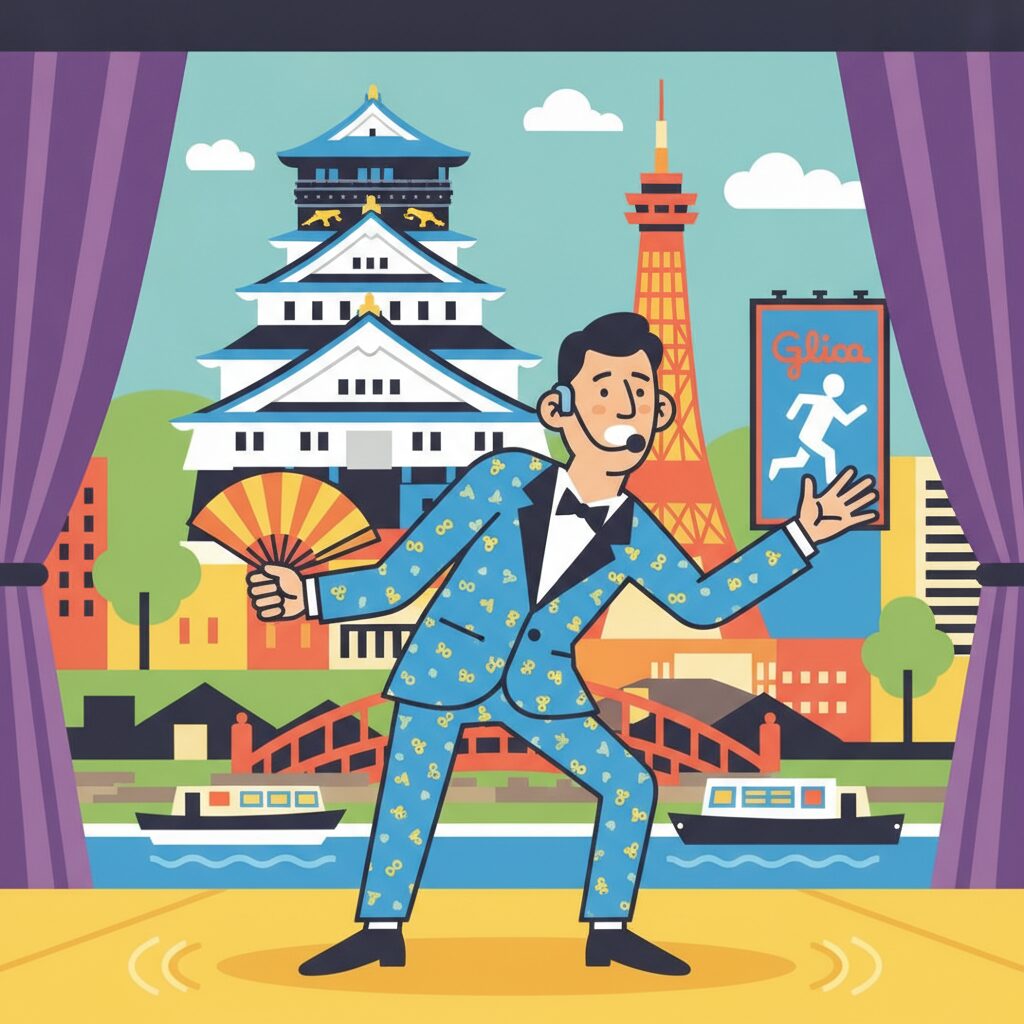
To understand Osaka’s style of humor, you first need to grasp two key terms: `boke` and `tsukkomi`. These words originate from `manzai`, Japan’s traditional two-person stand-up comedy, but in Osaka, this comedic interplay happens everywhere. The `boke` is the funny character, the airhead who says or does something absurd, silly, or just plain wrong. The `tsukkomi` is the straight man, the one who responds with a sharp retort, a hand flick, or the classic Osaka phrase, “Nande ya nen!” which roughly means “What the heck?!” or “No way!”
This dynamic isn’t limited to comedians; it’s a social contract embedded in everyday life. The interaction is a constant, flowing exchange where someone offers a `boke`, and someone else is socially obliged to answer with a `tsukkomi`. It’s like a conversational game of catch. Failing to respond—or worse, taking the `boke` seriously—is the biggest faux pas you can make. It kills the atmosphere instantly.
Picture this: you’re walking with a friend who trips on perfectly flat pavement. In Tokyo, the immediate, caring response would be, “Daijoubu? Are you okay?” Polite, considerate, and logical. In Osaka, the script flips. The immediate reply might be a theatrical, “Wow, what an amazing new dance! Planning to go pro?” or a simple, “Aho ka!” (“Are you an idiot!”). This isn’t mean-spirited; rather, it’s a `tsukkomi` that highlights the silliness of the moment, turns a minor embarrassment into a shared joke, and signals, “I’m so comfortable with you that I can tease you.” The person who stumbled is then expected to play along, maybe strike a dramatic pose and say, “Just practicing for my big debut!” This is the rhythm: a silly action thrown out (`boke`), followed by a witty correction (`tsukkomi`). This playful exchange strengthens social bonds. Ignoring the stumble might be polite in Tokyo, but in Osaka, it would come across as cold and distant.
From the Supermarket Aisle to the Boardroom Table
This comedic sensibility isn’t limited to conversations among friends. It infuses every part of life here, transforming mundane errands into memorable exchanges and turning stiff professional environments into something much more human. You have to be prepared for the punchline at all times, whether you’re buying vegetables or delivering a quarterly report. The key is to recognize the setup and understand your role.
The Checkout Counter Comedy Club
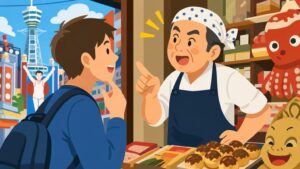
The local shotengai, or shopping arcade, serves as the ultimate training ground for your `tsukkomi` skills. The vendors, particularly the older generation of `obachan` and `ojichan`, are seasoned pros. They are experts in the deadpan `boke`. Approach a fruit stand and ask the price of a melon, and don’t be surprised if the owner replies, “For you? One million yen,” without cracking a smile. This is a challenge. The wrong move is to become flustered or confused. The right response is to play along. You might shoot back, “Only a million? What a deal! I’ll take two!” Or pull out your wallet with a dramatic sigh and say, “Alright, but you’ll have to accept payments.” Nail it, and you’ll be rewarded with a hearty laugh, a discount, and a new friend.
This happens everywhere. The supermarket cashier might notice you buying instant noodles and say, “Cooking is too much trouble tonight, huh?” The butcher might hold up a piece of meat and declare, “This will make you strong enough to fight a bear!” These aren’t criticisms or random remarks; they’re conversational openings. They’re little `boke` moments thrown your way, waiting for you to complete the exchange with a `tsukkomi`. A simple laugh and a “You got me!” is all it takes. This is a far cry from the silent, efficient, and impersonal transactions common in many other parts of Japan and beyond. Here, making a purchase is a chance for a performance.
Office Banter: The Serious Business of Not Being Too Serious
You might think this disappears in the corporate world, but you’d be mistaken. While the jokes may be more subdued, the fundamental `boke-tsukkomi` dynamic remains an essential tool for office politics and team building in Osaka. It lubricates communication in ways that formalities often cannot. In a typical Tokyo office, hierarchy is strict and interactions can be rigid. In Osaka, humor is frequently used to momentarily level that hierarchy and foster camaraderie.
I once witnessed a department head, in the midst of a serious presentation, switch to a slide that was just a picture of his cat. He deadpanned, “And as you can see from these projections, cuteness is up 30% this quarter.” The room paused for a moment. In another city, this could have been career suicide. But here, a young employee from the back called out, “Bucho, that’s the wrong cat! That’s last year’s model!” The entire room burst into laughter. The boss pointed at the employee, pretending to be angry, and said, “You’re getting a pay cut!” More laughter followed. The tension was broken, and the meeting continued with renewed energy and unity.
The younger employee’s `tsukkomi` wasn’t disrespectful; it showed engagement. It indicated he was paying attention, understood the boss’s personality, and felt comfortable enough to join the joke. For a foreigner, this can be tricky to navigate. Being too formal or serious can make you seem distant. Being overly jokey without grasping the context can backfire. The key is to watch the flow, start with light `tsukkomi` with trusted colleagues, and show that you appreciate the humor, even if you’re not ready to initiate it yourself.
Why Tokyo Thinks Osaka is Loud (And Why Osaka Doesn’t Care)
This constant display of humor lies at the heart of many stereotypes about Osaka. People from Tokyo and other regions of Japan often describe Osakans as loud, aggressive, or even rude. However, they aren’t truly hearing the words; they are misinterpreting the rhythm. The perceived “loudness” isn’t about volume; it’s about the intensity of interaction. Conversations in Osaka are rapid-fire exchanges, not slow, deliberate talks. There are fewer pauses. People speak over one another, not out of rudeness, but to build on a joke or deliver a perfect `tsukkomi`. Timing is crucial in comedy, after all.
In Tokyo, conversations tend to prioritize harmony and avoiding conflict. Everyone waits their turn to speak, and statements are often softened with qualifiers. In contrast, Osaka conversations focus on engagement and connection. The aim is to provoke a reaction, make the other person laugh, and show mutual understanding. A flat or non-committal response can feel more offensive than a playful tease. This style can be startling for newcomers, with the energy feeling overwhelming. Yet once you realize it’s all part of a collective effort to enhance the moment, it begins to sound less like noise and more like a symphony.
This approach traces back to Osaka’s history as a city of merchants. For centuries, it served as Japan’s commercial center. Business wasn’t conducted through stiff formalities but through relationships. Merchants needed to establish rapport and trust quickly. Humor was a shortcut, breaking down barriers, revealing personality, and forming bonds faster than any polite bow. That spirit endures. The drive to bridge distances between people and find common ground through laughter is a legacy of the merchant spirit. So, when someone from Osaka seems overly familiar or teases you right after meeting, they’re not being rude—they’re doing business, the Osaka way—the business of friendship.
A Foreigner’s Survival Guide to Osaka Banter
So, how does a non-native comedian survive and thrive in this city of punchlines? It can feel like you’ve been thrown into an improv class you never signed up for. But don’t worry—you don’t have to be a natural-born entertainer. You just need to learn the basic rules of engagement.
Rule #1: Don’t Take It Personally
This is the golden rule. Teasing is a form of affection. A joke made at your expense is almost always an olive branch. When the lady at the bakery says, “You’re buying too much bread! You’ll get fat!”, she’s not insulting you. She’s inviting you into her world. She’s treating you like a regular, a neighbor, someone she feels comfortable enough with to joke around. The right response is to laugh and say, “But your bread is too delicious! It’s your fault!” Reacting with hurt or offense will only create awkward silence and shut down the connection she was trying to build. See the tease for what it is: a welcome mat.
Rule #2: You Don’t Have to Be a Comedian (But You Do Have to React)
The pressure to be witty can be overwhelming, but you can relax. No one expects you to deliver a perfect, killer `tsukkomi` in flawless Japanese. The key is simply to react. A blank stare is the kiss of death. A laugh is good. A big, theatrical laugh is even better. A smile and a wave of the hand works well. Showing that you understand a joke has been made is 90% of the battle. Your participation, however small, keeps the exchange going. And if you want to try your hand at the verbal side, learn the magic phrase: “Nande ya nen!” You can use it for almost anything. Someone tells an unbelievable story? “Nande ya nen!” Someone makes a silly pun? “Nande ya nen!” Someone points out you’re wearing your shirt inside out? A slightly embarrassed “Nande ya nen!” is your all-purpose key to joining the conversation.
Rule #3: When in Doubt, Play the ‘Boke’
As a foreigner, you have a secret superpower: you’re a natural `boke`. No one expects you to know everything. Your cultural missteps, language mistakes, and confusion about local customs are all potential comedy gold. Rather than be embarrassed by them, lean into them. Own the `boke` role. Did you accidentally try to pay for your train ticket with a supermarket point card? Don’t just apologize—turn it into a performance. Look at the card with mock betrayal. “You failed me!” you could say to the card. Share the story with your friends later, exaggerating your cluelessness. People in Osaka love a good self-deprecating story. By laughing at yourself, you show that you don’t take yourself too seriously, which is a highly valued trait here. You give them the perfect chance to play the `tsukkomi`, and they’ll love you for it.
The Heart of the Matter: Humor as a Form of Connection
Ultimately, all this joking and teasing, this city-wide comedy act, isn’t really about being funny. It’s about being human. It’s a communication philosophy based on the idea that laughter is the most efficient and sincere way to connect with others. It’s a method of bypassing formalities and getting straight to the core of things. A shared laugh says, “I see you. You see me. We’re in this together, so we might as well enjoy ourselves.”
This is the true reason Osaka is known for being so “friendly.” It’s not just that people smile more or are more willing to help a lost tourist. They intentionally break down barriers between strangers, using humor as their main tool. A joke is an invitation. A `tsukkomi` is a response. It’s a continual, open call to join the community, to be more than just an anonymous face in the crowd. Living in Osaka means learning to view the world as a stage. It means realizing that the person next to you isn’t just a stranger; they’re a potential comedy partner. Once you grasp the rhythm of `boke` and `tsukkomi`, you’ll find you’re not just watching the show anymore—you’re part of it. And there’s no better feeling than that.