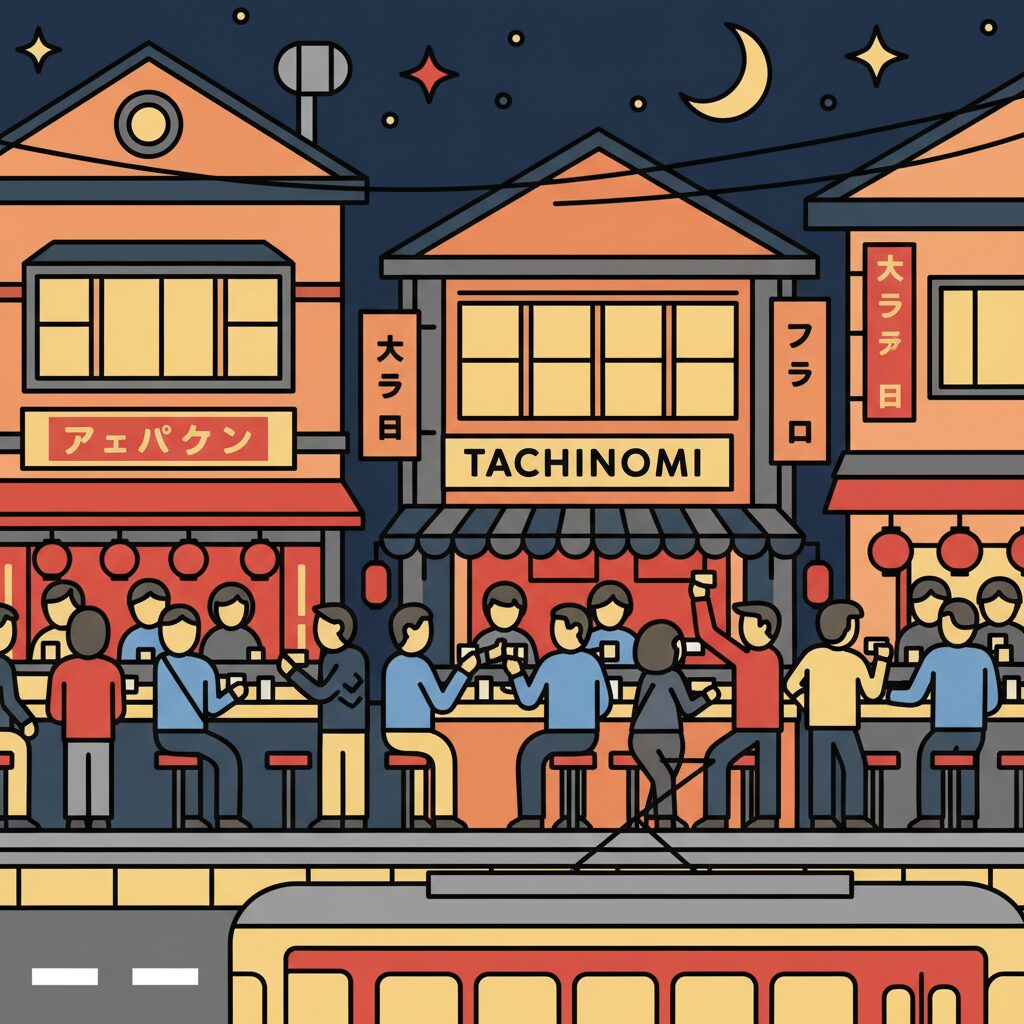
Hello, beautiful people! Sofia here, ready to pull back the curtain on one of Osaka’s most essential, and often misunderstood, institutions. When I first arrived, I’d walk past them every evening: glowing doorways spilling warm light and boisterous laughter onto the pavement. Inside, crowds of people stood shoulder-to-shoulder, packed into spaces no bigger than a generous walk-in closet. My first thought? These must be intense, hardcore bars for salarymen to pound cheap drinks after a long day. A little intimidating, a little gritty, and maybe not for me. How wonderfully, completely wrong I was. What I was seeing wasn’t just a bar. It was a community center, a networking hub, a neighborhood newsroom, and the city’s living room, all rolled into one. It was the tachinomi, the standing bar, and understanding it is key to understanding the very soul of Osaka.
These places are the social glue of the neighborhoods they inhabit. They are the antithesis of the quiet, reserved interactions you might expect in Japan. They are loud, they are close-quarters, and they are unapologetically human. To show you where this magic happens, I’ve pinned a map to the heart of Tenma, one of Osaka’s most legendary tachinomi districts. It’s a maze of covered shotengai arcades and narrow side streets, each one pulsing with the energy of these incredible standing bars. This is where you go to feel the city’s true heartbeat.
Osaka’s vibrant communal spirit extends beyond its pulsating tachinomi culture to the culinary artistry where takoyaki and okonomiyaki similarly bring neighbors together through each flavorful bite.
The Great Equalizer: Why Standing Changes Everything
Imagine a typical bar. You arrive with your friends, locate a table, and form a private island amid a sea of other private islands. Even if you’re in a room with fifty other people, your interaction is limited to your own small group. A tachinomi breaks down those islands. By eliminating chairs, it removes social barriers. Suddenly, you’re not bound to a table. Instead, you become part of a fluid, ever-changing ecosystem of people. The space between you and the person beside you shrinks from a polite distance to just inches. This physical closeness creates an immediate, unspoken sense of shared experience.
This highlights a fundamental difference between Osaka and Tokyo. While Tokyo does have standing bars, they often feel more utilitarian—a quick, efficient stop for a solo drink before catching the last train. The atmosphere tends to be more reserved, with people keeping to themselves. In Osaka, however, the tachinomi is the main attraction. It’s a destination people visit specifically for the communal vibe. You might see a construction worker in his work clothes chatting animatedly with a woman in a stylish business suit. Or a young university student receiving life advice from a retiree who’s lived in the neighborhood for sixty years. Your profession, age, and background all fade into the background. Within the warm, buzzing space of the tachinomi, everyone is simply a neighbor, sharing a drink and a story. The only status that matters is whether you’re a jōren-san, a regular—an honor earned through loyalty, not wealth.
The Unwritten Choreography of the Standing Bar
For those unfamiliar, the bustling atmosphere of a popular tachinomi can feel overwhelming. Yet beneath the apparent chaos lies a beautiful, unwritten rhythm that everyone intuitively follows. Learning these subtle cues is key to truly enjoying the experience. It’s less about rigid rules and more about a shared understanding of how to coexist harmoniously in a compact space.
The Currency of Trust: Ordering and Paying
Forget about waving down a waiter or waiting for the bill at the end. Tachinomi relies on systems of remarkable efficiency and trust. The most common approach is kyasshu on deribarī, or simply “cash on.” You order your drink and a dish, then pay immediately. The staff delivers your order, you hand over the cash, and they give you change. It’s a straightforward transaction that keeps things flowing smoothly.
Even more distinctive is the tray system. You receive a small tray or bowl to place a 1,000 or 5,000 yen note. Each time you order, the staff takes the exact amount from your tray and returns any change. There’s no running tab or complicated POS system. It’s an honor system that embodies the Osakan spirit: practical, straightforward, and rooted in mutual trust. This elegant solution says, “We’re all here to enjoy ourselves, let’s keep things simple.”
The Art of Personal Space (or Lack Thereof)
In a city that generally respects personal space, tachinomi stands as an exception. The aim is to accommodate as many happy patrons as possible within a small area. This demands some spatial awareness. When you enter, you don’t barge in. Instead, you look for an opening and politely ask, “Sumimasen, koko ii desu ka?” (Excuse me, is it okay here?). The answer is almost always a warm yes, as people naturally shift to make room.
You learn to take up minimal space. Your bag goes into a basket at your feet or hangs on a small hook under the counter. You keep your elbows tucked in and angle your body toward the bar, carving out a small personal zone. It’s a dance of tiny adjustments and mutual respect. If you accidentally bump someone, a quick “sumimasen” and nod suffices. This shared closeness adds to the charm; it breaks down both physical and social barriers, fostering a sense of collective mindfulness.
The Graceful Exit: The Philosophy of a Quick Drink
A common newcomer’s mistake is to treat a tachinomi like a regular bar and settle in for a long evening. This misses the essence of the place. Tachinomi thrives on movement and turnover. It’s meant for a quick, refreshing stop. The Japanese word for this is sappari, meaning clean, crisp, and revitalizing. That’s the ideal tachinomi vibe.
You drop in, enjoy one or two drinks, maybe a couple of small, tasty dishes like doteyaki (slow-cooked beef tendon) or fresh sashimi. You share a few words with the master, chat briefly with your neighbor, and then leave gracefully, opening space for the next guest. This isn’t a place for deep, marathon conversations. It’s for light, breezy, meaningful exchanges. Lingering too long holds up the flow. The beauty is in the brevity, keeping the atmosphere lively and new faces coming through.
The Soul of the City: Why Tachinomi Culture Flourishes Here
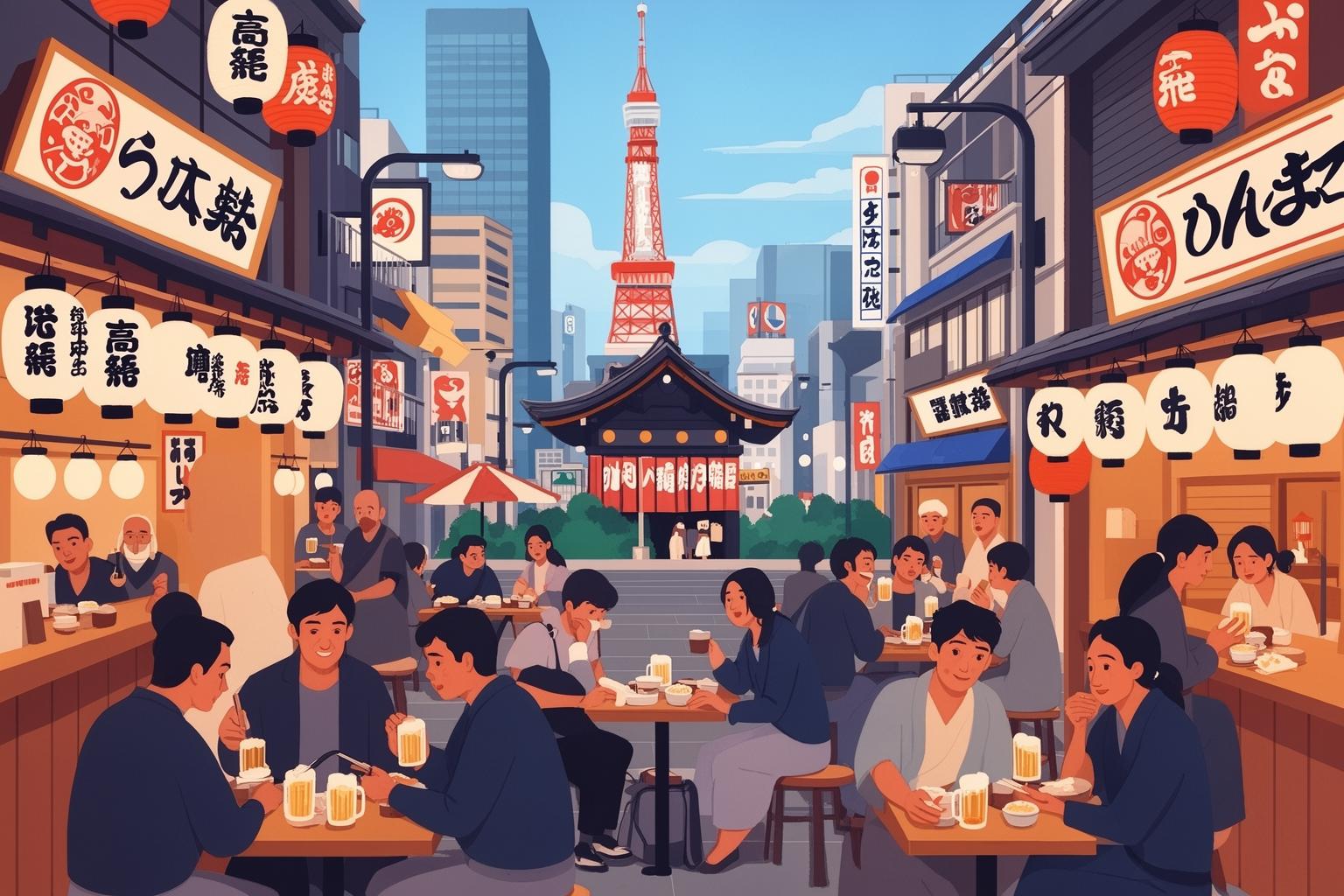
So why is this culture of standing, chatting, and quick-drinking so deeply ingrained in Osaka’s DNA? It’s no coincidence. Tachinomi perfectly embodies the city’s historical and cultural identity, reflecting the practical, merchant-class spirit that has shaped Osaka for centuries.
The Merchant City’s Mindset
Osaka has long been known as Japan’s kitchen and commercial powerhouse—a city founded by merchants, or akindo. This background has fostered a distinct mindset centered on value, straightforwardness, and strong relationships. Osakans are well-known for their emphasis on cospa, or cost performance. Tachinomi exemplify this: drinks are affordable, the food quality surpasses expectations for the price, and there’s no table charge. It’s about maximizing social returns on a minimal investment. This isn’t about being cheap; it’s about being savvy, a trait highly prized in Osaka.
Moreover, in a merchant culture, communication is currency. Networking, exchanging information, and maintaining good relationships are critical for success and survival. Tachinomi serve as the modern gathering places for this purpose. They are where informal deals are made, gossip is traded, and the complex fabric of neighborhood connections is woven and sustained. It’s a seamless blend of business and pleasure.
A Proud Rejection of Tokyo Formality
Osaka frequently defines itself in opposition to Tokyo. While Tokyo is seen as polished, formal, and hierarchical, Osaka takes pride in being down-to-earth, straightforward, and delightfully chaotic. Tachinomi embody this identity physically. There are no fancy interiors, elaborate cocktail menus, or hushed tones. Instead, it’s raw and authentic. Menus are often handwritten on paper strips pinned to the wall, and the decor may have remained unchanged for decades. This isn’t a flaw but the essence of the experience.
This rejection of superficiality in favor of genuine connection is central to Osaka’s character. People aren’t impressed by what you spend or wear but by your humor, storytelling ability, and readiness to engage. Tachinomi provide the ideal setting for this kind of sincere interaction, a stark contrast to the buttoned-up formality of an upscale Tokyo Ginza bar.
The Community Stronghold: Your Neighborhood Spot
In a vast, impersonal metropolis, tachinomi act as crucial anchors of local identity. People display fierce loyalty to their neighborhood spots. They don’t just visit a tachinomi; they go to their tachinomi. The owner, known as the taisho or mama-san, is much more than a bartender—they are a confidant, connector, and the steadfast guardian of the community spirit.
They remember your name, your usual drink, and your last conversation. They’ll notice if you’re feeling down and may offer a word of encouragement. They’ll introduce you to another regular they think you’ll get along with. Becoming a jōren-san at a local tachinomi feels like being welcomed into a new family. It’s the place to share good news or find a familiar face after a hard day. It’s a powerful remedy to the loneliness that can sometimes accompany city life and a rare level of neighborhood connection in today’s world.
Finding Your Place at the Counter
For a foreigner, stepping into this vibrant, close-knit world for the first time can feel like crashing a private party. You may worry about the language barrier or accidentally breaking an unspoken rule. However, the biggest misconception about Osaka is believing that its lively energy is exclusive. In truth, it is profoundly inclusive.
Your best tools are a warm smile and a few simple Japanese phrases. A cheerful “Konbanwa!” when you enter and a clear “Sumimasen!” to catch the master’s attention are all you need to begin. Point at the menu, use gestures—it’s all part of the enjoyment. Osakans value effort over perfection. Naturally curious, they often see a foreign face as an exciting chance for a new conversation, not an intrusion.
Read the atmosphere. If it’s a tiny bar with five elderly men who all stop talking and stare when you walk in, perhaps try a slightly larger, more diverse spot nearby. But more often than not, your presence will be greeted with a friendly nod or even a direct “Doko kara kitan?” (Where are you from?). Be open, be curious, and ask for a recommendation. Saying “Osusume wa nan desu ka?” (What do you recommend?) shows respect and serves as a great icebreaker.
So next time you’re strolling down a shotengai and notice the warm glow of a tachinomi, don’t hesitate. Don’t think of it as just a place to get a drink. See it for what it truly is: an invitation. It’s an invitation to experience the real Osaka—not the one on postcards, but the living, breathing, laughing city that exists in these small, cherished spots. Slide open the door, find a little spot at the counter, and order a beer. You might come for a drink, but you’ll stay for the community.