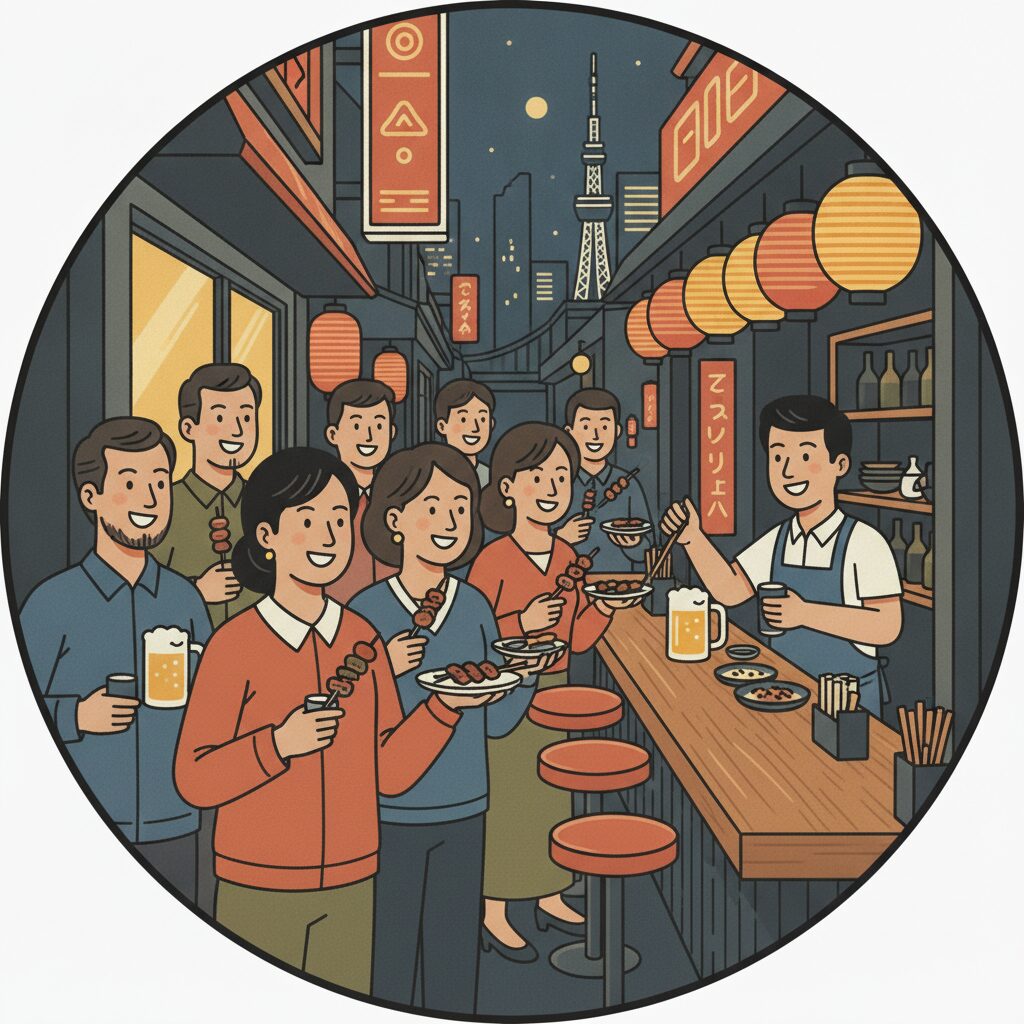
I’ll never forget my first encounter with a proper Osaka tachinomi. It was a Tuesday evening in Kyobashi, a neighborhood humming with the post-work energy of a thousand tired but thirsty salarymen. I saw a glowing lantern, a door slid open, and a wall of sound and steam hit me. Inside, a crowd of people were packed shoulder-to-shoulder, glasses in hand, laughing loudly over a long wooden counter. The strange part? There wasn’t a single chair in sight. Not one. My British sensibilities screamed, “Why would anyone choose this? Where do you put your coat? Isn’t it uncomfortable?” But as I watched, I realized I wasn’t looking at a place of inconvenience; I was looking at a perfect expression of Osaka itself. Fast, efficient, unpretentious, and surprisingly communal.
This is the world of tachinomi (立ち飲み), or standing bars. And while you’ll find them all over Japan, in Osaka, they aren’t just a trend or a niche. They are a fundamental part of the city’s social fabric, a living museum of its merchant soul, and the absolute best place to understand how this city breathes, talks, and thinks. Forget the polished cocktail bars and the serene, private rooms of a high-end izakaya. If you want to get to the heart of Osaka, you need to get on your feet. It’s a culture that rewards the decisive and the easy-going, a place where social barriers are as low as the prices. To help you find your footing, here’s a look at one of the city’s most vibrant tachinomi battlegrounds, the area around Tenma Station.
For those eager to uncover how dietary needs shape Osaka’s nomikai scene, our nomikai dietary guide offers essential insights.
The Unspoken Rules of the Standing Counter
Walking into a tachinomi for the first time can feel like boarding a fast-moving train. The pace is rapid, the rules are unspoken, and hesitation only holds you back. But once you catch the rhythm, it becomes wonderfully straightforward. This experience goes beyond just drinking; it’s about engaging in an efficient social system grounded in a few fundamental principles.
Your Space is Borrowed, Not Owned
The key thing to remember is that you don’t own your spot at the counter; you’re simply borrowing it temporarily. Your personal space shrinks to the width of your shoulders. Avoid spreading out your belongings. Keep your bag at your feet or hang it on a hook underneath the counter if one is available. When sliding in to find a gap, a polite nod or a quiet “sumimasen” (excuse me) will suffice. You’ll be surprised how a seemingly full bar can effortlessly create room for one more person. This is the Osaka art of accommodation in a densely packed urban setting. It’s an unspoken pact: we’re all sharing this tight space, so let’s make it work.
The Art of the Quick Order
Forget spending ten minutes studying a leather-bound menu. At most traditional tachinomi, the menu is posted on the wall in handwritten Japanese script. The tempo is fast. The staff is busy, and they expect you to know what you want. The best approach is to decide on your first drink before reaching the counter. A “nama biiru” (draft beer) or a highball (“haibouru”) is always a reliable choice. When a staff member catches your eye, state your order clearly and confidently. They’ll have it in your hand within a minute. Ordering food works the same way. Point to something sizzling on the grill or a menu item on the wall. This isn’t rudeness; it’s about efficiency. The system is designed for smooth flow, not prolonged deliberation.
Cash is King (and It Lives on the Counter)
Many traditional tachinomi run on a cash-on-delivery system known as daikin hikikae (代金引換). When you arrive, you’ll often notice a small tray or bowl in front of each customer holding a pile of coins and a 1,000 yen note. This acts as your tab. Place your cash in the tray. Each time you order a drink or a dish, the staff will take the exact amount from your tray. It’s a brilliantly simple, trust-based method. It’s transparent—you always know how much you’ve spent. It’s fast—there’s no bill to split or card machine to handle at the end. When your tray is empty, it’s time to either add more cash or call it a night. This straightforward, no-nonsense approach to money exemplifies Osaka’s merchant culture.
Know When to Go
Tachinomi are temporary spaces. They aren’t meant for lingering. The average visit lasts anywhere from 20 minutes to an hour. It’s a pit stop, a social recharge before moving on with your evening. You come, have a drink or two, enjoy a few small dishes, then leave. This fleeting nature keeps the energy lively and the spaces accessible. Staying for hours over a single drink is a major faux pas. When you finish, clear your glasses and plates to the designated spot on the counter if that’s the rule, give a nod to the staff, and make your exit. You’re making room for the next person looking for a quick, affordable, and cheerful drink.
Who Thrives in Osaka’s Standing Bar Scene?
The tachinomi isn’t suited for everyone, but for a particular kind of person, it’s more than just a bar—it perfectly matches their lifestyle and personality. The crowd represents a cross-section of the city, and understanding who thrives here means understanding who thrives in Osaka.
The Efficient Solo Operator
Imagine a salaryman in his 40s. After a long day, he doesn’t want the commitment of a full dinner or the effort of organizing a group outing. He simply wants a cold beer and some yakitori, and he wants it immediately. The tachinomi serves as his sanctuary. He can slip in, stand at the counter, unwind for 30 minutes, and catch his train home without any social pressure. He might focus on his phone, watch the TV in the corner, or listen to the conversations around him. There’s no obligation to engage or socialize. It’s a space that honors independence and the need for a quick, solitary recharge. This scene is a familiar one, reflecting the rhythm of a city filled with hardworking people.
The Budget-Conscious Social Butterfly
For students, young professionals, and anyone who values affordability, the tachinomi is a financial blessing. A draft beer might be ¥300, a highball ¥250, and a plate of doteyaki (beef sinew stew) ¥200. You can enjoy two drinks and a couple of snacks for under ¥1,000. This is the famous Osaka kosupa (cost performance) in action. It enables spontaneous, low-pressure socializing. You can meet a friend for a “quick one” without worrying about a large bill. This ethos is woven into Osaka’s DNA—a merchant city where people have always understood the value of a yen and resist paying for unnecessary extras. Why pay more for a seat when the beer tastes just as good standing?
The Decisive and Spontaneous Adventurer
The standing bar rewards those who can make swift decisions and go with the flow. No dithering allowed. See a spot? Take it. See a dish you want? Order it. This setting suits people weary of the rigid planning that often defines social life in Japan. It’s a place for spontaneity. You can decide at 6 PM to have a drink and be home by 7 PM. This captures the flexible, pragmatic, and occasionally impatient spirit of Osakans. They like to accomplish things efficiently, and that extends to their downtime as well.
The Genuinely Curious Observer
If you’re open-minded and willing to engage, the tachinomi is the city’s best spot to strike up an unexpected conversation. Standing shoulder to shoulder with strangers breaks down social barriers. The shared experience of being crammed into a small, lively space fosters camaraderie. It’s common for the person next to you to ask where you’re from or suggest their favorite dish. Here, the cliché of “friendly Osakans” rings true. It’s not intrusive friendliness; it’s a situational openness born from shared space and a culture that values direct, straightforward interaction. You’ll learn more about the city in a 15-minute chat with an elderly patron at a tachinomi than from any guidebook.
…And Who Might Prefer a Seated Izakaya?
For all its advantages, the standing bar is a specialized tool designed for a specific purpose. It’s important to acknowledge when it’s not the right fit. Understanding this will save you discomfort and help you appreciate both tachinomi and izakaya for what they truly are.
The Group on a Mission for a Deep Catch-Up
If you’re gathering with old friends to delve into life, love, and work for several hours, a tachinomi is a poor choice. The noise level is often overwhelming, making subtle conversation impossible. You can only really talk to someone standing immediately beside you. The constant flow of people coming and going adds to the distraction. For these moments, the relative quiet and privacy of a seated izakaya, where you can reserve a table and relax comfortably for a long visit, is far superior.
The Comfort and Relaxation Seeker
Let’s be honest: standing for an hour after a long day on your feet isn’t everyone’s idea of relaxation. If your main aim is to rest tired legs, sink into a cozy seat, and unwind in a peaceful setting, the tachinomi will feel more like a punishment. Its design is functional and high-energy, more akin to a shot of social espresso than a calming chamomile tea. Don’t try to make it serve a purpose it wasn’t intended for.
The First-Date Hopefuls
This almost goes without saying, but a tachinomi is one of the worst venues for a first date. It’s noisy, crowded, and completely lacking in romance or privacy. You’ll be shouting over the grill’s sizzle and brushing elbows with a tipsy salaryman. The entire atmosphere is built for speed and efficiency, the exact opposite of the slow, relaxed pace ideal for a good date. Save it for the third or fourth outing when you can both enjoy its chaotic charm.
The Truly Shy and Reserved
While it’s totally fine to keep to yourself in a tachinomi, the close physical proximity to others can be overwhelming for those who are truly shy or prefer a lot of personal space. There’s always a chance a stranger might strike up a conversation. If this prospect fills you with anxiety rather than excitement, the experience could be more stressful than pleasant. A seated bar or izakaya offers clear social boundaries that tend to feel much safer.
Tachinomi vs. Tokyo: A Tale of Two Cities
To truly understand the essence of Osaka’s tachinomi culture, it is helpful to compare it with that of Tokyo. While the capital city certainly has standing bars, their function and atmosphere differ subtly, reflecting the distinct personalities of Japan’s two largest metropolises.
In Tokyo, many standing bars—especially newer ones in neighborhoods like Ebisu or Shinjuku—tend to feel more specialized and refined. You might encounter a standing craft beer bar, a standing wine bar, or a stylish standing washoku (Japanese cuisine) spot. These venues are often clean, modern, and cater to a particular, discerning clientele. The ambiance is generally more subdued, serving as a spot for professionals to enjoy a quick, efficient drink before catching the last train. They form part of the city’s urban infrastructure, offering convenient options in a place that values efficiency and variety.
Osaka’s tachinomi culture, by contrast, feels less like a modern convenience and more like a cultural tradition with deep, tangled roots. The best establishments, concentrated in areas like Tenma, Kyobashi, and Namba, are often decades old, charmingly divey, and wholeheartedly unpretentious. The walls bear the stains of years of smoke and laughter. Menus are simple, hearty, and affordable. The atmosphere is not only lively; it can be downright boisterous. It resembles less a bar and more a communal living room for the entire neighborhood. In Osaka, the tachinomi is not just a spot to drink; it is a place to belong, even if only for twenty minutes. It offers a direct, unfiltered expression of the city’s working-class heritage and its rejection of pretension.
Beyond the Beer: What Tachinomi Reveals About the Osaka Mindset
A simple standing bar reveals more about the local philosophy than any history book. It serves as a tangible expression of several fundamental Osakan values.
Pragmatism Over Polish
The key question a tachinomi asks is: “Do you really need a chair?” If the aim is to enjoy a cold drink and a hot snack at an affordable price, then a chair is an unnecessary expense. This embodies the core of Osaka pragmatism. The city was built by merchants, not samurai. While aesthetics matter, function and value take priority. An Osakan would rather spend ¥300 on an excellent beer while standing than ¥600 for the same beer just to have a seat. This unwavering emphasis on kosupa isn’t about being cheap; it’s about being practical and avoiding pretension.
Fluid Social Boundaries
In a seated izakaya, your group is defined by your table—it’s your island. In a tachinomi, there are no islands, only a flowing river of people. The company president might stand next to a construction worker, who stands next to a university student. For a moment, titles and hierarchies dissolve at the shared counter. This reflects the more egalitarian and direct social style found in Osaka, where people care less about formality and status and more about straightforward human connection.
A Culture of “Chotto Dake” (Just a Little)
The tachinomi is the temple of “chotto dake,” the art of doing something “just for a bit.” It perfectly suits the desire for “ippai dake” (just one glass). This sharply contrasts with the often rigid and planned nomikai (drinking parties) typical of corporate life. The tachinomi allows social interaction to fit into the small, unused moments of the day. It’s a low-commitment, high-reward way to stay connected. This spontaneity and flexibility are essential for navigating and enjoying daily life in Osaka’s fast-paced, energetic environment.
Where to Start? A Neighborhood Guide for the Uninitiated
Rather than listing specific bars, it’s more valuable to grasp the distinctive character of the key tachinomi neighborhoods, each offering a unique variation on the same fundamental culture.
Tenma: The Labyrinth of Choice
Just north of Osaka Station, the covered arcades and side streets near Tenma Station form a dazzling, intricate maze packed with hundreds of bars and restaurants. Here you’ll discover everything from long-established, rugged tachinomi to sleek, modern standing bars specializing in sake or Italian cuisine. The sheer concentration and diversity are intoxicating. Exploring Tenma is like diving into Osaka’s soul: chaotic, noisy, slightly overwhelming, yet endlessly rewarding for those willing to explore.
Kyobashi: The Salaryman’s Soul
East of Osaka Castle, Kyobashi serves as a major commuter hub, and its tachinomi scene embodies the raw, pulsing heart of after-work drinking culture. The standing bars here are gritty, affordable, and utterly authentic. This is no tourist spot; it’s where crowds of office workers unwind. It’s the ideal place to witness the pure, unfiltered ritual of the post-work pint, a tribute to the daily grind and the simple joys that make it bearable.
Umeda/Osaka Station: The Commuter’s Pit-Stop
Beneath the extensive Osaka and Umeda Station complex, you’ll find a cleaner, more contemporary take on tachinomi. Many are situated inside the station or within surrounding commercial buildings, designed for maximum convenience to serve the flow of commuters. While they may lack some of the gritty charm of older locales, they demonstrate how tachinomi culture has evolved in the 21st century, emphasizing speed and accessibility above all else.
Namba and Shinsekai: The Echo of the Past
In the city’s southern area, the entertainment district of Namba and the nostalgic neighborhood of Shinsekai offer a more traditional tachinomi experience. The bars here evoke the Showa Era, with worn wooden counters and an older clientele. Particularly in Shinsekai, you can enjoy standing and drinking kushi-katsu under the faded splendor of the Tsutenkaku Tower. It’s an opportunity to experience this culture not only as part of modern life but as a treasured link to Osaka’s lively, populist history.
Next time you encounter a packed bar with no seats, don’t see it as a hassle. See it as an invitation—an invitation to experience Osaka in its most genuine form. Squeeze into that narrow spot at the counter, order a beer, and listen. You’ll discover that here, standing tall while drinking is more than a habit. It’s a way of life.