
You feel it before you see it. A wave of sound—clattering plates, booming laughter, the sharp hiss of a deep fryer—spills out from under a faded blue noren curtain, carrying with it the scent of grilled meat and stale cigarette smoke. You peek inside. A dozen people are crammed shoulder-to-shoulder along a worn wooden counter, glasses in hand, heads tilted back in conversation. There are no chairs. There is no menu in English. There is, seemingly, no space. This is the tachinomi, the standing bar, and for a newcomer, it can feel like a fortress. It’s the polar opposite of a sleek Tokyo cocktail lounge where whispers are the currency of conversation. Here, the currency is connection, served loud, fast, and without pretense. For anyone trying to understand what makes Osaka tick, what makes its people so famously different from their Kanto counterparts, the tachinomi is not just a place to get a cheap drink. It’s a crash course in the city’s soul. It’s where the unspoken rules of Osaka society are on full display, a chaotic, beautiful ballet of practicality and community. Forget your textbook phrases and polite hesitations. To survive, and thrive, in the world of the tachinomi, you need to learn a whole new language of social interaction, one that’s written not in ink, but in gestures, glances, and the shared rhythm of a crowded room.
For those eager to grasp every layer of Osaka’s vibrant social fabric, diving into its shotengai lifestyle reveals a compelling blend of community charm and modern challenges.
The Tachinomi Threshold: More Than Just a Doorway
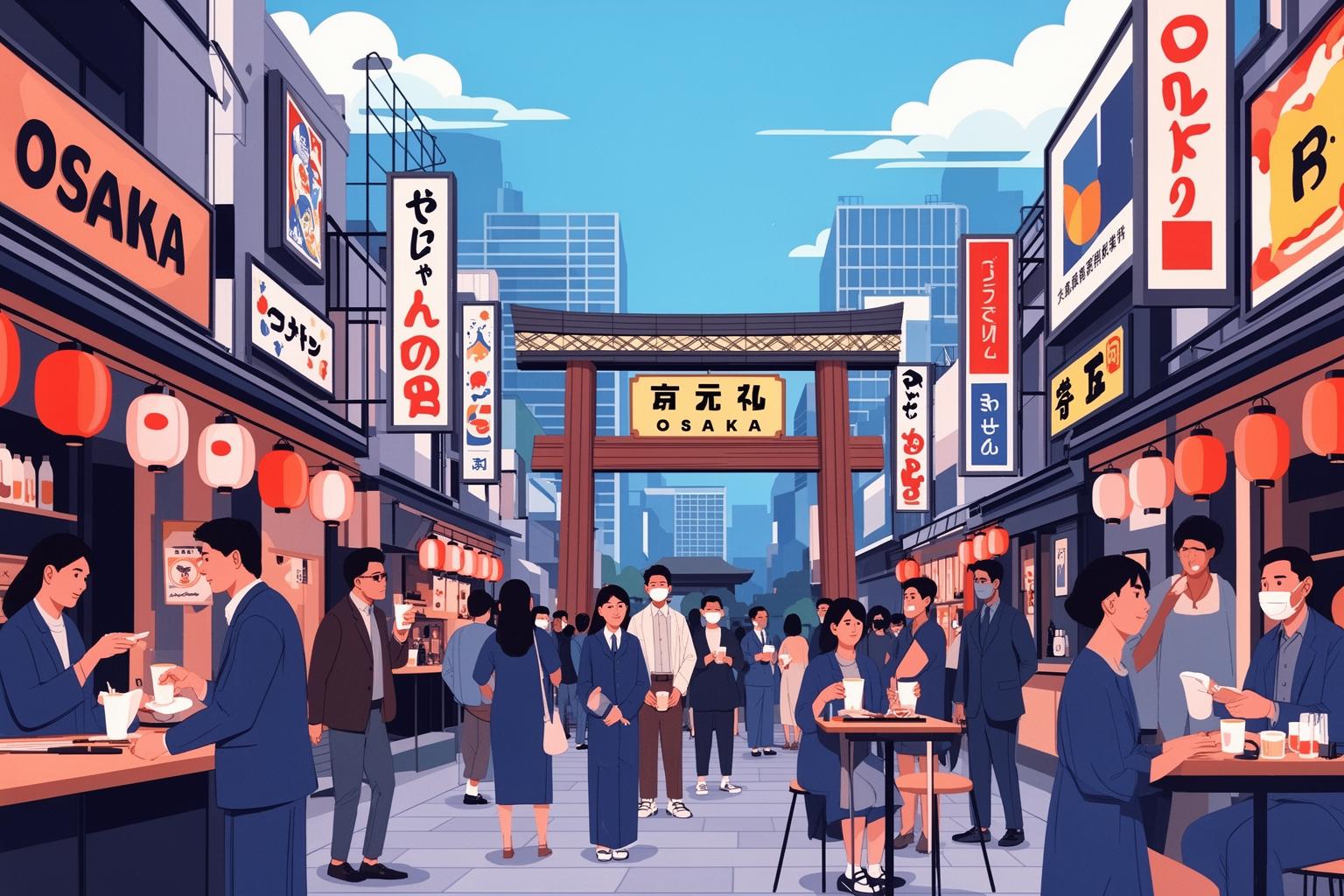
Entering a tachinomi is more than just opening a door. That cloth noren hanging at the entrance acts as a semi-permeable membrane—a gentle boundary separating the familiar street from the unpredictable world inside. The first skill you need to master is observation—a quick yet vital evaluation done from the threshold before you fully commit.
Reading the Room Before You Step In
Pause briefly. Listen. Is the energy frenetic and high-pitched, or a low, contented murmur? Look around. Are people so tightly packed they seem to move as a single organism, or are there visible gaps along the counter? Your initial judgment is about space. Unlike a restaurant with a host, no one manages capacity here. It’s a self-regulating system. If there’s truly no physical room to slip in without displacing someone, the bar is full. Forcing your way in is the first and most significant faux pas. It shows a fundamental misunderstanding of the tachinomi’s spatial contract, which is based on a shared respect for personal—albeit minimal—territory.
Next, evaluate the clientele. Is it a close-knit group of regulars who all seem to know each other, their conversation an impenetrable wall of inside jokes? This might be a harder crowd to penetrate if you’re alone. Or is it a varied mix—salarymen loosening their ties, young couples on a budget date, an elderly man nursing shochu? A more diverse crowd often indicates a more permeable social membrane, one more welcoming to newcomers. Don’t look for a sign that says “Welcome, Foreigners.” The welcome is unspoken. It’s found in the fluidity of the crowd, the transient nature of the patrons. This isn’t about exclusion; it’s about acknowledging that you are entering a space that, for many, serves as an extension of their living room. You are a guest, and a guest’s first responsibility is to maintain the peace, however loud that peace may be.
The Art of Finding Your Spot
Once you’ve judged the room as approachable, you face the delicate dance of claiming your place. This isn’t a land grab. You can’t just walk up to an open spot and stake your claim. The process is a subtle negotiation. Your goal is to find a gap, however small, between two people at the counter. You must catch the eye of the person you plan to stand beside. A slight nod, a questioning glance, and the universally understood phrase, “Sumimasen, ii desu ka?” (Excuse me, is this all right?) is your entry pass. The reply will almost always be an affirmative grunt and a small shuffle—an adjustment of their space to make room for you. They’ll pull their bag closer, angle their body slightly, and just like that, you’re in. You’ve been granted a few square feet of real estate.
This contrasts sharply with the Tokyo mindset, where space is more rigidly defined and personal bubbles are sacred. In an Osaka tachinomi, space is fluid—a resource to be shared and renegotiated moment by moment. Your territory is the width of your shoulders and the patch of counter directly before you. Your bag belongs on the hook under the counter or on the floor at your feet, never on the counter itself. Your coat is draped over your arm or squeezed onto the hook with your bag. You keep your footprint, both physical and material, as small as possible. This act of spatial humility serves as your first handshake, your silent agreement to honor the house rules.
The Currency of Communication: Ordering and Interaction
Once you step inside, the clock begins to tick. Tachinomi are temples of efficiency—not places for hesitant menu deliberations. The pace is quick, and keeping up is part of the unspoken social contract. Every interaction, from ordering a drink to settling your bill, is a streamlined exchange aimed at speed and clarity.
The First Order: Speed and Confidence
The master, or taisho, is a whirlwind of activity behind the counter—pouring drinks, plating food, taking payments, and mentally juggling a dozen different orders. There’s no time for hesitation. When his eyes meet yours, you must be ready. This is where the iconic Japanese bar phrase, “Toriaezu biru,” becomes invaluable. It means “Beer for now,” and serves as the perfect opening move. It’s decisive, straightforward, and buys you moments to scan the food options displayed on the wall or arranged on trays at the counter.
When you’re ready to order food, the same efficiency rule applies. Make eye contact. Speak clearly and loudly enough to rise above the noise. Pointing isn’t rude—it’s helpful. A simple “Are, hitotsu” (One of those), while gesturing toward the simmering pot of doteyaki (beef sinew stew), is entirely acceptable. In Osaka, directness is favored over elaborate politeness. This isn’t a formal dining setting; you’re here to eat, drink, and get on with your evening. The staff respects customers who understand this rhythm. In return, you receive prompt service and a subtle nod of approval from the taisho. You get it.
Cash on the Counter: The Unspoken Trust System
Many tachinomi use a cash-on-delivery system, a beautifully simple transaction that often puzzles newcomers. You’ll notice a small tray or bowl on the counter in front of you. Upon arrival, you place a 1,000 yen or 5,000 yen bill in it. As you order, the staff take the exact amount from the tray and immediately return your change. Your remaining balance stays there, ready for your next round.
A foreigner might wonder if this means they don’t trust you to settle a tab later. In reality, it’s the opposite. This system, known as kyasshu on, represents the pinnacle of tachinomi efficiency. It removes the need for a final bill, saving time for both customers and staff. It facilitates a smooth, continuous flow of transactions. More importantly, it reflects Osaka’s pragmatic, merchant spirit. It’s a system based on mutual understanding: you want quick service, and they want to run their business efficiently. There are no frills, no complex POS machines—just a tray of money and a shared goal. Leaving your cash on the counter isn’t a sign of mistrust; it signals that you’re part of a high-trust, high-speed ecosystem.
The Social Contract of the Shared Counter
That worn, wooden counter is more than just a surface for your drink; it’s a communal space. While the airspace above your spot is yours, the counter itself is a shared highway for plates and glasses. Here, the subtle community of the tachinomi reveals itself. If the person at the far end of the bar orders a plate of fried chicken and the taisho can’t reach them, he might set it in front of you with a gruff, “Pass this down.” Your role is to become the next link in the chain, handing the plate to your neighbor, who passes it along until it reaches its destination.
This simple gesture carries weight. It breaks down invisible barriers between strangers. For a moment, you’re not just individuals; you’re a team working together to keep the system running. Participation is expected. Ignoring the request or acting inconvenienced would be a major breach of etiquette. It’s a small test of your willingness to engage in the give-and-take of the space. Passing a plate of sashimi to a stranger is your initiation into the temporary family of the bar.
Cracking the Social Code: From Stranger to Neighbor
This is where Osaka truly contrasts with Tokyo. In a Tokyo bar, silence between strangers is the comfortable norm. In Osaka, it becomes a void waiting to be filled. The standing-only setup acts as a great equalizer; with no tables creating private spaces, you automatically become part of one continuous, flowing conversation. Engaging with this is the ultimate level of the tachinomi experience.
The Invitation to Converse (Or Not)
It often begins with a straightforward question from the person next to you, free of small talk. “Sore oishii?” (Is that good?), they might ask, nodding toward your plate. “Doko kara kitan?” (Where are you from?). These questions are not intrusions but openings—an invitation. The Osaka dialect, with its blunt yet melodic tone, serves as a tool to quickly bridge gaps.
Giving a simple one-word response will likely end the exchange. The key is to respond in kind. “It’s delicious, you should try it. What are you drinking?” This back-and-forth, the conversational volley, is what Osakans excel at. They are curious and genuinely engaged. For a foreigner living in Japan, accustomed to a certain polite distance, this can be both surprising and wonderfully refreshing. You are not merely a silent observer; you become an active participant. Your presence is recognized and welcomed, and you’re expected to add to the room’s energy.
The ‘Ogochiso-sama’ Culture: Treating and Being Treated
Don’t be startled if, after some conversation, your neighbor signals to the master, points at your empty glass, and orders you another drink. This is neither a romantic gesture nor a display of wealth. It is the highest form of welcome in the tachinomi world—an affirmation: “You’re one of us now.”
Proper etiquette here is essential. Refusing the drink is a significant social faux pas. You should accept it with a slightly surprised yet grateful look and a hearty “Ookini!”—the classic Osaka thank you. The next step is not to immediately offer to buy them a drink in return, as this can create awkward obligations. The gesture is a gift, not a transaction. Accept it as such. Enjoy your drink, keep the conversation going, and when it’s time for you to leave, you might offer to buy one then or simply remember the kindness and pay it forward to another newcomer on another night. This casual culture of treating underscores the bar’s role as a shared space where generosity flows as freely as the affordable sake.
Navigating the Osaka ‘Tsukkomi’: The Art of the Tease
Perhaps the most often misunderstood aspect of Osaka communication is the banter culture, especially the dynamic between boke (the funny person) and tsukkomi (the straight man who calls out absurdities). In a tachinomi, you’ll almost certainly find yourself on the receiving end of a tsukkomi. It’s a form of light-hearted teasing that in Osaka is a sign of affection.
Someone might overhear your Japanese and say, “Your Japanese is strange! But interesting!” A Tokyoite might feel mortified, but in Osaka, this is an opening for humor. They’re not criticizing your language skills; they’re engaging with you, inviting you into their favorite pastime. They might ask a blunt question about your job or love life. The aim is not to be rude but to provoke a reaction, to create a shared moment of laughter. The worst response is to take offense. The best reply is the ultimate comeback, the city’s unofficial motto: “Nande ya nen!” (Roughly, “Why the heck!” or “What are you talking about!”). Delivering it with a laugh earns instant respect. It shows you get the game—you’re not a fragile outsider but someone who can take a joke and give one back. This playful roughness is at the core of Osaka’s intimacy.
The Graceful Exit: Knowing When to Leave
Just as there’s a particular art to entering a tachinomi, there’s also an art to leaving one. These places are meant for quick turnover—they serve as pit stops, not final destinations. Lingering for hours over a single drink is a major faux pas, as you’re occupying valuable space that could be used by another customer.
The ‘Senbero’ Philosophy: 1,000 Yen and You’re Out
Many tachinomi follow the senbero concept, a blend of sen en (1,000 yen) and berobero (drunk). The idea is that you can get pleasantly tipsy for around 1,000 yen, which usually covers two or three drinks and a small side dish. It’s a philosophy centered on efficient enjoyment. The aim is to come in, have a good time, and leave without overspending. Typically, a visit lasts about 30 to 60 minutes. After reaching your senbero limit, it’s time to move on.
This transient atmosphere is what keeps tachinomi lively. It guarantees a steady flow of new faces and fresh energy. It’s a spot to pre-game before dinner, have a quick nightcap on the way home, or stop at as one of several bars on a crawl. Understanding this as a temporary social space is key to being a respectful patron.
The Unspoken Signals of Departure
When it’s time to leave, the departure is as smooth as your arrival. The first cue is to finish your drink without ordering another. Gather your empty plates and glasses, perhaps stacking them neatly on the upper-level counter if available. This simple gesture of tidying up is a silent thank you to the busy staff.
Make eye contact with the taisho, indicating you’re done, and clearly say, “Gochisousama deshita!” (Thank you for the meal/drinks). As you turn to go, a slight nod or small wave to the neighbors you’ve been chatting with adds a nice touch. Then, slip out as quietly as you came in, making room for the next person to begin their tachinomi experience. There’s no prolonged goodbye or drawn-out farewell—the exit is neat, brisk, and respectful of the bar’s continuous flow.
What Tachinomi Reveals About Osaka
If you can navigate a crowded tachinomi in Kyobashi or Tenma, you can grasp the true essence of Osaka. These standing bars are not merely a marginal aspect of the culture; they serve as a perfect microcosm of the city’s core values, a living museum of the Osakan spirit.
A Hub of Practicality and Community
The tachinomi embodies Osaka’s merchant DNA in physical form. Everything is designed for speed, value, and efficiency. The standing format accommodates more customers. The cash-on-delivery system simplifies payment. The simple, hearty food is prepared to be served swiftly. There is no pretension. It is a system perfected for the working person.
Yet, within this highly practical framework lies a strong sense of community. The tachinomi is one of Japan’s great social equalizers. The company president in a tailored suit stands shoulder-to-shoulder with a day laborer in work clothes, both grumbling about the Hanshin Tigers baseball team. Status and hierarchy, which play such a big role in other parts of Japanese life, seem to dissolve at the counter. All that matters is your willingness to share the space and the conversation. This captures the essence of what living in Osaka is like. Daily life is less formal, human connections are more straightforward, and there’s a shared feeling that everyone is in it together.
The Antithesis of Tokyo Polish
To truly appreciate the Osaka tachinomi, it helps to compare it with its Tokyo counterpart. A standing bar in Tokyo might be a sleek, minimalist spot, specializing in craft sake or natural wine. Conversations are often quiet, and interactions with strangers are infrequent. It is a curated, controlled experience. By contrast, the Osaka tachinomi is a celebration of chaos. It is loud, occasionally gritty, and unapologetically human.
This is not to say one is superior to the other. They simply reflect the different values of their cities. Tokyo often prioritizes presentation, order, and refined aesthetics. Osaka values function, connection, and raw, unfiltered authenticity. Choosing between them comes down to personality. If you seek spontaneity and thrive on direct, lively human interaction, the tachinomi—and by extension, Osaka—will feel like home. It offers a version of Japan that is less polished but perhaps more vibrant and accessible. It’s a city that invites you not just to observe but to participate, to laugh, and to become part of the beautiful, chaotic noise.