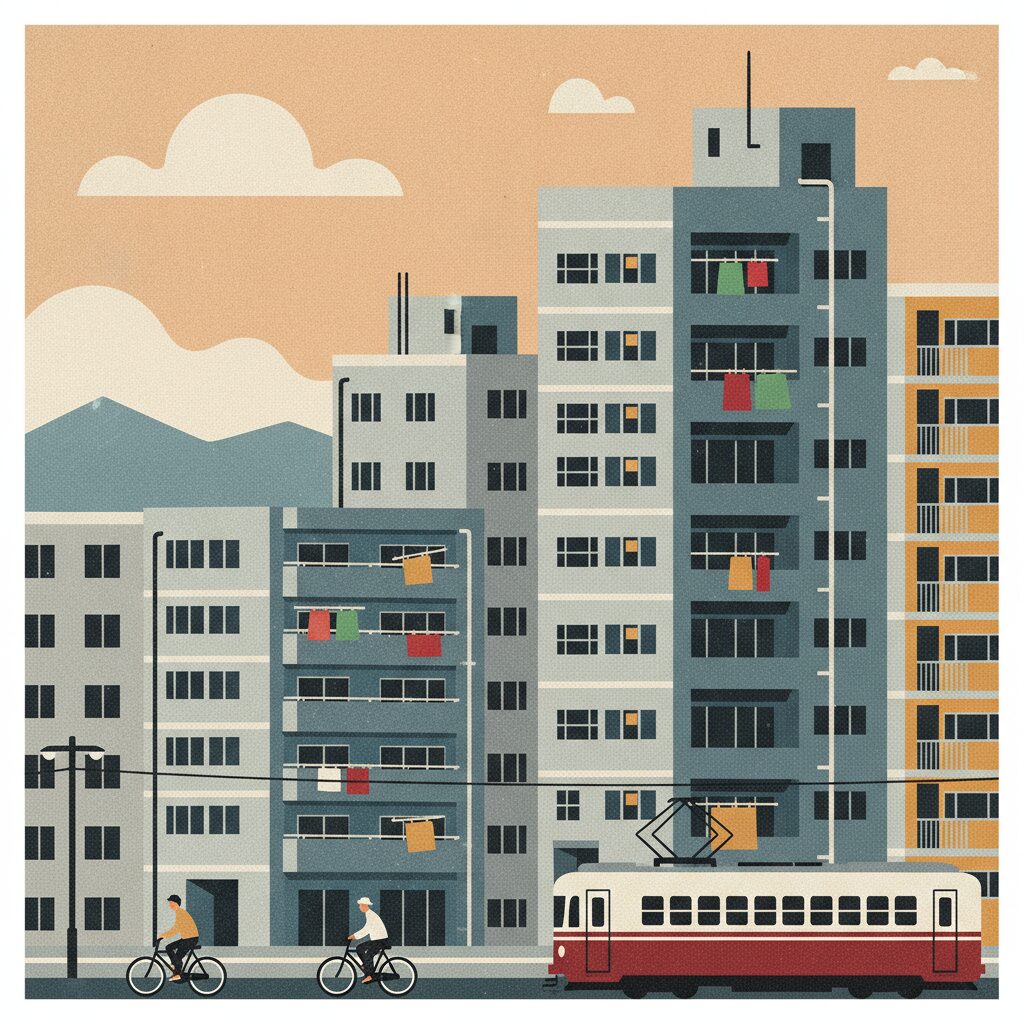
You see them everywhere once you start looking. Tucked between gleaming, tile-faced apartment blocks and modern single-family homes, they sit low and unassuming. They are the two-story wooden buildings, often clad in graying mortar, with a row of identical doors and windows marching across their facade. They look old, a little tired, and profoundly out of place in the 21st century. Your first thought might be that they’re storage units or abandoned workshops. But then you see the bicycles parked out front, the laundry hanging from second-floor balconies, the potted plants clustered around a doorway. People live here. This isn’t a relic; it’s a home. This is the Bunka Jutaku, or “Culture House,” and understanding this humble building is one of the quickest ways to get to the heart of what makes Osaka tick. It’s a journey into a world of practicality over polish, community over privacy, and a spirit forged in the city’s relentless, optimistic post-war reconstruction. These buildings are not just architecture; they’re a living archive of Osaka’s mindset.
Embodying a similar spirit of authenticity, many locals come together at lean tachinomi bars where the casual, unpretentious energy of Osaka’s post-war era is vividly on display.
What Exactly is a “Culture House”?
The name itself is a striking example of Osaka irony. “Bunka Jutaku” translates to “Culture House,” evoking images of art salons or refined living. In reality, it is much more pragmatic, born not from cultural sophistication but from urgent necessity. These homes are direct descendants of the traditional nagaya, or row houses, but simplified and standardized for an era that had no time for decorative excess.
A Quick History Lesson: Born from Ashes
To understand the Bunka Jutaku, imagine Osaka in 1945. The city lay in ruins after wartime bombings, its wooden core reduced to ashes. Millions were left homeless. As industry rapidly revived, people flocked to the city for work, urgently needing housing. The Bunka Jutaku provided the solution. They were the flat-pack furniture of their day: inexpensive to produce, quick to construct, and entirely functional. Built from wood, mortar, and tile, these two-story buildings were assembled in dense clusters, often by small, local contractors. The design was straightforward: a long structure divided into multiple narrow apartments. Each unit usually contained a small kitchen and living space on the ground floor, with a steep, ladder-like staircase leading to a tatami-mat sleeping area above. Early versions even included shared toilets, a holdover from a more communal pre-war period. These structures were a solution, not a statement—shelter created with the grit and determination that characterized Osaka’s recovery.
The “Culture” in the Name: Aspiration vs. Reality
Why then the grandiose name? It was pure marketing brilliance—a touch of aspirational gloss on a pragmatic design. In the 1950s and 60s, “bunka” was a buzzword representing all things modern and Western. A “bunka包丁” was a modern kitchen knife. A “bunka生活” signified a cultured, contemporary lifestyle. Calling these apartments “Culture Houses” was a way to suggest an upgrade from communal living of the past. They provided private entrances for each family, small but dedicated kitchens, and separation between living and sleeping areas. Compared to earlier housing, this was modern. This linguistic trick is classic Osaka: a bold, confident name applied to something very down-to-earth. It carries the same energy as a street vendor loudly claiming their takoyaki is the best in the universe. There’s optimism, a hint of bravado, and an honest representation of the product itself. It promises modern living, and on the most basic level, it delivers.
The Bunka Jutaku Lifestyle: A Study in Osaka Pragmatism
Living in a Bunka Jutaku offers an immersive lesson in the unspoken social rules of Osaka. It removes the polite distance typical of other regions in Japan and immerses you in a raw, unfiltered communal experience. While it may not suit everyone, it uncovers a fundamental truth about how people in this city connect with each other.
Forget Privacy, Embrace Proximity
The most defining characteristic of life in a Bunka Jutaku is the thinness of its walls. This cannot be emphasized enough. You won’t just hear your neighbors—you’ll experience their lives as if in surround sound. You’ll know what they’re watching on TV, when their children practice piano, the sizzle of oil as they start cooking dinner, and even the content of their arguments. This contrasts sharply with the Tokyo model, where apartment living is designed to preserve anonymity. In a typical Tokyo “mansion,” you might live for years without learning your neighbor’s name. It’s a culture that encourages managed silence and deliberate separation. In Osaka’s Bunka Jutaku, such separation is physically impossible. This enforced closeness creates a unique social dynamic, requiring greater tolerance and a more relaxed approach to noise and daily disturbances. You learn to filter out the ambient sounds of life, and in turn, become less self-conscious about your own. It’s an unspoken, collective agreement to coexist in tight quarters. Though not always peaceful, it is undeniably human.
The Economics of “Ma, Ikka” (Oh, Whatever)
Why opt for a life defined by such sonic transparency? In true Osaka style, the answer is straightforward: it’s affordable. Rent for a Bunka Jutaku can be a fraction of that for a modern apartment of similar size, appealing directly to Osaka’s famously frugal mindset, often called kechi. But this isn’t about stinginess; it’s about practicality. Why spend a large portion of your income on a cold, sterile concrete box when you can have a perfectly decent home for less, leaving more money for good food, business opportunities, or simply enjoying life? This is where the quintessential Osaka phrase “Ma, ikka” fits perfectly. It roughly means “Ah, well,” or “Oh, whatever.” The walls are thin? Ma, ikka, the rent is low. The kitchen is from the 1960s? Ma, ikka, it still works. The stairs are steep? Ma, ikka, it’s good exercise. This isn’t apathy; it’s a philosophy of prioritization—accepting imperfection in one area to gain advantages in another. This practical cost-benefit mindset is deeply ingrained in Osaka life, with Bunka Jutaku standing as its tangible symbol.
The Sounds and Smells of Daily Life
Living here keeps your senses fully engaged. The corridor outside your door is a bustling artery of neighborhood life. You smell the rich, savory aroma of your neighbor’s curry, the sharp scent of grilling fish, and the sweet fragrance of okonomiyaki. You hear the clatter of geta sandals on the pavement, the sing-song call of the tofu seller on his rounds, and the laughter of children playing in the narrow alley. It’s a multi-sensory experience that connects you directly to the neighborhood’s rhythm. It’s the opposite of the climate-controlled, soundproof existence of a high-rise. It’s messy, vibrant, and a constant reminder that you’re part of a living, breathing community.
Why Bunka Jutaku Persist in Osaka (and Less So in Tokyo)
Stroll through Tokyo and you’ll notice far fewer of these post-war survivors. The capital’s relentless “scrap and build” cycle, fueled by soaring land prices and corporate eagerness for redevelopment, has wiped out much of this architectural layer. In contrast, Osaka has quietly maintained its Bunka Jutaku with steady persistence.
Development Differences: The Reluctance to Rebuild
The reasons behind their survival are a combination of economic and cultural factors. Land prices in Osaka, while high, have historically never reached the exorbitant levels of central Tokyo, reducing the economic pressure to redevelop. Additionally, many of these properties are owned not by large developers but by individuals, families, or small local businesses. The owner might be an elderly woman who lives in the front unit and collects rent personally once a month. This ownership model naturally encourages a slower, more cautious approach to redevelopment. There’s a prevailing attitude of, “If it’s still generating rent, why endure the significant expense and hassle of tearing it down?” This is the ma, ikka pragmatism applied to real estate development. As a result, not just the buildings but entire neighborhoods have been preserved, giving parts of Osaka a nostalgic, Showa-era ambiance that is becoming increasingly rare in Japan’s major cities.
The Social Safety Net of a Neighborhood
These buildings also fulfill an essential social role. They provide crucial affordable housing in a country where rental deposits and key money can be prohibitively high. They accommodate students attending nearby universities, young artists and musicians starting their careers, single parents, and elderly residents living on modest pensions. They form the backbone of a community’s economic diversity. Demolishing a Bunka Jutaku to build a luxury condo doesn’t just alter the skyline; it displaces an entire ecosystem of people. The close-knit atmosphere of these buildings fosters an informal support network. The elderly resident who has lived there for fifty years keeps watch over the neighborhood. The young couple next door might share a portion of their dinner. It’s a system of mutual care and quiet support that arises naturally, without the need for formal committees or organizations. In a country with an aging population, this built-in sense of community is an invaluable and often overlooked social asset.
Should You Live in a Bunka Jutaku? The Unvarnished Truth
For a foreigner contemplating a genuinely immersive life in Osaka, the Bunka Jutaku offers an enticing yet demanding choice. It’s more than just an apartment—it’s an experience. Before diving in, it’s crucial to balance the authentic appeal against the significant downsides.
The Pros: Character, Cost, and Community
First, the positives. You’ll find character in abundance. No two Bunka Jutaku are identical, and many have been updated with quirky, unique touches. You’ll be living within a piece of Osaka’s history. The cost advantage is substantial—lower rent means greater freedom and less financial pressure. Lastly, the community aspect is rewarding. If you’re open to it, you’ll get to know your neighbors, practice Japanese through casual daily conversations, and glimpse a side of Japanese life hidden from the typical modern apartment complexes. It’s a fast track to feeling like a local rather than just a visitor.
The Cons: Noise, Drafts, and… Gaps
Now for a dose of reality. Noise is a constant factor. If you’re a light sleeper or need quiet to work or unwind, a Bunka Jutaku may not suit you. Poor insulation is a notable concern—winters are cold, with wind sneaking through cracks you didn’t even notice. You’ll become well acquainted with your air conditioner’s heating mode and the shocking electricity bills that come with it. Summers are hot and humid, and the upstairs sleeping area can resemble a sauna. Older buildings bring old issues: creaky floors, unreliable plumbing, and a higher chance of pests like cockroaches or centipedes. Layouts can be odd, with narrow doorways and steep, tricky stairs complicating the movement of furniture or laundry.
A Foreigner’s Experience: Navigating the Rental Process
Finding a Bunka Jutaku to rent can be an adventure on its own. These properties rarely show up on English-language housing platforms. Your best approach is to explore a neighborhood you like and visit small, local real estate agencies—the fudosan-ya with weathered posters in their windows. Expect some hesitation. Some older landlords might be cautious about renting to foreigners due to concerns about communication, cultural differences in noise habits, or waste disposal rules. Having a Japanese-speaking friend to assist can be invaluable. The process demands patience and a willingness to stray from the usual expatriate housing options, but the result is a truly distinctive living experience.
The Bunka Jutaku and the Soul of Osaka
Ultimately, the humble Bunka Jutaku represents far more than merely a type of building. It is a tangible expression of Osaka’s identity. It reflects the city’s resilience in the face of total destruction, its practical emphasis on function over form, and its deep-rooted faith in the strength of community. These buildings arise from a mindset that values human connection, even at the expense of personal space, and prioritizes practicality over aesthetic perfection. They are loud, imperfect, occasionally inconvenient, but undeniably alive.
Though they are gradually disappearing from the urban landscape, victims of earthquakes, decay, and redevelopment, the spirit they embody persists. It survives in the crowded shotengai shopping arcades, in the lively conversations you catch at a standing bar, and in the effortless interactions between strangers in this city. The Bunka Jutaku serves as a reminder that a city is more than a collection of buildings; it is a web of human connections. Living within its thin walls teaches tolerance, adaptability, and the straightforward, unvarnished reality of sharing a space and a life. They are Osaka’s living rooms, its shared history, and its slightly worn yet fiercely beating heart.