You’ve been in Osaka for a few months now. You’ve got your commute down, you know which konbini has the best egg sandwiches, and you can almost understand the station announcements at Umeda. But then Friday rolls around, and you hear your colleagues talking. They mention a name that sounds like a magic spell: “Kinosaki.” They come back on Monday, looking impossibly relaxed, carrying small boxes of snacks to share. You start to realize this isn’t just a random trip. It’s a ritual, a cultural reset button that seems hardwired into the Osaka psyche. You wonder, what’s really going on there? Is it just about hot water? Not even close. Kinosaki Onsen is where Osaka goes to be its most authentic self. It’s a small, steamy town where the city’s unwritten social rules are on full display, and understanding how Osakans do Kinosaki is a masterclass in understanding Osaka itself. Forget the glossy travel brochures showing serene couples gazing at cherry blossoms. The Osaka version is a bit louder, a lot more practical, and infinitely more fun. It’s less about silent meditation and more about a shared, communal exhale.
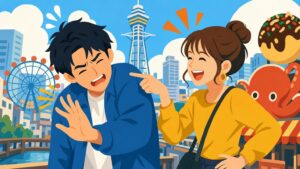
Diving deeper into Osaka’s spirited lifestyle, locals reveal their playful side through tsukkomi banter, offering a masterclass in the city’s unique humor.
The “Let’s Just Go” Mentality vs. Tokyo’s Perfect Plan
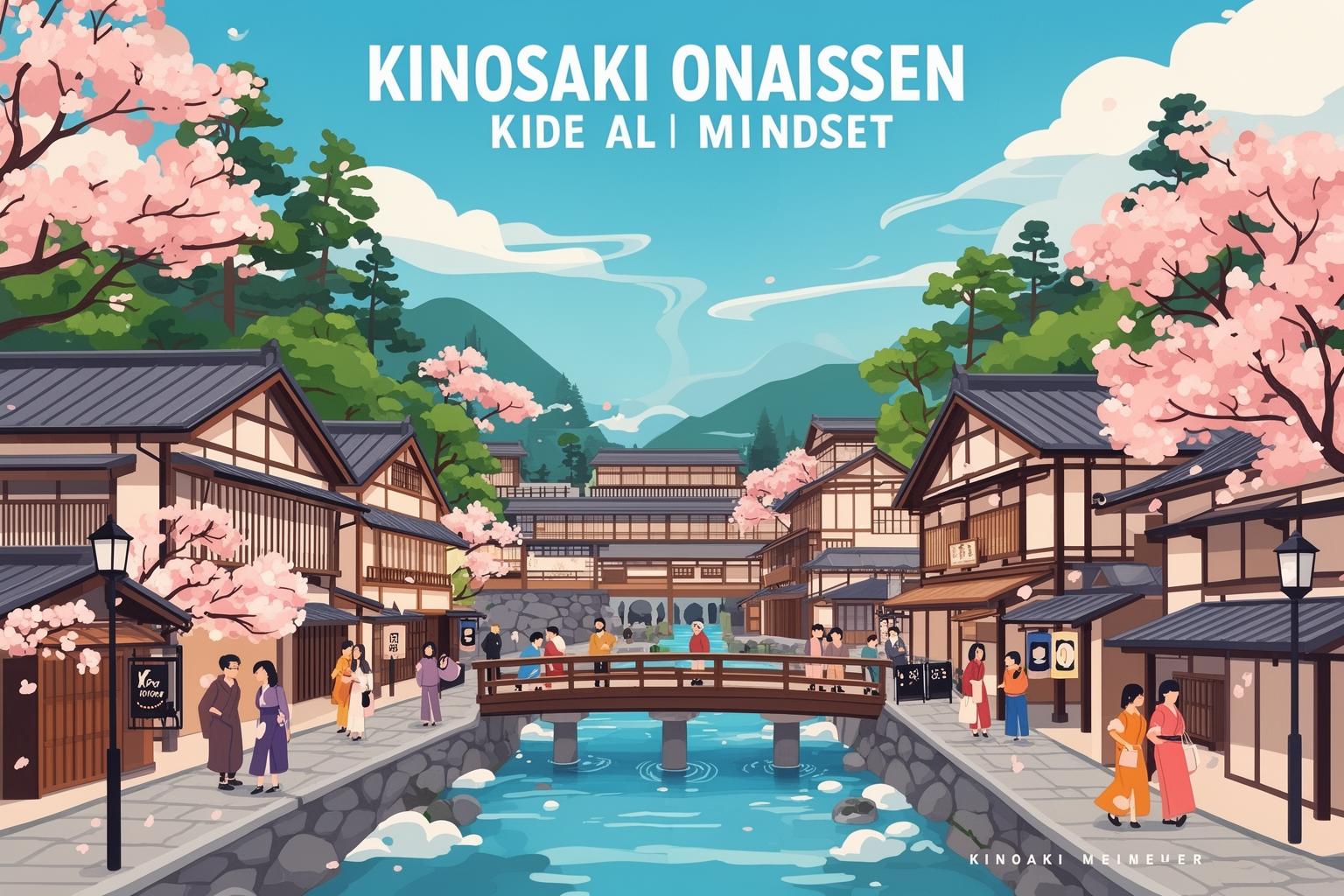
The first thing you’ll notice is how effortlessly an Osaka Kinosaki trip comes together. On a Tuesday, someone in your friend group might casually say, “The weather looks good this weekend. Kinosaki?” A rush of messages follows, a quick check on train times, and someone books a ryokan that seems decent enough. That’s it. There’s no month-long planning committee or spreadsheets comparing the thread count of the ryokan towels. The aim isn’t to engineer the perfect, Instagrammable getaway; it’s simply to go.
This reflects a core Osaka mindset: practicality and immediate gratification. Life is meant for living, not for planning how to live. Why spend weeks fine-tuning a trip when you could be there this weekend, soaking in a hot bath? This attitude permeates daily life. It’s the same reasoning behind the thriving tachinomi, or standing bar, culture. You don’t need a reservation or a three-course meal to unwind. All you need is a cold beer and a plate of fried chicken, right now, for fifteen minutes before catching your train home. Kinosaki is just the weekend-sized version of this philosophy.
In contrast, the Tokyo approach often feels like a project. A trip from Tokyo involves meticulous research, booking months ahead to secure that one specific ryokan featured in a magazine, and a detailed itinerary designed for maximum efficiency. It’s about crafting the perfect narrative. For Osakans, the narrative writes itself. The joy lies in spontaneity, unexpected conversations with shopkeepers, and discovering a tiny bar down a side street. The trip is about the feeling, not the checklist. This often confuses foreigners. Osaka’s apparent lack of planning isn’t laziness; it’s a deliberate choice to prioritize the present experience over an idealized future.
Yukata as Uniform: The Great Social Equalizer
When you arrive in Kinosaki and check into your inn, they give you a yukata, a simple cotton robe. Your first instinct might be to wear it only inside your room or on the way to the inn’s private bath. This is your first mistake. In Kinosaki, the yukata is not pajamas; it’s the town uniform. You are meant to wear it everywhere— to the seven public onsen, the souvenir shops, dinner, and the bars. The entire town becomes a giant, open-air spa, and everyone participates. The streets echo with the gentle, rhythmic clacking of hundreds of pairs of geta, the wooden sandals that complete the look.
This isn’t just a charming tradition; it’s a powerful social mechanism that deeply resonates with the Osaka spirit. In the city, your suit, brand-name bag, or company ID all signal your place in the hierarchy. In Kinosaki, all of that is stripped away. The CEO and the part-time student wear the same uniform. This profound sense of equality appeals to the Osakan aversion to stuffiness and pretense. People here value `ningenmi`, that hard-to-translate concept of being down-to-earth, relatable, and human. The yukata embodies `ningenmi` in clothing form.
A foreigner might feel self-conscious at first, as if they’re in a costume. But watch the locals. They wear the yukata with casual, comfortable confidence. It’s liberating. It’s a physical signal that you’ve left your urban armor behind—you’ve shed the stress of the city along with your jeans and T-shirt. Not participating, and instead walking around in your street clothes, marks you as an outsider who doesn’t quite grasp the collective spirit of the place. It’s an unspoken rule: to be in Kinosaki is to be in a yukata. It’s your ticket to belonging to the town, not just observing it.
The Seven Baths: A Social Pub Crawl, Not a Silent Spa
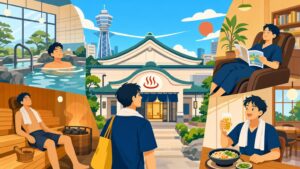
Kinosaki’s main attraction is the `sotoyu meguri`, the pilgrimage to the seven public bathhouses lined along the willow-filled river. Each offers a different style and claimed health benefit. You get a pass and try to visit as many as possible. For many tourists, this sounds like a serene, meditative spa experience. But when you’re surrounded by Osakans, it feels more like a pub crawl, just with hot water instead of beer (though the beer comes right after).
The atmosphere inside is rarely quiet. It’s filled with the buzz of conversation. Families discussing dinner plans, old friends catching up, fathers and sons talking about the Hanshin Tigers. It’s a communal space, an extension of the living room. This is a crucial insight into Osaka life. While Tokyoites might value public silence and private spaces, Osakans see public areas as chances for connection. Their default mode is social.
This can be a culture shock. You might expect a solemn, quiet soak, but what you get is a lively, steamy social club. The goal isn’t just to absorb minerals through your skin; it’s to absorb the community spirit. Osakans gamify the experience, turning it into a friendly competition. “How many have you hit? We’re on our fourth! Let’s go for one more before the beef skewers sell out.” This approach to relaxation—active, social, and slightly competitive—is quintessentially Osaka. It mirrors the energy of a `shotengai`, the covered shopping arcades where commerce is inseparable from conversation and community.
Food and Drink: The Real Main Event
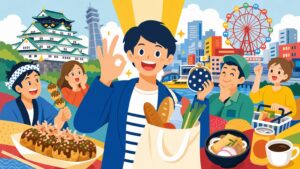
Let’s be honest. For many Osakans, the onsen is just the opening act. The real reason for coming all this way is the food and drink. The city’s `kuidaore` (`eat until you drop`) philosophy doesn’t take a vacation. A trip to Kinosaki is a culinary mission.
The ritual begins the moment you step out of your first bath. The post-onsen beer or bottle of cold milk isn’t optional; it’s a sacred rite. It’s the punctuation mark that completes the whole experience. Then, as you stroll the streets in your yukata, the town reveals itself as a gauntlet of delicious temptations. Stalls selling melt-in-your-mouth Tajima beef skewers, shops where you can boil your own onsen tamago in the steaming spring water, and vendors offering freshly steamed crab in the winter.
This is where the Osaka obsession with `kosupa`, or cost performance, shines. While the multi-course `kaiseki` dinner at the ryokan is often spectacular, the true joy lies in these simple, high-quality street foods. It’s about direct, unpretentious pleasure. You see something appealing, you buy it, you eat it right there on the street. No fuss. It’s a sensory-driven experience, not an intellectual one. This starkly contrasts the more formal dining culture you might find elsewhere. An Osakan’s measure of a good trip is often told through the stomach. “The bath was great, but you should have tried the squid… incredible.”
The Language of Relaxation: Kansai-ben and Friendly Intrusion
Listen carefully in Kinosaki. The soft murmur you hear isn’t standard Japanese. It’s the broader, more melodic, and much more direct dialect of the Kansai region. Within the relaxed, informal atmosphere of the onsen town, the local language, Kansai-ben, emerges in its purest form. It’s louder, more expressive, and filled with the quick-witted exchanges known as `tsukkomi`, the playful jabs that define Osaka humor.
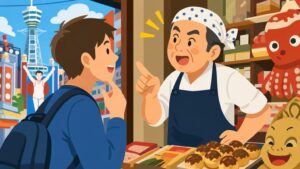
This is often what foreigners mistake for rudeness. The loudness isn’t anger; it’s passion. The direct questions aren’t an invasion of privacy; they’re an invitation to connect. In a Tokyo bath, a stranger might offer a polite nod at most. In a Kinosaki bath, an elderly man is likely to turn to you and ask, “Where you from? Ah, America! Big country. You like baseball?” before you’ve even adjusted to the water temperature. He’s not being intrusive. In true Osaka style, he’s being friendly. He’s treating you like a potential neighbor, not a stranger. He assumes you’re open to connection, which is the default social setting in this part of Japan.
This is exactly what daily life in Osaka feels like. The woman at the fruit stand will ask about your day. The local ramen shop owner will remember your favorite order. Life here is made up of small, informal interactions. Barriers between people are deliberately kept low. So when you’re in Kinosaki, don’t be surprised if strangers start talking to you. It’s a sign of acceptance. They’re simply applying the social rules of their home city to this shared vacation space.
The Return Trip: Sharing the Experience, Not Just the Souvenirs
The weekend winds down, and you see everyone at the station, clutching their `omiyage`, the boxes of souvenirs. But in Osaka culture, this is more than just a formal office ritual. The `omiyage` acts as a narrative tool. It’s a tangible piece of the story you’re about to share. When your colleague hands you a crab-flavored rice cracker on Monday morning, it’s not merely a gift. It’s an opening line: “Here, I went to Kinosaki. It was amazing. The crab was in season, and after the third onsen…”
This act of sharing strengthens the social bonds that form the foundation of the city. In a more reserved culture, vacations are private experiences. Here, they are communal, even after they have ended. The trip serves its purpose: a full mental and physical reset. It clears away the stress of the city, not through silent solitude, but through a lively, warm, and welcoming communal energy.
Returning to the neon glow of Namba or the bustle of Umeda, you feel different. You carry a bit of that onsen town calm with you. This is the rhythm of life for many in Osaka. You work hard, engage with the city’s chaotic energy, and then escape to a place like Kinosaki to recharge—not by isolating yourself, but by immersing yourself in a different kind of community. It’s a reminder of why you endure crowded trains and long work hours. It’s for these moments of simple, shared pleasure. And now, you’re in on the secret.