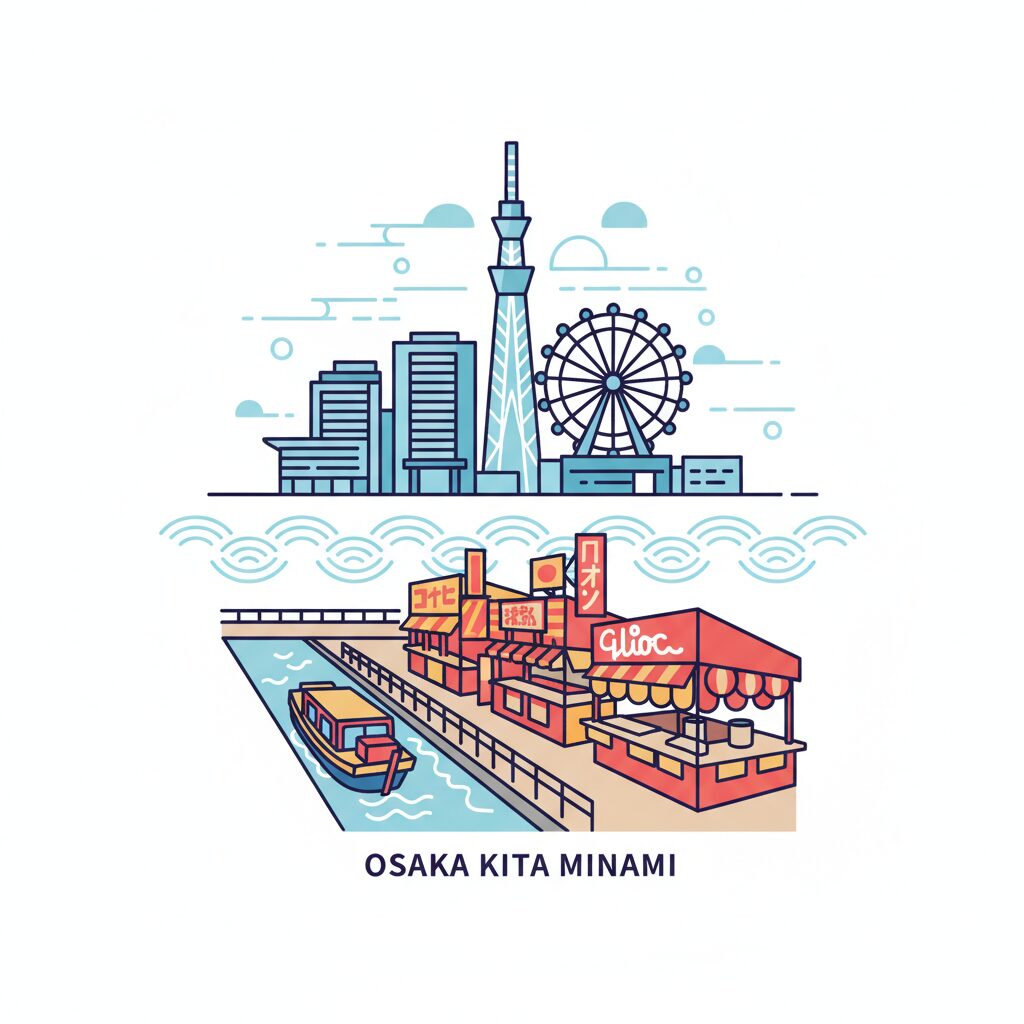
So you’ve landed in Osaka. You’ve heard the talk. It’s Japan’s wilder, funnier, more down-to-earth second city. A welcome break from the buttoned-up precision of Tokyo. People are friendly, the food is legendary, and the energy is electric. All true. But then you ask a simple question: “Where’s downtown?” And you get a confusing answer. “Well, do you mean Kita, or Minami?” You’ve just stumbled upon the fundamental social fault line of Osaka, a city with two hearts beating to entirely different rhythms. This isn’t just about geography, a simple north-south marker on a map. It’s about identity. It’s a mentality, a social code that dictates everything from where you shop for a suit to where you get roaring drunk with your best friends. One is the city’s polished, ambitious face, the one it shows to the world of business. The other is its loud, chaotic, and endlessly creative soul. Understanding the difference between Kita (Umeda) and Minami (Namba) is the first real step to understanding how Osaka truly works. It’s about decoding the city’s dual personality, a constant push and pull between aspiration and authenticity that makes this place so compelling. Forget the tourist maps for a second. We’re going deeper, into the unspoken rules that govern the flow of life in Japan’s magnificent merchant city.
Curious about how each district’s unique character influences local lifestyles, consider exploring this resident guide to Osaka’s centers for deeper insight.
The Vibe Check: First Impressions of Kita and Minami
Your first encounter with each district is a full-body sensory experience, and they couldn’t be more distinct. One feels like a deep, refreshing breath of cool air; the other is a surge of humid, neon-drenched energy.
Kita (Umeda): The Polished Professional
Step out of the sprawling, labyrinthine Umeda Station, and you immediately look up. Gleaming towers of glass and steel soar into the sky, reflecting the clouds and the orderly hustle below. This is Kita, the northern gateway. The air itself feels more structured, the sounds more subdued. You hear the rhythmic click-clack of heels on polished granite, the soft hum of escalators, and the distant whoosh of JR trains. The crowd is a sea of navy blue suits and elegant trench coats. People walk with purpose, briefcases in hand, heading to corporate headquarters, client meetings, or government offices. Kita is Osaka’s economic engine room, its face of modern commerce. It’s home to flagship luxury department stores: Hankyu, with its opulent window displays and high-end fashion, and Daimaru, a bastion of refined taste. The aesthetic reflects understated wealth and global sophistication. The streets are wider, the sidewalks cleaner. Restaurants are sleek and stylish, with minimalist decor and prix-fixe lunch menus tailored for business meetings. This is Osaka’s response to Tokyo’s Marunouchi or Shinjuku. It’s the city’s way of saying, “We can play on the world stage. We are a global business hub.” The energy is aspirational, controlled, and forward-looking. It’s impressive, but for some, it may feel a bit sterile, somewhat too close to the international standard of “downtown” and a bit distant from the Osaka they came to discover.
Minami (Namba/Shinsaibashi): The Vibrant Heartbeat
Now, take the Midosuji subway line just a few stops south to Namba. When you emerge from the station, the city hits you like a tidal wave. Welcome to Minami. The air is thick with the scent of grilled takoyaki and savory ramen broth. A chaotic symphony of sounds surrounds you: the clatter of pachinko parlors, the shouts of shopkeepers hawking their goods, the overlapping beats of J-pop blasting from a dozen different storefronts. Instead of looking up at skyscrapers, you look straight ahead, trying to absorb the visual overload. The iconic Glico Running Man sign towers over the Dotonbori canal, surrounded by a riot of gigantic, three-dimensional advertisements—a massive crab with moving claws, a fugu lantern, a dragon. The streets are narrower, packed with people who are here not to work, but to enjoy themselves. You see teenagers in flamboyant street fashion from Amerikamura, tourists with wide eyes and selfie sticks, and locals slipping into tiny, lantern-lit izakayas in the Hozenji Yokocho alleyway. Minami is a celebration of the visceral, the immediate, and the unapologetically commercial. It’s rooted in the city’s history as a center for theater, food, and entertainment. The aesthetic is “more is more.” It’s loud, gaudy, and utterly intoxicatingly alive. This is the Osaka of popular imagination, the source of stereotypes about brash, fun-loving locals. It’s where the city lets its hair down, takes off its tie, and reveals its raw, beating heart.
The North-South Mentality: How Osakans See Each Other
The physical distinctions between Kita and Minami are merely superficial. The true division lies in psychology—a set of deep-rooted attitudes and subtle remarks that influence how Osakans view their city and one another. It’s a friendly rivalry, but one that reveals an essential truth about the city’s identity.
How Minami Folks View Kita
If you’re talking to a bartender in a gritty Namba dive bar and mention you’re meeting a friend in Umeda, you might receive a playful eye-roll. To loyal Minami residents, Kita can be summed up in a single perfect Japanese word: kidorotteru. This means putting on airs, being pretentious or snobbish. They might say that people in Kita are trying too hard to imitate Tokyo, which is a cardinal sin in fiercely independent Osaka. The view is that Kita is all about appearances. It’s where you wear your most expensive clothes, sip politely on overpriced coffee, and engage in formal, stiff conversation. A Minami native might joke that Kita folks wouldn’t recognize real, delicious, affordable street food if it hit them in the face. They see Kita as a place of obligation—for work, formal events, or impressing your partner’s parents. It’s necessary but not where you can be your genuine self. The sleekness is perceived as a lack of character; the professionalism feels a bit cold. It’s a place that has lost the messy, human heart of what makes Osaka special.
How Kita Folks View Minami
Conversely, ask an office worker enjoying a quiet after-work drink in a refined Kitashinchi bar about Minami, and you’ll hear a different take. The key phrase might be gara ga warui, meaning something rough, coarse, or lacking class. Or they might call it gote-gote, a lively onomatopoeic word describing something gaudy, cluttered, and over the top. To the Kita-centric crowd, Minami is pure chaos. It’s fun, yes, but in a detached, almost anthropological way. It’s a great spot to show visiting friends the spectacle, but not for a calm, civilized evening. They view it as noisy, crowded, and a bit dirty. The fashion is too loud, the shopkeepers too aggressive, and the overall vibe is just a bit… much. It’s a playground, but not a place to be taken seriously. The underlying sentiment is that Minami is a caricature of Osaka, a performance for tourists, while the city’s real business and progress happen up north. They appreciate Minami’s energy, but from a safe, clean distance.
The Unspoken Social Code
This mindset results in a practical, unspoken social map that every Osakan instinctively understands. The choice of meeting place is a message itself. Want to impress on a first date? A classy Italian restaurant in Grand Front Osaka in Kita. A raucous reunion with old university friends? A crowded, smoky yakitori joint tucked away in Namba’s backstreets, without hesitation. A crucial business negotiation? Almost certainly in a hotel lounge or private room in Umeda. Shopping for an important gift for a superior? The beautifully wrapped offerings from Hankyu department store in Kita. Looking for a unique, vintage jacket? The only options are Amerikamura or the Shinsaibashi side streets in Minami. Osakans navigate these choices effortlessly, moving smoothly between the city’s two poles depending on social context. It’s a dance between the formal and informal, the polished and the raw, that defines the rhythm of life here.
Beyond the Stereotypes: Where the Lines Blur
Certainly, no city can be reduced to a simple binary. The charm of Osaka lies in its contradictions and its hidden corners that resist easy categorization. Both Kita and Minami feature neighborhoods that completely overturn stereotypes, demonstrating that the city is a complex mosaic rather than a divided map.
Kita’s Hidden Layers
Just a ten-minute walk east from the gleaming corporate towers of Umeda is Nakazakicho. Stepping into this neighborhood feels like stepping back in time. The broad avenues and modern architecture disappear, replaced by a maze of narrow alleyways lined with pre-war wooden Nagaya townhouses. Many of these have been lovingly transformed into quirky vintage clothing stores, independent art galleries, and bohemian cafes where time seems to slow down. The atmosphere is creative, relaxed, and distinctly anti-corporate. It carries the artistic, independent spirit one might expect from Minami, but it quietly thrives in Kita’s shadow. Then there’s Tenma, a little further northeast. By day, it’s a quiet area boasting one of Japan’s longest covered shopping arcades. By night, it bursts into one of Osaka’s most vibrant and authentic drinking districts. The area around Tenma Station is a sprawling network of affordable standing bars, smoky izakayas, and specialty eateries packed shoulder-to-shoulder with locals. The energy is pure Minami: loud, friendly, and unpretentious. These neighborhoods show that beneath Kita’s polished exterior, the city’s lively, convivial soul remains strong.
Minami’s Softer Side
Minami also has pockets of sophistication that challenge its reputation for being “gaudy and loud.” Walking west from the bustle of Shinsaibashi, you’ll find Horie. Once a furniture-making district, it has evolved into one of Osaka’s chicest neighborhoods. Here, the neon glare is replaced by the warm glow of designer lighting in minimalist boutiques, upscale interior design shops, and trendy, health-conscious cafes. The pace slows, the crowds thin, and the style becomes more curated and fashion-forward. It’s an ideal spot for a leisurely brunch or a quiet afternoon browsing independent labels, far removed from the sensory overload of Dotonbori. Even within Shinsaibashi itself, stepping off the main covered arcade reveals quieter streets lined with high-end international brands and established, elegant restaurants that have stood the test of time. Minami knows how to be refined; it simply chooses not to be most of the time.
The Language and Attitude: A Tale of Two Dialects
While nearly everyone in Osaka speaks the city’s iconic dialect, Osaka-ben, its usage and intensity can vary significantly as you move from north to south. It’s less about vocabulary and more about context and delivery.
In Kita, especially within business or upscale retail environments, you’ll find a toned-down version of the dialect. During formal meetings, many professionals switch to standard Japanese (Hyojungo) or adopt a softer, less forceful form of Osaka-ben. The service culture in Umeda’s department stores exemplifies this: it’s impeccably polite and professional, matching Tokyo’s standards, but often infused with a subtle hint of Kansai’s warmth. The emphasis is on efficiency, courtesy, and maintaining a professional tone.
In Minami, Osaka-ben is heard in its pure, enthusiastic form. This area is the heart of the akindo (merchant) culture, where conversation doubles as entertainment and relationship-building. A shopkeeper on Sennichimae Doguyasuji (kitchenware street) won’t just sell you a knife; they’ll share a story, crack a joke, and ask about your origins. The interaction is straightforward, familiar, and often quite funny. This is where the “friendly Osakan” stereotype originates. It goes beyond friendliness; it’s a communication style shaped by centuries of commerce, where quickly establishing warm rapport is part of the exchange. The playful teasing, mock outrage, and the famous nori-tsukkomi (playing along with a joke before pointing out its absurdity)—this is the linguistic currency of Minami.
Living in the North vs. the South: What it Means for Residents
For anyone thinking about making Osaka their home, understanding the Kita-Minami divide is essential, as it will fundamentally influence your daily life. Your choice of neighborhood reflects your chosen lifestyle.
Living near Kita (in areas like Fukushima, Nakatsu, or along the Hankyu lines toward Kobe and Kyoto) means embracing a life of refined convenience. Your commute will likely be smooth, with major train lines converging at Umeda Station. Local supermarkets will be well-stocked, streets clean and relatively quiet, and you’ll have easy access to upscale shopping and dining. It’s an adult version of Osaka—organized, efficient, and comfortable. The trade-off is that it might feel more anonymous and less connected to the city’s lively cultural core. You may need to actively seek out the “Osaka” energy instead of having it right at your doorstep.
Living near Minami (in neighborhoods such as Daikokucho, Shimanouchi, or along the Nankai and Kintetsu lines) means immersing yourself in the city’s vibrant, chaotic pulse. Your daily life will be rich with character. You’ll enjoy a remarkable variety of affordable, delicious food available 24/7. Your neighbors are more likely to be small business owners, artists, and students. There’s a stronger sense of community and the feeling that you’re in the heart of it all. The downside can be noise, crowds, and a general rawness that might be draining for some. It’s a life directly connected to the city’s main artery, for better or worse.
Why This Divide Matters to You
So, why should this story of two city centers matter to you, a foreign resident trying to build a life here? Because this isn’t just trivia for a city guide—it’s the crucial framework for understanding Osaka’s character. The city isn’t a single entity; it’s a dynamic balance between its two halves. It’s a place that is simultaneously a polished, global business hub seeking international recognition (Kita) and a fiercely local, counter-cultural playground that defines itself in opposition to the rest of Japan (Minami).
Grasping this duality helps you interpret social cues. It helps explain why your work colleagues might be reserved and professional at the office in Umeda, but transform completely after a few drinks in Namba. It clarifies why the city can feel both incredibly modern and charmingly old-fashioned simultaneously. Osaka needs both its brain and its heart, its ambition and its humor. It requires the sleek towers of Kita to drive its economy, and it needs the neon-lit streets of Minami to nourish its soul. Learning to navigate this social geography, appreciating both the suit and the leopard print shirt, is key to truly feeling at home in this wonderfully complex and contradictory city. It’s a city that works hard so it can play harder, and that boundary is drawn straight down the middle, from Kita to Minami.