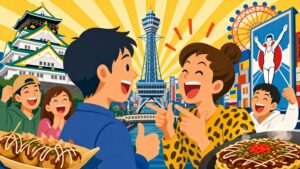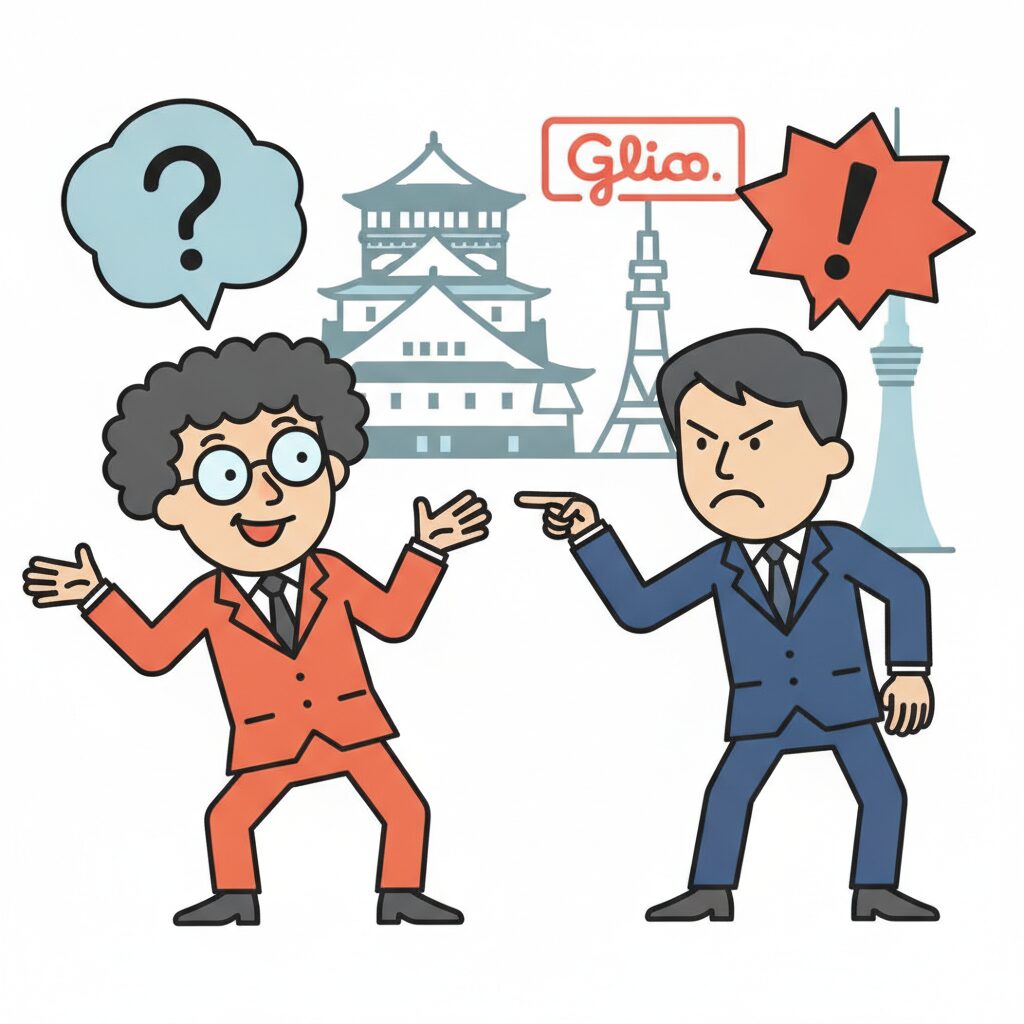
You’re standing in a shotengai, a covered shopping arcade, somewhere deep in the heart of Osaka. The air hums with the calls of vendors and the shuffle of feet. Suddenly, you hear what sounds like an argument. A middle-aged woman is talking to a shopkeeper. Her voice rises, his voice cuts back, sharp and fast. You brace for a conflict, but then… laughter. Bright, rolling laughter from both of them. The woman playfully swats the shopkeeper’s arm, grabs her bag of vegetables, and walks away smiling. What just happened? You’ve just witnessed a live performance, an everyday ballet of words fundamental to this city’s soul: the art of boke and tsukkomi. This isn’t just stage comedy for weekend TV shows; it’s the conversational currency of Osaka, the rhythm that powers interactions from the boardroom to the bus stop. It’s a system of playful idiocy and sharp-witted retorts that can feel utterly baffling to outsiders, but once you understand it, you unlock the very essence of what makes this city tick, what makes its people connect, and why living here feels so different from anywhere else in Japan. This is your guide to decoding that rhythm, a map to navigating the verbal dance of Osaka.
The lively banter you’ve witnessed is just one layer of a city where even everyday logistics, like Osaka shotengai renting, reflect a unique blend of humor and practicality.
The DNA of Osaka Banter: More Than Just Jokes
This isn’t your typical setup-punchline comedy. It’s a collaborative, conversational tennis match where the aim is to keep the volley going for as long as possible. One person serves up an absurd statement, the other slams it back with reality, and points are scored through mutual laughter. Forget formal greetings and stiff politeness; in Osaka, the quickest way to build a connection is to find a crack in logic and drive a joke straight through it.
What are Boke and Tsukkomi, Really?
Let’s break down the two central roles in this ongoing comedic exchange. At its heart, the whole system depends on a duo, whether it’s two friends, a customer and a cashier, or a grandmother and a complete stranger. First, there’s the boke (ボケ). The word derives from the verb bokeru, meaning to be senile, dazed, or to play the fool. The boke is the one who says something utterly ridiculous, factually wrong, or contextually odd. They might see a pigeon and ask if it needs a train ticket, or point at a clear blue sky and say, “Looks like heavy rain today.” The boke isn’t truly stupid—they intentionally derail the conversation from logical tracks, sending it careening into absurdity. It’s a deliberate, playful act of silliness, a creative contribution. Then comes the tsukkomi (ツッコミ). This role is the straight man, the anchor to reality. The term comes from the verb tsukkomu, which means to thrust or poke into something. The tsukkomi’s job is to immediately, often loudly, “poke” a hole in the boke’s statement. They’re the ones who hear the pigeon comment and snap back, “Nande ya nen!” (What the heck are you talking about!), or see the blue sky and say, “Are your eyes turned the wrong way today?” The tsukkomi isn’t being mean or aggressive; their retort is the essential second half of the joke. Without the tsukkomi, the boke is just someone saying something strange. With the tsukkomi, it becomes a complete, satisfying comedic moment. It’s a performance of correction, a sharp slap of sense that transforms nonsense into humor.
The Daily Stage: Where You’ll See It
This dynamic isn’t limited to comedy clubs. It happens everywhere. Step into a Tamade supermarket, known for its chaotic vibe and rock-bottom prices. You might see a friend hold up a giant daikon radish and declare, “I’ve finally found a weapon to defeat my enemies.” Without missing a beat, their friend grabs it back and says, “Put that down, you idiot, we’re making oden, not starting a war.” No one blinks. This is normal. Or picture yourself at a takoyaki stand. The vendor hands you your steaming octopus balls. You nearly drop them, and he deadpans, “Careful, those takoyaki just graduated from a top university. They’re very valuable.” The natural response isn’t a confused “thank you.” It’s a quick tsukkomi, such as, “If they’re so smart, they should know not to jump out of the container!” The vendor will bark out a laugh, and you’ve just joined in a classic Osaka exchange. Even exchanges with the elderly can be fair game. An obaachan, a grandmotherly figure, might say, “My, you’re a handsome young man.” If you just say thanks, the conversation stalls. But if you take on the boke role and reply, “I know, it’s a terrible burden to be this good-looking,” you’ve handed her a golden opportunity. She can then deliver the tsukkomi: “Don’t get ahead of yourself, sonny. I’ve seen better faces on a potato.” And just like that, you’re no longer strangers—you’re co-conspirators in a shared moment of joy.
The Great Divide: How the Rest of Japan Sees Osaka’s Humor
To truly understand the uniqueness of Osaka’s conversational style, you need to recognize how it is received—or misunderstood—in other parts of Japan. What counts as friendly banter in Osaka may come across as aggressive, confusing, or downright rude elsewhere. This contrast represents one of the most pronounced cultural divides within the country.
Tokyo’s Perspective: The Polite Silence
Head east to Tokyo, and you enter a very different realm of social interaction. In Tokyo, the overriding principle is to preserve wa (和), or group harmony. Conversations tend to be more reserved, indirect, and focused on avoiding conflict. If someone from Osaka were to drop a typical boke joke in a Tokyo setting—like loudly claiming the office coffee machine is planning a robot uprising—the response would probably be an awkward pause. People might offer a tight, polite smile, unsure whether it’s a joke or a sign of instability. There would be no sharp, corrective tsukkomi. A direct remark such as “Stop talking nonsense and get back to work!” would be seen as shockingly rude and disruptive. It breaks the unspoken rule of kuuki wo yomu, or “reading the air.” In Tokyo, reading the air means gauging the group’s mood and aligning with it; in Osaka, it means detecting just the right moment to drop a comedic bombshell. A Tokyo local witnessing an Osaka-style exchange might mistake it for a heated argument and completely miss the affectionate and playful undertones. They catch the volume and bluntness but miss the laughter beneath it all.
Kyoto’s Reaction: The Subtle Shade
Just a short train ride away, Kyoto offers yet another fascinating contrast. As the former imperial capital, Kyoto values elegance, subtlety, and refinement, traits that extend to their sense of humor. Their wit is dry, clever, and often delivered with a polite smile that hides a sharp barb. An Osakan’s loud, physical, and obvious boke-tsukkomi style often strikes Kyotoites as somewhat crude. If an Osakan says something outrageous, a Kyoto native wouldn’t respond with a blunt tsukkomi. Instead, they might reply with something layered and passive-aggressive. For example, in response to someone claiming takoyaki went to university, a Kyotoite might say, “Oh, that’s very Osaka of you,” accompanied by a gentle smile. The implied meaning is, “How simple and unrefined.” It’s a form of verbal judo, using the other person’s energy against them effortlessly. They regard the Osaka style as lacking a certain finesse. For Kyoto, the best jokes are subtle enough that half the audience only realizes the humor after they’ve left. Osaka’s direct, slapstick humor stands in stark contrast to Kyoto’s understated wit.
Nationwide Stereotypes: The “Loud Comedian” Label
Thanks largely to the influence of Yoshimoto Kogyo, the Osaka-based entertainment giant responsible for almost all of Japan’s most famous comedians over the past century, Osakans have developed a clear, if somewhat simplistic, national image. They are seen as born entertainers, always ready with a microphone in one hand and a paper fan for playful smacking in the other. While there’s some truth to this—humor is undeniably central here—the stereotype misses the essence. People in other prefectures often view the boke-tsukkomi exchange as a performance, something Osakans “put on” for an audience. They may admire the quick wit but feel uneasy trying to join in. It’s treated as a spectacle to watch, not a style of conversation to engage in. The key misunderstanding is seeing it as a deliberate act of “being funny,” rather than what it truly is: a natural, ingrained way of communicating that builds rapport and expresses affection. It’s not a show; it’s simply how you talk to friends, family, and the fishmonger alike.
Surviving and Thriving: Your Role in the Comedy Duo
So, you’re living in Osaka, surrounded by a steady stream of comedic banter. Naturally, you might wonder: what role do I play in all this? Do I need to buy a joke book? Must I become a stand-up comedian just to order a coffee? The good news is that the entry barrier is much lower than you think.
The Foreigner’s Dilemma: To Boke or To Tsukkomi?
The biggest concern is the pressure to be funny on demand. Relax. No one expects you to suddenly become a seasoned Manzai comedian. In fact, trying too hard can seem forced. The key is not to join in actively but to understand. Feel the rhythm. When your coworker says something silly, recognize it as a boke. When the shopkeeper shoots back with a sharp reply, see it as the friendly tsukkomi it is—not rude customer service. Your reaction is part of the exchange, even if your response isn’t a perfectly scripted comeback. A simple, genuine laugh works wonders. It shows you caught the joke, appreciated the effort, and you’re part of the moment. Even a look of utter confusion can serve as a form of tsukkomi. Your puzzled expression becomes the punchline, the reality check to their absurdity. The only real misstep is a flat, emotionless reaction. The boke is a conversational ball tossed your way; all you need to do is catch it. Don’t let it drop in silence.
A Beginner’s Guide to Tsukkomi
If you’re feeling adventurous and want to try jumping into the verbal exchange, there are a few simple, go-to tsukkomi phrases to learn. Mastering these will earn you instant respect with locals. The undisputed favorite is “Nande ya nen!” (なんでやねん!). It’s the Swiss Army knife of retorts. It can mean “Why?!”, “What the heck?”, “You’ve got to be kidding me!”, or “That makes no sense!” The key is in the delivery—quick, a bit loud, and incredulous, never angry. Another great one is “Akan ya n!” (あかんやん!) meaning “That’s no good!” or “You can’t do that!” Perfect for when someone suggests something clearly ridiculous, like trying to pay for a train ticket with a banana. For a subtler option, there’s “Honma ka?” (ほんまか?), meaning “Really?” or “Are you serious?” When said with a skeptical, drawn-out tone, it nicely punctures a weak boke. Sometimes, tsukkomi can be physical—a light, playful tap on the upper arm. It’s a classic move, but best reserved for people you know well. Start with the phrases, nail the tone, and watch faces light up. You’ll be speaking their language.
The Ultimate Compliment: When You Get a Tsukkomi
Here’s the most important lesson for any foreigner navigating social life in Osaka: if someone directs a tsukkomi at you, it’s not an insult. It’s not criticism. It’s a warm, welcoming gesture. It’s the ultimate sign of acceptance. When someone feels comfortable enough to tease you, calling out a minor mistake with a sharp but smiling retort, it means they’ve dropped the formal barrier between “local” and “outsider.” They see you as one of them, someone who’s in on the joke, someone who can handle the banter. If your Osaka friend messes up and you respond with a perfect “Nande ya nen!“, and they laugh and hit you back, you’ve just leveled up. You’re no longer just observing the culture; you’re an active participant. Being on the receiving end of a tsukkomi is your unofficial initiation into Osaka life.
Beyond the Laughs: What This Humor Says About Osaka
This deeply rooted comedic instinct is more than just an eccentric habit. It offers insight into the history, economy, and collective spirit of Osaka. The ongoing interplay of boke and tsukkomi reflects the city’s fundamental values: connection, pragmatism, and a resilient spirit that draws strength from shared laughter.
A Culture of Connection
Osaka rose to prominence as Japan’s kitchen, a lively center of merchants and traders. In a world where business was conducted face-to-face, quickly building rapport was not only a social skill but a necessity for survival. Commerce depended on trust, and humor was the quickest path to creating it. A well-placed joke could break the ice, ease tense negotiations, and turn a transactional relationship into a personal one. This tradition continues today. The boke-tsukkomi dynamic acts as social glue, a means to instantly bridge gaps between people. It cuts through formal, hierarchical barriers and fosters an immediate, equalizing sense of camaraderie. Through this playful exchange of wit, people are implicitly expressing, “I see you. I’m paying attention. Let’s not take things too seriously.” It’s a shortcut to intimacy, building bonds through shared moments of absurdity.
Valuing Honesty (and a Good Deal)
The merchant mentality also nurtured a culture of pragmatism and straightforwardness. In the marketplace, there was no room for vague niceties or beating around the bush—you had to get straight to the point. The tsukkomi embodies this ideal in conversation. It cuts through the nonsense—the boke—and goes directly to the core of the matter, even if it’s just a silly joke. This reflects a wider cultural preference for directness. Osakans are often viewed by other Japanese as very forthright, stemming from the same spirit as the tsukkomi. It’s a form of honesty: “I’m not letting you get away with nonsense; I’m calling it out.” But because it is framed comedically, it becomes a form of affectionate honesty. It builds trust by showing active engagement and correction, yet does so playfully enough to avoid offense. This delicate balance is central to the city’s character.
Resilience Through Laughter
Like any major city, Osaka has faced its share of fires, earthquakes, and economic hardships. Across its history, its people have developed a vital survival tool: the ability to laugh in adversity’s face. Humor serves as a profound coping mechanism, offering light in dark moments and helping maintain perspective during tough times. When you can frame a problem—no matter how serious—with a touch of boke, you diminish its power. When friends and neighbors respond with a supportive tsukkomi, a communal solidarity is created. It conveys the message, “This is absurd, this is tough, but we’re all in it together, and we can still find reasons to smile.” This shared laughter offers immense psychological strength, uniting the community and fostering an indomitable spirit of optimism. It’s the soundtrack of Osaka’s resilience, a constant reminder that no matter what happens, there’s always room for a joke.