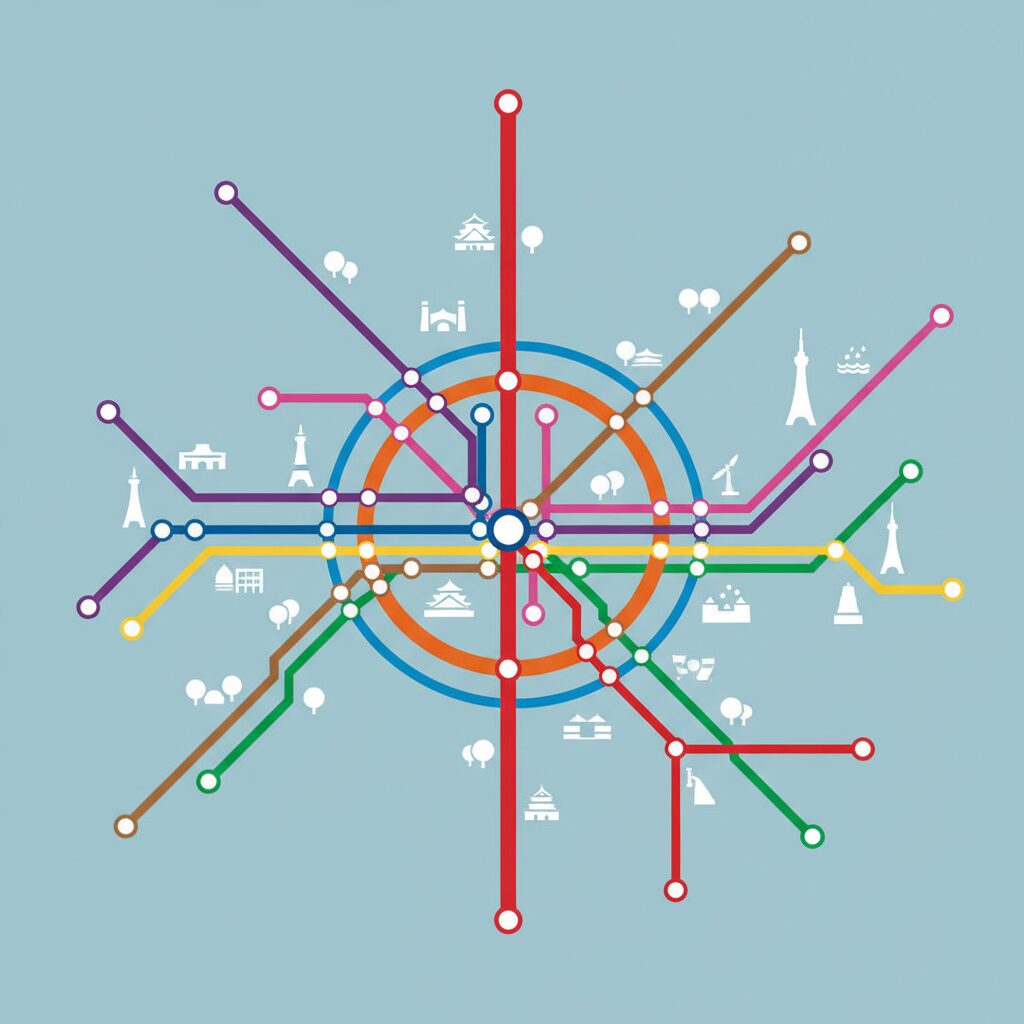
Walk through Tokyo, and the city’s pulse seems to beat along a single, perfect circle: the Yamanote Line. It’s the unifying artery, the green thread stitching together the urban giants of Shinjuku, Shibuya, and Tokyo Station. It defines the center, and everything else radiates from it. Newcomers learn its map like a catechism. Come to Osaka, and you’ll find no such simple geometry. The city’s heart doesn’t beat in a loop; it pulses outwards from two distinct centers, Umeda in the north and Namba in the south. And from these hubs, a web of private railway lines fans out, each carving its own territory, each nurturing its own distinct culture. This isn’t just about getting from A to B. In Osaka, the train line you live on is a statement of identity. It’s a tribe. It’s the invisible ink that writes the social contract of your neighborhood.
For a foreigner trying to understand the city’s complex personality, looking at a transit map is like staring at a plate of spaghetti. The bold, simple lines of the municipal subway are easy enough to grasp, but they only tell part of the story. The real narrative of Osaka life is written by the three private railway titans: Hankyu, Kintetsu, and Nankai. These aren’t merely transport companies; they are feudal lords, each with its own kingdom, its own customs, and its own loyal subjects. Choosing to live along a Hankyu line isn’t the same as choosing Kintetsu, any more than choosing to live in Florence is the same as choosing Naples. You’re opting into a specific version of Osaka. You’re choosing the texture of your daily life, the unspoken attitudes of your neighbors, and the aspirations you’re expected to hold. This is the social geography of Osaka, a city defined not by a central loop, but by the straight, powerful lines of commerce and culture that shoot out into the Kansai plain. This is the key to understanding why Osaka feels so different, not just from Tokyo, but from itself, block by block, station by station.
To embrace Osaka’s multifaceted lifestyle, consider exploring the city’s vibrant Kyobashi bar hopping scene to discover yet another layer of its unique social fabric.
The Hankyu Kingdom: Sophistication in the Northern Hills
There is no better introduction to the Hankyu identity than its terminal in Umeda. It’s less a station and more a cathedral of commerce and transit. While other stations are a chaotic jumble of signs and hurried commuters, Hankyu Umeda represents an exercise in curated calm. The platforms are vast, spacious, and impeccably clean. The iconic trains, coated in a deep, glossy maroon known as “Hankyu marron,” glide into their berths with a quiet hum. There’s a sense of order and prestige. This isn’t simply a place to catch a train; it’s the grand entrance to a carefully crafted world. Everything, from the polished brass railings to the uniformed attendants who bow with synchronized precision, hints at a higher standard.
The Umeda Hub and the Hankyu Image
The Hankyu brand was meticulously shaped by its founder, Ichizo Kobayashi, a visionary who didn’t just build a railway; he created a lifestyle. He understood that to encourage people to move out of the city center, he had to sell them a dream. That dream was one of clean air, spacious homes, and a cultured, modern way of life. He established the Takarazuka Revue, an all-female theater troupe that still exudes a certain high-society glamour. He opened the Hankyu Department Store right at the terminal, ensuring that his customers never had to mingle in the rough-and-tumble markets of the city. He pioneered the concept of the railway company as a cradle-to-grave lifestyle provider.
This legacy continues to permeate the atmosphere today. The Hankyu brand is synonymous with class, aspiration, and a refined form of Kansai living. It’s the railway of choice for old money, professionals, and families who prioritize education above all else. To live along the Hankyu line is to signal that you value quality, order, and a life that’s a bit more polished, a bit less… stereotypically Osaka. It’s the city’s response to Tokyo’s affluent western suburbs—a bubble of civility that keeps the city’s boisterous energy at a polite distance.
Life Along the Kobe and Takarazuka Lines
Travel west from Umeda on the Hankyu Kobe Line, and you enter the heart of this domain. The train passes through stations like Shukugawa and Ashiyagawa, names synonymous with wealth and exclusivity in the Kansai region. This is the Hanshin-kan Modernism belt, an area developed in the early 20th century featuring a distinctively cosmopolitan, Western-influenced style. The neighborhoods are leafy and tranquil, filled with handsome houses, exclusive private schools, and boutique bakeries. This isn’t the Osaka of neon and takoyaki stands; it’s a world of afternoon tea, piano lessons, and weekend drives to the Rokko mountains.
The stereotype of the “Hankyu Mom” exists for good reason. You’ll see her at stations like Nishinomiya-kitaguchi, home to one of the largest Hankyu department stores. She’s impeccably dressed, often in understated, expensive brands, ferrying her children between cram schools and extracurricular activities. Conversations revolve around exam scores and school admissions. It’s a life founded on educational ambition and social propriety. For these residents, the very idea of living along another railway line is often unthinkable. It’s not just about convenience; it’s about cultural alignment. Their social lives, shopping habits, and entire worldview are contained within the Hankyu ecosystem, from the Hankyu Oasis supermarket to the Hankyu-owned Toho Cinemas.
The Kyoto Line: A Corridor of Culture and Academia
The Hankyu Kyoto Line offers a slightly different flavor, but the core elements remain the same. It connects Umeda to the cultural capital of Kyoto, forming a corridor that’s less about old money and more about academic and professional life. The line serves cities like Ibaraki and Takatsuki, home to major university campuses and corporate research centers. The vibe is somewhat more middle-class, but the focus on education and a well-ordered life endures.
The unspoken rule on any Hankyu train is one of quiet decorum. People read books or browse their phones in silence. Loud conversations are rare. There’s a tangible sense of shared understanding that this is a space for calm transit, not boisterous socializing. It is, in essence, a rolling extension of the quiet, orderly neighborhoods it serves. To choose Hankyu is to choose a life shielded from chaos, a daily commute that reinforces belonging to a more refined slice of Osaka.
The Kintetsu Empire: The Expansive Heart of the Kansai Plain
If Hankyu built a carefully curated kingdom in the north, Kintetsu established a sprawling, pragmatic empire stretching to the east and south. Kintetsu is a different kind of beast. It boasts Japan’s largest private railway network, an extensive web of lines connecting not only Osaka but also Nara, Kyoto, Mie, and Nagoya. Its scale is vast, and its identity much more diffuse and diverse compared to Hankyu’s sharply focused brand of sophistication. Kintetsu serves the everyday person. It’s the workhorse, the vital artery that brings life to the broad, flat plains of eastern Osaka and beyond.
The Namba-Tennoji Axis and the Kintetsu Vibe
Unlike Hankyu, which centers around a single grand terminal, Kintetsu operates several major hubs, reflecting its expansive nature. There’s Osaka-Namba, immersed in the lively chaos of Minami; the quieter, more business-like Osaka-Uehommachi; and Osaka-Abenobashi in Tennoji, crowned by the towering Abeno Harukas, Japan’s tallest skyscraper. This multi-polar setup is crucial for understanding Kintetsu. It doesn’t project one unified image but rather adapts to the character of the neighborhoods it serves.
The atmosphere is immediately different. The trains are functional rather than luxurious. The passengers represent a true cross-section of society: factory workers from Higashiosaka, students traveling to Nara, families on pilgrimages to Ise Shrine, and office workers commuting downtown. The Kintetsu experience centers less on aspiring to a specific lifestyle and more on the practicalities of living it. It’s grounded, unpretentious, and deeply woven into the diverse fabric of the Kansai region. It’s the railway for small business owners, for multi-generational families living in the same neighborhood for decades, and for a life lived close to the ground.
From Urban Grit to Suburban Sprawl: The Nara and Osaka Lines
Travel the Kintetsu Nara Line from Namba, and this diversity unfolds. The first stop, Tsuruhashi, is the vibrant, smoky heart of Osaka’s Koreatown. The air is dense with the scent of yakiniku, and the covered shopping arcades overwhelm the senses. This is raw, energetic Osaka—far from the manicured lawns found in Hankyu suburbs. Moving east, the train passes through Higashiosaka, a city known for rugby and countless small-to-medium factories. This is Osaka’s industrial engine room, a place defined by hard work, craftsmanship, and a straightforward attitude. The community here is proud and pragmatic, their identity linked to their labor and local ties rather than a polished corporate image.
Further out, the view opens to vast suburban housing developments. This is Kintetsu’s heartland: sprawling residential areas home to much of Osaka’s working and middle-class population. Life revolves around the local train station, nearby shotengai (shopping streets), and large AEON malls scattered throughout. It’s a world that feels more familiar and universally Japanese than the unique enclave of the Hankyu line. Here, social currency isn’t about prestige but reliability, community engagement, and neighborly goodwill. This is where you find the quintessential Osakan, often stereotyped as loud, direct, and thrifty—traits born of a life shaped by practical commerce and close-knit community living.
The Southern Reach: A Different Kind of Kintetsu
The Kintetsu Minami Osaka Line, extending south from Abenobashi, offers yet another variation. It serves the southern Osaka plain, an area with its own distinct history and character, overlapping and competing with Nankai territory. The identity here leans less on industry and more on a long historical settlement. It’s a quieter, older-feeling part of Kintetsu’s realm, a reminder that this railway is not a monolith but a federation of diverse regions, each bearing its own story. Riding Kintetsu reveals the sheer breadth and depth of life in Kansai, far removed from the curated perfection of the north.
The Nankai Republic: The Gateway to the South
Head to Namba, but continue walking past the subway and Kintetsu entrances. Push through the crowds toward the grand, neoclassical facade of Nankai Namba Station. Here, you enter the third of Osaka’s great railway realms: the domain of Nankai. If Hankyu represents the sophisticated head and Kintetsu the sprawling body, Nankai embodies the city’s tough, spirited, and deeply traditional soul. It links Osaka to the south, to Kansai International Airport, the industrial coast of Wakayama, and the sacred heights of Mount Koya. Nankai’s identity is shaped by industry, maritime trade, and a fierce, unyielding local pride.
The Namba Terminus: Raw Energy and Unfiltered Osaka
Nankai’s hub is pure, unrefined Minami. It lacks the palatial grandeur of Hankyu Umeda. Its energy is raw, chaotic, and immediate. The station itself feels like a grand old dame, a little worn around the edges but full of character. It spills out into a landscape of vibrant entertainment: the Namba Parks shopping complex built on the site of an old baseball stadium, the kitchenware haven of Doguyasuji Shotengai, and the raucous, food-filled alleys surrounding the Namba Grand Kagetsu theater, home to Yoshimoto comedy. This is Osaka at its most performative and uninhibited. The Nankai terminus doesn’t try to shield you from the city; it throws you right into its roaring, laughing heart.
The atmosphere here is distinctly different from the corporate polish of Kita. It’s older, grittier, and more deeply connected to Osaka’s roots as a merchant city. People move with a different kind of purpose—less of a rushed commute, more of a deliberate swagger. This is the Osaka that doesn’t care what Tokyo thinks. It’s self-reliant, a bit rough around the edges, and fiercely proud of it.
The Main Line: Industry, Community, and the Coast
Take the Nankai Main Line south, and you travel through the industrial backbone of the region. The train rattles through Sakai, a city with a history of craftsmanship—renowned for its samurai swords and knives—that predates Osaka itself. Further along, you reach the coastal cities of Kishiwada and Izumisano. This is working-class territory, home to fishermen, factory workers, and families who have sustained the region’s industry for generations. The air carries the scent of the sea. The sense of community is strong and tangible.
Nowhere is this spirit more evident than in the Kishiwada Danjiri Matsuri. This is no polite, orderly festival. It’s a raw, thrilling, and genuinely dangerous spectacle where teams of men haul massive, intricately carved wooden floats (danjiri) through narrow streets at breakneck speed. It’s an explosion of communal passion, a testament to a collective identity built on strength, tradition, and a healthy dose of recklessness. To be from Kishiwada is to be part of the Danjiri. This is the cultural DNA of the Nankai line—a pride that is visceral, loud, and utterly unapologetic. It’s an identity you can’t simply adopt; you have to be born into it.
The Koya Line: From Urban Mix to Mountain Retreat
Like the other railways, Nankai has its own internal contrasts. The Koya Line branches off and heads inland, climbing from dense suburbs toward the sacred Buddhist sanctuary of Mount Koya. This line offers a different story. It’s a path of pilgrimage and escape. It serves sprawling residential areas in northern Sakai and Kawachinagano before ascending into deep, forested mountains. This line represents another side of the southern identity—one connected not to the sea and industry, but to spirituality, nature, and a retreat from the urban hustle. It’s the line that takes you away from the raw energy of Namba and toward a place of quiet contemplation. The Nankai Republic, then, is a land of powerful contrasts: the roar of the festival and the silence of the monastery, the grit of the factory and the serenity of the ancient forest.
The Invisible Borders: How the Lines Define Your Osaka Life
Grasping these three railway republics is the final key to unlocking Osaka’s social code. The city is far from a homogeneous entity; it’s a mosaic of identities with the railway lines acting as the seams. These lines form invisible boundaries that influence everything from property values to dating habits. When an Osakan answers the question “Where do you live?” it’s rarely just with the neighborhood name; more often it’s prefaced by the railway line, as that single detail conveys a wealth of social context.
The North-South Divide: Umeda vs. Namba
The entire framework hinges on the essential polarity between Kita (North/Umeda) and Minami (South/Namba). Kita, home to Hankyu, is viewed as sophisticated, stylish, and business-centric. It’s the go-to area for upscale shopping and corporate gatherings. Minami, dominated by Nankai and Kintetsu, is the hub of entertainment, dining, and traditional Osaka culture. It carries a vibe that’s more casual, chaotic, and lively.
This divide is deeply ingrained in Osaka’s residents. Asking someone if they’re a “Kita person” or a “Minami person” truly probes their personality. A Kita person is expected to be reserved and refined, while a Minami person tends to be outgoing, approachable, and perhaps a bit louder. Your preferred hangout reveals something essential about you. Although people move across the city, they generally have a gravitational center defined by their main railway hub.
Social Mobility and Railway Choice
These railway identities aren’t a strict caste system, but they mirror and reinforce social and economic realities. The Hankyu line, notably the Kobe and Takarazuka branches, boasts the highest property values and the most esteemed reputation. It represents an aspirational address. It’s common for families, after reaching a certain financial milestone, to relocate from Kintetsu or Nankai suburbs to Hankyu areas, largely for reputedly better schools and a “nicer” environment for their children. The railway line becomes a symbol of upward mobility.
On the other hand, a kind of reverse snobbery exists. Residents along the Nankai or Kintetsu lines often express strong pride in the authenticity of their neighborhoods. They may regard Hankyu areas as sterile, dull, or pretentious. They cherish their tight-knit communities and the unpolished, “real” Osaka culture. This friendly rivalry and ongoing identity negotiation infuse Osaka with its vibrant, multifaceted character.
What Foreigners Often Miss
Newcomers from abroad often gravitate toward the JR Osaka Loop Line or the Midosuji subway line. These lines feature prominently on tourist maps and provide the easiest access to the city’s major attractions. There’s nothing wrong with this, but it means residing within a transit corridor that overlooks the deep-rooted cultural identities tied to the private railway lines.
To live in Osaka without understanding the distinctions between Hankyu, Kintetsu, and Nankai is to view the city in only two dimensions. You might locate places, but you won’t comprehend why they are as they are. You’ll miss the subtle social signals, neighborhood rivalries, and the underlying currents of aspiration and identity flowing along these train lines. The real map of Osaka isn’t the one displayed on the station wall—it’s the mental map every resident carries in their mind, defined by their train’s color, the character of their terminal, and a profound sense of belonging to one of the great railway republics.