You feel it before you see it. A gentle waft of dark-roast coffee, a hint of yesterday’s cigarette smoke clinging to the velvet curtains, the low hum of a television broadcasting the morning news to an audience of one. This is the siren song of the Osaka kissaten, the traditional Japanese coffee shop. It’s a portal to another time, a neighborhood institution as vital to the city’s rhythm as the first train of the day. For a newcomer trying to find their footing in this vibrant, chaotic city, the kissaten feels like the perfect place to start. It promises a slice of authentic daily life, a quiet corner to watch the world wake up. And it offers a legendary deal: the ‘morning set,’ or as it’s known everywhere, simply ‘morning.’ Coffee, toast, a boiled egg, a small salad, all for the price of the coffee alone. It’s the ultimate expression of Osaka’s obsession with value. But this simple desire for a local breakfast experience runs headfirst into a very modern problem. What happens when you don’t eat eggs, or butter, or dairy? What happens when you’re plant-based? Your quest for a simple vegan-friendly breakfast becomes an unexpected journey into the heart of Osaka’s culture, revealing the city’s unwritten rules, its stubborn traditions, and its surprising capacity for human connection. This isn’t just about finding something to eat; it’s about learning to communicate in a city that values relationships over rules and practicality over polish.
For those seeking a serene spot to continue their plant-based journey while blending work and local culture, exploring quiet cafes in Osaka’s Hankyu suburbs might just offer the ideal environment.
The Unspoken Contract of the ‘Morning Set’

Before you attempt to place an order, you need to grasp what the ‘morning set’ truly signifies. It isn’t a menu item in the Western sense; rather, it’s a social and economic pact, a cornerstone of Osaka’s renowned ‘cos-pa’ culture. ‘Cos-pa’ is a shortened form of ‘cost performance,’ and it functions almost as a quasi-religion here. It’s not about simply being cheap. It’s about obtaining maximum value—a fantastic deal, an experience that feels like you’ve cleverly outsmarted the system. The morning set is the crowning jewel of cos-pa. For roughly 400 to 500 yen, the price of a single cup of carefully brewed siphon coffee, you receive a complete breakfast platter. The shop isn’t truly profiting from the toast and egg; these items are a gift, a form of ‘service’ (a term in Japan meaning ‘a little something extra, on the house’). This gesture fosters loyalty, turning a passing customer into a regular, a ‘joren-san.’
This system, however, depends on ruthless efficiency. The classic set is an unchanging trinity: a thick slice of fluffy, white ‘shokupan’ toast, a hard-boiled egg, and a small heap of shredded cabbage salad. The toast is nearly always pre-buttered or served with a small packet of butter-margarine blend. The egg is boiled by the dozen and rests in a basket on the counter. The salad is often topped with a creamy sesame or wafu dressing that includes fish-based dashi. This isn’t a mere suggestion; it’s a carefully refined formula, perfected over decades to be produced quickly, consistently, and with minimal waste. The shop’s master, often an elderly man or woman who has been stationed behind that same counter since the Showa era, has calibrated this offering down to the last yen. It’s a well-oiled machine designed for a specific purpose: to provide a fast, filling, and incredibly affordable start to the day for local office workers, shopkeepers, and retirees who have been ordering the exact same thing for thirty years.
“Sumimasen, Bataa Nuki de Onegaishimasu” – The Art of the Special Request
Now, you step into this perfectly balanced ecosystem with a special request. In Tokyo, especially in neighborhoods like Shibuya or Omotesando, dietary requests are becoming more common. A barista at a sleek, minimalist cafe won’t bat an eye at an order for an oat milk latte or a gluten-free pastry. That’s part of the service they offer. But in a time-honored Osaka kissaten, where the average age of the customers is sixty-five, asking to alter the sacred morning set can feel like you’re trying to renegotiate the terms of an agreement you didn’t realize you’d made.
The initial response is often one of deep, yet polite, confusion. You say, “Sumimasen, bataa nuki de onegaishimasu?” (Excuse me, no butter please?). The master may pause, wipe the counter, and look at you as if you’ve asked him to solve quantum physics. Butter isn’t just an ingredient; it’s part of the toast. Toast is butter. The request doesn’t fit the established formula. Mentioning the word ‘vegan’ (‘biigan’) usually goes nowhere. It’s an unfamiliar concept that doesn’t translate into local culinary terms, often being mistaken for ‘bacon.’ It’s better to focus on the specific items: no butter, no egg, no milk.
This is where you see the true Osaka spirit emerge, very different from Tokyo’s scripted politeness. You might get a flat, unsmiling, “Uchi wa kore dake.” (This is all we have.) This isn’t rudeness; it’s a plain, honest statement of fact. It means, “My system isn’t built for this. I can’t accommodate you without disrupting the entire morning rush for my twenty regulars.” There’s a certain integrity to this rigidity. It testifies to tradition and a rejection of the modern customer-is-always-right mindset.
But then, you might experience the other side of the Osaka coin. After a brief, puzzled pause, the ‘obachan’ (auntie) behind the counter might lean in, curiosity sparked. “Eh? You can’t eat that? Why not? Allergy?” The question isn’t intrusive; it’s a sincere effort to understand. If you can explain simply, she may step outside her rigid script. “Ah, sou ka. Jaa, jamu ni suru?” (Oh, I see. Well then, shall we use jam instead?). Or even more kindly, “Tamago akan no? Jaa, chotto kudamono tsuketaru wa.” (No eggs? Okay, I’ll give you a little extra fruit then). This isn’t polished customer service. It’s a spontaneous act of human kindness. It’s problem-solving, Osaka-style. You’ve presented an unusual problem, and she’s found a practical, personal solution. In that moment, you stop being a faceless customer and become a person with a unique toast situation. That connection is often mistaken by foreigners for simple “friendliness,” but it’s more specific: a pragmatic, person-to-person warmth fueled by interaction.
Navigating the Language of Food
Success often depends on how you phrase your request. Instead of declaring a dietary identity, focus on the ingredients. Simple, clear, and polite works best.
- For the toast: “Bataa nashi de, jamu dake onegaishimasu.” (No butter, just jam please.) This is your best bet. Most places have jam.
- For the egg: “Tamago wa nuki ni dekimasu ka?” (Can you do it without the egg?) Asking if it’s possible is less assertive than saying you don’t want it. Don’t expect a discount. You’re paying for the set, the ritual, the seat. The egg is a bonus you are choosing to skip.
- For the salad: This is the hardest part. The dressing is often a mystery. You can try, “Sarasada, doresshingu nashi de onegaishimasu.” (Salad with no dressing, please.) You might just get a small pile of plain, dry, shredded cabbage. It’s not gourmet, but it’s something green.
Kissaten Archetypes: Where to Go and What to Expect
Not all kissaten are made equal. Your likelihood of plant-based success varies greatly depending on the kind of establishment you walk into. Learning to interpret the signals from the street is an essential skill for living in Osaka.
The Showa-Era Time Capsule
These are the temples of coffee. You can recognize them by the dark, lacquered wood, the faded red velvet booths marked with tiny cigarette burns, the ornate siphon brewers bubbling like a science experiment, and the thick haze of smoke that time has yet to clear. The master is probably in his seventies or eighties, moving with quiet, deliberate grace. The menu, printed years ago, is likely yellowed and sealed in plastic. Here, the coffee is the main event. It’s dark, strong, and brewed with great pride. Requests for modifications are usually met with a silent, stoic refusal. He’s not being difficult; he is the guardian of a tradition. Changing the morning set would be like asking him to repaint a part of his masterpiece. Your best option is to order ‘jamu tosto’ (jam toast) separately, along with a ‘burendo kohii’ (blend coffee). Don’t fight it. Soak in the atmosphere. Watch the older men studying their horse racing forms. This is living history and it makes no compromises.
The Neighborhood Hub
This kind of kissaten is brighter, more casual, and serves as a local community center. It’s situated down a quiet ‘shotengai’ (shopping arcade) or on a residential side street. The décor is practical—formica tables, comfortable but not luxurious chairs. The air buzzes with laughter and gossip from a group of local ‘obachans’ who have gathered here every Tuesday for twenty years. The owner knows everyone by name and acts more as a host than a barista. Here, your chances improve significantly. The system remains in place, but the focus is on people. They are more likely to accommodate your request and find a solution. If you become a regular, they will remember you. Soon, you won’t even need to ask. You’ll walk in, and the owner will nod, saying, “Itsumo no ne. Jamu dake.” (The usual, right? Just jam.) This is the holy grail. You haven’t just found a vegan-friendly breakfast; you’ve become part of the neighborhood fabric.
The Modern Chain with Retro Flair
Chains like Komeda’s Coffee or Hoshino Coffee aren’t true kissaten, but they borrow heavily from the style. They blend the comfort of the old—dark wood paneling, cozy booths—with the consistency of a modern franchise. Their menus are extensive, laminated, and filled with glossy photos. Customization is built into their business model. The staff are younger, trained by corporate manuals, and will handle your ‘no butter’ request without hesitation. Many even offer soy milk as a standard choice. While these places lack the unique soul and personal connection of independent shops, they provide a safe, reliable, and stress-free option. They are an excellent starting point for newcomers and a dependable fallback when you don’t have the energy for a cultural negotiation before your first coffee.
Beyond Toast: Reimagining the Plant-Based Osaka Morning
Occasionally, you need to accept that the traditional morning set is a beautiful, delicious ritual that simply isn’t suited to you. This doesn’t mean you’re excluded from the Osaka morning experience; it just means you have to think outside the box. Despite its strong ties to tradition, this city is also a culinary powerhouse that rewards those who seek something different.
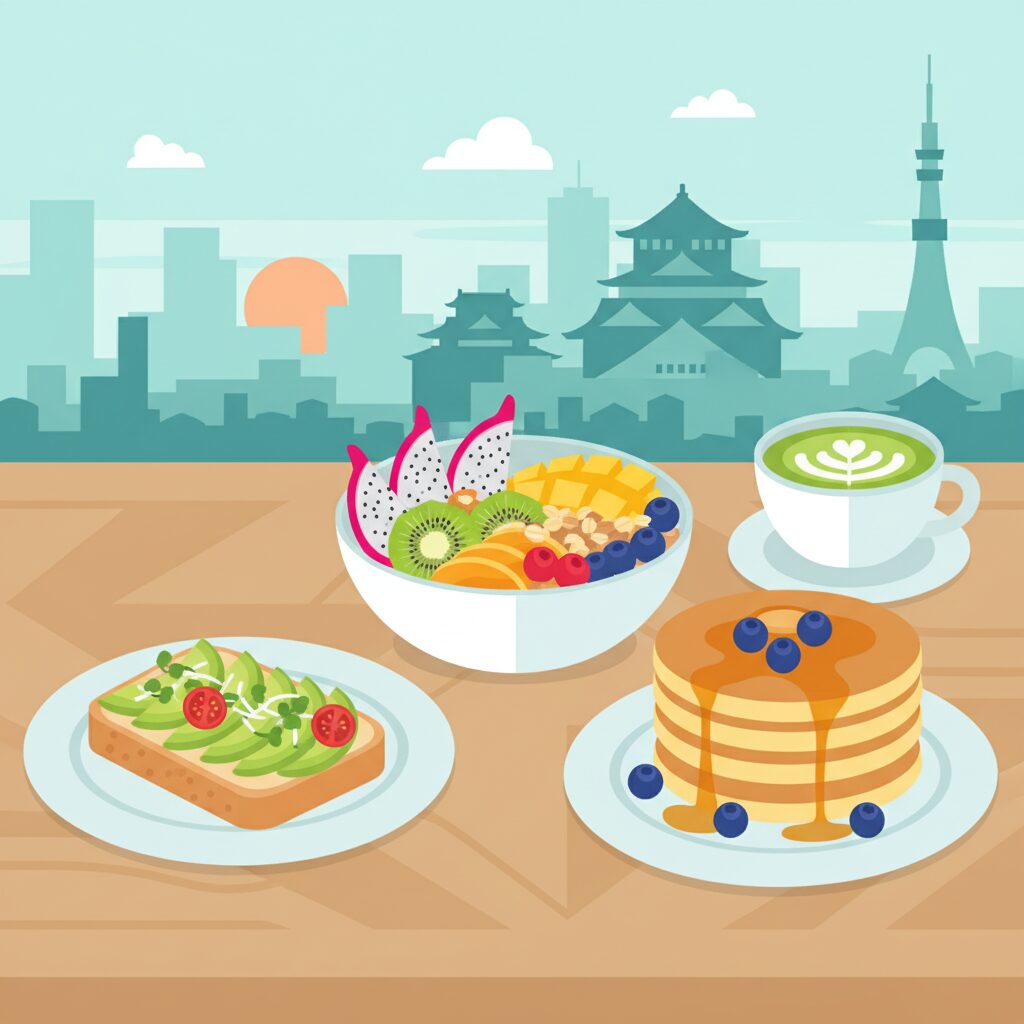
One option is to explore the modern, dedicated vegan cafes. They do exist and are increasing in number, often found in trendier neighborhoods like Horie or Nakazakicho. These spots serve beautiful smoothie bowls, avocado toast, and expertly crafted soy lattes. While wonderful, it’s important to understand they operate in a world parallel to the kissaten culture. They represent Osaka’s new, international face, frequently run by a younger generation who has traveled and caters to a different crowd. Visiting them provides a glimpse of the city’s future, while the kissaten connects you to its past.
Another option is to create your own morning set ritual. One of the joys of living in Japan is the quality of its bakeries. Osaka is full of amazing small ‘pan-ya-san’ shops selling loaves of ‘shokupan’ that are truly exceptional—pillowy, soft, and often vegan (though it’s wise to ask about ‘nyuseihin’ or dairy products). You can buy a fresh loaf, pick up some artisanal jam from a department store basement (‘depachika’), and brew your own coffee at home. Assembling your own perfect, plant-based morning set becomes a satisfying ritual in itself, a way to embrace the spirit of the kissaten—simple, high-quality, and comforting—while tailoring it to your own lifestyle.
Why This Matters: Understanding Osaka Through a Slice of Toast
The seemingly simple quest for a piece of toast without butter offers a glimpse into the heart of Osaka. It reveals that this is a city founded on relationships rather than transactions. In Tokyo, service is often flawless, anonymous, and smooth. In Osaka, it’s personal, occasionally imperfect, and deeply human. You realize that tradition here isn’t a show for tourists; it’s a lived experience, a system that has endured for generations with no pressing reason to adapt to modern tastes.
Most importantly, you learn to navigate the city on its own terms. You pick up a few Japanese words, not from a textbook, but from a genuine need to express a simple idea. You learn to read social signals, to discern when to insist and when to yield. You discover that the gruff demeanor of a shopkeeper can conceal a surprising willingness to help, provided you approach with respect and a touch of humor. And when you finally find that one little kissaten, the neighborhood spot where the owner nods knowingly and serves your toast with just jam, no questions asked, the feeling is one of deep belonging. You haven’t just mastered breakfast. You’ve shared an authentic conversation with the city, and it has spoken back.