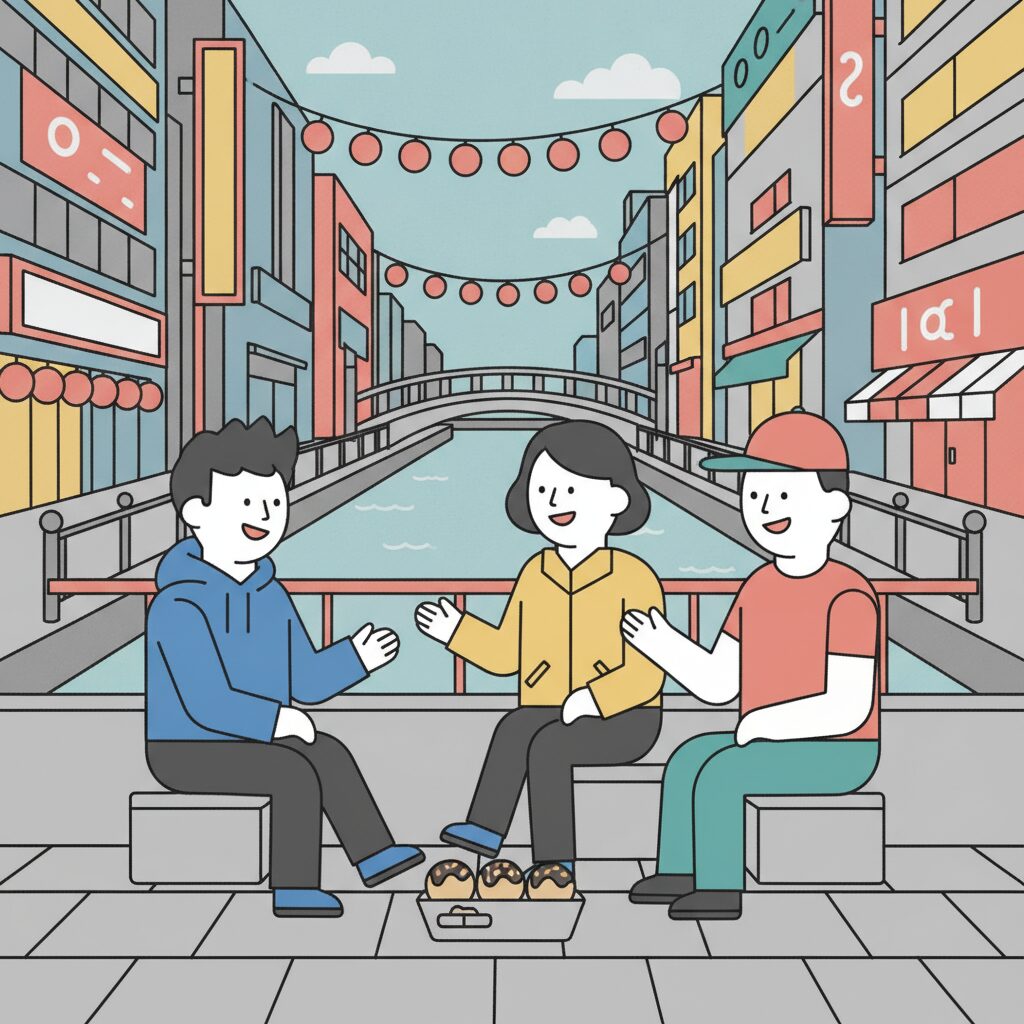
You see it before you understand it. You’re walking down a busy shopping arcade, maybe Tenjinbashisuji, with a mission in mind. You need to pick up groceries, get to the station, meet a friend. The flow of humanity is thick but generally moves with a purpose. And then you hit it: a human dam. Two, maybe three people, standing smack in the middle of the walkway. They’re not lost. They’re not in distress. They are, in fact, having the time of their lives. One is laughing so hard she’s clutching the handlebars of her rusty mamachari bicycle. Another is gesturing wildly, recounting a story with theatrical flair. They are completely, blissfully, unapologetically blocking the path.
Your Tokyo-trained instincts might scream. Your Western sense of personal space might twitch. You might think, “How rude! How inefficient!” You might perform the awkward sidewalk shuffle, trying to squeeze past without breaking their conversational forcefield. But what you’re witnessing isn’t a breach of social etiquette. It’s the opposite. You’re seeing a masterclass in a core Osaka social skill, a fundamental part of the city’s operating system. This is ‘tachibanashi’ (立ち話), the art of the standing chat. And if you want to understand how Osaka truly works, you need to understand why stopping in the middle of everything to talk is not just acceptable, but essential.
The city’s lively spirit extends beyond casual street chats, inviting you to delve deeper into the nuances of danchi living as another thread in Osaka’s intricate urban fabric.
What ‘Tachibanashi’ Actually Looks Like
Picture this: you’re outside a local supermarket in a neighborhood like Nakazakicho. An obachan—a middle-aged or older woman, instantly recognizable by her practical perm and a formidable aura of knowing everyone’s business—is loading leeks into the basket of her bike. Someone calls her name. It’s another obachan from down the street. The mission to get home and start dinner is immediately abandoned. The bikes become anchors, propped up with their kickstands to create a conversational island.
The conversation begins simply. “Oh, Hisako-san, long time no see!” But it’s never just a greeting. It’s a performance. Voices grow louder. Laughter bursts out, sharp and genuine. Hands gesture animatedly, emphasizing a point about the outrageous price of cabbage or the latest antics of a grandchild. They lean in close, sharing a piece of gossip in a conspiratorial stage whisper audible three shops down. Ten minutes pass. Fifteen. The ice cream in one woman’s bag is definitely melting, but this is far more important. This is the daily social ritual that keeps the neighborhood network alive.
It’s not only the realm of the obachan. You’ll see salarymen in suits bumping into an old university friend near Umeda Station, suddenly forgetting their train and launching into a 10-minute catch-up. You’ll see the owner of the local tofu shop, standing outside his storefront, shooting the breeze with a regular customer who has already paid and, by all logistical accounts, should be walking away. But they’re not. They’re deep in a debate about the Hanshin Tigers’ chances this season. In Osaka, the transaction is merely the excuse for the interaction.
The Unspoken Rules of the Sidewalk Stand-Up
To an outsider, tachibanashi appears chaotic and random. However, like many aspects of Japanese life, this sidewalk ballet is guided by unwritten rules. It’s not merely about stopping anywhere to chat with anyone; rather, it is a structured, though seemingly spontaneous, social practice.
It’s Not Random, It’s Relational
Although Osakans are known for their openness with strangers, genuine tachibanashi revolves around nurturing your existing social network. You don’t just stop a random passerby. Instead, you pause to talk with your neighbor, the dry cleaner, your child’s former teacher, or the woman who runs the fruit stand. These interactions are the lifeblood of the community, transforming anonymous urban living into a village-like atmosphere, even within a city of millions. Through these exchanges, you learn who recently had a baby, who is job hunting, or whose dog has passed away. It’s a decentralized, analog information system that relies on face-to-face updates. In an age of digital alienation, tachibanashi remains strikingly, insistently human.
The Time-Distortion Field of Osaka Chat
A fundamental aspect of tachibanashi is that once you’re engaged in one, ordinary time seems to stop. The promise of “I’ll just be a second” is understood as a polite fiction. Everyone knows that a good story or an interesting piece of news takes priority over any schedule you might have had. This contrasts sharply with the clockwork punctuality typical of public life in places like Tokyo. In Tokyo, being on time and efficient is crucial. In Osaka, however, the quality of the human connection in that moment can often outweigh the urgency of being punctual. What should be a five-minute errand can easily turn into thirty minutes, derailed by a series of friendly conversational detours. Newcomers soon learn to build this “tachibanashi buffer” into their daily routines.
The Art of the ‘Ame-chan’ Exchange
If you ever find yourself talking with an Osaka obachan, be ready for the ‘ame-chan’. This small, often hard candy will almost inevitably appear from the mysterious depths of her handbag. “Here, have an ame-chan,” she will say as she presses it into your palm. This is not simply a sweet treat. The ame-chan is a social tool—an act of goodwill, a way to extend the conversation, a tiny gift that says, “I see you, we’re connected.” It serves to break the ice, soften advice, or simply express kindness. Accepting the ame-chan means accepting the social bond; to refuse it would be to miss the meaning of the entire exchange. It’s a micro-transaction of community spirit, wrapped in cellophane.
Why Tokyo Thinks Osaka is Blocking the Way
To fully understand the significance of tachibanashi, you need to compare it with Tokyo. In Tokyo, public spaces are mainly designed for transit. The function of a sidewalk, a train station corridor, or an escalator is to enable the smooth and efficient movement of large crowds from Point A to Point B. The implicit social rule is to minimize your presence, keep to your lane, and avoid interrupting the flow. Pausing for an extended conversation in the middle of a busy Shinjuku walkway would be regarded as rude, disrupting collective harmony, or wa (和). It causes a ‘meiwaku’ (迷惑), a disturbance to others.
In Osaka, public spaces serve multiple purposes. They are for transit, certainly, but also for commerce, community, and living. A shopping arcade isn’t merely a passageway between stores; it’s the city’s living room. As such, stopping to socialize and strengthen connections is viewed as entirely valid, even essential. The ‘meiwaku’ isn’t the act of stopping to chat; the real social misstep would be passing a neighbor without stopping, offering only a brief, cold nod. That would be perceived as distant, unfriendly, and suspiciously Tokyo-like.
This fundamental difference in how public space is perceived lies at the core of the Osaka-Tokyo rivalry. Tokyoites see Osakans as loud, intrusive, and inconsiderate. Osakans view Tokyoites as cold, impersonal, and overly formal. What a Tokyo resident considers “blocking the path,” an Osaka local interprets as “nurturing the community.” Both are simply following their own local, deeply rooted social norms.
How to Navigate (and Maybe Even Join) the World of Tachibanashi
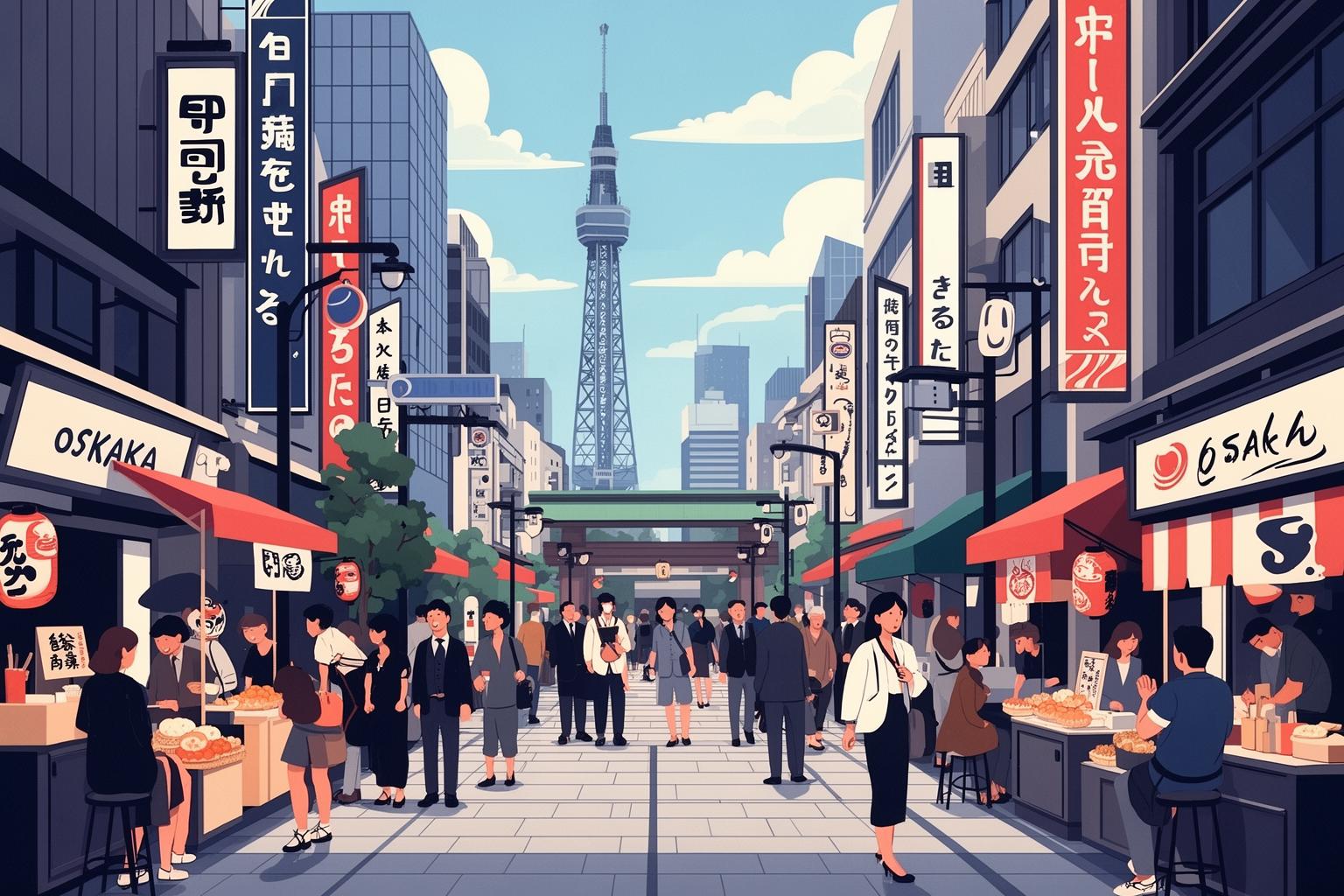
For a foreigner living in Osaka, the ubiquity of tachibanashi can initially be frustrating until you learn the unspoken rules of engagement. After that, it becomes one of the most delightful and rewarding parts of city life.
Don’t Get Mad, Get Around
First, the practical advice. When you encounter a tachibanashi blockade, don’t get annoyed. Don’t expect them to part like the Red Sea. They’re immersed in conversation and may not even notice you at first. The right approach is gentle and almost apologetic. A soft “Sumimasen” (Excuse me), accompanied by a slight bow and a shoulder-first shimmy, usually suffices. They’ll briefly pause, let you pass, then immediately return to their chat as if nothing happened. It’s not personal. You’re not the main character in their story—just a temporary obstacle to be politely navigated before their conversation continues.
The Gateway to Local Life
The real breakthrough happens when you stop being the one navigating and instead become the destination. The day a local shop owner or neighbor pauses you for a proper tachibanashi is the day you truly transition from “foreign resident” to “local.” It’s a sign of acceptance. They’re comfortable enough to interrupt your day to connect. Your role then is to embrace it. Don’t offer only one-word responses. Ask how they’re doing. Comment on the weather. Inquire about their family. Share a small, trivial detail about your day. This short investment in seemingly meaningless chatter is what builds the relationships that make a place feel like home.
Your Own ‘Tachibanashi’ Starter Pack
Ready to start your own? It’s easier than you might think. A warm “Maido!” (the classic Osaka merchant greeting, open to anyone) to a shopkeeper is a perfect opener. A simple remark like “Meccha atsui desu ne!” (It’s incredibly hot, isn’t it!) can break the ice. Don’t hesitate to ask questions like, “Are those apples good today?” or “Your dog is adorable — what’s its name?” Osakans generally value directness and warmth. They’re often more curious about you than you are about them. By showing a little interest, you give them the perfect reason to do what they do best: stop, chat, and connect.
More Than Just Talk: Tachibanashi as Osaka’s Social Glue
Ultimately, it’s important to recognize that tachibanashi is not wasted time. It represents the unseen, essential work of sustaining the community. It’s how information spreads, how bonds are reinforced, and how a sense of shared identity is renewed daily on thousands of street corners and throughout countless shopping arcades across the city.
It embodies everything fundamental to the Osaka spirit: a preference for practicality over formality, a passion for storytelling, a deep-rooted belief that people matter more than rules, and the idea that a good laugh with a neighbor is more valuable than a few minutes saved on a commute. So next time you find your way blocked by a laughing group of Osakans, don’t view it as a nuisance. Recognize it for what it truly is: the city’s heartbeat, pulsating strongly right there in the middle of the sidewalk.