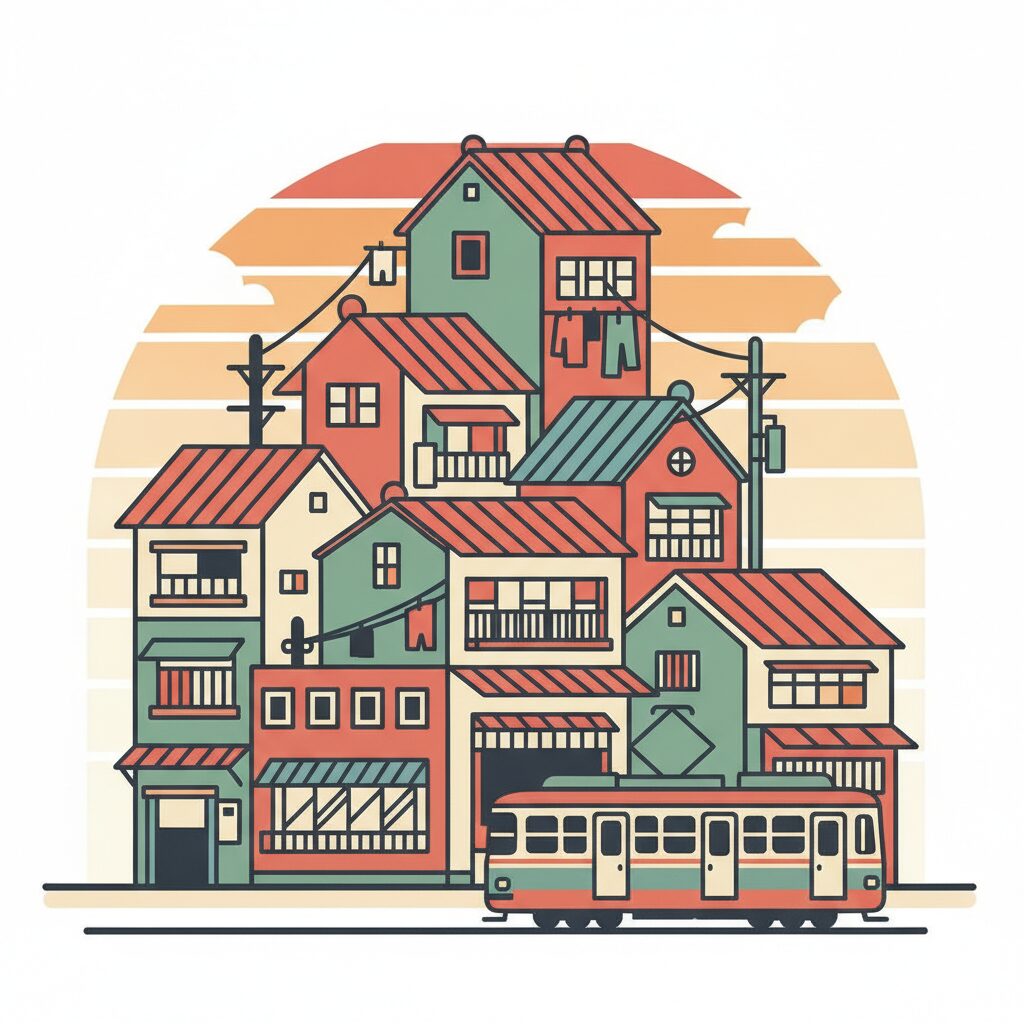
Walk away from the neon glow of Dotonbori, past the sleek high-rises of Umeda, and duck into the quiet, tangled backstreets of a neighborhood like Nishinari or Taisho. The air changes. The sounds shift from the rumble of trains to the clatter of a distant workshop, the chatter of neighbors, the hum of an old air conditioner. Here, you’ll find them: the Bunka Jutaku. The ‘Culture Houses.’ They stand in silent, two-story rows, their wooden frames weathered by decades of sun and rain, their tiled roofs a mosaic of grey and green. To a newcomer, especially one coming from Tokyo’s relentless modernity, they might look a little run-down, a bit forgotten. But to understand these buildings is to understand a deep, stubborn, and vital part of Osaka’s soul. This isn’t just about finding a cheap place to live. It’s about plugging into the city’s living history, into a community network that operates on a completely different frequency from the rest of hyper-modern Japan. They are a physical manifestation of Osaka’s practical, post-war spirit, a world away from the curated perfection of a Tokyo apartment. Forget what you think you know about Japanese housing; we’re taking a look at a style that is fading fast, and what it really means to call one home.
In these historic neighborhoods, the enduring charm of the Bunka Jutaku is complemented by the energy found in the vibrant Osaka shotengai, where community and culture continue to thrive.
What Exactly is a ‘Bunka Jutaku’? A Trip Back in Time
Let’s clarify the name first. ‘Bunka Jutaku’ (文化住宅) literally means ‘Culture House.’ It sounds impressive, doesn’t it? Almost poetic. The name itself was a brilliant marketing move back then. These buildings originated during the Taisho and early Showa periods but gained massive popularity during the post-war reconstruction boom of the 1950s and 60s. Japan urgently needed housing. Osaka, a city heavily bombed and blazing, needed it even more. The Bunka Jutaku was the solution.
So, what defines a ‘Culture House’? It’s a hybrid, a blend of concepts. Think of it as an evolution from the older, more traditional ‘nagaya’ (長屋), simple, elongated wooden row houses. The Bunka Jutaku took that basic design and infused it with a touch of Western modernity, a hint of ‘culture.’
The Anatomy of a Culture House
Visually, they have a distinctive shape. Most are two-story wooden buildings, constructed from timber and plasterboard. They often share a wall with the neighboring unit, a classic row-house style that optimizes land use. The roofs are usually covered with traditional Japanese tiles, or ‘kawara,’ giving them a timeless, old-world charm that contrasts sharply with the corrugated metal or modern materials of newer constructions.
What made them ‘cultural’ at the time were the features. They often had private entrances, unlike the fully communal nagaya. They included glass windows instead of just paper shoji screens. Some of the more elaborate ones even had a small decorative alcove or a cozy reception room with a Western-style wooden floor. This represented aspirational living for the rising middle class of the Showa era. It marked a move toward privacy and modernity—a symbol of a nation in recovery.
Inside, the layout feels like a time capsule. You’ll often find tatami mat rooms next to a small kitchen with linoleum flooring. The spaces are compact and designed to fit a family’s daily routine. The staircase is usually steep and narrow, exemplifying efficient use of every inch. Don’t expect built-in closets; storage falls to the ‘oshiire,’ deep cupboards meant for futons. These aren’t just apartments; they are purpose-built homes, echoes of an era when life was lived more locally and communally.
Why Osaka? The City Woven with Wooden Walls
While Bunka Jutaku can be found elsewhere in Japan, they feel inherently Osakan. Their widespread presence here is no coincidence; it directly stems from the city’s history and character. Tokyo, despite its many wonders, is a city defined by impermanence. It demolishes and rebuilds with astonishing speed. An earthquake, a fire, the Olympics—any reason serves to replace the old with something new, bigger, and shinier. Tokyo’s identity is firmly linked to the future.
Osaka, conversely, wears its past openly, sometimes reluctantly, sometimes with pride. As a city of merchants and craftsmen, practicality has always been paramount. After the war, the objective wasn’t to erect architectural monuments; it was to house people quickly and get businesses operational. The Bunka Jutaku was an ideal solution: quick to build, inexpensive, and efficient. They filled vacant lots, creating compact, walkable neighborhoods where communities could rekindle.
This practical attitude endures. Although large redevelopment projects are ongoing in Osaka, there remains a slower, more persistent resistance to change in the city’s residential core. Property owners may keep an old Bunka Jutaku for generations, earning modest rent without the means or incentive to demolish it and replace it with a sterile, characterless apartment block, or ‘mansion’ as they’re called in Japan. This results in a captivating urban mosaic where a gleaming new tower can rise just a block away from a quiet lane lined with Showa-era wooden houses. It is this contrast, this reluctance to fully erase its past, that imparts Osaka with a texture and grit often missing in Tokyo.
Living in a Bunka Jutaku means you’re not merely renting a space; you’re inhabiting a piece of Osakan pragmatism. It’s a choice that prioritizes character over convenience, community over anonymity, and affordability over luxury. It’s truly a very Osaka way of life.
The Bunka Jutaku Lifestyle: Community, Noise, and Everything In-Between
This is the most important aspect to grasp and the greatest difference from living in a modern apartment. The hallmark of a Bunka Jutaku isn’t its tiled roof or wooden frame—it’s the thinness of its walls.
When I first visited a friend living in one, I was taken aback. I could hear his neighbor’s television with complete clarity. I could hear them cooking, laughing, arguing. This isn’t a flaw; it’s an intentional characteristic. In a modern concrete ‘mansion,’ you might go years without ever speaking to the person on the other side of your wall. Anonymity is the default. In a Bunka Jutaku, anonymity is impossible.
The Unspoken Social Contract
You become part of a small, tightly-knit local ecosystem. You learn the daily rhythms of your neighbors through sound. You know who wakes early, whose children are practicing piano, who enjoys singing in the shower. This might seem like a nightmare for those who value privacy, and for some, it is. But for many, it creates a unique, unspoken sense of connection. It encourages a certain degree of mutual consideration. You know they can hear you, so you might avoid blasting music at 2 AM. They know you can hear them, so they keep their arguments at a low volume.
This closeness fosters a casual intimacy that is rare in modern urban Japan. Neighbors will greet you, talk about the weather, and ask where you’re headed. An elderly woman next door might bring you a plate of simmered daikon, an ‘osuso-wake’ or sharing of food, simply because she made too much. You’ll see futons airing on balconies, smell the aroma of grilled fish drifting through the alleys, and become part of a living, breathing community. This stands in stark contrast to the sterile, silent hallways of a Tokyo high-rise.
Of course, it’s not always perfect. A neighbor’s argument might become your evening entertainment whether you want it or not. A crying baby next door can feel like it’s in your own room. It demands a mental adjustment and an acceptance of shared space that extends beyond your own four walls. It’s a reminder of a time when community wasn’t a lifestyle choice, but a simple fact of life.
The Hunt: How to Find Your Retro Osaka Pad
So, you’re curious and ready to trade soundproofing for character. But how do you actually locate one of these places? It’s not as easy as filtering for ‘retro’ on a major real estate portal. The search for a good Bunka Jutaku is an adventure in itself.
Know Your Neighborhoods
First, you need to focus your search in the right areas. The shiny central wards like Kita and Chuo are mostly off-limits. Instead, look into the city’s older, more residential districts such as:
- Nishinari-ku: Known for its toughness, it contains a large number of older homes, including many well-preserved Bunka Jutaku.
- Taisho-ku: Famous for its Okinawan community and industrial background, it’s lined with low-rise residential streets perfect for your hunt.
- Sumiyoshi-ku: Located slightly further south, this district around the renowned shrine has clusters of charming old wooden houses.
- Ikuno-ku: With one of Japan’s largest Korean communities, it’s an area rich in history and packed with older buildings.
These neighborhoods preserve the essence of old Osaka. Walking or cycling through them is the best way to do your research.
Partner with a Local Fudosan-ya
Your best option isn’t a big corporate real estate agency near the train station. Instead, seek out a small, local, likely family-run ‘fudosan-ya’ (real estate agent) in the area you’re interested in. These agents have decades of experience, know the properties and landlords, and have access to listings that won’t appear online. Many Bunka Jutaku landlords are elderly and not internet-savvy, relying on their local agent to find reliable tenants.
Be upfront about what you want. Use these key terms:
- 文化住宅 (Bunka Jutaku): The essential keyword.
- 長屋 (Nagaya): This will also pull up row houses, which share a similar vibe.
- レトロ物件 (Retoro bukken): ‘Retro property.’
- 古い木造アパート (Furui mokuzō apāto): ‘Old wooden apartment.’
Expect some skepticism. The agent might push you toward a newer, “nicer” place, assuming foreigners can’t handle the quirks of older buildings. Stay polite but firm—explain you understand the challenges and are specifically seeking the character and atmosphere of an older home.
What to Check During a Viewing
When you finally tour a property, shift your mindset from ‘appreciating aesthetics’ to ‘conducting a thorough inspection.’ These buildings hide secrets. Look out for:
- Gaps and Drafts: Inspect window and door frames. Hold your hand up—can you feel air passing through? That ‘sukimakaze’ (gap wind) can be your enemy in winter.
- Water Damage and Mold: Inspect walls, ceilings, and closet (‘oshiire’) interiors for dark stains. Smell the air—mustiness is a serious warning for ‘kabi’ (mold).
- The Foundation: Check if the floors are level. Old wooden homes settle, but severely uneven floors might signal structural problems.
- Plumbing and Utilities: Test water pressure in the kitchen and bath. Ask whether the property uses city gas (cheaper and more convenient) or propane tanks (LPG). Count electrical outlets; older homes weren’t made for today’s gadget-heavy lifestyle.
- Sound: This is crucial. Bring a friend—have them speak in the adjacent room. Go outside and listen from the street. Knock on shared walls. Make sure you fully understand what you’re getting into.
The Reality Check: Pros and Cons of Showa-Era Living
Living in a Bunka Jutaku offers a unique experience, but it’s not suitable for everyone. You need to balance the romantic ideal with the tough realities. Let’s be straightforward.
The Pros
- Rent: The primary advantage. These units are often much cheaper than contemporary apartments in the same neighborhood. You can find surprisingly spacious two-story homes for the cost of a tiny modern studio.
- No ‘Money Culture’: Many older landlords don’t adhere to modern rental practices like ‘key money’ (reikin) or renewal fees (koushinryou). This can save you a significant amount of money upfront.
- Character and Charm: Each one is unique. They have history, texture, and warmth that a concrete building simply can’t match. Living in one means inhabiting a piece of history.
- Community: As noted, you’ll know your neighbors. For those looking for connection and a less anonymous urban life, this can be a major benefit.
- DIY Freedom: Some landlords are quite lenient about modifications. You might have more liberty to paint walls, install shelves, and personalize the space compared to strict modern buildings.
The Cons
- The Elements: Insulation is often lacking. They can be freezing in winter and sweltering in summer. Expect high utility bills for heating and cooling.
- Noise: You’ll hear your neighbors, and they’ll hear you. If you’re a light sleeper or require absolute quiet, this lifestyle isn’t for you.
- Pests: Old wooden buildings attract unwanted guests. Be prepared for the possibility of insects and sometimes rodents.
- Outdated Infrastructure: Expect low water pressure, quirky plumbing, and a constant hunt for free electrical outlets. The bathroom might be a cramped ‘unit bath’ or even a more rustic arrangement.
- Safety: Though generally safe, these homes don’t meet modern earthquake resistance standards. This is a genuine risk you need to accept.
More Than Just Walls: A Vanishing Piece of Osaka
Ultimately, choosing to live in a Bunka Jutaku goes beyond simply finding a place to stay. It is a deliberate decision to connect with a fading side of Osaka. Each year, more of these wooden row houses are demolished, replaced by parking lots or nondescript apartment complexes. With every teardown, a small, intricate community is uprooted, and a fragment of the city’s architectural and social heritage vanishes forever.
Residing in one means becoming a temporary guardian of that history. It involves embracing the drafts, the noise, and the idiosyncrasies in return for something genuine and tangible. You come to cherish the tilt of afternoon light through an old wooden window, the sound of the neighborhood tofu vendor’s horn, and the familiar greeting from the elderly man who sits on his porch daily. It provides a bond to the place, its people, and its past—connections that are growing increasingly rare. Though sometimes challenging and uncomfortable, it offers a profoundly rewarding way to experience the true, unfiltered heart of Osaka. It’s not merely renting a house; it’s renting a piece of the culture itself.