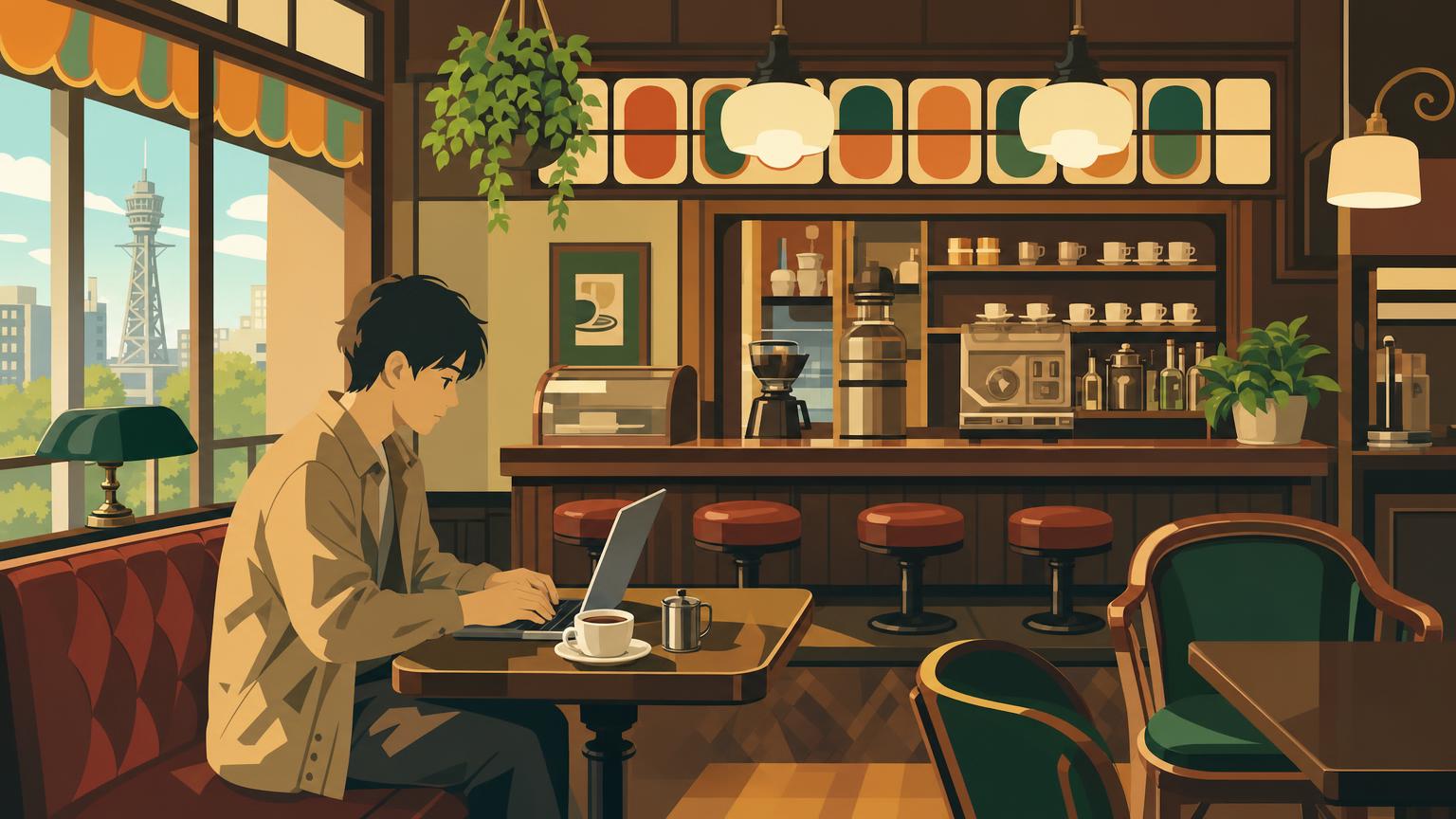
Can you open a laptop in a traditional kissaten in Showa-cho, order one coffee, and work until lunchtime? Sometimes. But if you arrive expecting the atmosphere of a modern coworking café, you may misunderstand the room, the owner, and the people around you.
A kissaten is not simply an old-fashioned café. In Osaka, it is often a small neighborhood institution. The same people may sit at the same tables each morning. The owner may know who wants toast with a boiled egg, who reads the newspaper from front to back, and who only needs a quiet cup of coffee before opening the shop. The room may have dark wood, glass ashtrays, heavy curtains, a television in the corner, and coffee served in a thick cup. It may also have no Wi-Fi, no outlet beside the table, and no expectation that one drink buys several hours of office space.
This is the central reality of remote work in a traditional Showa-cho kissaten: you are not renting a desk. You are entering somebody’s daily rhythm.
Showa-cho, in Abeno Ward, feels different from the commercial core around Umeda or Namba. It is connected to the city by the Osaka Metro Midosuji Line, but its streets are residential, local, and comparatively unhurried. Around Showa-cho Station and Bun-no-sato Station, older houses, small shops, clinics, neighborhood restaurants, and long-established cafés exist beside renovated homes and newer coffee businesses. The area is useful for understanding how Osaka works when it is not performing for visitors.
The map is best treated as an orientation tool, not a promise that every marked café accepts laptop work. Conditions change, small businesses close, and a shop that welcomes a quiet customer at 8:00 a.m. may not welcome a laptop session during its busy lunch period. Check the latest notice, look at the room before ordering, and ask politely when you are unsure.
The First Misunderstanding: A Kissaten Is Not a Coworking Café
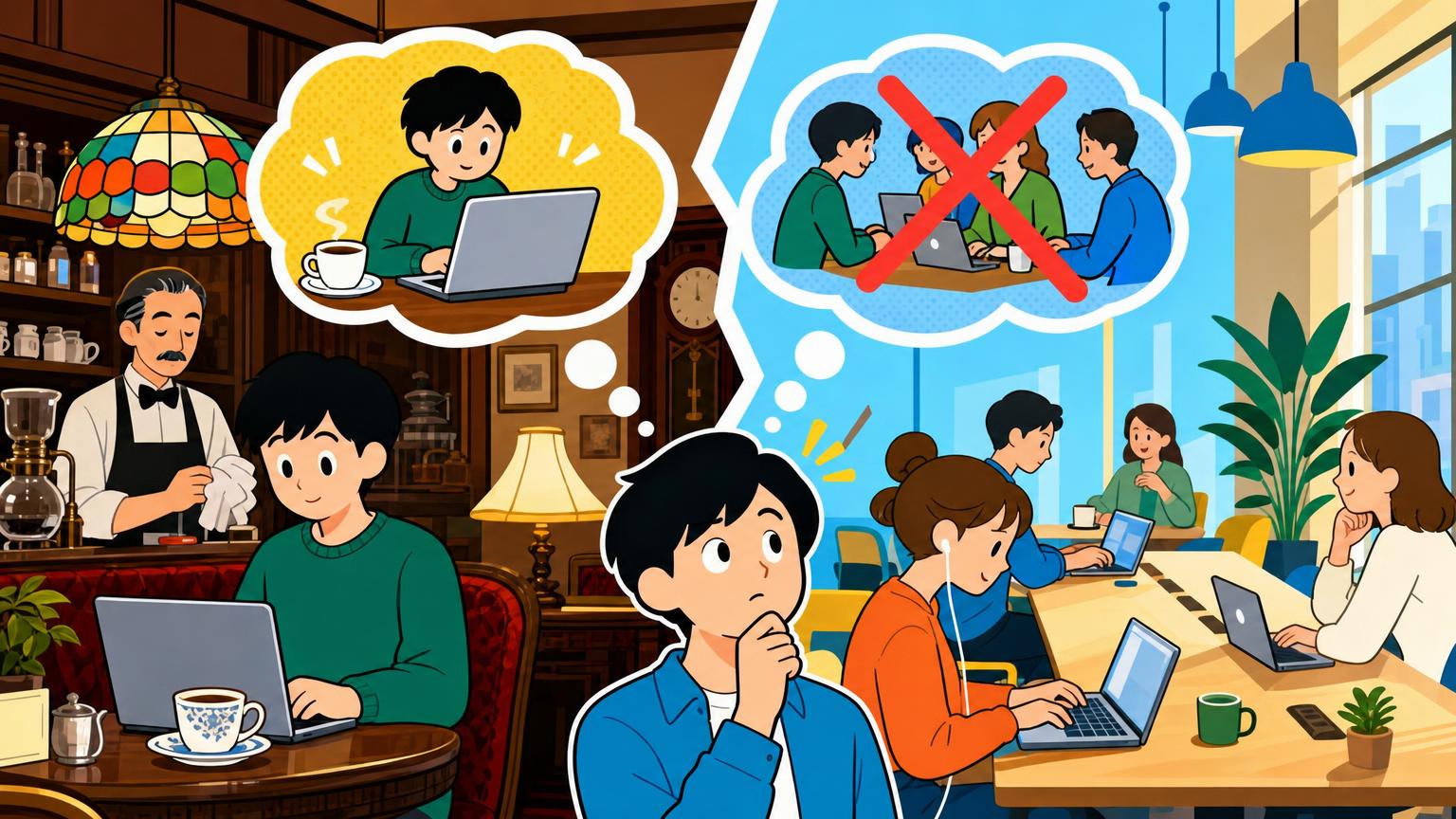
Foreign residents often use “café” and “kissaten” as though they mean the same thing. They do not.
A modern café is usually designed with flexibility in mind. It may offer Wi-Fi, power outlets, takeaway drinks, long opening hours, mobile ordering, shared tables, and seating for customers who study or work. Some chain cafés operate on the assumption that people will sit with a laptop. A specialty coffee shop may also welcome longer stays, particularly when the interior includes communal tables and visible sockets.
A traditional kissaten developed from a different concept. It is closer to a coffee restaurant, neighborhood salon, or small breakfast spot. The main product is not the chair, but the drink, the food, the quiet conversation, and the continuity of the place. Even when the owner is warm and welcoming, the business may not have been designed for remote workers.
That difference explains why a kissaten can feel perfect for one hour of focused writing yet completely unsuitable for a full workday. The atmosphere may be calm, but calm does not automatically mean laptop-friendly. A small room can be peaceful while still having only one wall outlet, weak mobile reception, limited seating, and regular customers who rely on their usual table.
In Osaka, this distinction is especially important because friendliness is often expressed through practical behavior rather than formal service language. A staff member may not provide a lengthy explanation of the rules. They may simply point to a seat, tell you that the shop is full, place a menu on the table, or ask whether you are eating. The meaning is conveyed by the situation.
If you treat the kissaten as a free office, you may miss the social contract. If you treat it as a small local establishment where you are buying breakfast and borrowing a little time, you will usually understand the room much better.
Why Remote Workers Choose Showa-cho Kissaten Anyway
The appeal is not merely visual. Yes, the amber lamps, old signage, leather chairs, chrome coffee equipment, and hand-painted menus are photogenic. But the deeper attraction is that the room moves at a different tempo from the digital economy.
In a modern café, you may hear video calls, keyboard taps, music playlists, milk steamers, delivery orders, and the constant opening and closing of the door. In a traditional kissaten, the soundscape can be more restrained. A spoon touches a cup. A newspaper turns. The owner calls out a morning order. Someone at the counter asks about the weather. A television speaks softly in the background.
For some remote workers, this creates a useful boundary. You enter, order coffee, put your phone away, and work for a defined period. You do not drift into a six-hour café session simply because Wi-Fi is available. The limited infrastructure can become a form of discipline.
There is also a cultural reason to choose Showa-cho over a large chain. Living in Osaka is not only about finding the fastest train connection or the most convenient English-language service. It is also about learning how ordinary people use public spaces. Morning kissaten culture shows you that many Osaka residents do not separate food, conversation, errands, and work into neat categories. A person may read the sports pages over coffee, discuss a neighborhood issue with the owner, eat toast, and leave within twenty minutes. The café is part of a daily route, not an Instagram stop.
This is one reason a kissaten can teach you more about local life than a polished café designed for visitors. You see the people who live nearby. You notice what time the first customers arrive. You learn whether the shop is a breakfast place, a smoking place, a meeting place, or a quiet retreat. You also learn that not every useful local space is optimized for foreign expectations.
What Showa-cho Morning Culture Looks Like
Morning is the best time to understand the neighborhood, but morning does not mean the same thing at every kissaten.
Some shops open early enough for commuters. Customers may arrive before work, order a morning set, and leave as soon as they finish. Others open later and function more like daytime cafés. A shop may advertise morning service, yet the atmosphere can change dramatically between opening time and late morning.
A typical morning set may include coffee or tea with toast, butter, jam, a boiled egg, salad, or a small sandwich. In Osaka, the set is often practical rather than elaborate, giving regulars a predictable start to the day. The price may be lower than ordering each item separately, but the exact contents and hours vary from shop to shop.
For a foreign resident, the important point is that morning is often a period of movement. Customers are not necessarily coming to sit for two hours. They may be eating before work, stopping between errands, meeting someone briefly, or taking a familiar break. A laptop user who occupies a four-person table during this period may create tension, even if nobody says so directly.
Observe the room before settling in. If most customers are eating quickly, choose a small counter seat if one is available. If the shop has only a few tables and several people are waiting, end your work session sooner. If the owner is constantly moving between the kitchen and the tables, this is probably not the right time for a long remote-work stay.
Showa-cho also reveals an Osaka contrast that foreigners sometimes miss. The area can feel relaxed without being passive. People may speak casually, tease one another, and appear informal, but they still notice whether you are being considerate. Osaka directness is not permission to ignore boundaries. A cheerful greeting, a quick apology, and a clear order can matter more than elaborate Japanese.
The Reality of Working in a Traditional Kissaten
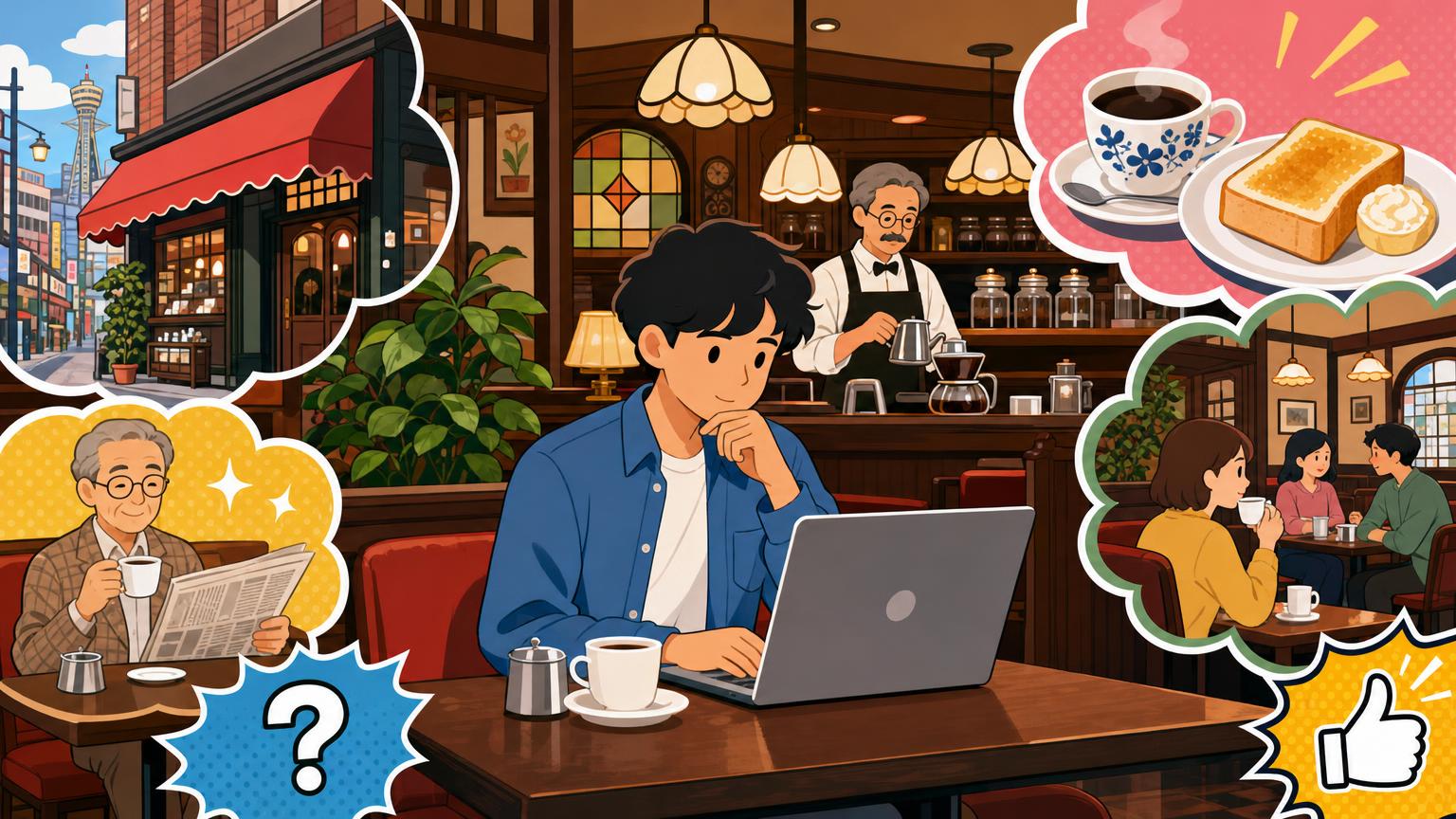
The honest answer is that traditional Showa-cho kissaten are generally better suited to short, low-intensity tasks than to a full remote shift.
They can work well for reading, planning, journaling, answering messages, preparing notes, editing a document, or taking a quiet break between meetings. They are less suitable for long video calls, confidential conversations, large uploads, presentations, or anything that relies on a stable, high-speed internet connection.
Before opening your laptop, consider these four questions:
- Is the shop visibly quiet, or is it already busy?
- Does the menu or entrance mention Wi-Fi, power, or work use?
- Is there a suitable seat that will not block another customer?
- Can you complete your task without making calls or spreading equipment across the table?
If the answer to several of these questions is no, choose a modern café, library, coworking space, or your home instead. The point is not to force every old café to become a remote office, but to use each place according to its character.
Some Showa-cho businesses do offer Wi-Fi or power, but the information can be inconsistent across listings. For example, café directories report Wi-Fi and power availability for some businesses in the neighborhood, while traditional shops such as Cornell are listed without Wi-Fi or power and with cash-only payment information in recent customer reports. Treat directory information as a starting point rather than a guarantee.
The small café Usagi to Boku is a useful example of the middle ground. It occupies a renovated longhouse-style building, offers free Wi-Fi, and has a quiet atmosphere, but its own guidance emphasizes the shop’s small size, limited group sizes, and lack of customer-facing outlets. A mobile battery may be available, but that does not turn the shop into a plug-in office.
This is a good model for reading local signals. A place can be modernized, aesthetically beautiful, and equipped with Wi-Fi while still asking visitors to behave quietly and respect the limited number of seats.
Where to Look Around Showa-cho
The following places are not presented as guaranteed laptop offices. They are examples of the different types of café experiences found around Showa-cho. Check current opening hours, seating rules, and available equipment before making them part of your work routine.
Cornell: The Traditional Local Pattern
Cornell, near Showa-cho Station, represents the classic neighborhood kissaten style: early opening, a retro atmosphere, coffee, toast or sandwiches, and a room shaped more by regular customers than remote workers. Recent customer information indicates a 7:30 a.m. opening, morning food, cash-only payment, and no listed Wi-Fi or power. Other reports mention that smoking is part of the atmosphere. Conditions and prices can change, so confirm in person.
For a foreign resident, Cornell is probably best approached as a place to experience local breakfast culture and complete a small amount of quiet work. It is not the place to assume that your charger, video call, and three-hour stay will be convenient.
If you arrive early, order a morning meal, and work quietly on a small laptop after the rush, you may fit into the room. If you arrive during the busiest period and occupy a large table with a full workstation, you may not.
Montmartre: Retro Atmosphere with a Non-Smoking Listing
Montmartre is listed as a traditional café near Showa-cho Station, offering morning service, limited seating, and an entirely non-smoking environment. Recent listing information also indicates cash-oriented payment limitations, with cards, electronic money, and QR payments not accepted. Its small size is significant: with only sixteen seats, a laptop session has a greater impact than it would in a chain café.
A non-smoking room does not automatically mean it is work-friendly, but it may be a better fit for people who want a retro café without tobacco smoke. The polite approach is to observe first, choose a compact setup, and avoid occupying a table during breakfast hours.
New White: A Long-Established Morning Stop
Kissa New White is described in local listings as a retro café near Showa-cho Station with a long operating history and a distinctly Showa-era atmosphere. Customer reports emphasize morning visits and the nostalgia of the space.
Places like this are valuable for foreign residents because they show that nostalgia is not necessarily a formal theme. For regular customers, the old interior is simply normal. The owner may not be trying to create a photogenic experience. The café has survived because people use it.
That distinction matters. Visitors sometimes photograph the old furniture while overlooking the social function of the space. If you work there, keep your behavior low-key. Do not turn a quiet neighborhood room into a content studio without permission.
Usagi to Boku: A Renovated Longhouse with Clearer Guidance
Usagi to Boku is not strictly a traditional kissaten, but it helps illustrate how Showa-cho’s older architecture is being reused. The shop occupies a roughly ninety-year-old renovated longhouse and combines self-roasted coffee with a calm, carefully managed café environment. It offers free Wi-Fi, but there are no regular customer outlets, and visitors are asked to remain mindful of its small scale and quiet atmosphere.
For remote workers, the lesson is clear: Wi-Fi availability is not the same as unlimited permission to work. A café may accommodate a short laptop session while still expecting small groups, quiet behavior, and reasonable turnover.
Newer Options Near the Kissaten District
Some businesses around Showa-cho are more café-like than traditional kissaten-style establishments. Café Pu-rin, for example, is listed as offering Wi-Fi, power, cashless payment options, and a more flexible café-bar format, although its opening hours begin later than those of the classic morning kissaten. Sole Coffee is also listed as having Wi-Fi and power and operates in a more contemporary setting.
These places may be more practical when your main priority is computer work. They also show that living in Osaka does not require choosing between old and new all the time. You can have breakfast in a traditional kissaten, move to a café with outlets for a focused work session, and return to a local shop later for a drink. That is often more realistic than expecting one venue to meet every need.
How Showa-cho Compares with Umeda and Namba
The neighborhood shapes the meaning of café behavior.
In Umeda, a café may be surrounded by department stores, offices, hotels, railway connections, and business meetings. Customer turnover is higher, and chains and commercial cafés are more accustomed to people arriving alone, ordering quickly, and using the space for study or work. The environment may feel less intimate, but it is often more predictable for remote workers.
In Namba and Shinsaibashi, the mix is even more varied. You may find old kissaten, busy restaurants, entertainment districts, shopping streets, and cafés used by residents, visitors, students, and office workers. A traditional café there may welcome a quick coffee but have little patience for someone staying with a laptop for a long time during peak hours.
Showa-cho is different because the neighborhood’s scale is more apparent. You are more likely to notice the same customers and the relationship between the shop and the surrounding streets. A small action, such as occupying the only large table for an extended period, matters more. A greeting matters more as well. Returning several times and behaving consistently can also carry greater significance.
This does not mean that Osaka neighborhoods are closed to outsiders. Rather, local acceptance is often built through repeated, ordinary behavior. You do not need to become a regular right away. You simply need to recognize that the café is part of a living neighborhood, not a neutral workspace.
The Cost of Working in a Kissaten
The cost is usually reasonable, but the proper way to calculate it involves more than the price of a single coffee. You are paying for food or drink, a seat, service, atmosphere, and a period of use.
At older Osaka kissaten, a cup of drip coffee typically costs several hundred yen, with many examples falling around ¥400 to ¥600 depending on the shop, roast, size, and location. Morning sets commonly range from the mid-hundreds of yen to approximately ¥1,000, although the contents vary widely. Recent local reports mention examples such as a ¥600 sandwich morning set at Cornell and a ¥700 dessert-and-coffee set, while other Showa-cho café listings offer drinks and light meals for under ¥1,000. These figures are indicative rather than a fixed neighborhood price list.
A sensible work session might therefore include:
- A morning set costing roughly ¥500 to ¥900
- One additional coffee or tea if you stay for several hours
- Cash in physical yen in case cards and mobile payments are not accepted
- A backup plan if the shop has no Wi-Fi or electrical outlet
The extra drink is not a formal, universal rule, and you do not need to order unnecessarily if the shop is empty and your visit is brief. However, if you stay for two or three hours, especially in a small establishment, ordering another drink is a polite way to recognize that the seat continues to serve you.
Do not regard this as buying unlimited time. A second drink may make a longer stay more considerate, but it does not take priority over a busy period, a waiting customer, or a request from the staff. The needs of the establishment come first.
The morning set also reflects Osaka’s practical attitude toward value. People often want a filling, straightforward meal at a sensible price. Toast, egg, coffee, and a familiar seat may matter more than elaborate presentation. A foreign resident who expects every café experience to center on specialty beans or digital convenience may overlook how much local satisfaction comes from reliability.
Cash, Cards, and the Importance of Being Prepared
Cash remains essential at traditional kissaten. Some shops accept cards or QR payments, but older independent businesses may not. Recent information lists both Cornell and Montmartre as not accepting common cashless payment methods, while newer cafés in the same general area may support cashless payments.
Carry ¥1,000 notes and coins, and do not assume that a foreign-issued card will work. Avoid making the staff wait while you search through multiple payment apps. If the menu is handwritten, check the price before ordering, especially if you cannot read every detail.
A useful phrase is:
“Cash only desu ka?”
This means, “Is it cash only?”
You can also say:
“Card wa tsukaemasu ka?”
“Can I use a card?”
In a small shop, asking a simple question before ordering is more considerate than discovering at the register that you cannot pay.
Wi-Fi and Power Outlets: Never Assume
Traditional kissaten often do not offer public Wi-Fi. Some may provide a password if you ask, but that does not necessarily mean the network is intended for extended remote-work sessions. Others may list Wi-Fi online even though the signal is weak at a particular table or the equipment has since changed.
Power outlets are even less predictable. A socket may be located behind a counter, beside a refrigerator, or somewhere reserved for staff equipment. Do not unplug a lamp, television, coffee machine, or another customer’s charger, and do not move furniture without asking.
Bring your own mobile data. A Japanese SIM or eSIM with tethering can make the difference between a pleasant writing session and a stressful one. Carry a fully charged power bank, download documents before you arrive, and keep your equipment compact. If your work requires a second monitor, an external keyboard, or several devices, a kissaten is probably not the right environment.
When asking about power, you can say:
“Kon센to, tsukatte mo ii desu ka?”
May I use the outlet?
A more natural shorter version is:
“Kon센to, daijōbu desu ka?”
Is it okay to use the outlet?
If the answer is no, accept it immediately. A refusal is not a judgment about you. The outlet may simply be needed for the shop’s equipment, or the owner may want to prevent cables from crossing the floor.
Smoking Is Still Part of the Kissaten Reality
Many foreign residents are surprised that authentic older kissaten may still permit smoking indoors. This is not an accidental flaw in the atmosphere. In some traditional cafés, tobacco has long been part of how regular customers use the space. A coffee, a cigarette, a newspaper, and a brief conversation may all belong to the same morning routine.
That does not mean every old café permits smoking. Some are entirely non-smoking, some have designated smoking areas, and others impose restrictions based on current regulations, building type, or local policy. Montmartre is listed as fully non-smoking, while customer information about Cornell describes smoking as part of its atmosphere. Café Pu-rin is also listed with smoking-related information. Always check the latest sign at the entrance or ask the staff.
The respectful approach is neither to romanticize smoke nor to insult those who smoke. Understand the cultural reality, then choose the environment that suits your health. If you are sensitive to tobacco, look for a clearly non-smoking shop, visit early when the room may be better ventilated, or choose a newer café. Do not enter a smoking-permitted kissaten and loudly demand that the room change for you.
You can ask:
“Kin’en desu ka?”
Is it non-smoking?
Or:
“Kitsuen dekimasu ka?”
Is smoking allowed?
If your Japanese is limited, gesturing toward the smoking sign and saying “smoking” will usually communicate the question. A translation app can help, but do not hold your phone in the staff member’s face as though they are being tested. Show the phrase calmly and wait.
Ordering Etiquette in a Small Japanese Café
The first rule is simple: order before you start working.
Do not sit down, open your laptop, connect to Wi-Fi, and decide afterward whether you will buy something. In a traditional kissaten, staff may expect you to place your order promptly. If the entrance is unclear, wait near the door until someone indicates where you should sit.
A typical order might be:
“Hotto kōhī hitotsu onegaishimasu.”
One hot coffee, please.
For a morning set:
“Moningu setto onegaishimasu.”
Morning set, please.
If you want to ask whether food is still available:
“Moningu, mada daijōbu desu ka?”
Is the morning set still available?
Do not expect a lengthy explanation in English. Menus may include pictures, but traditional establishments may not have them. Pointing politely is acceptable. If you have allergies or dietary restrictions, prepare a short written explanation in Japanese, as butter, mayonnaise, milk, egg, and fish-based ingredients may not be obvious.
When your order arrives, make some space. A kissaten table may be small. Move your laptop to one side, keep your cables under control, and avoid creating a wall of equipment between yourself and the staff.
How Long Is Too Long?
There is no single nationwide time limit; it depends on the shop, the time of day, the size of the room, and how much you order.
A quiet one-hour session after breakfast is very different from a five-hour workday at a six-seat counter. A traditional kissaten may tolerate the former and reject the latter without seeing any contradiction.
Look for practical signals:
- Customers are waiting near the entrance.
- Staff begin clearing tables quickly.
- The room becomes full during lunch.
- The owner indicates a closing time or asks whether you will order food.
- You have finished your drink and have been sitting much longer than the surrounding customers.
If the café fills up, close the laptop and leave gracefully. If you need to continue working, move to another venue. This is especially important in Showa-cho, where small businesses may depend on a steady flow of local customers rather than high-margin, all-day seating.
A useful personal rule is to plan for forty-five to ninety minutes in a traditional kissaten unless the shop clearly welcomes longer stays. Order again if you remain longer, but still be prepared to leave when the room needs the seat.
Table Choice Matters More Than Foreign Residents Expect
Choose the smallest suitable seat. If there is a counter, it may be preferable to a four-person table. If a table is clearly arranged for two or four people, do not occupy it alone while other seats are available.
Do not sit at a table that appears to be reserved, even if there is no English sign. If someone says a seat is reserved, move without arguing. The reserved table may be associated with a regular customer, a group arriving later, or a local custom that is not visible from the entrance.
Avoid placing bags on neighboring chairs. Keep your voice low. Use headphones for audio, but remember that headphones do not make a video call private. If you need to speak during a meeting, leave the shop.
In Osaka, people may speak more openly and loudly than in many Tokyo cafés, especially when they know one another. That does not mean your own business call will blend in. Local conversation is part of the room’s social fabric. A foreign-language meeting, with repeated explanations and a loud speaker, can quickly change the atmosphere.
Video Calls Are Usually the Wrong Fit
Remote work does not always involve silent typing. Many people need meetings, interviews, sales calls, lessons, or collaborative sessions, and a traditional kissaten is rarely the right place for these activities.
Even if the room is not silent, you are still asking strangers to overhear your private conversation. You may also expose confidential information to customers sitting nearby. The old-fashioned atmosphere is not the same as a soundproof office.
Use a coworking space, private room, hotel room, library area that permits calls, or your home for meetings. Reserve the kissaten for work that can be done quietly.
This distinction is especially important for people living in Osaka and working remotely under contracts with overseas companies. Time-zone differences may already create additional pressure. A morning kissaten session can be excellent for focused individual work, but an international conference call at 8:30 a.m. can be disruptive if the shop is serving breakfast.
What Osaka People May Think About Your Laptop
Foreign residents sometimes worry that people in Osaka will be either extremely welcoming or extremely strict. In reality, things are less dramatic. Most people are simply observing whether your behavior makes practical sense.
If you place an order, keep quiet, fit your equipment on the table, and leave when the space is needed, you will likely be treated like an ordinary customer. If you use a large table, make calls, ignore staff, and stay after the room fills up, the issue is not that you are foreign. The issue is that you are treating a small local business as though it were a free facility.
Communication in Osaka can be direct, but that directness often comes with humor or ordinary efficiency. A staff member may say something that sounds blunt in translation. A regular customer may glance at your screen or make a light comment about your large computer. Do not automatically interpret every direct remark as hostility.
At the same time, do not use the idea that Osaka people are friendly to excuse overly familiar behavior. A joke is not a waiver of the rules. Casual speech does not mean unlimited access. Warmth and boundaries can exist together.
Osaka Versus Tokyo: The Difference in Café Behavior
The Osaka-versus-Tokyo comparison is often reduced to personality, but everyday spaces tell a more useful story.
Tokyo often rewards advance planning, specialization, and efficient separation. You may choose a café because it is designed for laptop work, a bakery because it specializes in bread, and a coworking space because it is intended for meetings. The city is large enough to support highly specific places for highly specific needs.
Osaka also has specialized spaces, particularly in business districts, but neighborhood life often feels more mixed. A small café can serve as a breakfast room, a smoking room, a place to read, a meeting point, and a source of local information. The functions overlap.
That overlap creates flexibility, but it also brings ambiguity. You may not find a clear sign stating that work is permitted for ninety minutes. Instead, you are expected to read the room, notice the pace, and adjust.
For foreign residents, one advantage of Osaka is that repeated everyday contact can become comfortable quickly. The challenge is that the social rules may be less clearly written down. You learn by observing and returning, not just by reading a policy page.
This is one reason living in Osaka can feel less polished but more understandable over time. The city may not explain every rule in advance, but the pattern becomes easier to recognize once you notice who uses a place, when they arrive, and what they order.
A Practical Work Routine for Showa-cho
A realistic routine might start with a short morning session rather than an entire workday.
Arrive near opening time, especially if you prefer a quiet seat. Check the entrance for information about smoking, payment, and opening hours. Enter without taking photographs, and wait for guidance from the staff. Order a morning set or coffee, then choose a compact seat. Work on one clearly defined task for about an hour. Keep your phone on silent and avoid making calls. Order another drink only if the room is calm and you genuinely want to stay. Leave before the main breakfast or lunch rush if the café starts to fill up.
Afterward, continue working at home, in a library, at a modern café with clear work policies, or at a coworking facility. This two-location pattern is often more productive than trying to make a traditional kissaten function as a complete office.
Keep the following items ready:
- A charged laptop and phone
- Mobile data or tethering
- A power bank
- Physical yen
- Earphones for private audio, not calls
- A translation note for basic requests
- A backup work location
The backup location is essential. Small shops may close unexpectedly, change their hours, stop serving food, or become too crowded. In Japan, online listings are not always updated promptly when a family-run business changes its schedule.
Common Mistakes Foreign Remote Workers Make
Mistaking quiet for permission to stay all day
A calm room is not necessarily a coworking space. Quiet may simply mean that customers are there for breakfast, conversation, or a short break.
Assuming Wi-Fi is available because a café looks modern
Even renovated cafés may not have a public network or may provide Wi-Fi only as a convenience for brief visits. Ask before planning a work session.
Treating one coffee as a day pass
A low-priced coffee does not automatically include unlimited seating. In a small kissaten, consider ordering additional drinks or food if you stay longer, and leave when the room becomes busy.
Ignoring smoking information
Do not wait until you are seated with your laptop open to discover that smoking is allowed. Check the entrance, ask, or choose a non-smoking café.
Bringing a large setup
A laptop, notebook, charger, camera, tripod, and second screen may be reasonable at home but intrusive in a small café. Travel light.
Taking photographs without considering other people
Traditional kissaten include regular customers, staff, and private conversations. Ask before photographing the interior, especially when faces, tables, or staff are visible.
Confusing Osaka humor with permission
A friendly joke from the owner does not mean you can disregard payment, seating, or closing signals. Pay attention to the practical situation.
Expecting English service in every local shop
Showa-cho is a residential neighborhood, not an international service area. Learn a few Japanese phrases, use visual menus carefully, and remain patient.
How to Ask Politely About Laptop Work
If you want to be clear, ask before sitting down:
“Sumimasen. Pasokon o tsukatte mo daijōbu desu ka?”
Excuse me. Is it okay to use a computer?
You can also say:
“Shizuka ni shigoto shimasu.”
I will work quietly.
For Wi-Fi, ask:
“Wi-Fi wa arimasu ka?”
Is there Wi-Fi?
For a longer stay, ask:
“Chotto nagaku ite mo daijōbu desu ka?”
Is it okay if I stay for a little while?
The word chotto, meaning “a little,” is useful but not magical. If the staff hesitates, smiles without answering, or gestures toward a full room, understand that it is an indirect no. In Japanese service settings, hesitation can be a polite refusal.
Do not demand a direct answer in a confrontational manner. If you need certainty, choose a place that clearly advertises itself as suitable for remote work.
Is a Traditional Showa-cho Kissaten Good for Foreign Residents?
Yes, if you want a brief cultural experience connected to everyday life and can accept some uncertainty. No, if you require guaranteed Wi-Fi, dependable power, private calls, ergonomic seating, and a fixed desk for the entire day.
A traditional kissaten can help you understand Osaka in a way that a modern chain cannot. You can see how morning meals are enjoyed, how regulars build relationships with staff, how old buildings continue to function, and how a neighborhood preserves its habits without turning them into a museum display.
You also learn something more difficult: local warmth is not the same as unlimited accommodation. A shop can welcome you while still expecting you to follow its rhythm. An owner can be kind while refusing your request to use a laptop. A customer can chat with you while still expecting you to give up the table when the room fills up.
That is not a contradiction. It is a normal part of life in Osaka.
The Best Way to Balance Work and Local Life
Use the kissaten as an anchor, rather than treating it as your entire office.
Start with breakfast. Take in the room. Complete one quiet task. Pay in the manner the shop expects. Thank the staff, and leave before your presence becomes a burden. Return another day if you enjoyed the experience, perhaps at a different time. Over repeated visits, you may start recognizing the regulars, understanding the owner’s pace, and feeling less like someone borrowing a seat and more like a respectful customer.
That gradual familiarity is a central part of everyday life in Osaka. Relationships are often built through repeated small actions rather than dramatic introductions. You show up, behave sensibly, remember the routine, and become easier to place.
For foreign residents, this can be more valuable than finding a café with perfect English service. You begin to understand that Osaka is neither simply friendly nor unfriendly. It is responsive. People respond to whether you notice the room, can laugh at small misunderstandings, respect the practical needs of others, and return with the same good manners.
A Showa-cho kissaten may not offer the fastest internet or the most comfortable workstation. It may offer something else: a small window into how Osaka mornings are organized, how older businesses remain part of urban life, and how people share limited space without explaining every rule aloud.
That is the real etiquette of remote work there. Buy something. Observe the room. Keep your setup small. Respect smoking boundaries. Carry cash. Do not assume a quiet seat is yours for the entire day. When in doubt, ask simply and accept the answer.
If you can do that, a short laptop session over coffee can become more than a convenient work break. It can become a practical lesson in living in Osaka, one morning, one cup, and one unspoken rule at a time.