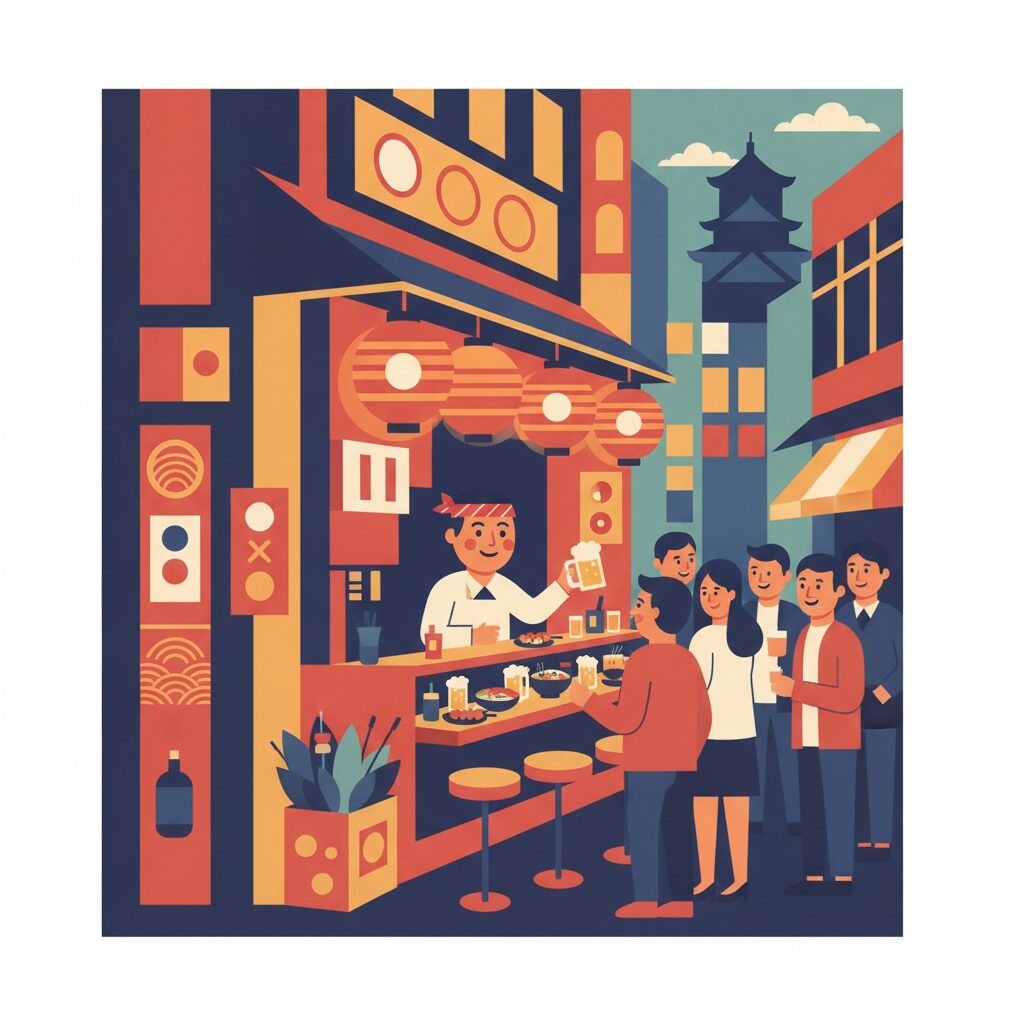
Step off the train at Tenma or Kyobashi after six in the evening, and you’ll find yourself adrift in a sea of sound and steam. The air, thick with the scent of grilled meat and savory dashi, pulls you into a labyrinth of glowing red lanterns and narrow alleyways. Here, under the rumbling train tracks and tucked into spaces barely wider than a doorway, you’ll find the beating heart of Osaka’s daily life: the tachinomi. The standing bar. To the uninitiated, these places can seem intimidating. There are no seats, no hosts to greet you, just a crowd of people packed shoulder-to-shoulder along a worn wooden counter, talking, laughing, eating, and drinking with a purposeful energy. It’s a world away from the hushed reverence of a Kyoto kaiseki restaurant or the polished, impersonal gloss of a Tokyo cocktail bar. This isn’t performative dining. This is life, lived on its feet.
For the foreign resident, the tachinomi presents a fascinating puzzle. It’s a space that feels simultaneously public and intensely private, a social club with an open-door policy. How do you enter? Where do you stand? What are the rules? The truth is, mastering the art of the tachinomi is a rite of passage for anyone trying to understand the Osaka mindset. It’s far more than a cheap place to grab a beer; it’s a living museum of the city’s merchant soul, a masterclass in social efficiency, and perhaps the most honest expression of what it means to live, work, and connect in Japan’s magnificent second city. It’s where you learn that in Osaka, community isn’t built around formal invitations, but forged in the delightful friction of shared, limited space. Before we dive into the unwritten constitution of the counter, let’s get our bearings. The area around JR Tenma Station is a classic starting point, a sprawling ecosystem of standing bars where this culture thrives.
Delving deeper into Osaka’s vibrant culture, you might also explore the enduring charm of its historic bunka jutaku apartments to see how traditional living spaces mirror the city’s lively, community-driven spirit.
The Tachinomi Trinity: Speed, Price, and Proximity

To understand why the tachinomi holds such a central place in Osaka, you need to grasp the three core principles that define its existence. These are more than mere business models; they are cultural values expressed through beer, skewers, and the absence of chairs. It’s a philosophy grounded firmly in pure, straightforward pragmatism.
Speed: The Get-In, Get-Out Approach
A tachinomi isn’t a spot to linger. You don’t settle in for a long, drawn-out evening. The entire concept prioritizes speed and turnover. It’s the home of the zero-kai — the pre-party drink before the main event — or the quick ippai, a single glass to unwind after work. The act of standing naturally discourages lingering. Your feet will signal when it’s time to move on. This embodies a key Osaka trait: an obsession with efficiency. Time isn’t meant to be wasted. The goal is to offer maximum satisfaction—good food, cold drinks, a bit of social interaction—in the shortest possible time. A whole meal, from first beer to last bite, can be completed in forty-five minutes. This isn’t rude; it’s the point. It’s a pit stop, not a destination—a brief pause in the middle of a busy day.
Price: The Economics of Standing Room
The most noticeable attraction of the tachinomi is the price. A draft beer might go for 350 yen, a highball 300 yen, and small plates of food start as low as 150 yen. This is the realm of senbero, a term meaning to get tipsy (berobero) for a thousand yen (sen-en). How is this achieved? Simple economics. By removing chairs and tables, the owner reduces the physical footprint, fitting more customers into a smaller space. This boosts turnover and revenue per square meter. Often, there’s no otoshi, the obligatory appetizer and table charge common in seated izakayas. All these savings go directly to the customer.
This isn’t just about being cheap; it’s about being savvy. Osaka’s past as Japan’s commercial center, the “kitchen of Japan,” has fostered a strong appreciation for kosupa (cost performance). An Osakan doesn’t just check the price; they evaluate the value. Spending extra on ambiance or brand prestige is often seen as wasteful when a no-frills spot delivers better quality at half the cost. A tachinomi perfectly embodies this mindset: it strips away everything unnecessary, focusing solely on the quality of food and drink. It’s a pure value exchange, and in Osaka, value reigns supreme.
Proximity: The Intimacy of Crowding
The final—and perhaps most crucial—element is proximity. In a tachinomi, you are physically close to strangers. Your elbows will brush. You’ll overhear conversations. You’ll have to ask someone to pass the shichimi pepper. This forced closeness acts as a powerful social lubricant. It breaks down typical Japanese reserve and creates a temporary, flexible community. There’s no room for pretense when you’re squeezed between a construction worker and an office manager, both enjoying a plate of doteyaki. This is where the stereotype of the “friendly Osakan” finds its most genuine expression. It’s not an abstract warmth; it’s a practical, situational friendliness arising from shared space. The tight quarters demand communication and cooperation, dissolving barriers in a way that a spacious, private booth never could.
Reading the Room: Unspoken Rules of the Standing Bar
Entering a tachinomi for the first time can feel like crashing a private party. The key is to exude quiet confidence and respect the unspoken rules. Think of it less as a restaurant and more as a shared public workshop. Everyone has their station and tools, and the aim is to operate smoothly alongside one another.
The Entry and The Claim
Hesitation is your foe. Peer inside, and if you notice any gap at the counter—even a small one—that’s your signal. Step in decisively. Don’t wait to be seated. Make eye contact with the person next to you and offer a slight nod or a quiet sumimasen (excuse me) as you slide in. Find your spot, claim it, and plant your feet. The staff, often a solitary taisho (master) or a stern mama-san, will have noticed your arrival. Catch their eye when you’re ready. If the bar is fully occupied with no visible gaps, don’t hang around awkwardly in the doorway. Proper etiquette is to move on. There’s another tachinomi just twenty steps down the alley.
The Order: Swift and Sure
The pace is brisk. Have your first drink order ready. Toriaezu biru (“Beer for now”) is the universal phrase, a perfect way to buy time while you scan the menu. The menu is often made up of handwritten paper strips called tanzaku plastered on the walls. Reading these can be tricky, a mix of kanji and katakana. This is your chance to engage. Point to what your neighbor is eating and say are, onegaishimasu (“That one, please”). Or ask the master for the osusume (recommendation). Order one or two dishes at a time. Large, single orders are out of place here. The rhythm is drink, dish, drink, another dish. This keeps the flow going smoothly for both you and the kitchen.
The Space and The Gear
Your personal space extends across your shoulders and the area directly in front of you at the counter. Be mindful of it. Hooks hang under the counter for bags and coats—use them. Don’t put your belongings on the counter, which is sacred ground for food and drinks. The counter is a shared space. Condiments like soy sauce, chili flakes, and salt are communal. If you need something from the other end, ask your neighbor to pass it along. This simple act of passing items down the line is a fundamental part of the communal experience.
The Exit: The Art of the Clean Break
Perhaps the most important rule is knowing when to leave. The guiding principle is sassato nonde, sassato kaeru—“Drink quickly, leave quickly.” A tachinomi is not a library. Nursing a single highball for an hour while scrolling on your phone is a cardinal sin. It occupies valuable space and disrupts the owner’s turnover. When you’re done, you’re done. Signal for the check (okanjo onegaishimasu). Payment methods vary. Some are cash-on, where you pay for each item as it arrives from a small tray of your own money. More commonly, you pay at the end. The master’s memory is often legendary, though sometimes they count plates. Have your cash ready. Settle up, offer a nod and a gochisosama deshita (“Thank you for the meal”), and make a swift exit. Someone else is waiting for your spot.
Beyond the Beer and Yakitori: What Tachinomi Reveals About Osaka
Once you become familiar with the mechanics, the tachinomi begins to emerge as a microcosm of Osaka itself. It functions as a social and economic institution that unveils the city’s authentic character, free from any tourist-oriented pretense.
A Social Leveling Ground
In the strict hierarchical environment of corporate Japan, the tachinomi acts as a great equalizer. The CEO of a small business might stand beside a part-time student, both commiserating over the Hanshin Tigers‘ recent defeat. Status, titles, and business cards hold no weight here. Your value is measured by your conversational skills, respect for the shared space, and appreciation for good, affordable food. This reflects a certain democratic, anti-authoritarian spirit within the Osaka mindset. People are evaluated more on their character and wit than their rank. It’s a place where conversations flow easily because the usual social barriers have been left outside.
Hyper-Localism and Strong Loyalty
While Tokyo’s drinking scene often feels dominated by large chains and slick brands, Osaka’s is fiercely local. Tachinomi are typically small, independent establishments, each boasting unique specialties and personalities. One might serve the freshest sashimi, another a secret simmered giblets recipe, and yet another be run by a sake enthusiast sourcing from obscure breweries. This focus fosters a culture of jouren, or regular patrons. People have their favorite spot, a local tachinomi where the owner knows their usual drink and they recognize the other regulars. This builds tight-knit, neighborhood-level communities. For a resident, discovering and becoming a regular at a local tachinomi is an essential part of truly belonging to their slice of the city.
Understanding Osaka “Friendliness”
Foreign visitors often comment that Osaka people are “friendly” and “open,” sharply contrasting with the perceived reserve of Tokyoites. The tachinomi is the perfect setting to grasp what this really signifies. Osakan friendliness isn’t about polite, surface-level niceties. It’s about straightforward engagement. The bar master might poke fun at your Japanese, another customer might ask a direct question about your home country, or someone may simply strike up a conversation about the food. This isn’t rudeness; it’s a form of connection. They treat you not as a delicate guest to be handled cautiously but as an equal participant in the scene. In Tokyo, silence often signals respect for privacy. In an Osaka tachinomi, silence can feel like a missed chance. Engagement is the default mode.
A Practical Guide for the First-Timer

Ready to dive in? Equipped with some basic knowledge, your first tachinomi experience can be thrilling rather than intimidating. Here’s a quick-start guide.
Prime Hunting Grounds
Certain neighborhoods are bustling hubs of standing bars. The areas around JR Tenma Station and JR Kyobashi Station are famous, with hundreds of options nestled within covered shopping arcades and beneath the train tracks. Namba’s back alleys, especially near Hozenji Yokocho, offer a similar atmosphere. For a more rugged, traditional experience, the Shinsekai district near Tsutenkaku Tower is the epicenter of tachinomi and kushikatsu culture. Start by strolling through these areas, and choose a spot that looks lively but has a small gap at the counter.
The Holy Trinity of Tachinomi Cuisine
While menus differ greatly, there are a few classic Osaka tachinomi dishes you definitely should try.
- Doteyaki (どて焼き): This is Osaka’s comfort food. It consists of beef sinew slow-simmered for hours in a flavorful, sweet stew of miso, mirin, and dashi until incredibly tender. Often bubbling away in a large pot on the counter, it pairs perfectly with a cold beer.
- Kushikatsu (串カツ): These are deep-fried skewers featuring meat, vegetables, and even cheese. They are affordable, tasty, and iconic. The crucial rule, posted everywhere, is 二度漬け禁止 (nidozuke kinshi)—NO DOUBLE-DIPPING. You dip your skewer once, and only once, into the communal tub of thin, tangy sauce. This rule is a vital custom for public hygiene and the ultimate test of tachinomi manners.
- Fresh Fish (お造り/焼き魚): Don’t let the modest setting fool you. Many tachinomi bars have excellent ties to the central market and offer surprisingly high-quality sashimi, grilled fish, and tempura at incredibly reasonable prices. Check the daily specials written on a whiteboard; that’s where you’ll find the freshest catch.
Tachinomi as a Way of Life
Ultimately, the tachinomi is more than just a bar. It serves as a lens through which to experience the authentic, unfiltered culture of Osaka. It reflects the city’s passion for value, its love of good food, its straightforward social nature, and its talent for fostering community in the most unexpected spaces. It is essentially a solo activity that seldom feels lonely. You arrive alone, enjoy your food and drink on your own terms, and leave when you’re ready. Yet during that brief moment at the counter, you become part of something larger—a transient, anonymous, yet profoundly human collective.
For any foreigner aiming to go beyond the surface of life in Osaka, learning to navigate the world of the standing bar is a vital skill. It’s where you’ll practice your Japanese, discover the rhythms of your neighborhood, and ultimately realize that in this city, you don’t need a chair to feel at home. You just need to find a small space at the counter, step up, and order a beer.