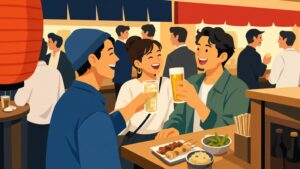
So you’ve been in Osaka for a bit. You’ve seen the neon lights of Dotonbori, you’ve eaten your fill of takoyaki, and you’ve maybe even figured out which side of the escalator to stand on. But you still have this nagging feeling, this question that hums beneath the surface of your daily life: where do the real people go? Not the tourists, not the weekend shoppers, but the tired, tie-loosened office workers who power this city from nine to five. Where do they unwind? Where do they shed the polite fiction of the workplace and become themselves again? The answer isn’t in a fancy cocktail lounge or a quiet, curated izakaya. It’s in a chaotic, smoky, and utterly intoxicating labyrinth of concrete and steel called Kyobashi. This isn’t a recommendation; it’s an orientation. Kyobashi is a cultural classroom disguised as a train station, and its primary subject is the art of the hashigo-zake, the bar-hop. Specifically, we’re diving into the world of tachinomi—standing bars. Forget what you think you know about Japanese bars, with their serene aesthetics and hushed tones. This is Osaka, unfiltered and unvarnished. This is where you learn how the city breathes after dark, one cheap beer and one grilled skewer at a time. It’s loud, it’s crowded, and it’s the most honest expression of Osaka’s soul you’re likely to find. Welcome to the salaryman’s paradise.
For an insightful contrast to Osaka’s bustling nighttime energy, consider exploring the distinctive kissaten culture that encapsulates the city’s daytime soul.
Why Kyobashi? The Unpolished Gem of Osaka Nightlife

To truly understand Osaka, you need to grasp its geography of release. Certain train stations serve as pressure valves for the city’s workforce, and Kyobashi is one of the most crucial. It’s not a destination in itself, which is exactly why it feels so authentic. No one comes to Kyobashi to visit a famous temple or a trendy boutique. They come because it’s a major intersection of their daily commute—the JR Loop Line, the Katamachi Line, the Tozai Line, the Keihan Main Line, and the Nagahori Tsurumi-ryokuchi subway line all converge here. It’s a human estuary where thousands of office workers from Osaka, Kyoto, and Nara spill out of their train carriages each evening, forming a powerful, temporary current of humanity that flows straight into the hundreds of tiny bars clustered around the station.
The Symphony Under the Tracks
The core of Kyobashi’s tachinomi scene beats right beneath the elevated train tracks. This is more than a metaphor. Standing shoulder-to-shoulder with strangers, the entire structure occasionally rumbles and roars as trains pass overhead. The sound becomes a rhythmic, percussive backdrop to the evening. It constantly reminds you of motion, transit, and the fleeting nature of the moment. The air is thick with a complex mix of aromas: the sweet, soy-based scent of doteyaki (beef sinew stew) simmering in large pots, the sharp, savory smell of grilled chicken skin, the faint acrid tang of aged cigarette smoke clinging to the walls, and the yeasty perfume of draft beer. Visually, it’s a chaotic collage of handwritten menus taped to walls, glowing red lanterns, steam fogging the windows, and bartenders moving with an economy of motion perfected over decades.
Tokyo’s Shimbashi vs. Osaka’s Kyobashi: A Tale of Two Salaryman Cities
If you’ve spent time in Tokyo, you might think you’ve seen this before. Shimbashi, near Ginza, is Tokyo’s best-known salaryman district. On the surface, they seem alike: clusters of cheap bars under train tracks catering to office workers. But the experience is fundamentally different, and this difference reveals the core of the Osaka-Tokyo cultural divide. Shimbashi, despite its grit, still holds a certain Tokyo-esque reserve. Groups tend to stick together, conversations stay a few decibels lower, and social boundaries remain more defined, even when drinking. It’s a collective unwinding, but within established circles.
Kyobashi is a free-for-all. The boundaries are blurred. The volume is turned up to eleven. Here, proximity isn’t just physical; it’s social. You’re not only standing next to someone; you’re sharing a piece of their day. The energy isn’t about polite decompression; it’s about cathartic, communal release. The Osakan mindset prizes directness and breaking down formality, and the tachinomi provides the perfect setting. There’s no room or time for pretense. This isn’t about networking or maintaining appearances. It’s about a cheap drink, a good bite, and a shared laugh with whoever happens to be beside you before you all dissolve back into the city’s circulatory system.
The Unspoken Rules of the Tachinomi
Walking into a crowded Kyobashi standing bar for the first time can feel intimidating. There’s no host to welcome you, no menus on the table, and seemingly no available space. However, there is a rhythm and a set of unwritten rules that, once grasped, make the experience run smoothly. Mastering them is your ticket into this world.
The Gentle Art of the Squeeze
Your initial challenge is finding a spot. Don’t wait to be seated. Scan the counter for any gap, even a small one. The key is to approach with a polite yet confident demeanor. Catch the eye of someone near the gap and give a slight nod or a small bow. A quiet “Sumimasen, chotto ii desu ka?” (“Excuse me, is this all right?”) works wonders. People will instinctively shift, pulling in their bags and elbows to create just enough space for you. This is the first rule: space is a shared resource. You don’t own your spot; you are temporarily occupying it. Your task is to be mindful of your footprint. Keep your bag at your feet, not on the counter. Don’t stretch your arms out. It’s a delicate dance of constant, slight adjustments that allows a surprising number of people to coexist in a tiny space. This isn’t just about politeness; it’s a deep-seated Osakan pragmatism. We make it work, together.
The One-Drink, One-Dish Philosophy
Tachinomi are not venues for long, lingering meals. They are pit stops. The system is designed for speed and efficiency. The unspoken rule is that you order at least one drink and one food item. This is essential. Ordering just a beer and occupying space for an hour is a faux pas. The business model depends on turnover. Think of your visit in terms of 15 to 30-minute increments.
When you’re ready to order, don’t wait for the staff to approach you. They are constantly busy. You need to confidently catch their eye and state your order clearly and briefly. Start with your drink: “Nama-biru, hitotsu!” (“One draft beer!”). Then add a food item. If you’re uncertain, just point at what the person next to you is having and say, “Are, kudasai” (“That, please”). It’s a foolproof strategy and often a great icebreaker.
Deciphering the Wall of Food
Forget laminated menus with pictures. In a traditional tachinomi, the menu is a collection of wooden or paper slips called fuda, pinned to the wall, with dishes written in Japanese calligraphy. This can be daunting for a non-native reader. Don’t worry. This is your chance to observe. Look at the simmering pots on the counter. You’ll likely see doteyaki (the aforementioned beef stew) and oden (a winter dish of various ingredients like daikon radish, tofu, and fish cakes simmered in a light broth). You’ll notice skewers (kushimono) being grilled. These are your safe options.
Key vocabulary to watch for:
- どて焼き (Doteyaki): The quintessential Osaka bar food. Rich, slightly sweet, and melts in your mouth.
- 串カツ (Kushikatsu): Deep-fried skewers of meat and vegetables. A golden rule here: absolutely no double-dipping in the communal sauce container!
- おでん (Oden): Comfort food. Just point at the items you want in the large simmering vat.
- ポテサラ (Potesara): Potato salad. Every bar has its own unique recipe, and it’s a surprisingly popular choice.
The Ritual of Payment
Payment methods vary. The two most common are cash on delivery (kyasshu on), where you place money in a small tray on the counter and the bartender takes payment as each order arrives, or settling the bill at the end. If you see a tray, use it. If not, the staff keep a mental or written tab. When you’re ready to leave, simply say “O-kaikei, onegaishimasu” (“The bill, please”). Be prepared with cash. While some larger places now accept cards or electronic payments, the soul of Kyobashi runs on crumpled yen notes and clinking coins. It’s quicker, simpler, and part of the old-school charm.
How Osaka People Think and Act in a Bar
This is where we transition from logistics to the cultural psychology of Osaka. A tachinomi serves as a social laboratory, showcasing the city’s true character. It’s loud, straightforward, and surprisingly intimate.
The “Tonari no O-chan” Phenomenon
In Tokyo, initiating a conversation with a complete stranger at a bar might be met with suspicion. In Osaka, it’s almost expected. This is the “Tonari no O-chan/Ni-chan” phenomenon—the person next to you. After a drink or two, the invisible barriers that separate people in everyday life vanish. Don’t be surprised if the middle-aged man beside you, the o-chan, turns and asks, “Nani shiten no?” (“What are you up to?”) or remarks on your food choice, “Sore, umai de!” (“That’s a good one!”).
This isn’t an intrusion; it’s an invitation. It’s a fundamental aspect of the Osakan social mindset. There’s a belief that sharing a space means sharing an experience. They are genuinely curious. Where are you from? What do you do in Osaka? Do you like baseball? (The right answer is always the Hanshin Tigers). This interaction is often misunderstood by foreigners. It’s not necessarily the start of a lasting friendship. It’s a temporary alliance, a brief connection in the everyday hustle. It’s a performance of community. You enjoy the conversation, share a laugh, and then you both go your separate ways, probably never to meet again. And that’s perfectly fine. It’s about the moment, not what comes next.
The Language of Satisfaction
Listen to the sounds inside the bar. You won’t hear many quiet, polite “Oishii desu ne” (“It’s delicious, isn’t it?”). Instead, you’ll hear a chorus of guttural, expressive exclamations in Osaka-ben: “Meccha umai!” (“Freakin’ delicious!”), “Kore, akan wa!” (Literally “This is no good!” but used ironically to mean “This is dangerously good!”), or a simple, satisfied groan of “Umaa!” This is how Osakans express enjoyment—directly, loudly, and with their whole body. It’s not considered rude to be loud; it’s considered sincere. You’re sharing your positive experience with the room, giving feedback to the chef, and adding to the lively atmosphere. To be quiet is to be distant. To be expressive is to be part of the community.
A Sample Kyobashi Bar-Hop: The Local’s Route
Forget about a list of the “best” bars—that’s a tourist mindset. The hashigo-zake is about the journey, the flow, and the gradual deepening of the experience. Here’s how a local might navigate an evening.
Stop 1: The Overture – A Beer and Doteyaki Under the Keihan Line
Begin at one of the legendary, sprawling tachinomi spots right by the Keihan station entrance, such as Toyo or Maru. These places are institutions. Your first stop is about recalibrating your senses. You squeeze into a spot, order a draft beer that arrives almost immediately, and a small bowl of doteyaki. The goal here isn’t to get full—it’s a primer. You have one beer, finish your dish in ten minutes, and soak in the initial blast of noise and energy. You’re acclimating, shedding the skin of your workday. You pay your 700 yen and head out. The night has officially begun.
Stop 2: The Deep Dive – Kushikatsu and the No-Double-Dip Rule
Next, slip into a smaller, more specialized alley. The Kyobashi Tachinomi Street, a narrow covered arcade, is perfect for this. Here you’ll find a place devoted to kushikatsu. The counter is lined with stainless steel trays of skewered meats, vegetables, and even cheese. You order a few at a time. The freshly fried skewers arrive, golden and crisp. Before you is the communal tub of dark, thin dipping sauce. You dip your skewer once, and only once. This is the sacred rule. Once it has touched your mouth, it cannot go back into the sauce. If you need more sauce, use the provided piece of raw cabbage as a spoon to scoop it onto your plate. This ritual is a lesson in public hygiene and social trust, learned over cheap beer and fried lotus root. You might switch from beer to a chuhai (shochu highball) here, cleansing your palate for what’s next.
Stop 3: The Hidden Gem – A Sake and a Quiet Word
Now that you’re warmed up, it’s time to find a real hidden gem. You wander away from the main streets, into a darker, quieter side street. You spot a simple Noren curtain over a doorway with a single red lantern. Inside, the place fits maybe six people. The master, an old man who has likely been standing behind that counter for four decades, barely looks up. The other patrons are quiet regulars. This is where you switch to sake. You don’t ask for a brand; you say “O-kan, kudasai” (“Warm sake, please”) and trust him to pour you the house standard. You order something simple, like shiokara (fermented squid guts) or some pickles. The conversation here, if it happens, is more subdued. It’s a place for contemplation, a quiet moment amid the storm. Here you might have one of those fleeting, memorable conversations with a stranger about life, work, or the Tigers’ chances this year.
The Final Stop: The Shime
The night wraps up with the shime, a final dish to close things out. While ramen is the famous choice across Japan, in the context of the Kyobashi bar-hop, the shime might be something different. It could be a last quick beer at yet another bar, or a simple bowl of su-udon (plain udon noodles in broth) from a 24-hour noodle stand inside the station. The idea is to take one last, simple taste to settle your stomach and signal to your body that the evening’s journey is over. It’s a full stop, a punctuation mark on the night, before you catch that last train home.
Kyobashi is More Than a Drink; It’s a Daily Ritual
To view Kyobashi merely as a collection of cheap bars is to completely overlook its significance. It is a vibrant, living ecosystem that serves a crucial role in the city. It represents a transitional space—between work and home, between public formality and private relaxation, between being part of the corporate machine and asserting individuality. The standing bars of Kyobashi reflect the Osakan spirit: practical, impatient with formalities, deeply communal, and finding joy in simple, unpretentious pleasures. They remind us that in a city as hardworking as Osaka, the rituals of unwinding are as essential as the work itself. Living here means embracing these rhythms. It means understanding that a city’s true culture isn’t always showcased in polished museums or famous landmarks but is sometimes found in a crowded, smoky bar beneath a rattling train track, sharing a plate of grilled chicken skin with a stranger you will never meet again.