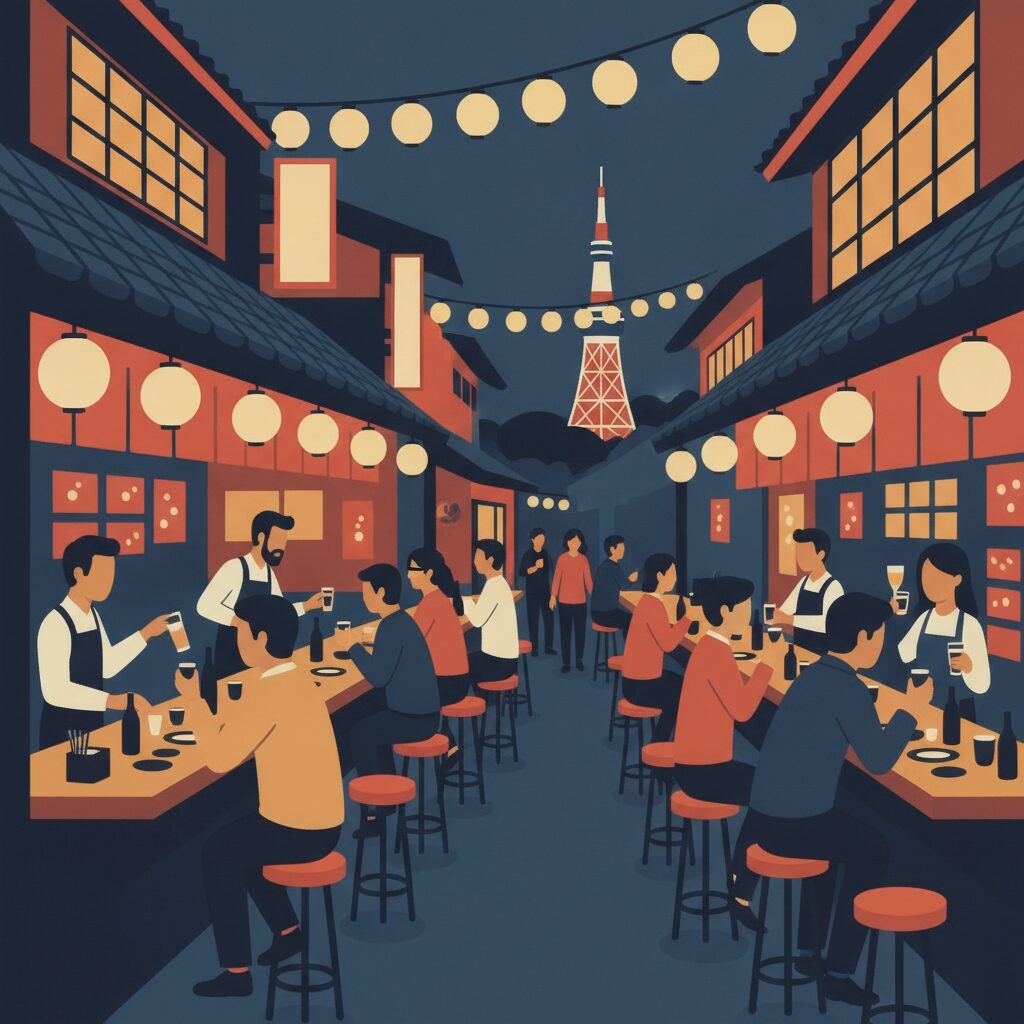
Walk down any covered shopping arcade in Osaka after 5 PM, maybe in the labyrinthine alleys of Tenma or the gritty, neon-soaked streets of Kyobashi, and you’ll see them. The bright red lanterns, the steam billowing out into the cool night air, the sound of laughter and clanking glasses spilling out onto the pavement. These are tachinomi, or standing bars. From the outside, they can look like chaos incarnate. A wall of people, mostly men in suits with their ties loosened, packed shoulder-to-shoulder in a space no bigger than a generous living room. There are no chairs, no tables, just a long counter and a sea of bodies. Your first instinct, especially if you come from a place where personal space is sacred, might be to walk right on by. It looks impenetrable, a private party you weren’t invited to. You might think, “How could I ever fit in there? Who would I even talk to?” This is a question many foreigners, and even many Japanese people from outside Osaka, ask themselves. In Tokyo, a bar is often a place of quiet refuge or a pre-arranged social event with colleagues or friends you already know. You stick to your designated group, your little island in a sea of strangers. But in Osaka, the tachinomi flips that script entirely. It’s not a place to escape the city; it’s a place where you dive into its very heart. It’s the city’s public living room, and understanding how it works is one of the fastest ways to understand the soul of Osaka itself. This isn’t just about cheap beer and fried skewers. It’s about a fundamentally different approach to social interaction, one that is built on casual, fleeting, yet surprisingly meaningful connections. Forget the awkward networking events or the pressure of formal introductions. The tachinomi is where Osaka’s famous friendliness stops being a vague stereotype and becomes a tangible, noisy, and incredibly welcoming reality.
Curious minds can explore the unspoken rules of Osaka tachinomi to uncover how these vibrant spaces foster genuine social connections across the city.
The Unspoken Invitation: Why Standing Breaks the Ice
The magic of the tachinomi begins with its most fundamental feature: the absence of chairs. This isn’t about saving costs; it’s a marvel of social engineering. In a typical bar, tables and chairs create invisible boundaries. You have your space, and they have theirs. Crossing that line to talk to someone at another table requires a considerable amount of social energy and carries the risk of rejection. You need a reason, an opening line, a purpose. In a tachinomi, those boundaries disappear. Simply standing at the counter physically places you in a single, fluid group. Your personal space contracts, but your social space expands dramatically. The man to your left ordering a highball, the woman to your right dipping a skewer of chicken into sauce—they aren’t strangers in the same way as they would be at separate tables. You share a few square feet of the same floor, breathe the same smoky air, and your elbows nearly touch. This close physical proximity fosters an immediate, unspoken sense of shared experience.
This dynamic environment lowers the barrier to conversation almost to zero. People drift in and out. Some might stay for fifteen minutes, enjoy a beer and a plate of doteyaki (slow-cooked beef sinew), and then disappear back into the night. Others might linger for hours, becoming a temporary part of the evening’s scene. This transience is essential. Interaction doesn’t have to mean commitment. You can strike up a conversation, share a laugh, then say goodbye without any awkwardness. It’s like social speed dating, but for friendship. This stands in sharp contrast to bar culture in Tokyo. While Tokyo does have standing bars, they often feel more utilitarian. They serve as quick stops for solitary salarymen before catching the last train—efficient places to refuel. The focus is often on the quality of sake or craft beer, with conversation being secondary or optional. In Osaka, drinks and food are just fuel; conversation is the driving force. The entire point of the place is to act as a social hub, a spontaneous gathering spot where the only entry requirement is a willingness to stand and be present.
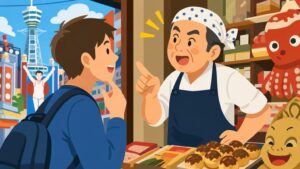
I recall my first solo tachinomi experience in the Shisekai area. I squeezed into a tiny gap at a counter slick with spilled beer. A man in his sixties, his face marked by a life well-lived, was nursing a cup of warm sake. He noticed my bewildered look as I stared at the Japanese-only menu scrawled on the wall. Without speaking, he pointed to his plate of glistening boiled pork, then to me, raising his eyebrows in a question. I nodded. He grunted to the owner, raised one finger, and a minute later, the same dish appeared before me. He then turned, raised his cup, and simply said, “Kanpai.” That was it. We spent the next half hour talking in broken Japanese and English about everything from the Hanshin Tigers baseball team to the best way to cook octopus. There was no agenda, no pretense. We were just two people sharing a counter, and that was reason enough to share a moment.
“Nani Nondoru?”: The Osaka Toolkit for Starting a Chat
One of the biggest challenges for foreigners in Japan is mastering the art of conversation, especially with strangers. The culture can feel indirect, and approaching someone you don’t know can seem intimidating. The Osaka tachinomi offers a handy shortcut. Here, starting a conversation is not just accepted—it’s expected. And the people of Osaka have a wonderfully simple toolkit for doing it. It often begins with a question about what’s right in front of you. “Nani nondoru?” (“What are you drinking?”) is a classic opener. It’s direct, straightforward, and a sincere question. They notice you with a beer they don’t recognize or a colorful cocktail, and their natural curiosity kicks in.
Another popular approach is commenting on food. “Sore oishisou ya na, nani?” (“That looks delicious, what is it?”). This invites you to share your experience. You might reply, “It’s kushikatsu, you should try it!” Suddenly, you’re no longer just a stranger; you become a temporary food guide, a fellow explorer in the bar’s culinary world. Such interactions can be misunderstood by outsiders. In Tokyo, and certainly in many Western cultures, a stranger asking direct questions about your food or drink might feel intrusive or forward. You may wonder about their intentions. In an Osaka tachinomi, what they usually want is simply to talk. The question serves as a conversational key, unlocking a door that’s already partly open. The unspoken assumption in these spaces is that everyone is a potential friend. If you choose to stand in that crowded room instead of heading home, you’ve already indicated your openness to being part of the group.
It also helps that the local dialect, Kansai-ben, is naturally more rhythmic, direct, and casual than standard Japanese. It’s a dialect built for banter and teasing. The intonation rises and falls more dramatically, making conversations feel livelier and more engaging. You don’t need to be fluent. Even attempting a single phrase of Kansai-ben like “Meccha oishii!” (“Super tasty!”) or “Honma?” (“Really?”) often brings delighted laughter and a warmer welcome. It shows you’re making an effort to connect on their level, to enter their world. People will often gently correct your pronunciation or teach you a new, more colorful phrase, turning this exchange into a bonding experience. The language, like the bar’s physical space, becomes a bridge rather than a barrier.
The Economics of Socializing: Why Cheap is Cheerful and Communal
You can’t discuss tachinomi culture without mentioning money—or more precisely, the minimal amount needed. A draft beer might cost as little as 300 yen, a highball 250 yen, and a plate of pickled vegetables or a savory skewer around 150 yen. You can enjoy a couple of drinks and some snacks for under 1,000 yen (roughly 7 US dollars). This affordability isn’t just a bonus; it’s essential to the entire social ecosystem. The low prices make the experience accessible to everyone. The person standing next to you could be a high-powered executive, a construction worker, a university student, or a retiree living on a pension. The bar acts as a great equalizer, where social status—usually indicated by where you can afford to eat and drink—is temporarily set aside.
This low cost encourages a wonderfully casual and generous atmosphere. You’ll frequently see the phenomenon known as “Ogotta-ru wa” (“I’ll get this one for you”). It’s not a grand gesture; it’s simply a man who’s been chatting with you for ten minutes saying, as he leaves, “Ano onii-san no tsugi no ippai, tsuke toite” (“Put that guy’s next drink on my tab”). This small act fosters immediate camaraderie, with no expectation of repayment. It’s a way of expressing, “I enjoyed our conversation. Welcome.” This spontaneous, informal gesture contrasts with the more formal, reciprocal gift-giving or treat-exchanging customs found elsewhere in Japan. It’s rooted in the shared experience of the moment.
This creates a sharp contrast with nightlife in other major cities. In Tokyo, while cheap bars exist, popular districts often feature table charges, pricier drinks, and a more curated, high-design vibe. There, it can feel like you’re paying for a polished experience. An Osaka tachinomi, however, feels more like paying for a utility: access to a warm, lively space filled with people. The emphasis is on function over form, community over curation. This practical approach is quintessentially Osaka. Why spend 800 yen on a beer in a quiet, stylish bar where you only talk to the person you came with, when you can spend 300 yen here and potentially strike up conversations with ten new people? It’s a straightforward calculation of social return on investment, and in Osaka, the math always favors connection.
Navigating the Flow: The Unwritten Rules of the Standing Bar
Despite its seeming disorder, the tachinomi follows a refined set of unwritten rules and shared understandings. It’s a delicate dance, and learning the moves is part of the initiation. The first rule concerns space, which is a precious commodity. You learn to make yourself small, turn sideways to let others pass, and hold your glass close as you move from the counter to a slightly less crowded spot. When someone new arrives seeking a place to stand, people instinctively shuffle and squeeze together to create just enough room. This is a collective, silent effort to always accommodate one more. Your bag doesn’t get its own space; you either hang it on a hook beneath the counter or keep it tucked between your feet. Taking up more space than necessary is the biggest social misstep you can make.
Next is the issue of payment. Many traditional tachinomi operate on a cash-on-delivery system, or kyasshu on. You place a 1,000 yen bill or some coins in a small tray before you. Each time you order, the staff removes the exact amount from the tray. This system is incredibly efficient. It removes the hassle of flagging down a busy bartender for a bill, figuring out who owes what, and waiting for change. It keeps the bar’s energy flowing and supports its transient, no-fuss nature. You can leave immediately after your last sip. This system is founded on trust and pragmatism, two core values of the Osaka mindset.
The most important figure in this entire ecosystem is the taisho or master—the owner or manager behind the counter. They are more than just a bartender; they are the conductor of a social orchestra. A good taisho knows the names of their regulars, recalls their usual drinks, and skillfully steers conversations. They might say, “This guy is from England! He thinks our winters are cold, can you believe it?” to the person next to you, sparking a connection. They are the gatekeepers and facilitators, ensuring the bar stays welcoming to both seasoned regulars and wide-eyed newcomers. Building a rapport with the taisho is essential to becoming part of the place’s fabric.
Lastly, there are social expectations. The most crucial is to be present with the room, not your phone. Scrolling through social media in a tachinomi is like wearing headphones at a concert. You’re physically there but mentally elsewhere, which contradicts the communal spirit of the space. You’re meant to engage, listen, talk, and become part of the fleeting community that forms each night.
From Bar Counter to Barbecue: When Tachinomi Friendships Leave the Nest
Perhaps the most surprising aspect of the connections formed in an Osaka tachinomi is that they often continue even after you step outside. It’s common to hear people part with a cheerful, “Kondo, mata!” (“See you again soon!”) or “Ja, mata doumo!” (“Well then, thanks again!”). In many situations, this might be just a polite, casual goodbye. But within the tachinomi culture, it frequently carries a sincere promise. It’s not unusual for a lively conversation at the bar to conclude with an exchange of LINE contacts or Instagram handles.
This is where the tachinomi truly shines as a social incubator for locals, rather than merely a fleeting experience for visitors. These casual meetings often develop into genuine friendships. I’ve witnessed this happen repeatedly. A conversation about fishing with a stranger at a bar in Namba can lead to an invitation to join him and his friends on a boat trip the following weekend. A shared passion for an obscure musician, discovered while shouting over the noise in Tenma, might result in attending a concert together a month later. A chat about cooking with a woman at a tiny sake bar can turn into an invitation to a takoyaki party at her home.
This is what truly sets the experience apart from a typical night out. At a seated bar, you’re contained within your group of friends, aiming to strengthen existing bonds. At a tachinomi, the goal is to form new ones. The very design of the place is meant to speed up the process of turning strangers into acquaintances, and acquaintances into friends. For anyone looking to settle in Osaka, to lay down roots and build a social network from scratch, the tachinomi is an invaluable resource. The key is consistency. You can’t just drop by once. Find one or two local spots you like and become a regular. The first visit, you’re a customer. The second visit, you’re a familiar face. By the third or fourth time, someone will greet you with, “Ah, maido!” (“Welcome back!”), and you’ll realize you’re no longer just a visitor. You’re part of the community.
Ultimately, the standing bar serves as a perfect metaphor for Osaka itself. It may appear loud, crowded, and somewhat intimidating from the outside. But once you muster the courage to step inside, you discover a place that is unpretentious, remarkably efficient, and built on a deep-rooted belief in the value of human connection. It’s where the city’s spirit of pragmatic friendliness is brewed and shared daily. So if you’re feeling a little lost or lonely in this vast metropolis, the solution might be simpler than you imagine. Find a red lantern, push aside the plastic curtain, and snag a small spot at the counter. Order a beer, turn to the person next to you, and offer a simple “Kanpai!” It’s Osaka’s way of saying, “There’s always room for one more.”