Walk through Dotonbori on any given night, and Osaka hits you like a confetti cannon of sensory overload. The electric flash of the Glico Running Man, the giant mechanical crab waving its claws with unnerving enthusiasm, the hypnotic sizzle of takoyaki batter hitting hot iron. This is the postcard image of Osaka’s famous creed: Kuidaore. The word is plastered everywhere, a rallying cry for tourists and locals alike. It’s usually translated as “eat until you drop,” or more dramatically, “eat yourself into bankruptcy.” It’s a fantastic slogan, promising a city of endless indulgence, a culinary playground where the only rule is to keep eating. But after living here, weaving through the crowded shotengai and ducking into smoky back-alley izakayas, I’ve learned that the tourist-facing slogan is just the flashy wrapper on a much deeper, more complex, and infinitely more interesting philosophy. Kuidaore isn’t about gluttony; it’s a mindset. It’s a daily practice, a cultural language, and the invisible engine that powers this city’s relentless, vibrant heart. It’s the secret code to understanding why Osaka feels so fundamentally different from the polished, reserved elegance of Tokyo. To truly grasp what makes this city tick, you have to look beyond the giant octopus signs and understand how the people of Osaka practice kuidaore not as a wild vacation splurge, but as a way of life.
For travelers looking to balance Osaka’s vibrant culinary scene with a taste of nature, a weekend hiking excursion offers a refreshing counterpoint.
The True Ledger of ‘Kuidaore’

Let’s examine the word itself. Kui (食い) means ‘to eat,’ while Daore (倒れ) means ‘to collapse’ or ‘to go bankrupt.’ The image it evokes is one of utter abandon—a person so devoted to pursuing delicious food that they spend their last yen on a perfect slice of fatty tuna, collapsing in a state of blissful, penniless contentment. However, the historical essence of this term isn’t about losing control; it’s about overflowing passion. Osaka was, and in many ways still is, Japan’s merchant capital. It was the country’s kitchen, where rice and goods from across the nation were gathered, traded, and sold. This fostered a city of pragmatic, discerning businesspeople who understood value better than anyone. For them, food was more than sustenance; it reflected their craft. A merchant serving bad food was a merchant untrustworthy in business. A customer unable to distinguish between good and great was one easily swindled. Thus, kuidaore developed not from gluttony, but from an obsessive, merchant-class appreciation. It represents the willingness to invest—even to the point of ‘bankruptcy’—in quality, flavor, and authentic experiences. It embodies the belief that spending your hard-earned money on an exceptional meal is one of the best investments you can make. This philosophy dismisses the notion that fine dining is only for the elite. In Osaka, the keenest food critic might be the taxi driver, the office worker, or the grandmother shopping for groceries. Everyone is an expert, and everyone has an opinion.
The Holy Trinity: Umai, Yasui, Hayai
If kuidaore is the guiding philosophy, its daily mantra is a three-word chant you’ll hear repeated endlessly: Umai, Yasui, Hayai (Delicious, Cheap, Fast). While this might sound like the catchphrase of a typical fast-food chain, in Osaka, it represents a complex formula for gauging value and serves as the ultimate standard for nearly every meal. Food must satisfy all three criteria to be truly exceptional. The true gems of Osaka’s everyday dining scene are those that achieve a flawless harmony of all three elements. This trio dictates the lunchtime choices of millions and explains why a restaurant with a queue out the door at noon is likely worth your attention, no matter how modest its appearance. It’s the practical embodiment of the grand kuidaore philosophy, enacted daily on the city streets.
The Gospel of ‘Cospa’ (Cost Performance)
More than anywhere else in Japan, Osaka thrives on the principle of cospa, a shortened form of ‘cost performance.’ This is the relentless, almost spiritual quest to obtain the highest possible quality for the price paid. It is the core of yasui (cheap) in this sacred triad. However, ‘cheap’ here is often misunderstood. It does not simply mean low-priced. An Osakan will readily pay a premium for a truly outstanding meal, but it must be worth it. On the other hand, spending 1,500 yen on a bland, forgettable pasta lunch is regarded as a grave offense, a personal failure in judgment. Feeling shortchanged, even by a few hundred yen, wounds the Osaka soul more than any culinary letdown. This reverence is why the lunch special is a hallowed tradition. Office workers scatter from their buildings with the precision of hunters, searching for the ideal 800-yen teishoku (set meal), which includes a perfectly fried piece of fish, flawless rice, flavorful miso soup, and a couple of well-prepared side dishes. They assess their options as seriously as stock traders. “That place offers free rice refills.” “This one uses superior quality miso.” “The line is long over there but moves quickly.” It’s a daily ritual of calculation and gratification. The excitement of kuidaore lies not only in eating but in the chase for the best deal, the discovery of a hidden gem where quality far surpasses price. This pragmatic approach starkly contrasts with Tokyo, where branding, celebrity chef endorsements, or stylish interiors often justify higher prices. In Osaka, the guarantee is only on the plate.
‘Umai’ is the Unshakable Foundation
While cospa reigns supreme, it means nothing if the food isn’t truly umai (delicious). This is the non-negotiable cornerstone of the entire culture. The collective palate of this city is famously exacting, sharpened by centuries as Japan’s kitchen. The standard for quality is simply higher. This is most apparent in the city’s passion for dashi, the essential soup stock that forms the soul of Japanese cuisine. Osakans possess an innate, profound understanding of what constitutes good dashi. It should be light yet intricate, with a clean umami flavor derived from premium kombu (kelp) and katsuobushi (bonito flakes). A bowl of udon noodles may cost just 500 yen, but if the dashi tastes weak or artificial, the restaurant will be harshly judged and likely won’t survive. This pressure fuels fierce competition. From Michelin-starred kappo restaurants to tiny, family-run takoyaki stands hidden in forgotten shotengai corners, there is an unspoken pledge to get it right. A bad meal is an insult not only to the customer but to the entire culinary ecosystem. That’s why Osakans patiently queue at one particular stall, even if another selling the same item is just a few meters away with no line. They know. They taste the difference in the batter, the quality of the octopus, the secret ingredient in the sauce. This grassroots expertise, a citywide panel of citizen judges, maintains incredibly high standards and turns eating here into a continuous journey of discovery.
Kuidaore in the Wild: A Neighborhood Safari
To truly experience kuidaore in action, you need to break free from Namba’s gravitational pull and venture into the city’s various neighborhoods. Each area boasts its unique character, its own culinary environment where the principles of deliciousness and value are continuously tested and validated. Here, the theory transforms into something gloriously messy and irresistibly real.
The Shotengai: The Everyday Testing Ground
The shotengai, or covered shopping arcade, serves as the lifeline of neighborhood life in Osaka. Far from being a charming relic, it is a vibrant arena of flavor and value. Stroll through the Tenjinbashisuji Shotengai, Japan’s longest, and you’ll discover a living museum of kuidaore. It’s not about elegant restaurants; it’s about experts. There’s the butcher whose deep-fried croquettes, crispy and golden on the outside and fluffy and savory inside, keep locals lining up for a quick bite. There’s the tofu shop, run by three generations, whose silken tofu far surpasses supermarket varieties. There’s the tea vendor who lets you sample various brews while sharing their backgrounds. Life here thrives on relationships and trust. People buy from these shops not only for quality but because they know the owners. The shotengai offers the essentials for a great homemade meal, and it’s also the place to find the finest, most affordable prepared foods, each a small testament to the owner’s pride and craft.
Tenma: The Salaryman’s Maze
Just north of the city center lies Tenma, a chaotic and delightful labyrinth of narrow alleys packed with hundreds of tiny izakayas, standing bars (tachinomi), and specialized eateries. This is the after-work playground for Osaka’s salarymen and women, representing kuidaore in its most lively and genuine form. Lanterns cast a warm glow over streets filled with laughter and the clinking of glasses. The air is rich with the aromas of grilled yakitori, simmering oden, and fresh sashimi. The aim here is to move from one venue to another, savoring a specialty dish and drink at each stop. You might begin at a standing bar with a cheap beer and some doteyaki (beef sinew stewed in miso), then head to a tiny stall for grilled scallops, and wrap up at a ramen shop. The focus is on social, communal dining. It’s noisy, crowded, and incredibly enjoyable. Tenma captures the spirit of exploration—you wander until a scent or a sound draws you in. There are no reservations, no dress codes, only a never-ending array of high-quality, budget-friendly choices.
Tsuruhashi: A Symphony of Smoke and Kimchi
Disembark at Tsuruhashi, and you are immediately enveloped by the unmistakable, mouth-watering scent of grilled meat. This is Osaka’s Koreatown and the undisputed center of yakiniku (Japanese-style Korean barbecue). The streets are a lively mix of kimchi shops, Korean grocery stores, and most importantly, dozens upon dozens of yakiniku restaurants. Here, the kuidaore philosophy is applied to meat cuts. Locals passionately debate which place serves the best horumon (offal), the most tender kalbi (short ribs), or the richest marinade. The competition is so fierce that quality is a given; restaurants differentiate themselves through subtle details—the specific cut, house-made sauces, and the quality of charcoal used for grilling. Tsuruhashi illustrates how kuidaore encourages specialization. A neighborhood can become world-famous among locals for perfecting a single culinary style, turning it into a pilgrimage spot for those seeking the absolute best.
The Osaka Dinner Table Conversation
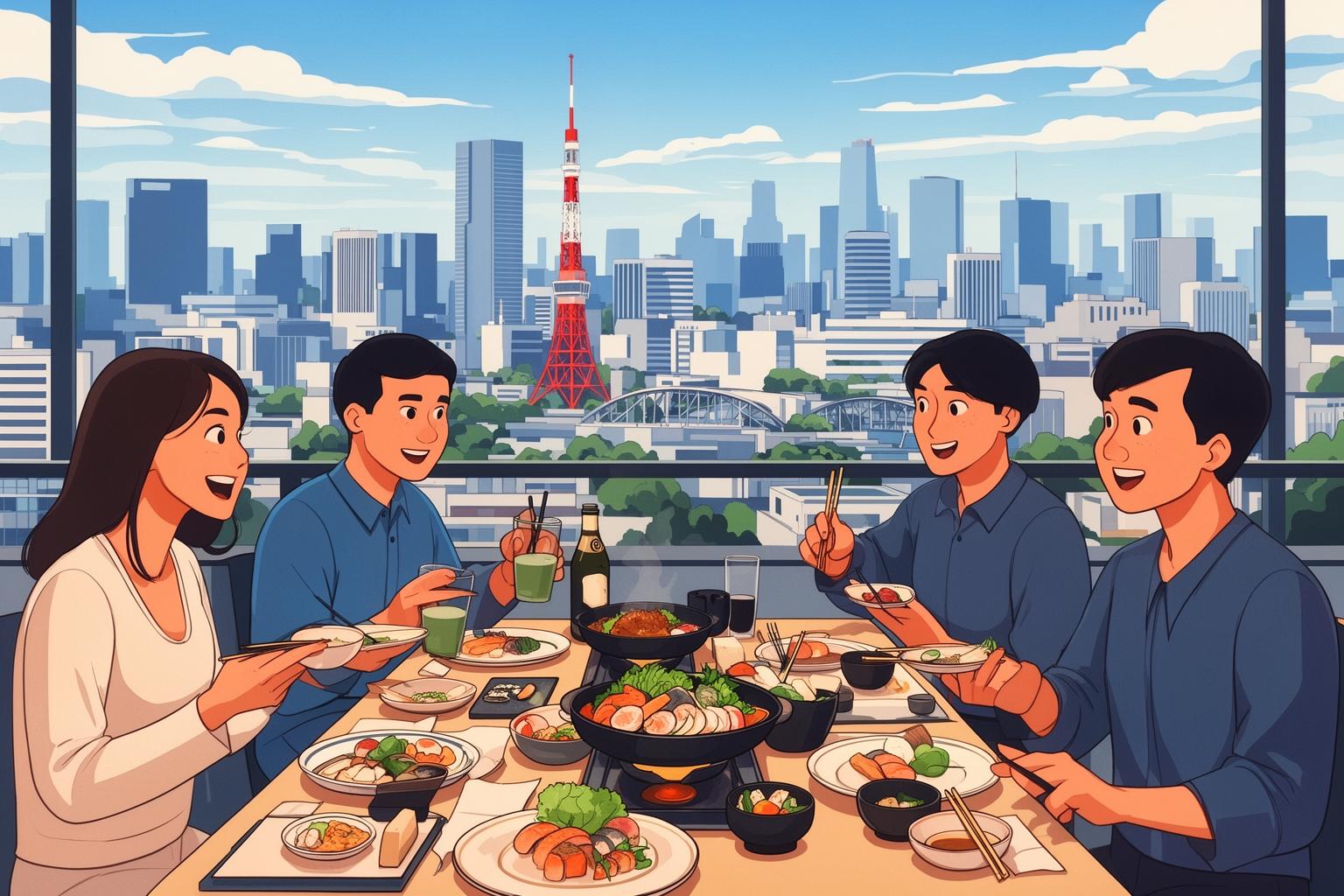
One of the clearest signs of Osaka’s food-centered culture is the way people talk. Food isn’t merely a conversation topic; it often is the conversation. When meeting a friend, after the usual greetings, the question almost always is, “Have you eaten anything good lately?” People share their latest discoveries with the enthusiasm of finding treasure. They’ll describe the noodle texture, the richness of the broth, the exact price of the lunch set, and the location of the tiny, unmarked shop. This is how information spreads, forming a city-wide, word-of-mouth database of deliciousness.
Direct, Not Rude: The Food Critic in Everyone
This passion also fosters a striking directness that can be surprising to outsiders, especially those used to Tokyo’s more indirect style of communication. In Osaka, if a meal is mediocre, people will say so. Not out of spite, but with a sense of disappointment, as if a promise has been broken. A friend might say, “The ramen there has gone downhill. The soup was weak today.” This isn’t seen as rude; it’s honest feedback, part of a collective effort to keep standards high. This is in sharp contrast to the Tokyo tendency to offer polite, vague praise (oishikatta desu – “it was delicious”) even if the meal was average. This frankness powers quality control. Restaurant owners know they can’t rely on a stylish interior or a prestigious address. Their reputation depends on every single bowl of noodles they serve.
‘Konamon’ and the Merchant’s Soul
At the core of Osaka’s casual food scene is konamon, literally meaning “flour things.” This group includes the city’s most iconic dishes: takoyaki (octopus balls), okonomiyaki (savory pancakes), and kushikatsu (deep-fried skewers). The deep affection for these simple, flour-based foods is closely linked to Osaka’s merchant history. They were created out of a need for food that was affordable, filling, tasty, and easy to eat. It was the common people’s food, designed for busy merchants needing a quick, satisfying meal. There’s a practical ingenuity in transforming humble ingredients like flour, cabbage, and scraps of meat or seafood into something widely beloved. It embodies the merchant’s spirit: making the most of available resources, adding value through skill and creativity, and selling at a fair price. The takoyaki stand is essentially a small business reflecting the core values of Osaka’s economy and its kuidaore culture.
What Newcomers Often Get Wrong
For anyone moving to or living in Osaka, it’s easy to fall into the surface-level interpretation of kuidaore. The biggest misconception is equating it with binge eating or all-you-can-eat buffets. It’s not about the quantity of food consumed in one sitting but the quality and value of each individual eating experience, cherished over a lifetime. Another frequent mistake is assuming Osaka’s food scene is limited to the greasy, fried delights of takoyaki and okonomiyaki. While these are essential, the kuidaore philosophy applies just as much to the most delicate kaiseki course, the perfect piece of sushi, or the most aromatic bowl of soba noodles. The question is always the same: “Is it worth it?” The price is irrelevant if the answer is a definite yes. True locals despise wasting money on mediocrity, whether it’s a 300-yen snack or a 30,000-yen dinner.
So, How Do You Live Like a Kuidaore Local?
Embracing kuidaore isn’t about dining at every famous restaurant. It’s about shifting your perspective. It’s about engaging with the city on its own terms. So, start small. Your mission, should you choose to accept it, is to discover your spots. Explore the shotengai nearest to your apartment. Find the croquette you believe is the best. Become a regular at a small coffee shop. Don’t be put off by restaurants that look a little old or rundown; these are often the places that have lasted for decades relying solely on the quality of their food. Listen to the buzz around you. When you hear colleagues raving about a new curry spot, go try it. Ask the owner of your local bar where they get their ramen. Join the conversation. Form your own opinions. Start to map the city internally, marked not by train stations, but by flavors. Hone your own cospa radar. Begin to appreciate the quiet satisfaction of a fantastic 700-yen lunch and the slight sting of a disappointing 2,000-yen dinner. Once you start thinking and eating this way—valuing authenticity, celebrating worth, and passionately seeking out delicious food—you’ll no longer be just living in Osaka. You’ll be part of it.