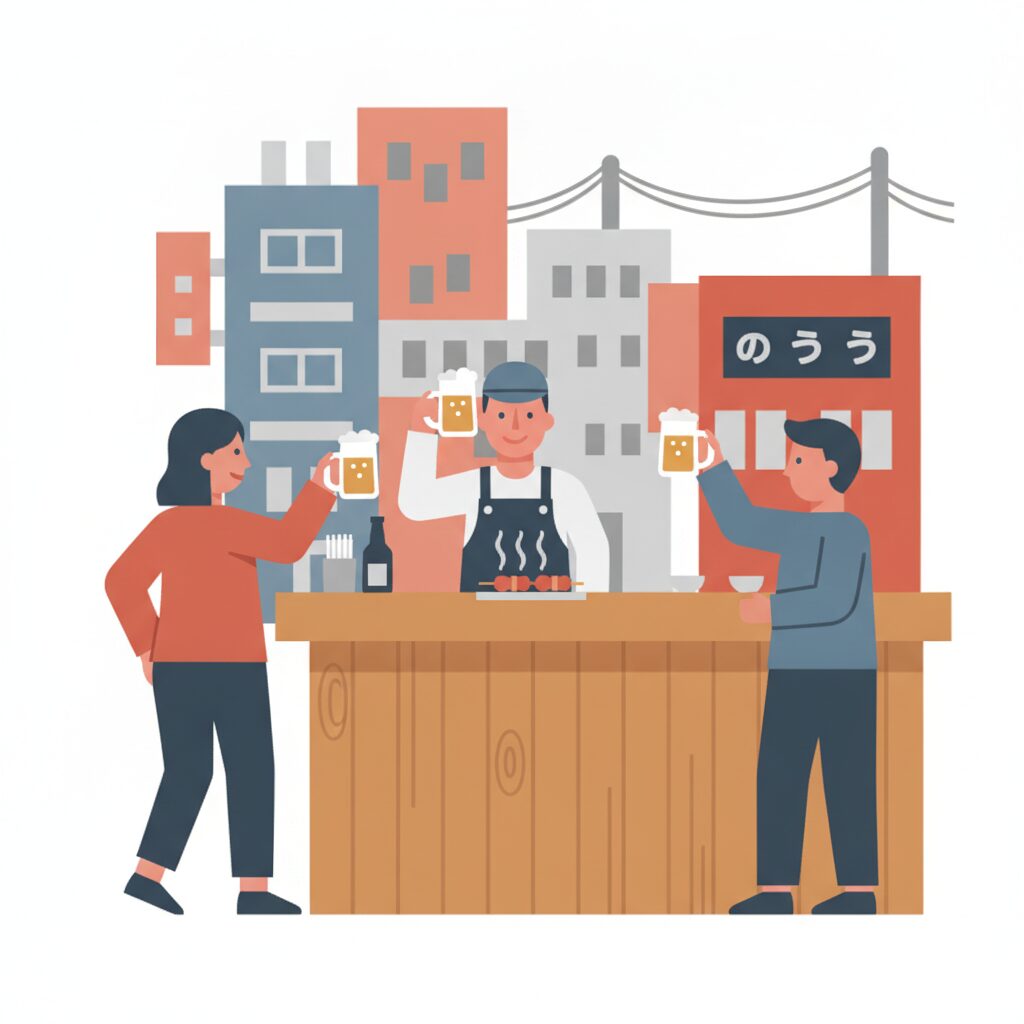
When I first moved to Osaka from Spain, my mental image of Japanese after-work life was painted in shades of Tokyo formality. I pictured quiet, private rooms, colleagues seated in a precise hierarchy, and carefully orchestrated conversations. Business, I thought, was done behind closed doors, sealed with a deep bow and a formal exchange of business cards. So, you can imagine my surprise when my boss, after a long day of meetings, turned to me with a grin and said, “Sofia-san, chotto ippai? Let’s go for a quick one.” I expected a sleek cocktail lounge or a traditional izakaya with tatami mats. Instead, we ducked under a worn-out noren curtain into a brightly lit space no bigger than my living room, buzzing with energy and packed with people. The most shocking part? There were no chairs. None. Just a long counter, a swirl of delicious-smelling steam, and dozens of professionals in suits and office attire, standing shoulder-to-shoulder, laughing, drinking, and eating. This was my introduction to the world of ‘tachinomi,’ Osaka’s standing bars. I quickly learned that these weren’t just places for a cheap beer; they were the city’s real networking hubs, the unofficial boardrooms where connections are forged, information is traded, and deals are nudged forward, all while on your feet. It’s a culture that feels worlds away from the buttoned-up corporate rituals of Tokyo, revealing the pragmatic, efficient, and deeply social soul of Osaka’s business world.
The lively counter interactions not only redefine networking but also offer insight into communication styles in Osaka’s standing bars, where rapid exchanges pave the way for lasting professional relationships.
The Unspoken Rules of the Standing Bar Shuffle

Your first time in a tachinomi can feel like jumping onto a moving train. It’s an overwhelming mix of clinking glasses, sizzling grills, and a lively chorus of Kansai-ben. The atmosphere itself shapes the entire experience. These venues are deliberately small, designed not for leisurely comfort but for a vibrant flow. The absence of seating is intentional, not a flaw. It’s a philosophy that maintains high energy and constant movement, ensuring a steady rotation of new faces and chances for conversation. Navigating this unique social scene requires knowing the unwritten rules that govern the standing bar shuffle—a delicate dance of closeness and social finesse that every Osaka local seems to master effortlessly.
The Art of Quick Entry and Exit
Unlike a traditional bar where you might linger for hours, the tachinomi thrives on brief visits. A typical stop lasts no more than twenty to thirty minutes. It’s a quick pause, a social pause between the end of work and the ride home. This brevity is its charm. It significantly lowers the social hurdle to joining in. Inviting a colleague or new acquaintance to a formal dinner can feel like a big commitment, but suggesting “chotto ippai”—just a quick drink—is simple and casual. It’s an easy invitation to extend and accept. You drop by, have a beer and a few kushikatsu skewers, chat briefly, then move on. This rapid turnover means the crowd is always changing, boosting the chances of serendipitous conversations. One minute you’re talking with an accountant, the next you’re elbow-to-elbow with a graphic designer or logistics manager.
Reading the Room: Proximity and Permission
In a city where personal space is scarce, the tachinomi follows a different set of spatial norms. You will be close to others. Very close. But there is a specific etiquette around this closeness. You don’t just push into a group. You spot a small gap at the counter, claim your tiny spot, and gently blend into the bar’s social rhythm. Early interactions often happen without words—a slight nod to a neighbor, a shared glance appreciating a particularly enticing aroma from the grill. Joining a conversation is an art. You don’t interrupt; you wait for a natural break, a moment to offer a fitting comment or question. Saying “That oden looks delicious, what do you recommend?” is a classic, safe way in. It’s a gentle approach, flattering the other person and inviting conversation. It’s about being attentive and aware, reading the social dynamics before jumping in.
The “Cash on the Counter” System
Contributing to the sense of efficiency is the payment method favored by many traditional tachinomi: kyasshu on, or cash on delivery. You place your money in a small tray on the counter, and the bartender takes the exact amount with each order. There’s no tab to run or bill to wait for. This straightforward, transactional system reinforces the bar’s core values of speed and ease. It allows for a smooth exit. When you’re done, you finish your drink, nod, and leave—no awkward splitting of the bill or waiting for credit card processing. This practical approach, rooted in Osaka’s impatient merchant spirit, keeps everything running smoothly and focused on what truly matters: the quick, easy exchange of food, drink, and conversation.
Why Standing Works: The Psychology of Osaka Networking
The physical act of standing has a significant psychological impact on the nature of interaction, and it is precisely this aspect that makes tachinomi such an effective networking tool, particularly when contrasted with the corporate culture of Tokyo. In Tokyo, business entertainment often centers around reinforcing hierarchical structures. Superiors and subordinates sit according to rank at a long table, often in a private room where interactions are controlled and predictable. It’s a system intended to maintain order. Osaka’s tachinomi culture, however, completely overturns that model. It’s designed for productive chaos—a space where the city’s pragmatic and egalitarian spirit truly comes alive.
Breaking Down Barriers, Literally
When everyone is standing, traditional hierarchies begin to dissolve. There is no head of the table. A company president might be squeezed between a junior salesperson and a factory worker from an entirely different industry. This physical leveling engenders a psychological one. Without the barrier of a table between people, conversations become more direct, open, and personal. You’re not addressing a title; you’re speaking to the individual beside you. This setting nurtures a sense of camaraderie and shared experience. You’re all together in this small, crowded, lively space. This informality is a hallmark of Osaka’s business culture, which has long valued practical relationships over strict formality. Deals are more likely founded on mutual trust and rapport than rigid adherence to protocol, and that trust often begins with a shared laugh over a spilled drink in a packed tachinomi.
The Power of Serendipity
Tachinomi serve as engines of serendipity. You simply cannot anticipate who you will meet. This sharply contrasts with formal networking events where you strategically scan name tags and approach predetermined contacts. At a tachinomi, connections happen organically. You might start a conversation because you both ordered the same rare brand of sake, only to find out they run a shipping company that can solve a logistical challenge your business has faced for months. I’ve witnessed this. A friend of mine, an architect, landed a major project after a chance discussion about the structural integrity of the bar’s old wooden counter with a property developer he’d never met before. This is something Osakans instinctively understand: opportunities don’t always come in scheduled meetings. More often, they emerge in unplanned, informal spaces where different worlds intersect.
“Maikai no Koto ya” – The Osaka Mindset of Repeat Business
This culture is deeply linked to Osaka’s historical identity as a city of merchants. The mindset here isn’t about a single, triumphant sale but about cultivating a web of long-term, mutually beneficial relationships. The phrase “maikai no koto ya” (it’s a thing of every time) encapsulates this spirit. It’s about fostering loyalty and repeat business. The tachinomi is the ideal environment for these relationships to grow. You become a regular at a certain spot. The owner knows your name and your usual drink. You start recognizing the same faces from nearby companies. Familiarity builds trust. These encounters aren’t cold calls; they’re warm connections nurtured over time. The brief, frequent interactions at a tachinomi allow relationships to evolve naturally, without pressure. One day you might chat about the Hanshin Tigers baseball team; the next week, you might mention a project you’re working on. It’s a slow-burn approach to networking that yields far stronger and more resilient business connections over time.
The Language of the Tachinomi: More Than Just Words
If you were to simply listen to the conversations buzzing around a tachinomi, you might not assume much business is happening at all. You’ll hear far more laughter and friendly banter than corporate jargon. But that’s because the language of the tachinomi is subtle. The true communication occurs between the lines, in the relaxed humor and shared moments that lay the groundwork for future business. It’s a social ritual with its own distinct vocabulary and rhythm, and understanding it is essential to unlocking its potential.
From Banter to Business
Hardly any conversation in a tachinomi begins with business. That would feel abrupt and somewhat rude. The opening line is always light and observational, often about the food, the weather, the local sports team, or a bit of self-deprecating humor. This initial exchange serves a vital purpose: it tests the waters and forges a human connection. Osakans, known for their directness and love of a good laugh (warai), use this moment to gauge each other. Are you approachable? Do you have a sense of humor? Can you relax and just be yourself? Only once this rapport is established does the conversation smoothly shift toward the professional realm. It might be as simple as, “So, what do you do?” but by that point, it’s no longer a cold question—it’s a genuine expression of curiosity about the new person you’ve just shared a laugh with.
The “Chotto Ippai” Invitation
As noted, the phrase “chotto ippai” is the key that opens the door to the tachinomi world. It’s a social masterstroke. “Chotto” means “a little,” and “ippai” means “one drink” or “one glass.” The invitation is intentionally non-committal. It doesn’t suggest a long, drawn-out evening, but rather something quick, easy, and casual. This makes it very hard to refuse without seeming unfriendly. For foreigners, grasping the significance of this phrase is vital. When a colleague offers this invitation, they’re not just offering a drink—they’re opening the door to the inner circle. They’re inviting you into a uniquely Osakan ritual. Accepting signals your willingness to engage with the local culture on its own terms and is one of the fastest ways to build trust and camaraderie with your Japanese coworkers.
What Foreigners Often Miss
A common mistake for newcomers is to see a tachinomi and write it off as just a cheap, noisy dive bar. The visual chaos can be overwhelming, and the rapid-fire Kansai dialect hard to follow. It’s easy to grab a quick, inexpensive drink and leave without ever realizing the complex social and professional networking happening all around you. The value is not in the 300-yen draft beer; it’s in the access. It’s about being present in a space where information flows freely. You might hear about a new construction project before it’s announced publicly or find out a key person is leaving a competitor. The tachinomi acts as the city’s unofficial news wire. To see it as merely a drinking spot misses the point completely. It’s a living, breathing network, and simply by showing up, you become a part of it.
A Practical Guide for the Foreign Professional
So, you’re ready to jump in. The concept of spontaneous networking and forming authentic connections sounds exciting. But how do you transition from being an outsider to an engaged participant? While the tachinomi scene is very welcoming, having a few key strategies can help make your initial experiences smoother and more rewarding. It’s about selecting the right setting, knowing how to start a conversation, and grasping the subtle etiquette around business card exchanges.
Finding Your Place: From Umeda’s Salaryman Hubs to Namba’s Gritty Gems
Not all tachinomi bars are the same. The atmosphere can vary greatly depending on the neighborhood. For a classic white-collar, or salaryman, experience, the maze-like basements of the Osaka Ekimae Dai-ichi, Ni, San, and Yon Buildings in Umeda are iconic. These busy, no-frills spots are filled with professionals from nearby corporate offices. The Tenma area offers a livelier, almost chaotic vibe, with countless bars spilling onto the streets. It’s younger and rowdier. For something with more grit and old-school charm, check out the back alleys around Namba and Shinsekai. My recommendation is to begin in Umeda to get a sense of the business-oriented atmosphere. Wander around, peek behind the curtains, and find a place that looks busy but has a little room at the counter. A friendly bartender is always a good sign.
Your Opening Line
Once you’ve found your spot, what should you say? Keep it simple. Often, the easiest approach works best. As mentioned, asking your neighbor about their food is a guaranteed icebreaker. Point to their plate and say, “Oishisou desu ne. Sore wa nan desu ka?” (That looks delicious. What is it?). Most people are happy to share their favorite dishes. Another effective tactic is to compliment the bar or ask the bartender a question. “Koko no osusume wa nan desu ka?” (What do you recommend here?). This signals your interest and engagement. The key is to be genuinely curious. Osakans value sincerity and can easily tell if someone is just trying to get something. Be a person first, and a professional second.
The Etiquette of Exchange
In formal business meetings in Japan, exchanging business cards, or meishi, is a carefully choreographed ritual that takes place right at the start. In a tachinomi, it’s the opposite. Introducing your business card too early is a rookie error. It can kill the casual, friendly atmosphere immediately, making it seem like you’re only there to pitch something. The card exchange usually happens much later, often at the end of the conversation, and only if a genuine rapport has been established. It should feel like a natural conclusion, a way to keep in touch. Someone might say, “We should continue this conversation sometime,” which is your cue. The exchange itself is also more informal. You still offer the card with both hands as a sign of respect, but the strict formality is replaced by a warmer, more personal gesture. It’s a promise of ongoing connection, not the start of a negotiation.
Beyond the Beer: The Real ROI of Standing Shoulder-to-Shoulder
Ultimately, the tachinomi is more than just a bar. It embodies Osaka’s unique cultural DNA. It represents a city founded on commerce, yet one that recognizes commerce as fundamentally a human endeavor. It challenges the notion that business must be cold, formal, and restricted to the office. Here, business is social, fluid, and based on the kind of trust that only forms through shared experiences. The true return on investment from spending time in these standing bars isn’t a single contract won, but the gradual, steady buildup of social capital—the relationships, insider knowledge, and sense of belonging to the city’s dynamic professional community.
Standing shoulder-to-shoulder with strangers, you hear about the city’s successes and frustrations. You get the unfiltered truth about the economy, the real story behind news headlines, and the industry gossip that never makes it into official reports. In Tokyo, you might build a network. In Osaka, you become part of a community. For any foreigner who genuinely wants to understand what drives this city, who wants to build a life and career here, my advice is simple: find a tachinomi, squeeze into a spot at the counter, and order a drink. It’s the most genuine and effective business school Osaka has to offer, and your classroom is ready—no chairs needed.