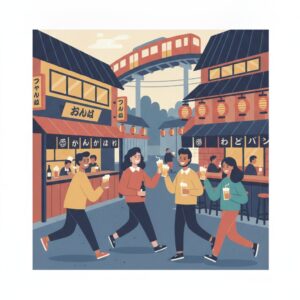
Osaka has a reputation. It is a reputation built on bright lights, sizzling street food, and a relentless, kinetic energy. Tourists arrive expecting a city draped in neon, where the air smells perpetually of fried batter and savory sauce. They anticipate a metropolis that speaks loudly, moves quickly, and never quite sleeps. They expect the chaotic brilliance of Dotonbori. They look for the towering advertisements of Shinsaibashi. They want the gritty, unapologetic hustle of a city that has always prioritized commerce over quiet contemplation. But this dominant narrative, while partially true, misses the deeper heartbeat of the city. It obscures the profound historical foundations upon which modern Osaka is built. To truly understand this city, to grasp how its people think, act, and navigate their daily lives, you must look beyond the neon corridors. You must step away from the tourist hubs. You must walk north. You must find the water. You must cross the bridges and step onto the slender, elegant sandbank known as Nakanoshima.
This island is not merely a geographic feature. It is the cultural and historical spine of Osaka. Stretching roughly three kilometers between the Dojima River to the north and the Tosabori River to the south, Nakanoshima is an urban oasis that defies every stereotype foreign visitors hold about this great merchant city. Here, the frantic pace of the metropolis softens. The dense concrete jungle opens up to wide, tree-lined promenades. Historic architecture forged from red brick and carved stone stands proudly against a backdrop of sleek contemporary skyscrapers. Nakanoshima is where the city breathes. It is where the merchant elite of centuries past built their legacies. It is where modern residents come to find a moment of peace amidst the relentless hum of urban life.
As a British historian living and studying in Japan, I have spent years untangling the complex narratives of Japanese cities. Tokyo, the capital, is a city of samurai heritage, built top-down through imperial decree and bureaucratic planning. Osaka, however, is a city of merchants. It was built bottom-up. It was forged by the ambition, pragmatism, and undeniable grit of the people. And nowhere is this merchant legacy more beautifully preserved and adapted for modern life than on Nakanoshima. This article is not a simple checklist of tourist attractions. It is an exploration of the Osaka mindset. It is an honest, practical look at how the city actually functions, seen through the lens of its most significant cultural district. We will explore the historical currents that shaped this island. We will examine the architectural marvels that serve as civic anchors. We will observe the daily rituals of the people who work, study, and relax along these riverbanks. By the time we conclude, you will not just know what to see in Nakanoshima. You will understand the very soul of Osaka.
Why Nakanoshima is Osaka’s Cultural Island
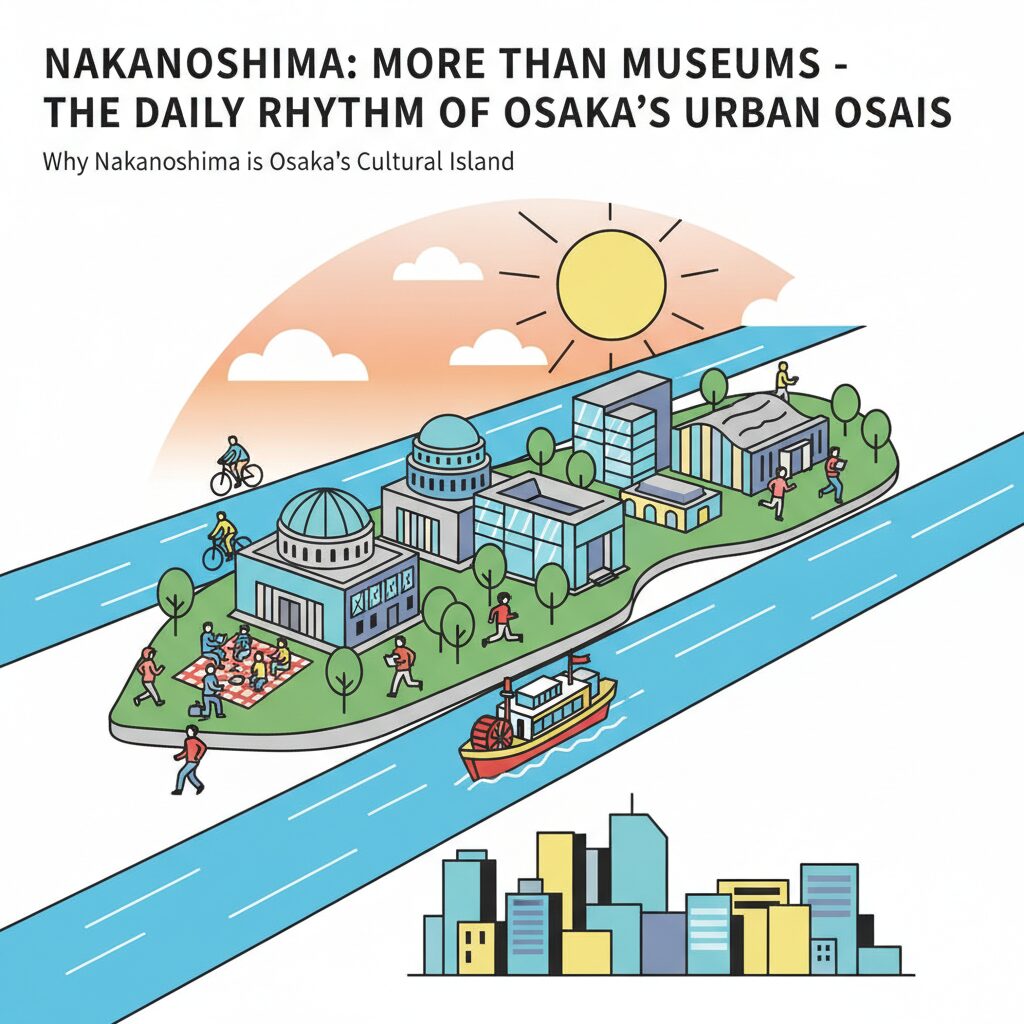
To grasp the unique character of Osaka, one must first understand the concept of the Water Metropolis. Long before expansive railway networks and elevated highways shaped the cityscape, Osaka was defined by rivers, canals, and bridges. It served as the logistical center of the Japanese archipelago. During the Edo period, from the early seventeenth to the mid-nineteenth century, while the shogun held political authority in Edo—now Tokyo—the true economic power lay in Osaka. The city was famously known as the Kitchen of the Nation. This was not a nod to its culinary excellence, which developed later, but a literal description of its economic role. Rice, the fundamental currency and staple food of the time, was transported from feudal domains across Japan directly into Osaka.
Nakanoshima stood at the heart of this vast economic engine. The island was lined with kurayashiki, large storehouse estates owned by powerful feudal lords who brought their regional wealth to this sandbank. They exchanged rice for hard currency, and in doing so, unintentionally created a social hierarchy quite different from the strict samurai codes of Edo. In Osaka, wealth and business savvy mattered more than inherited rank. A successful merchant could hold more influence than a low-ranking samurai. This historical reality gave rise to the renowned Osaka pragmatism, fostering a culture where straightforwardness, sharp negotiation skills, and a relentless focus on practical results became core civic values.
Just off the island’s northern edge stood the Dojima Rice Exchange, arguably the most important financial institution of early modern history. It was here that the world’s first organized futures market was born. Merchants bought and sold contracts for rice that had yet to be harvested. They speculated, took risks, and developed advanced financial instruments centuries before similar practices emerged in Wall Street or the City of London. Walking through Nakanoshima today means treading on ground that fundamentally changed Japan’s economic path—you are walking on the birthplace of Japanese capitalism.
However, the merchant princes of Osaka were not simply wealth accumulators. They recognized that true civic greatness required more than just bustling markets and abundant storehouses. As Japan rapidly modernized during the Meiji and Taisho eras in the late nineteenth and early twentieth centuries, Osaka’s wealthy industrialists looked to Europe. They admired cities like Paris, London, and Vienna, where grand civic architecture, public libraries, and expansive parks shaped the urban experience. They resolved that Osaka needed similar landmarks. Importantly, these monuments were not built by imperial order but were financed by the merchants themselves as philanthropic gifts to the city.
This explains why Nakanoshima feels fundamentally different from Tokyo’s bureaucratic centers. When viewing the grand architecture here, you’re not seeing the power of the state, but the pride of private citizens. You are witnessing the physical manifestation of the Osaka spirit—a spirit that values hard work, celebrates success, and believes deeply in giving back to the community that enabled that success. Today, Nakanoshima remains the city’s undisputed cultural and intellectual hub, housing major museums, historic libraries, grand public halls, and prestigious corporate headquarters. It serves as the sophisticated, elegant counterbalance to the chaotic, vibrant entertainment districts to the south. For foreign residents seeking to understand their new home, recognizing this duality is vital. Osaka is not just one thing—it is the raw energy of Minami and the refined, historical grace of Kita, perfectly embodied by Nakanoshima.
Top Things to Do in Nakanoshima
When local residents plan a day out in Nakanoshima, they don’t treat it as a hectic sightseeing spree. The atmosphere here encourages a slower, more intentional way of exploring the city. The island is meant to be explored on foot. It’s designed to be experienced in a chronological and geographical sequence, allowing the natural transition from contemporary artistic expressions to preserved historical architecture. The places that follow are more than just attractions; they are the civic living rooms of Osaka—spaces where the city reflects, learns, and reconnects with its heritage.
Explore the Nakanoshima Museum of Art (NAKKA)
Approaching the western tip of the island, you’re suddenly met with a striking, massive black cube. This is the Nakanoshima Museum of Art, Osaka, commonly known as NAKKA. Opened in early 2022, this bold building showcases the city’s contemporary face. The architecture itself makes a statement. In a neighborhood defined by red brick neo-renaissance public halls and neoclassical stone libraries, the architects opted for a monolithic, unapologetically modern geometric shape. It perfectly embodies Osaka’s refusal to be confined by its past. While the city honors its history, it is always looking forward with determination.
For foreign residents, observing local interactions with NAKKA offers deep insight into modern Osaka’s mindset. The museum was not intended merely as a vault for precious objects. Instead, it was conceived as an active, permeable public space. The ground floor is home to a broad green lawn that has quickly become one of the district’s favorite gathering spots. On any weekend, you’ll see art students sketching, families enjoying picnics, and office workers stealing quiet moments from their busy days. The enormous, playful cat sculpture by Kenji Yanobe on the lawn is a perfect icebreaker, bridging the gap between high art and everyday relaxation.
Inside, NAKKA reveals even more. Its central feature is a vast open core called the Passages—a network of towering intersecting escalators and walkways crossing the hollow black cube’s center. This gives visitors a dynamic, almost theatrical sense of movement. It feels less like a traditional gallery and more like an indoor urban plaza. The collection focuses heavily on modern and contemporary art, with special attention to works reflecting Osaka’s industrial and design heritage. Visiting NAKKA means engaging with the city’s ongoing cultural dialogue and witnessing how Osaka shapes its modern identity for the world.
Visit the Underground National Museum of Art, Osaka
A short walk from NAKKA’s stark black cube brings you to a markedly different structure, equally important in purpose. The National Museum of Art, Osaka, is an architectural wonder demonstrating the city’s creative approach to limited space. In an ultra-dense urban setting where land is scarce, the architects made a bold choice: the museum is built entirely underground.
The only visible sign of its extensive subterranean galleries is a striking silver skeletal structure rising from the plaza above. Designed by famed architect Cesar Pelli, this twisting metallic form symbolizes the elegant growth of bamboo reaching toward the sky. It offers a beautiful, organic counterpoint to the rigid geometry of surrounding corporate towers. Upon entering the glass pavilion and descending the escalators, you’ll notice a dramatic sensory shift: city noise fades, sunlight gives way to carefully controlled gallery lighting, and the temperature stabilizes. You have entered an entirely different realm.
This descent marks a powerful psychological transition, encouraging mental slowing and a refocusing of attention. The underground layout is more than space-efficient—it’s a deliberate architectural choice meant to shield the art from the distractions of the bustling city above. The collection here is among Japan’s most comprehensive, concentrating on contemporary works by domestic and international artists. For foreign residents aiming to grasp Osaka’s intellectual depth, the National Museum of Art offers a vital sanctuary for contemplative exploration of the complex currents in global contemporary art.
Admire the Osaka City Central Public Hall & Retro Architecture
Heading east along the island, the modern concrete and glass recede, making way for the architectural gems of the Taisho and early Showa periods. The crown jewel of this historic preservation is the Osaka City Central Public Hall. With its vibrant red brick exterior, elegant green bronze domes, and sweeping neo-renaissance arches, it is arguably the city’s most beautiful building. Yet, its true significance lies less in its appearance and more in the poignant and inspiring story behind its creation.
The hall was not government-funded; it was built thanks to a single individual, Einosuke Iwamoto. Iwamoto was a stockbroker during the economic boom surrounding the First World War, amassing a vast fortune on the nearby Kitahama exchange. Contrary to the stereotype of the greedy financier, Iwamoto was deeply devoted to his city. Inspired by the grand public buildings he had seen during his travels in America, he donated a staggering sum of his own wealth to create a world-class gathering place for Osaka’s people. Tragically, Iwamoto suffered severe financial losses soon after and took his own life before the hall’s completion.
Today, the Osaka City Central Public Hall stands as a lasting tribute to Iwamoto’s civic pride. It remains a functioning venue, hosting classical concerts, graduation ceremonies, and elegant weddings. When you see the Public Hall, you witness the essence of Osaka’s merchant spirit—the conviction that private success should yield public good. Nearby stands the Osaka Prefectural Nakanoshima Library, another masterpiece of civic generosity. Gifted by the wealthy Sumitomo family, this grand structure boasts massive stone columns and a breathtaking classical portico that would fit seamlessly in Rome or London. Together, these buildings form a precinct of unmatched historical dignity, a constant reminder that Osaka is a city with deep cultural roots, shaped by the ambition and generosity of its citizens.
Relax at Nakanoshima Park & the Rose Garden
At the island’s far eastern tip, where the Dojima and Tosabori rivers merge, lies Nakanoshima Park. Established in the late nineteenth century, it holds the distinction of being Osaka’s first public park. In a city dominated by dense urban development, where concrete and asphalt prevail, this vast green space is not just a luxury—it is an essential civic lung.
The park is divided into several distinct areas, each serving different community needs. Wide open lawns attract families for weekend picnics, children tossing baseballs, and university students strumming guitars in circles. Quiet, tree-shaded benches along the riverbanks provide serene spots for elderly residents to watch the flowing water. But the true highlight is the Nakanoshima Rose Garden, arguably one of western Japan’s most exquisite horticultural displays.
Home to thousands of rose bushes representing hundreds of varieties, the rose garden is a masterpiece of landscape design. Timing your visit is key, as the garden boasts two spectacular blooms annually. The first occurs in May, ushering early summer with bursts of vibrant color. The second, subtler bloom emerges in late October and early November, painting the island with rich autumn hues. During these peak times, the air is thick with the roses’ sweet, complex fragrance. Paths fill with amateur photographers, couples on romantic outings, and office workers seeking a brief escape from their screens. Watching locals interact with the garden offers a refreshing counterpoint to the stereotype of Osaka as relentlessly fast-paced. Here, amidst soft petals and flowing water, the city slows, savors beauty, and breathes.
Riverside Cafes and Dining in Nakanoshima
Nakanoshima’s cultural identity is deeply connected to its culinary scene. Osaka has long been a city passionate about food. The local philosophy of kuidaore, roughly meaning eating oneself into ruin, reflects the residents’ fervent and almost reckless delight in dining. Yet, Nakanoshima’s food culture stands apart from the loud, boisterous street food stalls of Dotonbori. Here, dining is an elegant experience, emphasizing atmosphere as much as ingredients, and the subtle art of conversation set against the backdrop of flowing water.
Walking along the southern bank of the island, facing the historic Kitahama district across the Tosabori River, you’ll encounter one of the city’s most unique dining phenomena. The riverside buildings have embraced the waterfront by adding spacious, open-air wooden terraces extending over the water. This terrace culture, while a recent innovation, has radically transformed residents’ relationship with the river. Once viewed primarily as industrial waterways—polluted and largely ignored—the rivers are now clean, their banks illuminated, and have become central to community leisure thanks to extensive environmental restoration.
The cafes and restaurants here span from historic establishments to innovative third-wave coffee roasters. At Kitahama Retro, a charmingly quirky tea house housed in an authentic early twentieth-century British-style brick building, you can enjoy delicate scones with clotted cream on the terrace. Alternatively, you might choose a flawlessly brewed single-origin espresso from one of the modern roasteries, relaxing on the concrete steps that lead down to the water.
The real charm of these riverside spots lies in the social scene. Unlike Tokyo’s often solitary cafe culture, where people sit alone with headphones, absorbed in laptops, Osaka’s cafes are lively and communal. Tables are set close together, conversations spill between groups, and laughter is genuine and free. Sitting on a Nakanoshima terrace with a cup of coffee, hearing the city’s hum behind you and the soft ripple of the river below, you experience the true rhythm of daily life in Osaka—a distinct blend of sophistication and warmth that defines the local character.
Experience the Water Metropolis: Nakanoshima River Cruises
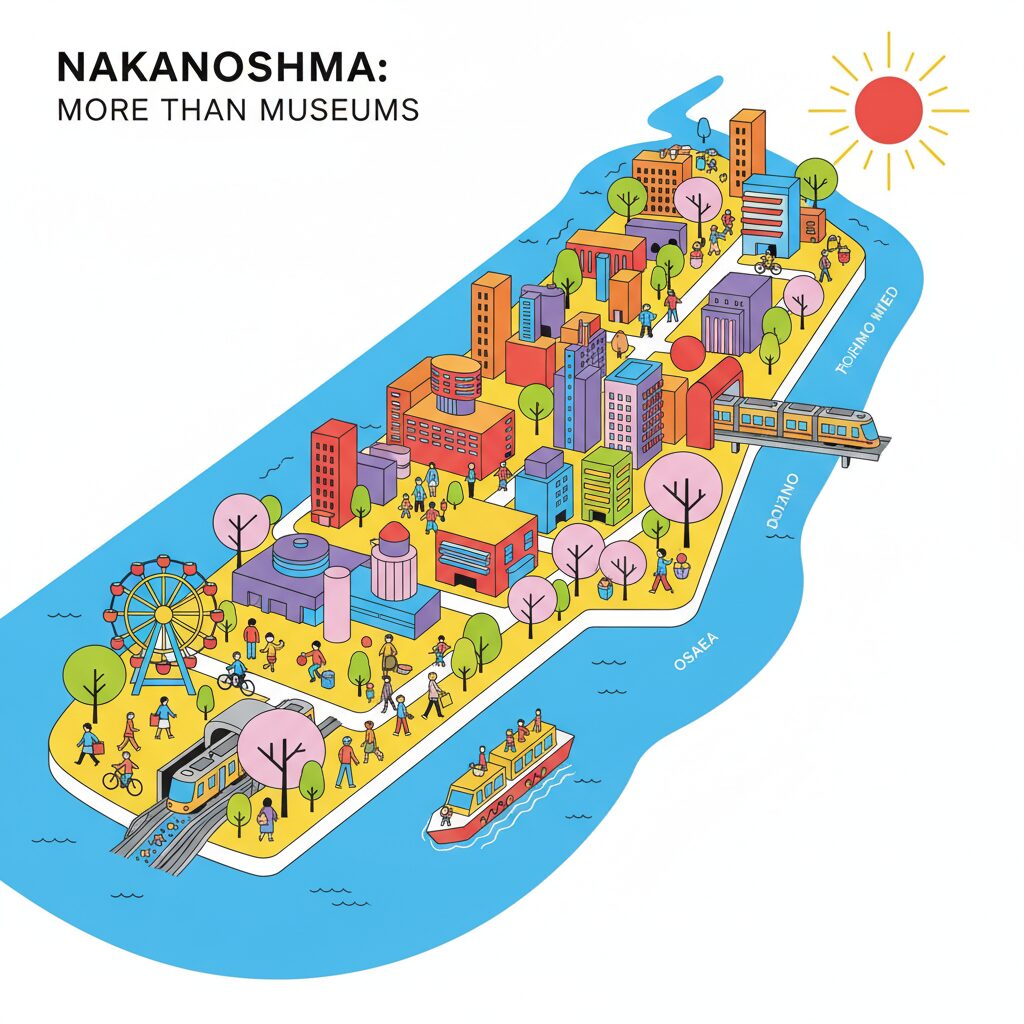
To fully comprehend the geographical reality of Nakanoshima and understand why the idea of the Water Metropolis is so integral to the city’s identity, you must leave the solid ground of the island and venture onto the water. A river cruise is not merely a passive sightseeing activity; it is a historical imperative. For centuries, the rivers served as the main arteries for communication, commerce, and transportation. By navigating these waterways, you follow the very lifelines that enabled Osaka to prosper.
Historically, the city was renowned for its eight hundred and eight bridges. This figure was not a precise count but rather a poetic way to express an innumerable multitude. The bridges were the essential connective tissue that linked the city’s fragmented geography. Each bridge had its own name, unique history, and specific role in the daily lives of residents. While some were constructed by the government, most were funded by wealthy merchant guilds, highlighting the private civic pride that characterizes Osaka.
Today, various vessels navigate the waters around Nakanoshima. The most famous is the Aqua Liner, a sleek, flat-roofed boat specially designed to glide smoothly beneath the extraordinarily low bridges spanning the rivers. The journey takes you on a full circuit around the island. From this unique vantage point on the water, the architectural contrasts of Nakanoshima become vividly apparent. You look up to see towering glass facades of modern financial institutions reflecting the sky. You pass by the red brick elegance of the Central Public Hall. You drift under the massive stone arches of historic bridges that have endured earthquakes and wartime bombings.
The experience is especially enchanting in the evening. As the sun sets, the city undergoes a striking visual transformation. Neon signs from distant entertainment districts bleed into the night sky, while the historic buildings on Nakanoshima are bathed in soft, warm architectural lighting. The bridges are lit up, casting long, shimmering reflections across the dark river’s surface. The noise of traffic is softened by the water. Taking an evening cruise around the island offers a deep sense of perspective, allowing you to see the city not as a chaotic jumble of concrete and steel but as a carefully orchestrated, historically layered urban masterpiece.
A Perfect Half-Day Nakanoshima Walking Itinerary
Grasping the abstract ideas of history and culture is one thing, but for a foreign resident aiming to truly experience Nakanoshima, practical navigation is crucial. The island rewards those who approach it with a well-organized plan, allowing the district’s story to unfold coherently. This half-day walking itinerary is crafted not just to show you the landmarks, but to help you sense the city’s rhythm. It takes you on a sensory journey from the historical roots in the east to the contemporary expressions in the west.
Start your journey at Yodoyabashi Station, conveniently located on the main Midosuji subway line. As you emerge from underground, the majestic Yodoyabashi Bridge immediately confronts you. This elegant concrete structure, with sweeping curves and classical details, spans the Dojima River. Pause in the center of the bridge. Look left, toward the west, to see the modern city skyline. Look right, toward the east, and you’ll find the green canopy of Nakanoshima Park. Take a deep breath—you are standing right on the dividing line between old and new.
Cross the bridge and step onto the island. Turn right and walk eastward toward the historic district. Your first major stop will be the Osaka Prefectural Nakanoshima Library. Take time to ascend the grand stone steps, run your hand along the massive columns, and feel the weight of history embodied in the architecture. It’s a tangible reminder of the Taisho era’s wealth and ambition. Continue past the library, where the magnificent red brick façade of the Osaka City Central Public Hall will dominate your view. Don’t just admire the exterior—step inside. The basement houses a fantastic retro restaurant where you can enjoy classic omurice, a staple of Japanese comfort food, in an elegant, historical setting.
After exploring these architectural landmarks, proceed eastward into Nakanoshima Park. If you visit in May or October, spend an hour wandering the intricate pathways of the Rose Garden. Observe the various people using the space: elderly couples strolling leisurely, office workers busily typing on their phones, young families spreading out picnic blankets. This is the civic living room in action. Walk all the way to the sharp eastern tip of the island, where the two rivers violently collide before continuing toward the sea.
Now, turn back and walk westward along the southern promenade, facing the Tosabori River. Here, the city transitions from historical preservation to modern leisure. The promenade is wide, paved with clean stone, and lined with overhanging trees. Look across the river to the historic buildings of the Kitahama district. Choose a riverside café, order a coffee, sit on the terrace, and watch the water flow. Notice the volume of the conversations around you—they’ll be louder, more animated, and more expressive than at a similar café in Tokyo. This is the Osaka communication style: direct, engaged, and unapologetically present.
Once refreshed, continue your westward walk. Pass beneath major roads that cut across the island, and watch the environment change. The red brick and classical stone give way to sleek steel and reflective glass as you enter the contemporary art precinct. Your final stops are the two great museums. First, descend into the quiet, subterranean depths of the National Museum of Art. Let the cool air and carefully selected contemporary works wash over you—an experience of profound intellectual isolation. Finally, step back into the sunlight and cross the street to the stark black cube of NAKKA. Sit on the green lawn, gaze at the giant cat sculpture, and reflect on the journey you’ve just taken. In just a few hours, you’ve walked from the Meiji era to the present day, experiencing deep history, architectural grandeur, and vibrant modern culture—all within the confines of a three-kilometer sandbank.
How to Get to Nakanoshima
Navigating Osaka’s transportation network can initially feel overwhelming for newcomers. The city is intersected by a highly intricate system of subway lines, private railways, and elevated highways. However, reaching Nakanoshima is surprisingly simple, reflecting its central significance within the city’s geography. Understanding the access routes goes beyond mere logistics; it offers insight into the daily commuting patterns of the millions living and working in the Kansai region.
The island is served by several major transit routes. The most notable is the Midosuji Line, the fundamental spine of Osaka’s subway system. Running strictly north to south, it links key hubs such as Umeda, Shinsaibashi, Namba, and Tennoji. Exiting at Yodoyabashi Station places you right in the heart of Nakanoshima, precisely where the historic and modern districts meet. The immense number of commuters passing through Yodoyabashi during rush hours is astonishing—a demonstration of orderly chaos. Despite the crowds, there is an unspoken etiquette and smooth flow that averts confusion. On the escalators, for example, Osaka residents stand on the right side to leave the left side open for walking, which is the opposite of Tokyo’s practice. This small detail is a constant daily reminder that Osaka sees itself as a unique cultural entity, distinct from the capital.
For those coming from the east or from the neighboring cultural hub of Kyoto, the Keihan Railway is the preferred choice. The Keihan Nakanoshima Line runs directly beneath the island, with stations providing finely tuned access to different areas. Naniwabashi Station places you right at the entrance to the Rose Garden, while Watanabebashi Station emerges next to the major art museums. The design of these underground stations is refreshingly clean and modern, with extensive use of wood and natural light, standing in stark contrast to the more utilitarian tile designs of older subway stops.
Yet, perhaps the most genuine way to approach Nakanoshima is by bicycle. Osaka is unmistakably a cycling city. Its relatively flat terrain makes riding a bike exceptionally easy. For foreign residents living in nearby wards like Kita, Nishi, or Fukushima, a standard city bicycle, lovingly called a mamachari, is the main mode of daily transportation. Cycling across one of the many bridges onto the island, feeling the slight incline and the cool breeze from the river, is a daily delight. It offers a sense of freedom and connection to the environment that the subway cannot provide. Whichever way you choose to arrive, the moment you cross the water and step onto the island, you sense a shift in atmosphere. You leave behind the hectic bustle of the outer city and enter the cultural heart of Osaka.