
You step off the train at Umeda Station, and the atmosphere shifts immediately. The air feels a little thicker. The pace of the crowd moves with a different, more chaotic kind of energy. But more than anything, it is the sound that catches your attention. It is not the polished, flat cadence you hear on the news or in the streets of Tokyo. It is something much more rhythmic. It rises and falls with a musical intensity. It is sharp, emotional, and unapologetically loud. You are hearing Osaka-ben, the local dialect of the Kansai region, pouring out from shop vendors, commuting salarymen, and groups of students laughing near the ticket gates.
For many foreigners who move to Osaka or spend an extended amount of time here, this dialect is intoxicating. It represents the soul of the city. It feels like the ultimate insider code. If you speak it, you belong. Or at least, that is the assumption. The temptation to drop a sudden, heavy local phrase into your daily conversation is incredibly strong. You want to show the locals that you are not just a passing tourist. You want to prove that you understand their culture, that you are part of the neighborhood, and that you are in on the joke.
But the reality of a non-native speaker utilizing regional dialects in Japan is complicated. It is deeply tangled in unspoken social rules, psychological boundaries, and historical pride. Growing up near a small, tight-knit rural community before experiencing the overwhelming scale of a city like Osaka, I learned very quickly that local language is a protected space. It is a living, breathing emotional boundary. Using someone else’s regional tongue without earning the right to do so can create instant discomfort. Osaka might be a massive, sprawling metropolis, but socially, it often functions like an oversized village. The people are incredibly warm, but they are also fiercely protective of their identity.
Before you start throwing out local slang at the local supermarket or the standing bar down the street, you need to understand the social landscape. You need to know how the people of this city think, how they protect their cultural spaces, and what actually goes through their minds when a non-native suddenly starts speaking in heavy Kansai dialect. This is not a lesson in vocabulary. This is a reality check on human connection in Japan’s most vibrant city.
The Social Nuances of Osaka-ben for Non-Natives
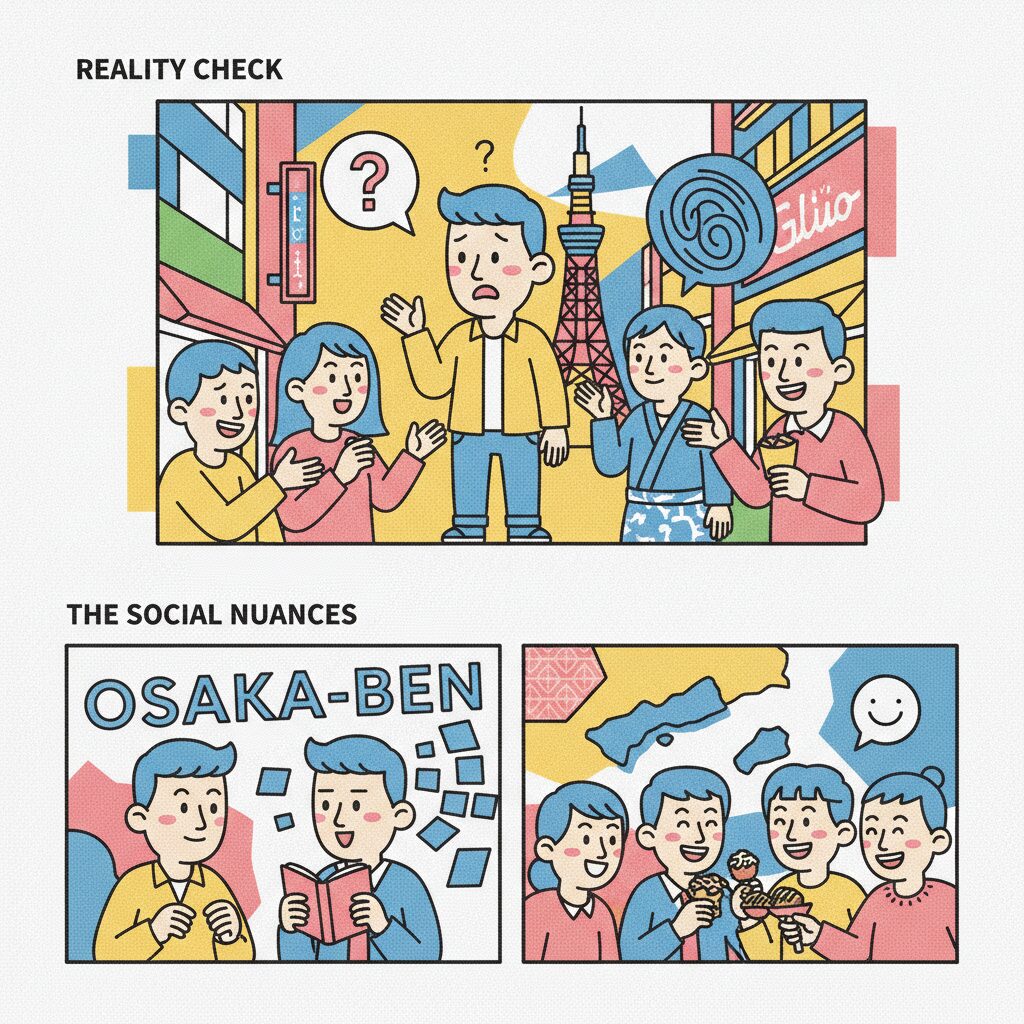
Language in Japan is never merely a tool for conveying information. It acts as a social barometer. Each time you speak, you are defining the distance between yourself and your listener. You are assessing hierarchy, familiarity, and respect. In Tokyo, standard Japanese functions as a protective shield, ensuring interactions remain smooth, predictable, and safely distanced. In Osaka, however, the dialect serves a different role: it aims to close the gap. It is intended to break down barriers, create warmth, and encourage playful banter. But closing that gap requires mutual consent.
The Welcoming Nature of Osaka Culture
There is a popular saying that Osaka is the friendliest city in Japan. This is true, but it needs context. The friendliness here isn’t necessarily polite in the Western sense. It is intrusive. It is curious. It is deeply human. If you look lost in a subway station, an older woman might physically grab your arm and pull you toward the correct platform. If you drop your wallet in a shopping arcade, the person returning it will likely joke that you owe them a drink.
This kind of interaction can be startling if you come from the quiet anonymity of other major Japanese cities. The people of Osaka thrive on immediate, unfiltered connection. The local dialect is the primary medium for this warmth. It is characterized by soft endings, exaggerated reactions, and a distinct melody that makes even complaints sound somewhat cheerful. Because the locals are so open, non-natives often feel a strong desire to reciprocate by adopting their language. You want to return the warmth. You want to match their energy. You believe that speaking their specific words shows them affection.
Why Forced Dialects Can Backfire
However, imitating the dialect too soon often yields the opposite effect. It creates sudden, invisible tension. To understand why, you must consider the psychology of intimacy in Japanese culture.
Intimacy is earned over time, through shared experiences and mutual trust. Regional dialects are the linguistic expression of deep intimacy. When you, as a newcomer or outsider, suddenly use strong local phrasing, you disrupt the natural process of building relationships. You artificially impose a level of closeness that hasn’t yet been established. It feels invasive. It is like entering a stranger’s home, sitting on their couch, and putting your feet up on the coffee table.
Moreover, pitch and melody present another challenge. Japanese is a pitch-accent language, and the Kansai region has a highly complex, deeply ingrained melodic pattern. Even native speakers from Tokyo struggle to perfectly replicate the pitch accent. When a non-native, already managing standard Japanese pitch, tries to layer the heavy Osaka-ben melody onto their speech, the result is often chaotic. It creates significant cognitive dissonance for the local listener. While the vocabulary is recognizable, the melody is entirely off. Instead of focusing on your message, they fixate on how strangely you’re speaking. You cease to be a conversational partner and instead become a linguistic anomaly. The warmth you sought to create immediately disappears, replaced by polite confusion and awkward smiles.
Appreciation vs. Mockery: How Locals Perceive Your Osaka-ben
The boundary between appreciating a culture and reducing it to a caricature is incredibly thin. In Osaka, this boundary is crossed daily by well-intentioned visitors and expats who don’t realize how their language use is perceived. The key issue is intent. Are you using the dialect because it naturally fits the flow of conversation, or simply as a party trick to elicit a reaction?
The “Anime Character” Stereotype and Why to Avoid It
For many foreigners, their first encounter with Kansai dialects comes through Japanese pop culture. In anime, manga, and variety shows, characters speaking Osaka-ben often fit a very specific stereotype. They are the comic relief—loud, brash, obsessed with money, and constantly shouting exaggerated punchlines. They slap others on the back and belt out catchphrases at full volume.
When non-natives attempt Osaka-ben, they frequently mimic this exaggerated media stereotype without realizing it. They abandon standard politeness, speak louder, and use aggressive, overly casual expressions learned from TV rather than real-life interactions.
For true Osaka residents, this is tiring. They are not cartoons—they’re real people living everyday lives: riding buses, doing taxes, grocery shopping, and raising kids. When a foreigner approaches a local store and loudly uses heavily exaggerated, slang-heavy phrases, the shopkeeper doesn’t feel respected. Instead, they feel like an actor in a theme park. The non-native treats a deeply meaningful cultural identity as a costume worn for personal amusement, which strips the language of its dignity. Locals might laugh politely, but inside, it sparks a deep, quiet cringe. It signals a lack of social awareness and a serious misunderstanding of the culture.
Natural Acquisition vs. Artificial Mimicry
There is, however, a huge difference between artificial mimicry and natural acquisition. If you live in a particular Osaka neighborhood for five years, shop at the same local market every Tuesday, and visit the same corner bar every Friday, something special begins to happen. The language slowly integrates into you.
You stop memorizing vocabulary lists and start naturally adopting the rhythms of those around you. A subtle, local expression slips out without thought. You use it perfectly in context, timing, and tone. When this occurs, the locals’ response is entirely different. There’s no awkward silence or polite laughter—just a quiet flash of recognition.
They realize you haven’t merely learned a word; you’ve absorbed their world. You’ve spent enough time in their community to genuinely reflect its environment. This authentic linguistic integration commands deep respect. It shows you’re paying attention to the real Osaka, not its media portrayal. The golden rule is simple: if you have to force yourself to remember a local phrase before saying it, you probably shouldn’t say it. Let the dialect come naturally. Let it emerge as part of your life here, rather than as a performance meant to impress.
Navigating Social Contexts in Osaka
Osaka is a city full of striking contrasts. It is renowned for its chaotic food scene and lively nightlife, yet it is also one of Japan’s historical commercial hubs, home to massive corporate headquarters, strict bureaucratic systems, and deeply rooted traditional business networks. For any non-native resident, understanding how to navigate these vastly different social settings is essential. The language you use must shift according to the physical and social environment you are in.
The Izakaya Test: Casual Banter and Building Rapport
The ultimate test of social integration in this city lies in the local drinking venues. Whether it’s a tiny, smoke-filled tachinomi standing bar in Kyobashi or a bustling, multi-level izakaya in Tennoji, these places serve as the heart of community interaction. Here, the city relaxes and unwinds.
If you find yourself in one of these spots, the pressure to join the loud, dialect-rich banter can be overwhelming. Those around you might start a conversation, offer you a skewer of grilled meat, or ask where you’re from. In these moments, the best approach is to stay grounded in polite, standard Japanese while letting your attitude become relaxed and open.
Locals don’t expect you to use their slang—in fact, they often prefer that you don’t. What they do expect is a willingness to participate. Osaka communication relies heavily on the boke and tsukkomi comedic style, where one person makes an absurd comment and the other points out its absurdity. You don’t need the regional dialect to join in; you just need good timing, a sense of humor, and the ability to not take yourself too seriously.
When a local jokes at your expense, laughing and responding in slightly informal standard Japanese builds much more rapport than awkwardly shouting a memorized slang phrase. The goal in the izakaya isn’t to prove your language skills but to show that you’re a safe, enjoyable presence. If you can listen attentively, smile sincerely, and handle some good-natured teasing, you’ll be accepted far quicker than someone who has simply memorized a dictionary of local phrases.
When to Stick to Standard Japanese (Keigo and Formal Settings)
The biggest error a foreign resident can make is assuming that the casual warmth of the izakaya carries over to the corporate office, city hall, or local bank. Osaka may be friendly, but it remains inherently Japanese. The strict societal rules around hierarchy, respect, and professionalism apply just as rigorously here as they do in Tokyo.
In business settings, standard Japanese and proper keigo polite language are absolutely essential. A non-native using casual regional expressions in a meeting or formal email will not be seen as charming or appropriately localized. Instead, they will be viewed as highly unprofessional, uneducated, and disrespectful of professional boundaries. The dialect is reserved for informal, off-the-clock moments. Using it formally breaches an ingrained sense of compartmentalization.
Even in everyday situations—such as speaking with a teller at the post office, a doctor at a clinic, or a real estate agent showing you an apartment—standard Japanese remains your safest and most respectful choice. It sets a baseline of mutual respect and demonstrates your understanding of the social rules of the community you’re living in. Once that baseline respect has been firmly established over several visits, local staff may occasionally slip in a casual dialect phrase to show friendliness. You can acknowledge it with a smile, but you should generally maintain your standard, polite language. In Osaka, you must learn and respect the rules before you are ever allowed to playfully bend them.
Safe and Socially Acceptable Osaka-ben Phrases for Visitors
Despite numerous warnings about forced mimicry and crossing social boundaries, there is a middle ground. A few subtle, deeply rooted local words, when used gently and in the appropriate context, can express your appreciation for the culture without overstepping boundaries. These words are not loud punchlines; rather, they serve as gentle social lubricants that ease daily interactions.
Expressing Gratitude Naturally
The most universally cherished word in the local dialect is the expression of gratitude. It is a soft, melodic term that merchants in this city have used for centuries. You will hear it when leaving a small shop, paying your bill at a diner, or when a taxi driver drops you off at your destination.
For a non-native resident, using this word can be a wonderful way to honor the local culture, provided it is done properly. The key lies in the delivery. It should never be shouted or forced into the middle of a complicated sentence. It works best as a parting gift. For example, when finishing your transaction at a small, independent bakery, and the older woman behind the counter hands you your bread and thanks you, you can simply nod, smile softly, and drop the local word for thank you as you head toward the door.
Since it is a word inherently linked to humility and gratitude, it rarely causes offense. It doesn’t demand intimacy; instead, it leaves a faint trace of warmth. It shows that you are attuned to the city’s rhythm and that you appreciate the exchange. By using it quietly and sparingly, you signal respect for the historical merchant culture that built this metropolis.
Reacting and Agreeing in Conversations
Communication in this region is highly interactive. Unlike Western conversations, where one person often speaks while the other waits quietly for their turn, Japanese conversation requires constant, active participation from the listener. This is known as aizuchi. You must audibly show that you are listening, engaged, and empathizing with the speaker.
In standard Japanese, this is usually done with simple words of agreement. In Osaka, the terms used for agreement are much softer and carry more emotional resonance. There are specific local phrases that roughly translate to “Is that so?” or “That is really true.” These small, reactive phrases are the safest and most effective way for a non-native to incorporate regional flavor into their speech.
When a local friend or a friendly bartender tells you a long, passionate story, naturally dropping a soft, localized agreement during the pauses shows deep empathy. It signals that you are perfectly in tune with their emotional wavelength. You are not trying to steal the spotlight or force a joke; you are simply using their linguistic tools to support their narrative. This kind of subtle, supportive language use is highly appreciated. It bridges the cultural gap without crossing any boundaries. It proves that you understand the true power of language lies not in how you speak, but in how you listen.
Embracing the Spirit of Osaka Without Overdoing It
Living in Osaka is an incredibly rewarding experience. It is a city that will test you, tire you, and ultimately welcome you if you allow it. The urge to speak the local dialect stems from a genuine place. It arises from a wish to connect, to belong, and to break down the invisible barriers that often separate foreign residents from the local community.
However, true connection cannot be achieved through memorizing vocabulary lists. The people of Osaka do not expect you to sound exactly like them to accept you. They take pride in their language and will protect it, but they are far more interested in who you are as a person. They want to see if you are honest. They want to know if you can appreciate a joke. They want to know if you will sit at a cramped counter, share a meal, and engage with them sincerely.
The true spirit of Osaka is not found in perfect mastery of the regional pitch accent. It lies in an attitude of openness, curiosity, and humility. You can speak flawlessly polished, textbook Japanese your whole life and still become a cherished and integral part of an Osaka community.
Focus on the fundamentals of human respect. Read the atmosphere. Recognize the difference between the casual intimacy of a back-alley bar and the formal structure of a municipal office. Let go of the need to perform for the locals, and instead, focus on being fully present with them. If you live here long enough, the city’s rhythms will naturally influence your speech. But until that happens on its own, trust that your genuine presence, your careful listening, and your honest responses are more than sufficient. You don’t need to adopt a different voice to be heard in Osaka. You just need to be yourself, respect the unspoken rules of the neighborhood, and let the city’s natural warmth take care of the rest.