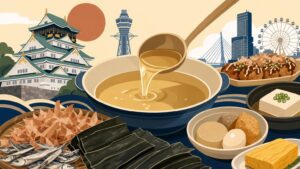
Step off the Shinkansen bullet train at Shin-Osaka Station, navigate your way through the dizzying maze of commuters, and descend into the city. The moment you step out onto the street, you will feel it. The rhythm of the city is fundamentally different. The air hums with a distinct, kinetic frequency. People walk faster here, rushing down the right side of the escalators with a purposeful stride. The quiet, polite restraint that characterizes Tokyo is nowhere to be found. Instead, you are met with a vibrant, chaotic, and deeply human energy. The colors are brighter, the voices are louder, and the unspoken rules of engagement have completely changed. You have entered a city built not by warlords, politicians, or emperors, but by merchants.
To truly understand Osaka, whether you are planning to relocate here, exploring the possibility of a long-term stay, or simply trying to crack the cultural code as a visiting traveler, you must first understand the “Akindo” spirit. Akindo is a traditional Japanese word for merchant. But in the context of Osaka, it represents far more than just buying and selling goods. The Akindo spirit is a philosophy of survival, a framework for humor, a catalyst for deep human connection, and the beating heart of daily life. As a historical researcher spending my days examining how Japan’s deep, complex past manifests in its modern identity, I can tell you with absolute certainty that Osaka is perhaps the most historically consistent city in the country. The merchant soul forged centuries ago during the Edo period has never left the streets. It lives in the bustling covered arcades, it thrives in the late-night standing bars, and it echoes in the everyday greetings of its people.
Many travelers and expatriates arrive in Japan expecting a uniform culture of quiet deference, rigid social hierarchy, and impenetrable politeness. When they reach Osaka, they are often caught off guard. Strangers might talk to them on the train. A shopkeeper might crack a joke at their expense. An elderly woman might hand them a piece of hard candy for no apparent reason. Without the proper historical and cultural context, these interactions can be confusing. Are they being mocked? Are they doing something wrong? No. They are simply experiencing the Akindo spirit in action.
In this comprehensive exploration, we will break down the Akindo spirit layer by layer. We will dive deep into its historical origins, examine its modern applications in both business and daily interactions, and contrast it with the culture of Tokyo to highlight what makes the Kansai region so incredibly unique. Most importantly, we will guide you on how to experience this spirit firsthand on the vibrant streets of Japan’s most dynamic city. You will learn not just how to observe Osaka, but how to participate in it.
What is the “Akindo Spirit”? Unlocking Osaka’s Merchant Soul
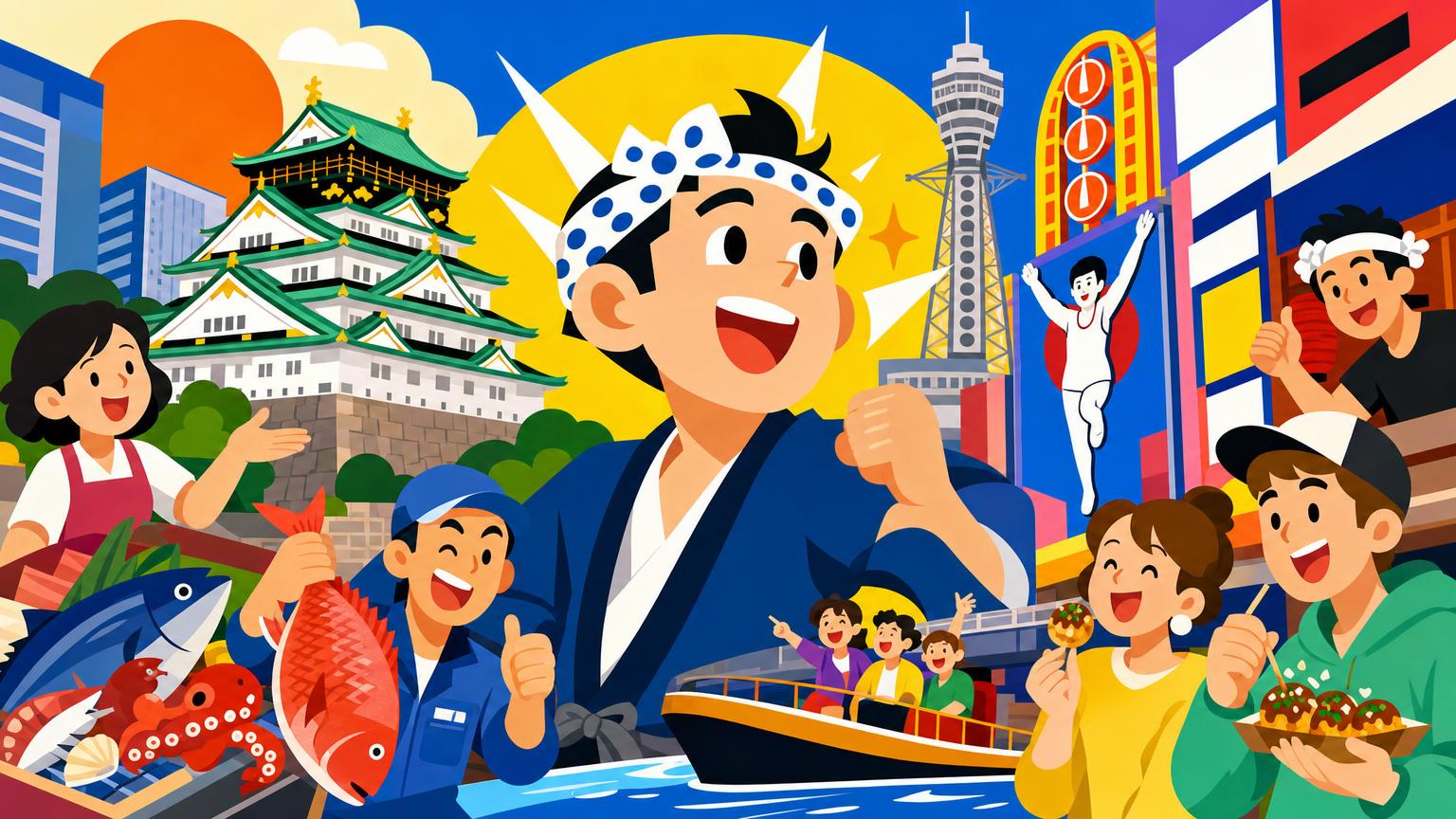
To truly understand modern Osaka, we need to look back in time. Cities are shaped by their inhabitants, and unlike the political capitals Kyoto and Tokyo, Osaka was crafted by ordinary people. It is a city defined by commerce, logistics, and a relentless drive for mutual prosperity. The Akindo spirit is not a recent marketing creation; it is a deeply embedded cultural DNA passed down through generations of market stalls, wholesale districts, and family-run businesses.
The Historical Roots: Osaka as the “Kitchen of Japan”
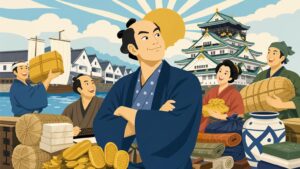
During the Edo period, from the early seventeenth to the mid-nineteenth century, Japan was unified under the strict, isolationist Tokugawa shogunate. The political center was firmly established in Edo, present-day Tokyo. The shogunate enforced a rigid social hierarchy called Shi-No-Ko-Sho. At the top were samurai warriors, followed by farmers producing rice, then artisans creating goods, and merchants at the very bottom. The samurai elite viewed merchants with suspicion and disdain, considering them unproductive since they only moved goods for profit, according to Confucian ideals. Thus, merchants were ranked as the lowest social class.
Yet, historical reality often contradicted this theory. Although samurai held all political and military power, Osaka’s merchants quietly amassed significant wealth. With political authority concentrated in Edo, Osaka operated with relative independence. Without the constant oversight of numerous high-ranking samurai, Osaka’s people were free to focus on commerce. Its geography was ideal for this purpose. Located at the mouth of the Yodo River, opening to the Seto Inland Sea, Osaka became the logistical hub of the Japanese archipelago.
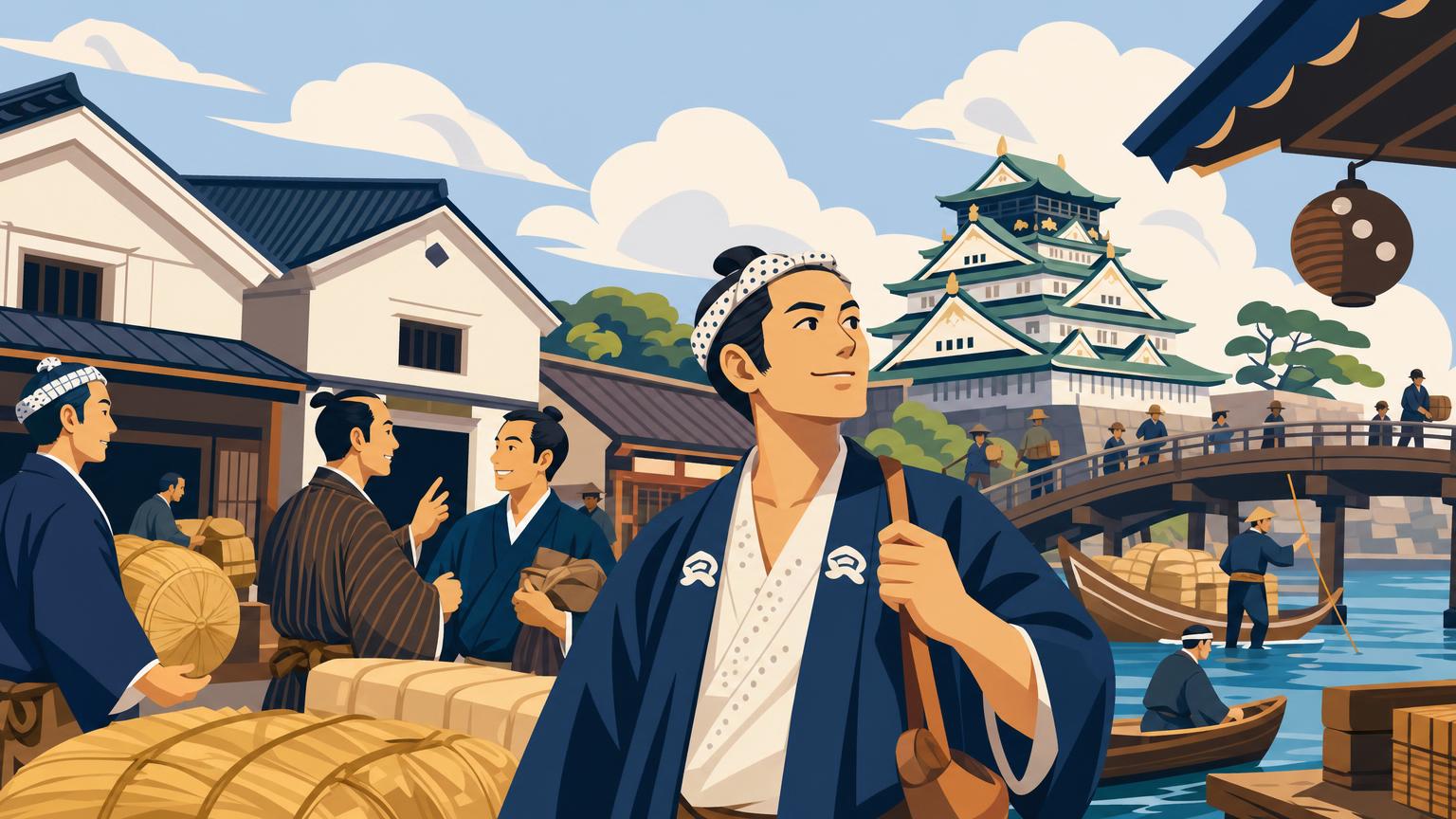
Feudal lords from across Japan sent tax rice and regional goods to Osaka’s vast storehouses. The city earned the title “Tenka no Daidokoro,” or “Kitchen of Japan.” Large fleets of wooden trading ships known as Kitamaebune navigated hazardous coastal waters, bringing kelp from northern Hokkaido, soy sauce from regional brewers, and many other essential commodities into Osaka’s extensive canal network. During this time, the Dojima Rice Exchange was founded in Osaka, operating as the world’s first formal futures market. These merchants were not merely selling goods; they were pioneering modern economic systems. They developed complex credit networks, insurance schemes, and standardized exchange rates long before such concepts reached the West.
Lacking social status and political protection, Osaka’s merchants depended entirely on their ingenuity, wide networks, and immaculate reputations. Samurai commanded respect with the sword, but an Akindo earned it through reliability, charm, and mutually beneficial deals. Survival required keen insight into people, strong negotiation skills, and nurturing long-term relationships. This historical need for social agility and financial savvy forms the core of the Akindo spirit: the understanding that human connection is the ultimate currency.
Core Values: Humor, Pragmatism, and Human Connection
Today, these survival strategies have evolved into defining cultural traits of the Akindo spirit. The first and most apparent is humor. In Osaka, humor is more than entertainment; it acts as vital social glue and a powerful business tool. Laughter breaks down barriers and eases tension. During the Edo period, when merchants haggled over large shipments of timber or rice, a timely joke often bridged stubborn divides.
This tradition continues in daily Osaka life. In Tokyo, if someone stumbles, people usually look away to spare embarrassment. In Osaka, a passerby might loudly ask if the person found a gold coin. This is not mockery but a humorous acknowledgment of shared human experience, creating a moment of connection. Humor levels the playing field and removes pretense. Visitors who embrace this, willing to laugh at themselves and respond with a friendly smile, quickly win local affection.
Pragmatism is the second pillar of the Akindo spirit. Osaka’s people have little patience for inefficiency, empty formalities, or bureaucratic delays. They value directness because merchants must keep things moving. Time spent on excessive bowing or shallow small talk was time lost closing deals. This explains why Osaka residents walk faster and stand on the right side of escalators, leaving the left side open for those in a rush, opposite to Tokyo’s custom. They want to get to the point and understand the bottom line.
Yet, this pragmatism is never cold or mechanical. It is deeply connected to a strong sense of human relationships. The Akindo spirit holds that business is never just a cold transaction but an interaction between people. A true Osaka merchant seeks not a one-time sale but a lifelong customer. They know that short-term cheating would ruin their reputation, and in a merchant city, reputation is everything. This idea is perfectly captured in the traditional merchant principle “Sanpo Yoshi,” meaning “Three-Way Satisfaction.” A successful deal must benefit the seller, the buyer, and society as a whole. When engaging with Osaka shopkeepers, you’ll feel this warmth. They genuinely care about where you’re from, what brings you to their city, and how they can enhance your experience.
“Moukari Makka?”: The Language of Osaka’s Streets
Language is the ultimate carrier of culture, and this is especially evident in Kansai-ben, the regional dialect spoken in Osaka and its surrounding areas. Kansai-ben is rhythmic, melodic, and richly expressive. It lacks the sharp, staccato formality characteristic of standard Tokyo Japanese. Instead, it flows smoothly, filled with elongated vowels and distinctive vocabulary that perfectly reflect the merchant mindset. To truly engage with the Akindo spirit during your visit to Osaka, grasping a few essential phrases of this local dialect is crucial.
How to Respond to Osaka’s Most Famous Greeting
If you want to capture the entire economic and social history of Osaka in just one two-word phrase, look no further than the traditional greeting: “Moukari makka?”
Literally translated, this phrase means, “Are you making money?” or “Is business going well?” To an outsider, or even a Japanese person from outside the Kansai region, this question may seem intrusive, blunt, or even rude. In many Western cultures, and certainly within the refined, samurai-influenced culture of Tokyo, directly asking someone about their financial situation is a serious breach of etiquette. Yet in Osaka, the city of merchants, this is as commonplace as asking, “How’s the weather?” or “How are you today?”
When a shopkeeper or an old friend says “Moukari makka?”, they aren’t asking for your financial statements. They want to know about your overall well-being through the lens of business, because historically, commerce was life in Osaka. It’s an expression of genuine concern. They want to see that you are surviving, thriving, and that life is treating you well.
But the real charm of this greeting lies in its required traditional reply. If someone asks “Moukari makka?”, you absolutely should not respond with, “Yes, I’m making a fortune!” Bragging about success could provoke jealousy and disturb social harmony. Similarly, you cannot say, “No, I’m completely bankrupt and struggling.” Complaining heavily would elicit pity and make the other person uncomfortable, spoiling the light-hearted tone.
The only appropriate response—the ideal Akindo reply—is: “Bochibochi denna.”
“Bochibochi” is a beautifully vague Kansai word roughly meaning “so-so,” “getting by,” or “slowly but surely.” Responding with “Bochibochi denna” strikes the perfect social balance: “I’m not rich enough to make you envious, nor poor enough to make you worry. We’re both out here surviving, moving forward step by step.” This reply is deeply rooted in the shared struggle and resilience of the merchant class.
Though you might not hear “Moukari makka?” among today’s younger generation in corporate offices, it still echoes, or at least its sentiment persists, in bustling wholesale markets, old shopping arcades, and late-night drinking alleys. Understanding this exchange is essential to unlocking the city’s psychology. It reveals that in Osaka, survival is a communal effort, and that humility mixed with a touch of humor is the best way to navigate life.
The Concept of “Omake” (The Little Extras)
Another important linguistic and cultural concept closely tied to the Akindo spirit is “Omake.” Omake refers to a little extra, a freebie, a bonus, or a small discount. It represents the merchant’s intention to build a lasting human connection beyond the mere exchange of money.
If you buy a bag of apples at a local Osaka market, the vendor might casually throw in an extra mandarin orange before handing you the bag. That is Omake. If your bill at a small neighborhood eatery totals 1,020 yen, the owner might wave their hand and say, “Just give me a thousand yen.” That’s Omake. If you’re browsing a traditional goods shop and strike up a friendly conversation with the elderly owner, they may slip a small origami crane or a packet of tissues into your bag. That is Omake.
For travelers used to rigid, barcode-scanned corporate retail environments where every penny is tracked closely, this can come as a surprise. You might feel tempted to refuse the extra item, thinking it’s a mistake, or insist on exact change out of a sense of fairness. Don’t do this. Refusing Omake is rejecting the merchant’s goodwill.
Omake isn’t a pricing error. It’s a deliberate, heartfelt investment in the relationship. The Akindo knows that by sacrificing twenty yen today or giving away a small piece of fruit, they’re creating genuine loyalty and warmth. They’re ensuring that next time you need apples, you’ll bypass three other stalls to buy from them. For a traveler, Omake is the ultimate sign that you’ve successfully bridged the cultural gap. If a vendor offers you an extra treat, it means they enjoyed your interaction. The best response is a bright smile, a slight bow, and a hearty “Ookini!”—the Kansai dialect word for thank you. Accept the gift, remember the kindness, and honor the merchant’s spirit.
Tokyo vs. Osaka: A Tale of Two Cities’ Cultures
To genuinely understand the unique texture of daily life in Osaka, it is extremely useful to compare it with the backdrop of Tokyo. Although Japan’s two largest metropolitan areas are only two and a half hours apart by bullet train, they often feel like entirely different worlds. The contrast between Kanto (the eastern region surrounding Tokyo) and Kansai (the western region around Osaka) is a favorite topic of discussion among Japanese people, and grasping this dichotomy is crucial for any foreigner navigating the country.
The Samurai Legacy vs. The Merchant Rule
As previously mentioned, these cultural differences arise directly from history. Tokyo was once Edo, the seat of the Shogun—the ultimate military ruler of Japan. The city was home to thousands of heavily armed samurai from various feudal domains. In Edo, social hierarchy was paramount. Lower-ranking samurai or commoners had to constantly regulate their speech, posture, and gaze when interacting with superiors. A single misstep in etiquette, a poorly chosen word, or a perceived insult could literally lead to death by sword.
As a result, Tokyo’s culture developed around the concept of “Tatemae,” meaning the facade, the public face, or the polite social fiction. In Tokyo, maintaining social harmony through strict rule-following, keeping physical and emotional distance, and avoiding direct confrontation at all costs became key to survival. This culture is characterized by refined, beautiful, but often impenetrable politeness.
Osaka, unburdened by the samurai elite’s presence, evolved quite differently. When your livelihood depends on negotiating the price of dried fish or wholesale textiles, excessive formality gets in the way. You cannot effectively haggle if you’re continuously bowing and speaking in highly codified honorifics. You need to understand what the other person is genuinely thinking. Therefore, Osaka’s culture centers on “Honne,” which means true feelings, honest desires, and blunt reality.
This historical split becomes clear the moment you step onto a subway train. In Tokyo, a crowded rush-hour train is famously—and almost eerily—silent. People stand shoulder to shoulder, absorbed in their phones or with closed eyes, desperately preserving a private bubble in public. Speaking loudly or laughing on a Tokyo commuter train is seen as a serious breach of public manners.
In Osaka, the auditory experience on trains is entirely different. While not chaotic, there is a constant low murmur of conversation. Friends discuss weekend plans, business partners quietly debate strategies, and an older woman might start chatting with the person next to her simply because they share the same seat. Spatial awareness and personal boundaries are fundamentally more relaxed in Osaka. The Akindo spirit encourages the notion that everyone in the city is in it together, so interaction is natural.
Communication Styles: Politeness vs. Pragmatic Warmth
This difference in communication style often causes culture shock for foreigners who have lived in Tokyo before moving to Osaka. In Tokyo, customer service is highly polished, polite, and standardized. A convenience store clerk recites a carefully scripted greeting with a perfect bow, processes your purchase efficiently, and hands you your receipt with both hands. It is elegant but can feel somewhat robotic and impersonal.
In Osaka, customer service tends to be more fluid, pragmatic, and personable. The clerk might still be polite but might also comment on the large amount of beer you’re buying for Friday night, or complain about the sudden rainstorm while bagging your groceries.
Nowhere is this pragmatic warmth clearer than in the iconic “Osaka Obachan“—the city’s middle-aged and elderly women. Often stereotyped as wearing flashy leopard print clothes, accompanied by a loud, booming laugh, and carrying a seemingly endless supply of hard candies, she perfectly embodies the city’s meddlesome yet profoundly caring nature. This trait is known as “Osekkai.”
Osekkai means being somewhat intrusive, sticking your nose into others’ business, but always with the intention to help. If you’re standing on a street corner in Tokyo looking lost, staring blankly at your phone’s map, people will likely pass by, assuming you want privacy and do not wish to be disturbed. In Osaka, however, an Obachan will probably approach you, grab your arm, loudly ask where you want to go, and physically escort you there—perhaps pressing a piece of candy into your hand before leaving. It is loud, direct, and invades your personal space, but it is done with genuine kindness. This is the essence of the Akindo spirit: we are a community, and community means engagement.
Where to Experience the Akindo Spirit in Osaka Today
Reading about the Akindo spirit offers some insight, but to truly grasp Osaka, you must immerse yourself in the environments where this merchant ethos continues to thrive. While the towering glass skyscrapers of the Umeda business district and the sleek, upscale boutiques lining Shinsaibashi’s shopping streets provide a view of modern corporate Japan, the city’s genuine historical heartbeat lies much closer to the everyday street level. For visitors and newcomers eager to experience authentic Osaka, these are the essential places where the Akindo spirit resonates in every exchange.
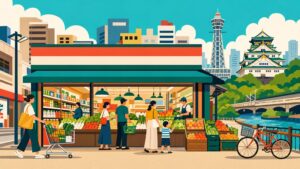
Strolling Through Shotengai (Covered Shopping Arcades)
No architectural feature embodies traditional Japanese urban life quite like the Shotengai, the covered shopping arcade. Though Shotengai exist across Japan, many in other cities have fallen prey to the “shutter street” phenomenon, where small family-run businesses close up, struggling to compete with sprawling suburban malls and online retail giants.
In Osaka, the Shotengai is not just surviving; it is vibrantly alive. And the crown jewel among them is the Tenjinbashisuji Shotengai. Stretching an incredible 2.6 kilometers, it holds the distinction of being the longest covered shopping street in Japan. Walking from one end to the other offers a masterclass in the Akindo spirit.
Beneath the vaulted ceilings, your senses are flooded. The aromas of freshly roasted green tea, crispy fried croquettes, and the rich, sweet scent of dashi broth simmering in enormous pots fill the air. Bicycles skillfully weave through the crowds, their riders navigating narrow lanes without hesitation. Storefronts form a charmingly chaotic collage. A high-end ceramics shop might stand beside a discount sock vendor with boxes stacked high, alongside a tiny stall where a grandfather tenderly repairs broken umbrellas.
Listen carefully as you stroll. The vendors’ rhythmic calls are distinct—never automated greetings, but live voices projecting down the arcade like auctioneers, shouting out specials. “Come here! Best strawberries today! Practically giving them away!” This vocal engagement is the Akindo way of claiming space and fostering connection.
When you make a purchase in a Shotengai, don’t just tap your IC card silently and walk off. Hand the merchant your cash, meet their gaze, and chat about the weather or the quality of their goods. Ask for their recommendations. These merchants hold decades of specialized expertise and take great pride in their selections. Engaging with them validates their dedication, and you’ll likely leave with a better product, richer cultural insight, and perhaps a little Omake as a bonus.
Kuromon Market and the Directness of Food Culture
If Osaka is Japan’s Kitchen, then Kuromon Ichiba Market is its pantry. Historically, this bustling market was the exclusive domain of professional chefs. Restaurant owners across Kansai would arrive before dawn to inspect the day’s freshest seafood, seasonal vegetables, and top-quality wagyu beef.
Recently, Kuromon has opened widely to the public and become a hotspot for international travelers. You might worry that this influx would dilute the traditional Akindo spirit, turning the market into a sanitized tourist trap. Yet the merchants here are remarkably resilient, adapting their Akindo pragmatism rather than abandoning tradition.
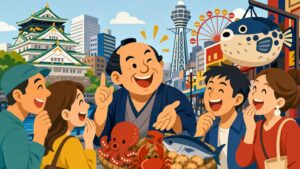
Today, as you walk Kuromon, you’ll see massive tuna expertly filleted with swords right before your eyes, and smell the rich aroma of beef skewers grilling over open flames. Vendors move fast, stay sharp, and are intensely observant. They’ve adapted to Osaka’s “Kuidaore” culture—a famous local saying meaning “eat until you drop” or “eat yourself into bankruptcy”—which expresses the city’s deep devotion to food.
The Akindo spirit here is transactional yet deeply passionate. A uni (sea urchin) vendor will call you over with fierce pride, crack the shell, serve it raw, and watch closely as you take your first bite. They’re not just waiting for payment; they’re waiting for your reaction. When your eyes widen at the creamy richness, they nod in approval. That moment of shared culinary appreciation is the true transaction. The money is merely secondary. To experience Kuromon fully, come hungry, bring ample cash, point to what looks good, eat onsite, and share your enjoyment with the vendor who prepared it.
Shinsekai: Nostalgia, Neon, and the Raw Osaka Vibe
For a raw, unfiltered, and endlessly fascinating glimpse of the working-class Akindo spirit, visit Shinsekai. Its name, meaning “New World,” is ironic given its origins in 1912 as a futuristic amusement district modeled after Paris and Coney Island. Today, it serves as a retro, neon-lit time capsule of Japan’s post-war Showa era.
Dominating the area is the Tsutenkaku Tower, a quirky steel lattice structure and beloved, slightly weathered symbol of Osaka. Streets below teem with affordable diners, retro arcade halls, and shogi (Japanese chess) clubs where older men linger amid cigarette smoke.
Shinsekai’s cultural and culinary highlight is Kushikatsu, the quintessential working-class fast food: skewers of various meats, vegetables, and cheeses, heavily breaded and deep-fried to golden perfection. The eateries here are bright, noisy, and perpetually bustling.
The Akindo spirit in Shinsekai revolves around efficiency, high volume, and a strict social contract. At a Kushikatsu counter, you’ll find a large communal tub of thin, dark, slightly sweet dipping sauce. Before ordering, grasp Shinsekai’s one firm rule: “Nido-zuke kinshi”—no double dipping.
Since the sauce is shared by all customers throughout the day, dipping a skewer you’ve already bitten into is a major violation of hygiene and etiquette. Vendors guard this rule zealously but with humor. Signs abound, and if you forget and try to re-dip, the chef might shout to stop you. This isn’t poor service—it’s the Akindo spirit protecting a communal good. This rule ensures everyone can eat cheaply, quickly, and safely. Need more sauce? Use a piece of raw cabbage from the complimentary bowl to scoop some onto your plate. Dining in Shinsekai teaches you that while Osaka’s rules may differ from elsewhere, they are deeply logical and rigorously upheld.
Den Den Town and the Art of Friendly Bargaining
Osaka’s answer to Tokyo’s Akihabara is Nipponbashi, affectionately called Den Den Town by locals. This long street is an otaku paradise, packed with multi-story shops selling the latest anime figures, vintage video games, rare trading cards, and specialty electronic parts.
What makes Den Den Town significant to understanding the Akindo spirit is that it remains one of the rare places in modern Japan where the ancient art of haggling and bargaining occasionally survives. In most Japanese retail—department stores, boutiques, convenience shops, and eateries—the price tag is final. Trying to haggle normally causes confusion and embarrassment.
Yet in smaller independent electronics shops, tool stores, and flea markets around Den Den Town, there can be some wiggle room, especially if you buy multiple high-value items or slightly older models. But Osaka-style bargaining isn’t aggressive or hostile like in tourist markets elsewhere. It’s a friendly, nuanced dance.
An Osaka Akindo won’t respond well to demands or threats to walk away. Bargaining here builds rapport. When inspecting a used camera lens, you might look at the price, smile warmly, and gently ask, “Mou chotto yasukunarehen?” (Could you make it a bit cheaper?) in the Kansai dialect.
You’re not challenging their price but inviting them into the merchant game. The owner might sigh, complain about tight margins, then offer to waive sales tax or include a free protective case. You accept graciously, both laugh, and the deal is made. The goal is a mutually satisfying outcome where you feel you scored a deal, and the merchant gains a loyal customer. It’s a social performance rooted in respect.
Izakaya Culture and Conversing with Local Vendors
When night falls and neon lights ignite, the Akindo spirit shifts from merchandising to hospitality. The Izakaya (Japanese pub) is the social hub, but in Osaka, the spotlight shines on Tachinomi, or standing bars.
Tachinomi bars are narrow, bustling spaces where patrons stand shoulder to shoulder along a wooden counter. There are no seats, no private areas. Bartenders, owners, and chefs are often the same person, working quickly and skillfully just inches from customers.
The Tachinomi master is the quintessential modern Akindo. They do more than pour draft beer and grill yakitori; they orchestrate the room’s vibe. They remember faces, know their regulars’ orders, and seamlessly weave newcomers into the evening’s rhythm.
As a foreigner walking into a Tachinomi, the noise and standing might feel overwhelming. Just find an open spot at the counter, order a drink, and stand confidently. Unlike Tokyo’s quieter drinking culture, in Osaka you’re never drinking alone. Within minutes, the person next to you will ask where you’re from; the bartender will toss in a joke. The close quarters encourage conversation.
In these intimate spaces, facades drop. Businessmen loosen ties and vent about bosses. Students celebrate exams passed. Laborers unwind after long shifts. The Akindo behind the bar moderates all, pouring drinks, offering a sympathetic ear, and keeping the mood lively. To join in, simply raise your glass, smile, and say “Kanpai!” (Cheers!). The community will take care of the rest.
Tips for Travelers and New Residents: Embracing the Local Vibe
Grasping the theory behind the Akindo spirit is crucial, but putting it into practice in your everyday actions is what will shift your experience in Osaka from that of a passive onlooker to an active participant. The people of Osaka are notably open-minded and hospitable to outsiders, as long as those visitors are willing to meet them halfway. To truly connect with the merchant soul of the city, you need to adapt your approach.
Engage with a Smile and Open Body Language
The key advice for anyone interacting with Osaka’s residents is to let go of the defensive, guarded posture that travelers often adopt in large cities. When entering a small shop, an izakaya, or a market stall, resist the urge to keep your head down and eyes averted. Approach with open body language.
When a shopkeeper greets you, don’t ignore them. Acknowledge their presence. Even if you don’t speak a word of Japanese, a bright smile, a nod, and a simple “Hello” go a long way. The Akindo spirit is founded on recognizing the humanity of the person across from you. If you look lost at a train station, don’t hesitate to make eye contact with a local. They are likely to stop and offer help.
Be ready for surprises and respond with good humor. If a vendor playfully teases your chopstick skills, don’t take offense or feel embarrassed. Laugh along, exaggerate your clumsiness to keep the joke lively. If you drop a coin and it rolls away, someone will probably point it out loudly. Thank them enthusiastically. Osaka rewards those who join in the everyday street theater.
Respecting the Line Between Banter and Disrespect
Although Osaka is unmistakably casual, funny, and loud compared to the rest of Japan, it’s vital not to confuse this relaxed atmosphere with a lack of standards or acceptance of disrespect. The Akindo spirit is deeply tied to pride. Merchants take great pride in the quality of their goods, the speed of their service, and the cleanliness of their shops.
Banter is enjoyable, but it’s a two-way street grounded in mutual respect. You can joke with a vendor, but never insult their product, even in jest. Lighthearted negotiation in Den Den Town is acceptable, but don’t aggressively demand a lower price or act entitled.
Moreover, practical sense dictates never blocking the flow of commerce. When waiting in line at a takoyaki stand or a busy convenience store, have your money ready. Don’t stand at the front counting coins slowly while a line of hungry locals builds behind you. Place your order clearly, pay promptly, and step aside to let the next person approach. Respecting the merchant’s efficient workflow is the highest form of politeness in Osaka.
Finally, remember that despite the more relaxed rules here, you are still in Japan. General manners apply: do not leave trash on the streets, avoid speaking loudly on your phone while riding the train, and don’t walk down the street eating messy food unless you’re in a market area designed for it. The Akindo spirit flourishes on social harmony, and as a guest in the city, helping maintain that harmony is your most important duty.
In conclusion, Osaka is more than just a destination; it’s a mindset. It’s a city that measures a person’s worth not by titles or formal etiquette, but by honesty, resilience, and the willingness to connect. By understanding the Akindo spirit and recognizing the deep historical currents of commerce, humor, and pragmatism flowing through its streets, you’ll discover a side of Japan that is warmer, louder, and infinitely more human than any standard guidebook could convey. So step into the arcade, listen to the vendors’ shouts, accept the extra piece of candy with a smile, and become part of the vibrant, ongoing exchange that is daily life in Osaka.