You step off the train and the air hits you differently here. It is not the hushed, almost reverent silence of a Tokyo morning, where thousands of commuters move like elegant ghosts in beautifully tailored wool coats, avoiding eye contact at all costs. No, Osaka breathes loud. It exhales in a symphony of rustling shopping bags, the clack of sensible walking shoes, and voices. So many voices. Voices that do not wait for permission to occupy the space between two strangers. You might be standing on a street corner in Umeda or Namba, perhaps wearing that carefully curated, layered outfit you brought from home, feeling a bit lost in the concrete labyrinth. Before you can even check your digital map, an older woman with a vibrant, fiercely independent sense of style taps your shoulder. She does not ask if you are lost. She tells you that you look cold, asks where you bought your scarf because she admires the bold color palette, and then, almost as an afterthought, points you toward the correct subway entrance. This is the heartbeat of the city. This is the raw, unfiltered, relentlessly human phenomenon known as seken-banashi. It is the art of small talk, the lifeblood of neighborhood gossip, and the invisible glue that holds this chaotic, wonderful metropolis together. As a travel writer with a background in fashion and art, I have spent countless long vacations exploring street corners around the world, analyzing how people move, how they dress, and how they interact. Osaka stands out as a fascinating anomaly. It is a major global city, yet it operates with the intimate, sometimes invasive, but deeply comforting logic of a small village. If you are a foreigner living in Osaka, thinking about moving here, or simply trying to understand the profound cultural differences between Japan’s major hubs, you must understand seken-banashi. It is not merely casual conversation. It is a sophisticated mechanism for community building, a decentralized security system for local neighborhoods, and a gateway into the true, unvarnished soul of the Kansai region. It dictates how business is done, how neighbors resolve disputes, and how safety is maintained on the streets long after the sun goes down. To understand Osaka, you must be willing to talk, to listen, and to become a participant in the endless, rolling dialogue of the city.
What is the Osaka Seken-banashi Community Building?
Many expatriates, international students, and foreign researchers dive into search engines before moving, eagerly seeking a tangible representation of this renowned local culture. They enter the exact phrase “Osaka Seken-banashi community building” into their browsers, anticipating a physical structure. They envision a modern civic center, possibly crafted by a famous Japanese architect, designed specifically for the art of small talk and cultural exchange. They imagine a building with welcome desks, language workshops, and organized community gatherings. It sounds entirely reasonable, doesn’t it? A literal building dedicated to breaking the ice and fostering neighborhood connections. But the reality is far more intricate, less literal, and infinitely more beautiful. There is no single building by this name. The phrase is a linguistic phantom, a conceptual misunderstanding born from digital algorithms and cultural translation. Yet, when you search this phrase, the internet often returns results for actual places, most notably the Semba Center Building, along with local ward offices and shopping arcades. This algorithmic confusion is no random mistake. It is a profound, accidental truth. The search engine is guiding you toward the real physical spaces where the concept of seken-banashi naturally flourishes, turning commercial and civic architecture into spontaneous community hubs.
The Semba Center Building Mix-Up
The reason your online search for an “Osaka Seken-banashi community building” often leads to the Semba Center Building is a compelling case study in phonetics and urban function. Firstly, the word “Semba” bears a slight phonetic similarity to “Seken-banashi,” enough to confuse an autocorrect algorithm seeking relevant local landmarks. More importantly, the Semba Center Building exemplifies the very community interaction you seek. Stretching an impressive one thousand meters beneath an elevated expressway in Chuo Ward, this massive commercial complex is a maze of wholesale textile shops, traditional kimono merchants, independent fashion boutiques, and bustling underground eateries. Historically, Semba was the heart of Osaka’s merchant culture. It was here that the legendary “shonin” (merchant) mindset was shaped. In Semba, business transactions are never mere exchanges of money for goods. They are social dances. They require seken-banashi. The merchants in the Semba Center Building won’t simply ring up your purchase silently. They’ll assess your attire, ask where you’re from, and discuss the changing seasons, cotton prices, or the latest Hanshin Tigers baseball game. They do this to build rapport, gauge your character, and establish a human connection before speaking about discounts. So, while “seken-banashi” may not be officially inscribed on its concrete facade, the Semba Center Building is arguably the city’s most genuine community building. It is a place where small talk builds business empires and weaves the neighborhood’s social fabric.
The Concept of Seken-banashi in Osaka’s Culture
To truly understand daily life in this city, one must unpack the term seken-banashi itself. In standard Japanese, “seken” means the world, the public, or society in general, while “hanashi” (which becomes banashi in this compound) means talk or story. Thus, seken-banashi roughly translates to “talk of the world” or, more simply, small talk and neighborhood gossip. But in Osaka, it carries a significance and practical role beyond idle chatter. In Tokyo, maintaining harmony often means keeping your distance. The unwritten rule there is not to impose yourself on others. You don’t intrude or pry—you read the air and blend in. Osaka functions on the exact opposite wavelength. Here, maintaining harmony means recognizing the people around you. Silence among strangers in close quarters is often seen not as respectful discretion, but as coldness or arrogance. Seken-banashi serves as the tool to close the gap between isolated individuals. It is the social lubricant that prevents friction in a crowded, high-energy environment. When an elderly man at a bus stop loudly complains to no one in particular about the humidity, he is casting a conversational net. He is offering a low-stakes invitation for anyone nearby to agree with him, validate his human experience, and briefly share the burden of the sticky summer heat. For a foreign resident, understanding this dynamic changes everything. When a local initiates seken-banashi with you, they aren’t necessarily seeking a deep, philosophical friendship. They are simply extending a brief thread of community. They are breaking the ice. Learning to catch that thread, to nod, smile, and respond with a simple agreement in broken Kansai dialect, is the quickest way to go from feeling like an outsider to feeling like a recognized member of the street.
Best Places for Community Building and Local Interaction in Osaka
If the hypothetical “Osaka Seken-banashi community building” does not exist as a singular entity, where can one go to experience this essential aspect of local life? The answer lies in the city’s everyday architecture. Osaka is designed, both deliberately and organically, to bring people together. From the sprawling underground retail labyrinths to the endless covered shopping arcades, the city’s physical layout ensures a certain degree of unavoidable human contact. To observe the locals, practice your Japanese, or simply soak in the warm, chaotic embrace of the community, you need to visit the spaces where seken-banashi is not just welcomed but practically obligatory. These are the contemporary and historical venues where the social fabric of the city is actively woven every day.
Semba Center Building: The Retro Commercial Hub
As mentioned earlier, the Semba Center Building is an essential stop for anyone wanting to grasp the merchant spirit of Osaka. Situated directly above the Sakaisuji-Hommachi and Hommachi subway stations, this brutalist architectural icon presents a fascinating contrast between its heavy concrete framework and vibrant, colorful human activity. For a travel writer with a keen eye for fashion, it is a paradise of raw materials. Here, thousands of independent vendors sell textiles, buttons, imported garments, and traditional Japanese clothing. But the real attraction is the interaction. The aisles are deliberately narrow—you cannot simply walk past a shop without the proprietor noticing you. The close physical proximity demands recognition. If you linger by a rack of vintage silk blouses, the shop owner will inevitably step out and start a conversation. They may ask if you are a designer, share the history of the fabric, or even offer you a piece of candy. This is community building at its most primal, transactional level. As a non-Japanese resident, you might find the rapid-fire Kansai dialect of these seasoned merchants intimidating. Don’t be. Their seken-banashi is not about testing your language skills but about creating a connection. A simple smile, nod, and a few words of appreciation for their goods will quickly earn their respect. Moreover, the underground restaurant floors of the Semba Center Building provide a masterclass in local dining culture. Tiny, smoke-filled izakayas and retro coffee shops (kissaten) serve as the living rooms for the local workforce. Sitting at a cramped counter for lunch, you’ll overhear business deals being made, family dramas analyzed, and lively debates on local politics—all delivered with the rhythmic, comedic timing Osaka is known for.
Naniwa Kumin Center: The Heart of Local Events
If you want to shift away from commercial exchanges and observe pure civic community building, look to the local ward centers. The Naniwa Kumin Center, in Naniwa Ward, is a prime example of how grassroots society organizes itself in Japan. Unlike the bustling shopping streets, a Kumin Center (Citizens Center) presents a more bureaucratic, orderly facade. The architecture tends to be utilitarian, with linoleum floors, fluorescent lighting, and rows of folding chairs. Yet beneath this sterile exterior beats the real heart of the residential community. These centers host disaster preparedness workshops, traditional tea ceremony classes, calligraphy sessions, and local neighborhood association (Chonaikai) meetings. For a foreigner living in Osaka, visiting a Kumin Center can be a grounding experience. It strips away the neon glamour of tourist areas and reveals daily life’s practical realities. The bulletin boards in the lobby function as an analog internet of neighborhood information, crowded with hand-drawn flyers for local festivals, lost pet notices, and volunteer recruitment posters. The grandmothers volunteering at the reception desks act as gatekeepers of local knowledge. They have an impressively precise mental map of every resident in their district. Engaging in seken-banashi with them is not just polite—it’s an initiation rite. Ask for directions to a clinic or inquire about a language class, and they won’t simply hand you a pamphlet. They’ll ask where you live, how long you’ve been in Japan, and whether you’re eating enough vegetables. They’ll introduce you to other residents and actively help fold you into the community fabric. This involvement can sometimes feel intrusive to those from highly individualistic Western cultures, but it’s important to recognize it as a profound, proactive system of mutual care and local resilience.
Namba Parks: Urban Architecture Meets Community Space
Community building in Osaka is not limited to retro shopping arcades and utilitarian civic centers. The city also features remarkable examples of modern urban design that intentionally encourage social interaction. Namba Parks is perhaps the most striking example of this philosophy. Designed by visionary American architect Jon Jerde, Namba Parks is constructed on the site of the former Osaka Baseball Stadium. Rather than a massive, monolithic concrete mall, Jerde envisioned an urban canyon—a sprawling, multi-tiered oasis of green terraces, rooftop gardens, and open-air walkways rising through an eight-story complex. From a fashion and lifestyle viewpoint, it brilliantly integrates high-end retail with public leisure space. Sociologically, it stands as a masterpiece of community engineering. The pathways are designed to wind and meander, encouraging visitors to slow their pace. Benches and seating areas are grouped in small alcoves, prompting strangers to sit near each other amidst carefully curated foliage. In a city as dense, noisy, and visually overwhelming as Osaka, spaces offering psychological respite are vital. Namba Parks provides this sanctuary, creating an environment where a different, gentler form of seken-banashi can flourish. It’s not the loud, transactional banter of merchant districts but quiet, relaxed conversation—between mothers watching children by rooftop streams or young professionals enjoying lunch on terraced lawns. From a safety perspective—a key concern for any woman navigating a foreign city—Namba Parks excels in passive surveillance. Its open sightlines, abundant lighting, and the constant presence of others make it an exceptionally safe place to linger during twilight hours. It exemplifies how thoughtful architecture can foster human connection while simultaneously ensuring public security.
Tenjinbashisuji Shopping Street: The Marathon of Local Chat
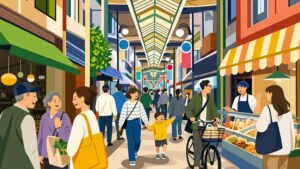
No discussion of Osaka’s community dynamics is complete without examining the “shotengai” (covered shopping streets), and the undisputed king among them is Tenjinbashisuji Shopping Street. Stretching an impressive 2.6 kilometers through Kita Ward, it holds the record as Japan’s longest continuous shopping arcade. Walking its full length is more than a physical marathon; it’s an endurance test of social interaction. Beneath the vaulted glass and steel roof, hundreds of independent businesses line the street. There are butchers, bakers, knife sharpeners, tea merchants, vintage clothing stalls, and countless tiny eateries. The sheer density of commerce creates a vibrant, almost chaotic atmosphere. Bicycles weave through pedestrians, shop owners call out daily specials with theatrical flair, and the scent of roasted green tea mingles with the rich aroma of frying croquettes. Tenjinbashisuji is the ultimate arena for seken-banashi. Here, merchants have perfected the art of small talk over generations. They will literally call out to you if you pass by uncertainly. Should you stop to buy a piece of fruit, prepare for conversation: they’ll ask if you live nearby, comment on the weather, and almost certainly share a joke or pun. This nonstop, rolling wave of friendly interrogation polices the street, maintains its unique identity, and helps it thrive in the digital commerce era. As a foreigner, the volume of interaction may initially feel overwhelming. The key is to think of the entire street as one sprawling community center. You don’t have to engage deeply at every stall. A bright smile, a polite bow, and a cheerful “Ookini” (the Kansai word for thank you) are all that’s needed to join the rhythm of the arcade. By the time you finish the 2.6-kilometer walk, your feet will ache, your bags will be full of unexpected treasures, and you will have gained a profound sense of what it means to be part of the Osaka crowd.
Location, Address, and Map Details for Visitors
For those who want to explore these tangible expressions of Osaka’s community spirit, having a solid understanding of the city’s geography is crucial. The city is generally divided into two main centers: “Kita” (North), focused around Umeda, and “Minami” (South), centered around Namba and Shinsaibashi. The nature of the seken-banashi you encounter will subtly vary depending on the ward you are in.
The Semba Center Building is located in Chuo Ward, extending linearly between the Hommachi and Sakaisuji-Hommachi subway stations. Its precise address covers several blocks (Semba-chuo 1-chome to 4-chome, Chuo-ku, Osaka). It is easily reachable via the Midosuji, Chuo, and Sakaisuji subway lines. The underground floors connect directly to the train stations, making it an ideal destination on rainy days.
Further south in Naniwa Ward, the Naniwa Kumin Center is situated at 2-chome-1-20 Inari, Naniwa-ku, Osaka. It is a short walk from Sakuragawa Station on the Sennichimae subway line or JR Namba Station. This primarily residential area provides a strong contrast to the neon-lit tourist districts nearby.
Namba Parks, an architectural canyon of greenery, stands adjacent to Namba Station in the Minami district. Its address is 2-chome-10-70 Nanbanaka, Naniwa-ku, Osaka. It is directly linked to Nankai Electric Railway’s Namba Station, serving as a major gateway for travelers arriving from Kansai International Airport. The fusion of transit and retail keeps a steady, varied flow of people passing through its terraced gardens.
Starting close to Tenjimbashisuji 6-chome subway station (commonly known as Tenroku), the Tenjinbashisuji Shopping Street stretches southwards, finally ending near Minami-morimachi station and the grand Osaka Tenmangu Shrine. The address is typically given as Tenjinbashi 1-chome to 7-chome, Kita-ku, Osaka. Exploring this vast arcade takes time and comfortable shoes, as it crosses several distinct neighborhoods, each with its own micro-culture and unique style of merchant banter.
Grasping the physical locations of these hubs is important, but more significantly, understanding the invisible social networks that link them will elevate your experience from simple sightseeing to authentic urban immersion.
How to Experience Genuine Community Connections in Osaka
Knowing where to go is only half the challenge; understanding how to behave upon arrival is the true key to unlocking daily life in Osaka. For many foreigners, especially those from cultures that highly value privacy and personal space, the locals’ straightforwardness can feel overwhelming. You might mistake a sudden question from a stranger for an invasion of privacy rather than the genuine invitation to connect that it is. To truly build community, you need to consciously lower your defenses. You must be willing to make mistakes, laugh at yourself, and embrace the charming awkwardness of cross-cultural communication.
The first step is to master the art of active response. In Osaka, listening is never passive. When someone initiates seken-banashi with you, they expect audible feedback. The Japanese concept of “aizuchi” (conversational interjections) is amplified to the fullest in the Kansai region. You need to nod enthusiastically and make sounds of agreement, surprise, and empathy. Phrases like “Sou desu ne” (That is true), “Hontou ni!” (Really!), and the extremely versatile “Ehhhh?” (an expression of surprise that can be drawn out for effect) are your essential tools. Even if you don’t catch every word the elderly fruit vendor says about the incoming typhoon, your lively participation in the conversation’s rhythm is what truly matters. It shows that you are present, respect their effort to connect, and are willing to join the exchange.
The second step is to become a regular. Community in Osaka is fostered through repetition. You can’t expect to be treated like a local on your first visit to a neighborhood café. You need to return. You need to order the same thing. You need to sit in the same seat. Over time, the anonymity barrier will dissolve. The owner will stop seeing you as a transient customer and start treating you like a local. They will remember how you take your coffee. They will notice if you miss a visit. This transition from stranger to regular is one of the most fulfilling experiences for a foreigner in Japan. It requires patience, consistency, and a willingness to invest time in a particular place.
Finally, don’t hesitate to initiate seken-banashi yourself. This may be the most intimidating task for a non-native speaker, but it offers the greatest rewards. You don’t need to create complex sentences. A simple comment about your immediate surroundings is enough. If you’re standing in a long line at a popular takoyaki stand, turning to the person nearby and saying, “Atsui desu ne” (It’s hot, isn’t it?) is a perfectly fine conversation starter. In Tokyo, this might be met with a polite but brief nod before the person returns to their phone. In Osaka, it’s likely to spark a ten-minute chat about the humidity, best ways to cool off, and a tip about a shaved ice shop just a few streets away. You need to be courageous enough to cast the net.
Osaka vs Tokyo: A Tale of Two Conversations
To truly grasp the distinctive nature of daily life in Osaka, one must view it through the perspective of contrast. The rivalry between Tokyo and Osaka is well-known, spanning everything from business customs to culinary tastes. Yet, the most significant difference lies in the psychological approach to communication and community. These two cities function according to fundamentally different social frameworks. If you are deciding which city offers a better living environment, understanding this divergence is essential.
Tokyo is a city founded on the concept of “tatemae” (the public facade) and the strong desire to preserve social harmony through non-interference. It is a marvel of collective self-control. Millions of people inhabit extremely limited spaces, yet the city operates seamlessly because everyone agrees to act as if others do not exist. You read the air (kuuki wo yomu). You keep your voice down on the train. You avoid starting unprompted conversations with strangers because it imposes an unexpected obligation on them to respond. In Tokyo, politeness is shown through maintaining distance. It is a beautiful, elegant, and highly efficient system, but for a foreigner seeking genuine, spontaneous human connection, it can feel deeply isolating. It can seem like living in a perfectly curated museum where touching the exhibits is forbidden.
Osaka, in contrast, is a city based on “honne” (true feelings) and the desire to uphold social harmony through active participation. The restraint admired in Tokyo is regarded here with some suspicion. If you don’t express your feelings, if you avoid the messy, noisy aspects of human interaction, how can anyone trust you? In Osaka, politeness is conveyed through closeness and warmth. The city is renowned for its comedy culture, especially the dynamic between “Boke” (the funny, foolish one) and “Tsukkomi” (the straight person who corrects them). This comedic pattern influences everyday conversation. Every interaction can turn into a small comedy sketch. The locals use humor as social currency, a means to ease tension, bridge cultural divides, and build instant rapport. If you make a mistake with your Japanese or accidentally wear your shirt inside out, an Osaka resident is much more likely to point it out and laugh with you than to politely ignore it to save face. This blunt honesty, wrapped in humor and delivered through relentless seken-banashi, can be overwhelming at first. But once you adapt to its rhythm, it is incredibly freeing. It means you don’t have to be perfect. It means you are allowed to be flawed, human, and fully present. Living in Osaka requires accepting that you will be noticed, questioned, and engaged with daily. For those seeking community, there is no better place in Japan.
Navigating Street Corners: A Woman’s Perspective on Safety and Style in Osaka
As a woman in her twenties who has spent significant time studying urban environments worldwide, the intersection of safety, style, and community interaction is a topic of deep personal and professional interest. For expatriate women contemplating a move to a major city, safety is almost always the foremost concern. They scrutinize crime data, identify the safest walking routes, and assess the security features of potential apartments. Japan is internationally celebrated for its outstanding safety, yet the nature of that safety varies greatly from one city to another. In my experience, Osaka’s safety feels strikingly different from the clinical, heavily policed atmosphere found in other global cities. The security in Osaka is organic, deeply embedded in the concept of seken-banashi, which we have been exploring.
Walking down a narrow residential street in Osaka at dusk, perhaps after a long day at work or a late dinner in Minami, the atmosphere feels inherently secure. This sense of safety does not primarily come from a visible police presence, although the local Koban (police boxes) are active. Instead, it feels safe because the street is alive, constantly observed by the decentralized network of local residents. The elderly woman tending her potted hydrangeas, the dry cleaner wrapping up his last pressing, the teenagers chatting outside the convenience store—they all constitute an invisible, analog surveillance system. The culture encourages noticing people, acknowledging their presence, and engaging in brief conversation, so strangers are instantly recognized. Regulars in the neighborhood are known by face and schedule, and any unusual behavior is quickly noted. If an unfamiliar person is lingering suspiciously, the neighborhood grapevine springs into action rapidly. This passive safety network is one of the most remarkable aspects of the city’s talkative culture. Gossip keeps the streets safe.
From a fashion perspective, this environment of continuous observation and social interaction creates a distinct dynamic. In cities where anonymity is prized, fashion often becomes defensive, designed to blend in. People wear dark colors, severe cuts, and minimalist accessories to avoid attracting attention. While Tokyo fashion is undeniably brilliant and globally influential, it often adopts this polished, impenetrable perfection as a form of armor. Osaka fashion, however, is completely different. Since interaction is unavoidable, clothing serves as a conversation starter. Locals embrace bold colors, expressive patterns, and a playful eccentricity. They dress to be noticed, to invite comments, and to spread joy. A leopard print coat or a bright yellow tote bag isn’t a fashion mistake—it’s a way to spark dialogue. As a foreign woman living here, this feels incredibly freeing. You don’t have to curb your personal style to avoid unwanted attention because the attention you get is usually benign, curious, and rooted in community interest. If an older woman points at your bright red boots and starts chatting rapidly in Kansai-ben, she isn’t criticizing your taste; she is complimenting your boldness and initiating seken-banashi. You can walk Osaka’s streets feeling both physically safe and sartorially free, knowing the community is watching out for you while also appreciating your fashion choices.
The Unspoken Rules of Daily Life in Osaka
To truly become part of this city’s fabric and stop feeling like a perpetual tourist, you need to internalize the unspoken rules that govern daily life. These rules are seldom found in official guidebooks, yet they form the foundational pillars of the Osaka mindset. Grasping them will transform your view from that of an outsider looking in to an insider engaged in the grand, chaotic rhythm of the metropolis.
The first unspoken rule is the absolute rejection of pretension. Osaka proudly embraces its working-class, merchant-driven identity. It has no tolerance for snobbery or affectation. If you act aloof, superior, or overly formal, you will face immediate resistance. Locals respect hard work, honesty, and a readiness to get their hands dirty. This is why inexpensive, incredibly delicious street foods like takoyaki and okonomiyaki are celebrated not just as snacks but as cultural icons. Eating while standing at a bustling counter, getting sauce on your chin, and laughing loudly with the vendor is considered far more authentic than dining in stiff silence at a high-end restaurant. In Osaka, cheap doesn’t mean bad; it means smart. People here take great pride in finding bargains and will happily boast about the discounts they secured on high-quality items. If someone compliments your jacket, the most Osaka-appropriate response isn’t a modest thank you but a proud declaration of the amazing deal you got. This shared appreciation of value and practicality forms a cornerstone of the local sense of community.
The second unspoken rule is the mandatory recognition of the human element in every interaction. As discussed extensively regarding seken-banashi, this applies to all aspects of life. You don’t just tap your transit card and ignore the bus driver; you offer a quick nod or a muttered thanks. You don’t treat convenience store clerks like invisible machines; you make eye contact. The city insists that you acknowledge the humanity of those serving you, working alongside you, and living near you. This need for frequent micro-interactions can be tiring for introverts, but it is the price of entry to a society that truly cares about its members.
The final unspoken rule is that humor is an essential coping mechanism. Life in a densely populated urban environment is stressful. Trains are overcrowded, summers are blisteringly hot, and work moves at a relentless pace. Instead of silently bearing this stress, Osaka releases it through laughter. The ability to complain about a tough situation in a way that makes others laugh is considered a refined art form. When you are sweating heavily on a jam-packed subway platform in August, loudly and dramatically complaining about melting into a puddle is not seen as whining; it’s a public service. It gives others permission to laugh at the shared hardship. This is the ultimate way to build community. It acknowledges that we are all trapped in this chaotic, wonderful city together, and the only way to survive with our sanity intact is to talk about it, laugh about it, and never, ever ignore the people standing right next to us. Living in Osaka isn’t just about occupying a physical space; it’s about taking part in an endless, sprawling, magnificent conversation.