
Tokyo whispers. Osaka shouts. You step off the Shinkansen and the air feels instantly heavier. The pristine, quiet, perfectly manicured streets of the capital fade into the rearview mirror, replaced by a sprawling concrete jungle that pulses with a frantic, unapologetic energy. Tokyo is a city of rules. Osaka is a city of negotiations. As a photographer, my lens has always gravitated toward the shadows, the neon reflections in the puddles of back alleys, the hidden towns that tourists walk past without seeing. When I first moved to Japan, I thought I understood the aesthetic. I expected paper lanterns. I expected quiet shrines. I expected a serene, muted palette of wood and stone. And then I walked down a street in Osaka at two in the morning and saw my first Super Tamade.
The lights hit you first. A blazing assault of canary yellow. A violent splash of crimson red. A relentless, flashing LED nightmare that looks less like a place to buy carrots and more like a pachinko parlor that has somehow merged with a circus. You blink. You look away. You look back. It is still there. Defiant. Glowing in the dark. It is a beacon for the weary, the hungry, the budget-conscious, and the insomniacs. For those of us who live here, who navigate the daily grind of this massive, mercantile city, Super Tamade is not just a grocery store. It is a state of mind. It is the raw, beating heart of Osaka’s relentless pursuit of a bargain.
Foreigners arriving in Kansai often carry a suitcase full of misconceptions. They expect everyone to be constantly cracking jokes. They expect the streets to run entirely on takoyaki and okonomiyaki. And while the food culture here is indeed legendary, the reality of daily life requires a different kind of navigation. You cannot eat out every night. You have to buy groceries. You have to stock your tiny apartment fridge. You have to figure out how to stretch your yen when the end of the month approaches and your paycheck is still a week away. This is where the polished veneer of upscale Japanese supermarkets shatters, and the gritty, glorious reality of Osaka steps in.
Super Tamade represents the absolute antithesis of the upscale, softly lit grocery stores of Tokyo, where perfect apples sit in solitary confinement inside individual foam nets, priced like luxury watches. Here, the aesthetic is chaos. The philosophy is volume. The goal is to get you in, get you cheap food, and get you out, all while bombarding your senses with a visual and auditory experience that you will never forget. It is jarring. It is disorienting. And after a few months of living here, it becomes absolutely essential.
If you want to understand how Osaka people think, you have to understand how they shop. Osaka is historically a merchant city. The people here respect the hustle. They respect value. There is no shame in finding a bargain here; in fact, there is intense pride in it. In Tokyo, admitting you bought your dinner for two hundred yen might earn you a polite, sympathetic nod. In Osaka, it earns you respect. It proves you are smart. It proves you know how to survive. Super Tamade caters exactly to this mindset. It strips away the pretense of grocery shopping and turns it into a high-octane sport.
This guide is not a glossy brochure. It is a survival manual. Whether you have just signed a lease on a shoebox apartment in Naniwa Ward, or you are a long-term resident trying to optimize your grocery budget, or even if you are just passing through and want to understand what makes this city tick behind closed doors, you need to know how to navigate these aisles. You need to know the unspoken rules. You need to know what to grab when the discount stickers come out, and equally important, you need to know what to leave on the shelf. Welcome to the neon underbelly of Osaka’s food scene. Welcome to the chaos. Welcome to Tamade.
What is Super Tamade? Osaka’s Most Iconic Supermarket
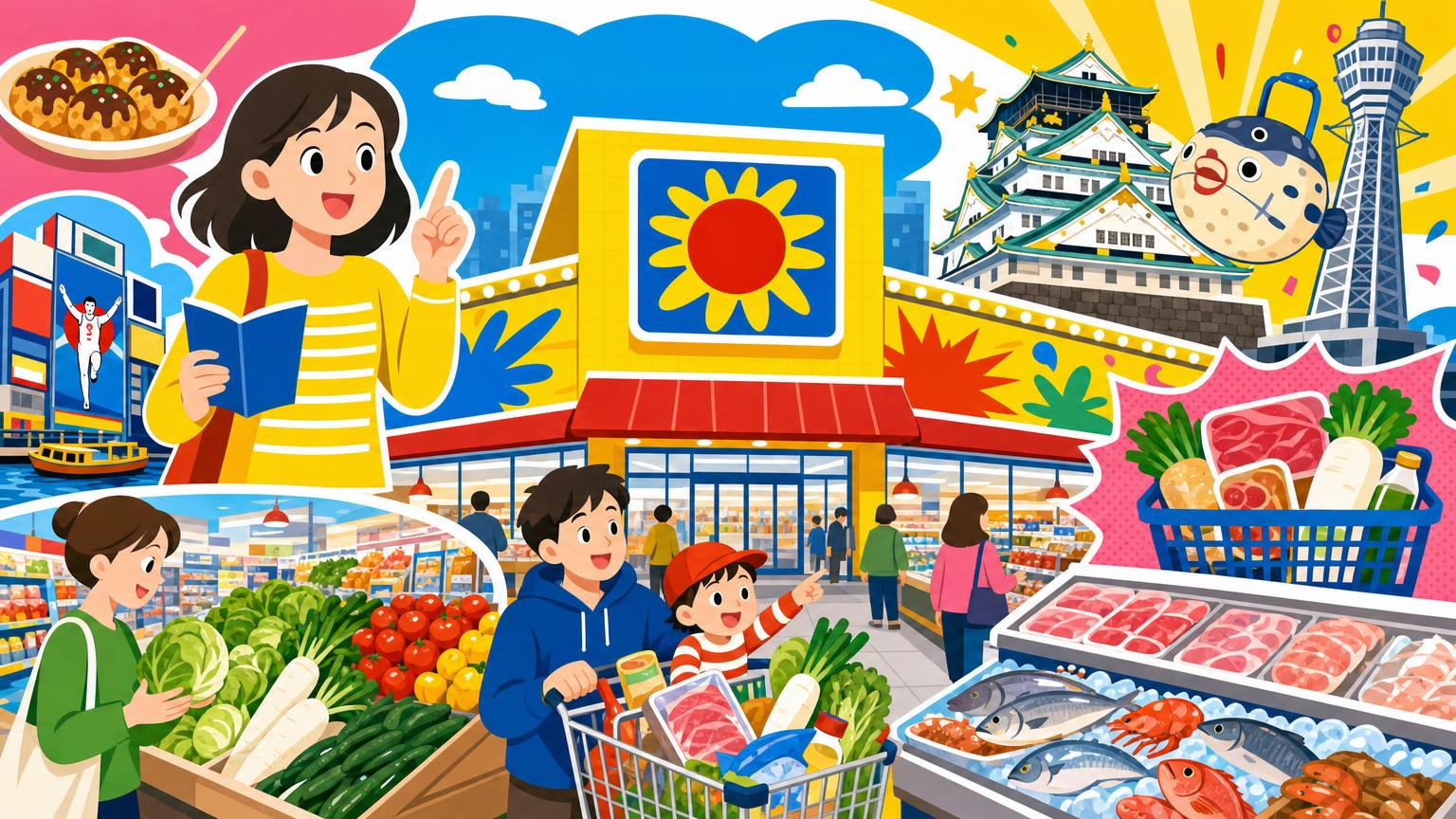
Calling Super Tamade merely a supermarket feels like a massive understatement. It is an institution—a deeply ingrained cultural touchstone that shapes the working-class fabric of Osaka. When locals discuss Tamade, a distinct reaction is inevitable: a smile, a slight eye roll, and a story about scraping by on their discounted noodles. Its reputation teeters between being a beloved local icon and a chaotic fever dream.
The chain’s history is woven into the core of Osaka’s merchant culture. Founded in Nishinari Ward, an area known for its gritty, working-class roots, the store was established on a straightforward mission: offer the absolute cheapest goods to those who need them most. This was never about catering organic produce to the elite; it was about feeding laborers and keeping the city moving. Over the years, the chain grew, stamping its wildly bright sunflower logo across neighborhoods and nightlife districts alike.
The store’s visual identity is a calculated psychological strategy. The intense lighting evokes the energy of a festival. The reds and yellows signal urgency, appetite, and commerce. In contrast, Tokyo supermarkets use cool tones—greens, blues, soft whites—to encourage relaxation and lingering. Super Tamade does not want you to relax; it wants you to feel the adrenaline of the hunt.
Perhaps the most legendary element of their business model is the famed 1 yen sales. Yes, a single yen. Spend a minimum amount—usually a thousand yen—and you earn the right to purchase select promotional items for just one coin that holds almost no value elsewhere. This isn’t a rare gimmick; it happens regularly. The 1 yen sales embody Osaka’s bargain-hunting spirit. They draw people in, creating loyalty through astonishing financial logic. When you see a bottle of tea or pack of noodles scanned for one yen on your receipt, you realize you have crossed beyond ordinary capitalist pricing. You are firmly in Tamade territory.
Why You Must Visit Super Tamade During Your Osaka Trip
The term tourist suggests a temporary state. Yet, whether you stay for five days or five years, your first step into this store will feel like a tourist experience because it is so fundamentally different from whatever grocery store you grew up with. You must cross the threshold. You must let the automatic doors slide open and let the atmosphere wash over you. It is a rite of passage for anyone seeking to understand the real, unfiltered Osaka.
The Unmistakable Neon Vibe and BGM
If you have your camera ready, prepare it before entering, but know that no lens can truly capture the manic energy of the store’s interior. The neon vibe extends beyond the exterior—it bleeds indoors. The aisles are densely packed. The ceilings are covered with hand-written, aggressively large price tags. But it is the sound that truly solidifies the experience.
There is background music—a BGM that loops endlessly. It is a high-pitched, frenetic melody resembling a vintage arcade game in a panic. It repeats. And repeats. And repeats. For the staff working there, it must transform into white noise, but for outsiders, it creates a profound sense of urgency. You find yourself walking faster. You catch yourself tossing items into your basket with sudden, inexplicable haste. The music, paired with blazing fluorescent lights, strips away your inhibitions. Grocery shopping becomes an extreme sport. You’re not just buying dinner; you’re surviving an audiovisual onslaught. It is deeply and wonderfully Osaka. It has no pretense. It is loud, proud, and indifferent to whether you find it overwhelming.
Unbelievably Cheap Eats and 24/7 Convenience
Convenience defines life in a sprawling Japanese city. But Super Tamade elevates this concept, turning it into a weapon for the budget-conscious. Many locations operate around the clock, twenty-four hours a day, seven days a week. When the clock hits three in the morning, when the bars in Minami are finally sweeping up and closing their shutters, when the trains have stopped running and the city drifts into a brief, uneasy quiet, Tamade continues to glow.
For night-shift workers, creatives editing photos till dawn, or anyone whose internal clock doesn’t match traditional business hours, this twenty-four-hour access is a lifeline. And it’s not just the access; it’s the price. At two in the morning, you can walk in and find shelves stocked with food costing less than a single train ticket. The affordability is staggering. It completely reshapes how you budget your life. You stop stressing over the cost of a late-night craving. You realize that for just a few coins, you can feast. It democratizes the night, ensuring that no matter the time or how tight your budget, you can always find a hot meal, a cold drink, and a blindingly bright place to buy them.
Best Super Tamade Locations for Tourists
Osaka is a vast, bustling city, woven together by an intricate network of train lines and subway tunnels. Although dozens of these yellow-and-red landmarks are scattered throughout the Kansai region, certain branches stand out as essential stops for both newcomers and urban explorers. Choosing the right location can significantly shape your experience.
Super Tamade Namba (Suomachi)
If you want to witness the clash of Osaka’s vibrant nightlife with everyday grocery shopping, the Suomachi branch in Namba is the place to go. This site is iconic. Namba is the neon-lit, pulsating core of southern Osaka. It draws tourists with its famous crab signs and running man billboards, but just a few streets away, the Suomachi Tamade serves as a crucial hub for the local community.
Thanks to its proximity to the entertainment district, the customers here represent a fascinating mix of people. At eight in the evening, you’ll see local grandmothers carefully selecting daikon radishes beside hostesses in elegant evening gowns picking up energy drinks before their shifts. At four in the morning, you’ll encounter tired bartenders, night owls, and insomniacs wandering the aisles. The atmosphere is electric, and stock turnover is rapid. It is ideally located for those staying in central hotels or living in the densely populated apartment blocks of Minami. It truly is the ultimate urban pantry.
Super Tamade Shin-Imamiya
To grasp the origins of the franchise, head south to Shin-Imamiya. Bordering the historic and complex Nishinari Ward, this area is the spiritual center of the discount lifestyle. Compared to Namba, the Shin-Imamiya branch feels distinct — the air heavier, the grit more tangible.
Here, the genuine working-class heartbeat of Osaka pulses strongly. Shoppers are not tourists seeking quirky photo ops but locals purchasing their everyday essentials. Prices here feel even more critical. You’ll find day laborers, elderly residents, and an increasing number of savvy backpackers drawn by the low-cost guesthouses nearby. Walking through this branch offers a deep insight into the city’s economic realities. It cuts through the polished tourist gloss and reveals the raw struggle to survive in a major metropolis. It’s humbling, authentic, and an essential perspective for anyone eager to truly understand Osaka.
Super Tamade Ebisu
Just a short stroll from the towering steel Tsutenkaku Tower stands the Ebisu branch. The surrounding Shinsekai neighborhood is renowned for its nostalgic Showa-era charm, kushi-katsu eateries, and carnival-like atmosphere. Ebisu Tamade fits this ambience perfectly.
This branch strikes a lovely balance. Nestled in a residential neighborhood, it serves families and older residents who have lived in Tsutenkaku’s shadow for generations while also catering to the overflow of visitors exploring the retro streets. Though the pace here is often calmer than the frenetic energy of Namba, the bargains remain sharp. It’s an ideal spot to stop after a day wandering through Tennoji Park or meandering the old alleys of Janjan Yokocho. You pick up your supplies, step back out onto the street, and look up at the tower illuminated against the night sky — a quintessential Osaka moment, framed by the yellow plastic bags in your hands.
What to Buy at Super Tamade: A Tourist’s Guide
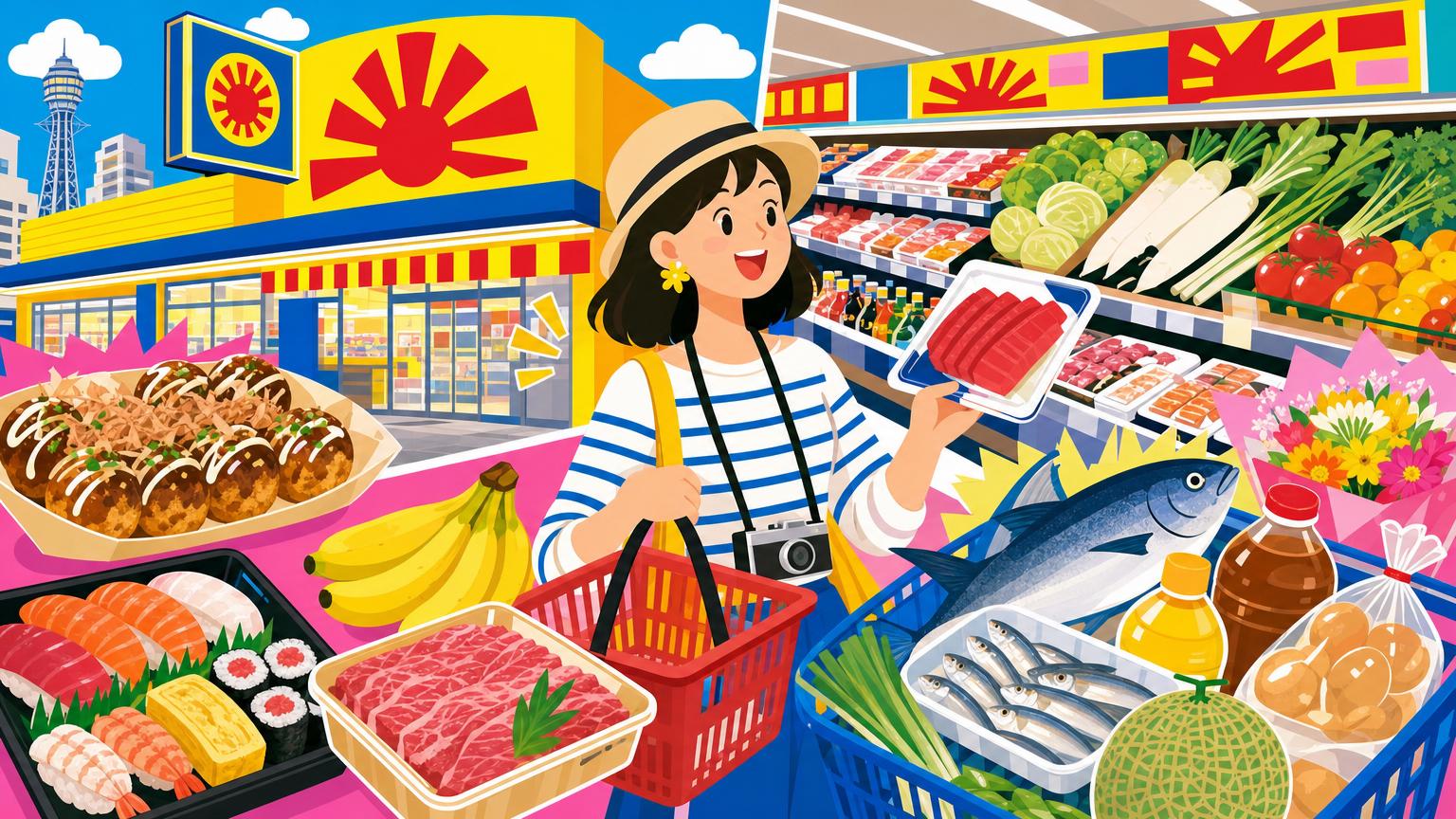
Entering the store is just the initial obstacle. The real test lies in figuring out how to navigate the inventory. The overwhelming number of items, combined with the visual clutter and the frantic background music, can cause decision paralysis. You need a plan. You need to understand what offers the best value and what might be better left for pricier stores. This insider knowledge is what distinguishes the confused newcomer from the experienced local.
Late-Night Bento and Deli Foods (Sozai)
The undeniable highlights of the Super Tamade experience are the prepared foods. In Japanese, these are called sozai—the deli items, fried croquettes, potato salads, and those pre-packaged lifesavers when you’re too tired to cook. The sozai section here is a vast array of brown, fried, delicious carbohydrates and proteins.
But the real gem is the bento—the lunch boxes. If you’re used to paying ten or fifteen dollars for a mediocre sandwich back home, the bento section here will bring tears to your eyes. You’ll find large containers of rice topped with fried pork cutlets, grilled mackerel, or heaps of karaage (fried chicken), all priced so low you’ll double-check the label to make sure you’re reading it right.
Here’s the most important secret of Osaka daily life: the discount stickers. As the evening goes on, usually starting around seven or eight, staff come out with sheets of yellow and red stickers. They go down the aisles, slapping twenty, thirty, sometimes fifty percent off labels onto the bento and sozai. This is when the locals strike. A bento that was already ridiculously cheap suddenly becomes nearly free. For a foreigner living on a budget or a traveler hunting for an affordable hotel dinner, searching for these half-price stickers is a crucial skill. The food is salty, filling, unapologetically greasy, and perfectly satisfying after a long day of walking on concrete.
Cheap Drinks and Snacks for Your Hotel
Don’t buy your drinks at convenience stores. Let me say that again. If there’s a Super Tamade nearby, don’t buy your drinks at the convenience store. Convenience stores are for emergencies. Tamade is for volume.
Whether you’re stocking your apartment fridge for the week or gathering supplies for a late-night hotel hangout, the beverage aisle is your haven. The two-liter bottles of green tea, oolong tea, and jasmine tea are priced so low they make vending machines outside seem like a ripoff.
And then there’s the alcohol—the canned chu-hi, strong zeros, beers, and local sake in glass cups. The prices here are deeply discounted. Osaka locals love a good drinking session and love it even more when it doesn’t drain their wallets. Grab a basket, load it with cheap cans of lemon sour, toss in a few bags of discounted rice crackers and potato chips, and you’ve built the perfect, affordable evening foundation. The snack aisle is just as overwhelming, packed with family-sized bags of senbei (rice crackers) and chocolate costing only a fraction of what you’d pay in a tourist trap. This is how you pre-game in Osaka. This is how you survive the weekend.
What to Avoid: Navigating the Fresh Produce and Meat
Honesty is necessary here. A true resident’s guide can’t be all praise. We need to address the fresh produce and meat.
Super Tamade shines with packaged goods, canned drinks, and fried bento boxes. It’s not, however, a premium organic farmer’s market. When you head to the back of the store where vegetables and raw meats are under glaring bright lights that seem intended to disguise something, you must be discerning.
The store’s philosophy is cheapness above all else. That means tomatoes might be somewhat pale. Cabbage could look a bit past its prime. Cuts of beef and pork are usually fine for a hearty, sauce-heavy stir-fry or a boiling pot of curry, but they’re not the beautifully marbled wagyu slabs found in upscale department store basements.
If you plan to cook a delicate, refined meal where the raw ingredients shine, you might want to spend extra yen at a standard supermarket like Life or Hankyu Oasis. The fish section especially calls for caution. While the pre-packaged sushi is edible and unbelievably cheap, the raw sashimi blocks are often best avoided unless you have an iron stomach or intend to cook them fully. Learn to divide your shopping: buy drinks, snacks, and heavy starches here; purchase delicate greens and raw fish elsewhere. This is the balanced reality of the Osaka grocery grind.
Essential Tips for Shopping Like a Local
You have your basket, filled with discounted croquettes, inexpensive green tea, and maybe a mystery item snagged during a 1 yen sale. Now, you face the final hurdle: the checkout.
Payment Methods: Cash or Card?
For ages, Super Tamade was a strictly cash-only stronghold, embodying the traditional Osaka merchant mindset—hard currency exchanging hands. But times have changed, and the chain has slowly embraced the modern era.
Nowadays, most locations accept credit cards, a huge relief for travelers and locals who prefer earning points over carrying heavy coins. Additionally, barcode payment apps, which have become hugely popular throughout Japan, are now accepted. Still, it’s wise to keep some physical yen on hand. Systems can occasionally fail, or a particular register might only accept cash. In a store that moves this fast, you don’t want to be the one holding up the line because your foreign card threw an error. Keep a crisp thousand yen note ready just in case. The payment process is quick, lacking the overly polite, drawn-out exchanges you might find at a boutique—just a straightforward swap of goods for money.
The Fast-Paced Checkout Hustle
This brings us to the register itself. If you’re expecting a cashier to scan your items with a smile and carefully bag them for you, prepare for a shock.
At Tamade, efficiency is king. The cashier scans your items at lightning speed, moving them from your full basket into an empty one. They’ll announce your total over the constant background music. You pay, and that’s it. They do not bag your groceries.
You must immediately take your filled basket to the bagging counters behind the registers. This is the packing area, a high-pressure zone where grandmothers sort cabbages with intensity and salarymen cram bento boxes into briefcases. You need to bring your own eco-bag, as plastic bags now cost a few extra yen—a nationwide regulation even Tamade follows.
You step up, organize your items—heavy bottles on the bottom, fragile bread on top—efficiently and without delay. The store’s flow depends on everyone keeping up. It’s a synchronized dance of urban survival. Once you master this checkout hustle—scan, pay, pack, and exit through the automatic doors smoothly—you’ve truly earned your stripes as an Osaka resident.
Experience the True Spirit of Osaka
Living in a foreign country is all about uncovering its layers. The first layer is the one shown on television: the pristine temples, the cherry blossoms, the polite bows. This layer is genuine, but it doesn’t tell the whole story.
The deeper you delve, the more you confront the everyday realities of survival. Eating. Sleeping. Buying toilet paper. It is in these ordinary moments that the true essence of a city emerges. Tokyo reveals itself in its silent train cars and perfectly organized queues. Osaka shows its character in the dazzling yellow lights of Super Tamade at three in the morning.
This place doesn’t pretend to be anything other than what it is. It’s loud. It’s cheap. It’s slightly chaotic. Yet it’s also incredibly reliable, profoundly practical, and deeply connected to the lives of those who call this urban jungle home. When you navigate the aisles, dodging restocking carts, searching for the yellow discount stickers on a plastic tray of fried chicken, you become part of a daily ritual shared by millions of locals.
You’re no longer just an observer behind a camera lens. You’re inside the frame. You’re in sync with the city’s rhythm. You realize that beneath the flashy exterior and booming merchant voices lies a deep pragmatism. The people of Osaka work hard, play hard, and don’t want to spend a fortune doing either. They seek value. They seek energy. And they find it beneath those neon lights. So grab a basket, embrace the noise, and jump in. The bento are half price, the BGM is looping, and the city awaits you just beyond the sliding doors.