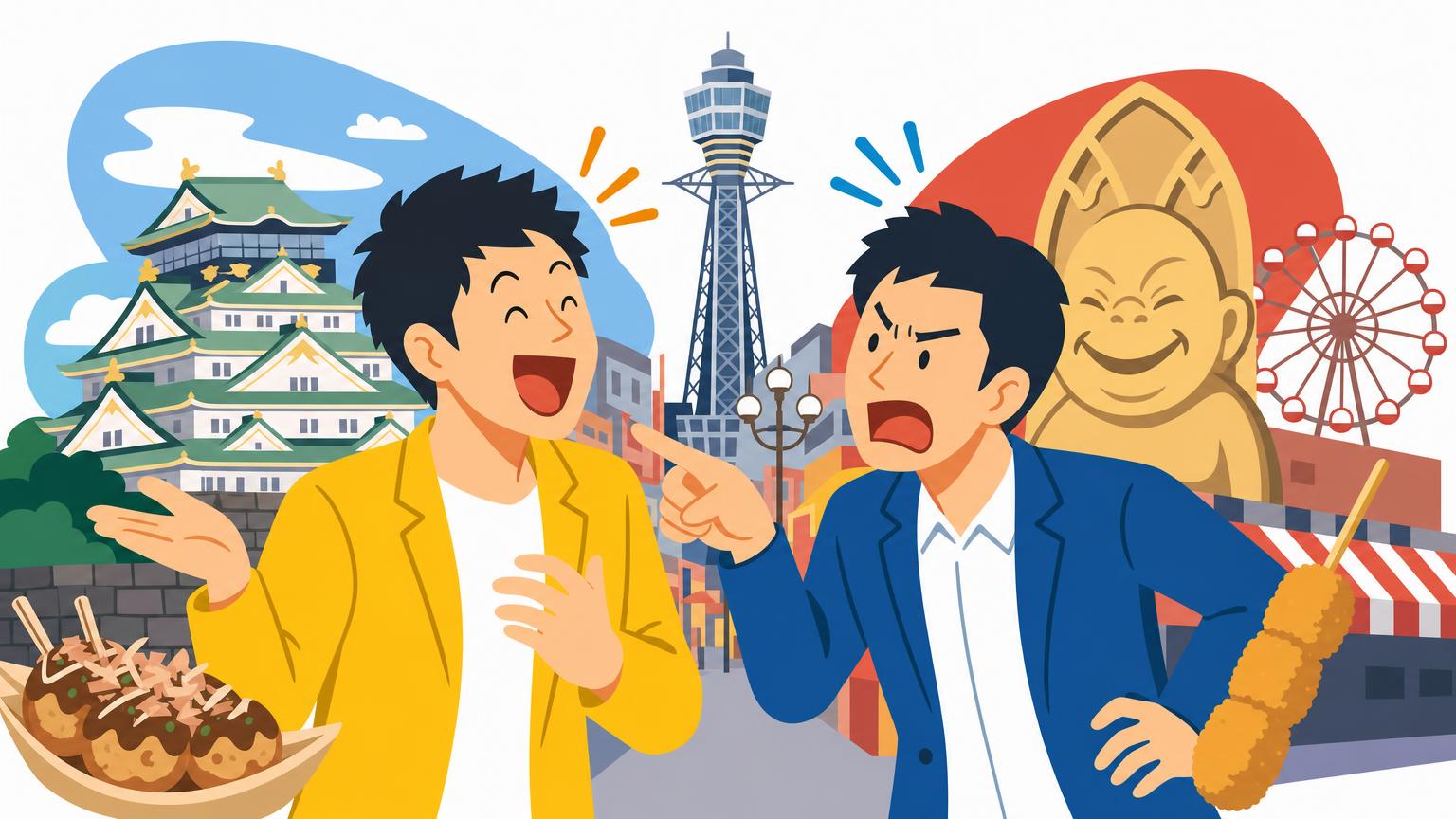
The air in Osaka does not merely sit; it vibrates with a constant, kinetic energy. When a newcomer first arrives in this sprawling, neon-drenched metropolis, they often bring with them a preconceived notion of Japan. They expect the quiet harmony of Kyoto temples or the structured, silent efficiency of a Tokyo commuter train. They anticipate a culture built on unspoken boundaries, rigid politeness, and a prevailing sense of emotional restraint. Osaka, however, immediately and unapologetically dismantles these expectations. It is a city of noise, of vibrant colors, of chaotic intersections, and, above all, of relentless conversation. To live in Osaka is to realize very quickly that the city operates on a fundamentally different social frequency than the rest of the nation. The people here do not merely communicate to exchange information; they communicate to entertain, to connect, and to establish a shared rhythm. At the absolute core of this unique social rhythm is the classic comedy duo dynamic known as Boke and Tsukkomi.
For the uninitiated expatriate or the bewildered traveler, Boke and Tsukkomi might initially appear as nothing more than a television trope, a localized form of stand-up comedy broadcast on weekend variety shows. But to dismiss it as mere entertainment is to fundamentally misunderstand the psychological and social architecture of Osaka. This comedic banter is the city’s operating system. It is the invisible thread that weaves through a tense corporate boardroom meeting, the casual transaction at a neighborhood supermarket, and the late-night revelry in a crowded izakaya. It is a method of survival, a way of breaking down hierarchical walls, and a tool for building immediate intimacy in a densely packed urban environment. Understanding this dynamic is not just an exercise in cultural curiosity; it is an absolute necessity for anyone who wishes to truly integrate into the fabric of daily life in Kansai. The moment you grasp the rhythm of the Boke and the Tsukkomi, the seemingly chaotic noise of Osaka transforms into a beautifully orchestrated symphony of human connection. You stop feeling like an outsider observing a strange phenomenon and start becoming a participant in the daily, city-wide performance of life.
What Are Boke and Tsukkomi in Japanese Culture?
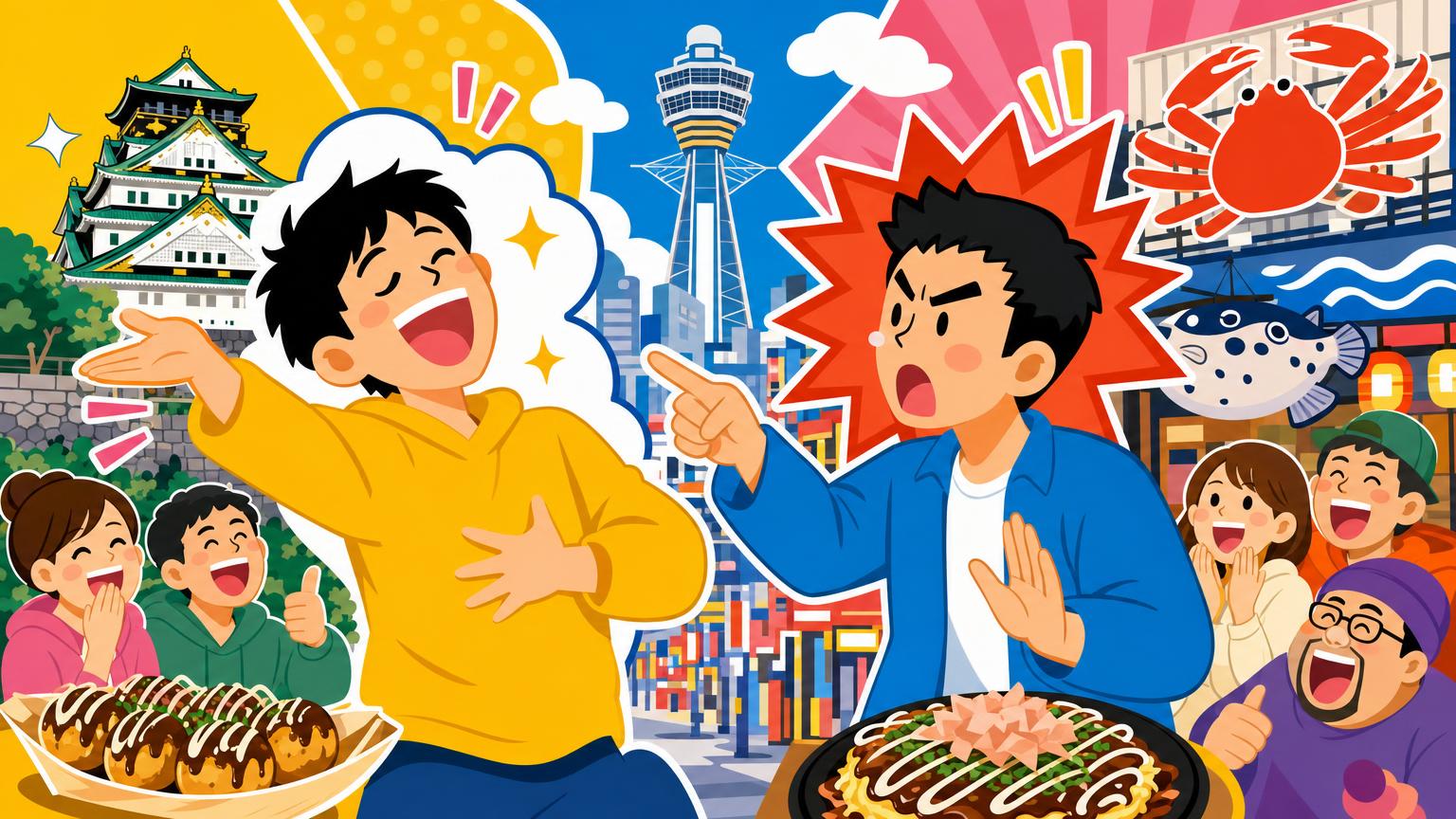
To understand the social fabric of Osaka, one must first unravel the essence of its most iconic cultural export. Boke and Tsukkomi form the two indispensable halves of a comedic whole. They embody the yin and yang of Japanese humor, striking a delicate balance between absurdity and reality, chaos and order. Though they reach their most formalized expression in Manzai, the traditional two-person stand-up comedy popular in the Kansai region, their true strength lies in how naturally they translate into everyday human interactions. These roles are not fixed; they are fluid, shifting between individuals depending on context, relationship, and the precise moment in conversation.
Boke: The Architect of Absurdity
Simply put, the Boke is the funny man, the fool, the instigator of chaos. The term derives from the verb bokeru, meaning to space out, become senile, or deliberately feign ignorance. In conversation and comedy, the Boke is the one who makes an obvious mistake, misinterprets a clear situation, states something blatantly untrue, or behaves in a way that is delightfully disconnected from reality. Yet, it’s important to note that the Boke is rarely a genuine fool. Their brilliance lies in the intentionality behind the absurdity. They create a deliberate gap in logic, a conversational void that practically demands to be filled.
In everyday Osaka life, playing the Boke is an invitation to engage. It involves lowering oneself to make others feel at ease. When a shopkeeper hands you your change and says, “Here is your one million yen,” they are playing the Boke. Both parties understand it’s not a million yen, but this absurd statement breaks the transactional coldness, inviting a shared moment of playfulness. The Boke sets the stage, waiting for the inevitable response. They deliberately build a fragile house of cards so someone else can enjoy the satisfaction of knocking it down. Appreciating the Boke requires recognizing the deep generosity in playing the fool. By making themselves the target of a joke, they ease tension in the room.
Tsukkomi: The Anchor of Reality
If the Boke is the architect of absurdity, the Tsukkomi is the anchor of reality. The word Tsukkomi comes from the verb tsukkomu, meaning to plunge into, thrust, or penetrate. In this comedic dynamic, the Tsukkomi plays the straight man, the voice of reason, sharply correcting the Boke’s deliberate error. The Tsukkomi’s role is to spot the logical gap created by the Boke and close it swiftly and precisely. Without the Tsukkomi, the Boke’s absurdity would drift off into awkwardness or confusion. The Tsukkomi grounds the exchange, providing the friction needed to spark comedy.
In Osaka, the Tsukkomi is more than just a reactor; they are vital to the social rhythm. Being a successful Tsukkomi demands keen social insight. One must read the room, grasp the Boke’s intent, and deliver the correction with just the right amount of force, tone, and timing. If too gentle, the joke falls flat; if too harsh, it turns from friendly teasing into real aggression. The classic physical Tsukkomi is a light slap to the back of the Boke’s head, wrist, or shoulder using the back of the hand or a folded paper fan. In daily conversation, this is often replaced by a sharp verbal comeback, usually delivered in the punchy, staccato cadence of the Kansai dialect. The Tsukkomi is the critical equalizer, restoring natural order after the Boke temporarily suspends reality.
The Dynamics of the Routine
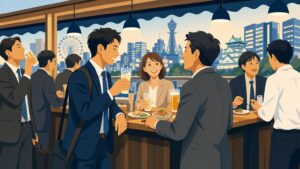
The charm of this dynamic lies in the unspoken agreement between the two participants. The Boke trusts the Tsukkomi to catch their absurdity, while the Tsukkomi depends on the Boke to supply the fodder for their pointed retorts. It is a conversational dance, a finely tuned tennis match of words and gestures. In Osaka, this dynamic unfolds naturally among friends, family, and even strangers. A group of coworkers at a tavern will easily slip into these roles, exchanging them throughout the evening.
What outsiders often miss at first is that this dynamic expresses deep affection. In many Western cultures, persistently correcting someone or calling them a fool might seem hostile or condescending. In Osaka, the Tsukkomi’s sharp correction acknowledges the Boke’s effort. Ignoring a Boke is a major social faux pas; it leaves them unsupported and their comedic contribution rejected. By responding with a Tsukkomi, you say, “I hear you. I understand what you’re doing, and I’m willing to play this game with you.” Beneath the rapid-fire insults and exaggerated frustration lies a profound expression of social solidarity.
Why is Osaka the Heart of Boke and Tsukkomi?
To understand why this particular style of conversational comedy fills the streets of Osaka yet is noticeably absent from the refined avenues of Tokyo, one must take a brief journey through Japanese history. Osaka’s identity is no recent creation; it represents the product of centuries of distinctive economic, social, and cultural evolution. The city’s historical role as the nation’s commercial center shaped a unique type of citizen—one who prized negotiation, pragmatism, and human connection over strict conformity to protocol.
The Roots of Manzai Comedy
The formal beginnings of the Boke and Tsukkomi dynamic can be traced back to traditional Manzai. Originally, the term Manzai referred to a type of celebratory performance during the New Year period that dates back to the Heian era. Performers traveled from house to house, delivering auspicious messages through song and dance to bring good fortune to each household. Over time, especially during the Edo period, this ritual performance transformed into secular entertainment.
By the early twentieth century, the Osaka-based entertainment company Yoshimoto Kogyo revolutionized the format. They removed traditional musical instruments and ceremonial costumes, placing two men in western suits before a single central microphone. This marked the birth of modern Manzai. The rapid-fire, conversational style perfectly matched the fast-paced, impatient temperament of Osaka audiences. Yoshimoto Kogyo solidified the roles of Boke and Tsukkomi, turning them into a universally recognized formula. Today, Osaka remains Japan’s undisputed comedy capital. Countless aspiring talents flock to the city, enrolling in comedy schools, hoping to become the next legendary Manzai duo. The city’s theaters, such as the iconic Namba Grand Kagetsu, are sacred spaces for this art form. Yet, the true stage for Manzai extends beyond the theater; it spills onto the streets, shaping how ordinary citizens interact daily.
The Merchant Mindset and the Economics of Humor
The historical backdrop that made Osaka the ideal incubator for this culture lies in its legacy as the “Kitchen of the Nation” during the Edo period. While Edo, which later became Tokyo, served as the Shogunate’s seat and was dominated by the rigid samurai hierarchy, Osaka was a city of merchants. In a samurai city, status was paramount. Communication was strictly patterned by rank, and a single misstep toward a superior could result in death. Silence, stoicism, and unfailing politeness were survival tactics.
In contrast, Osaka thrived on commerce. Merchants interacted with people from all social strata, ranging from wealthy feudal lords to humble farmers. To succeed in business, a merchant had to be personable, persuasive, and skilled at reading social cues. Arrogance was detrimental to business; a proud merchant risked losing customers. Therefore, Osaka’s merchants developed a culture of self-deprecation. By playing the fool and lowering their status, they made customers feel superior and at ease, smoothing the way for successful transactions.
Humor became an essential economic tool. A well-timed joke could ease a tense negotiation, break the ice with a new supplier, or convince a hesitant buyer. The Boke and Tsukkomi dynamic is the ultimate expression of this merchant mindset. It allows two people to interact, challenge each other, and generate tension without causing genuine offense. It serves as a method of negotiating social space, testing boundaries, and building trust through shared laughter. This historical heritage remains vividly alive in modern Osaka. The city still values pragmatic, meaningful human connections over superficial formalities.
How Comedy Shapes Everyday Life in Osaka
Due to this deep-rooted merchant heritage, Osaka residents see communication as an active, engaging process. In many parts of Japan, maintaining “Wa,” or social harmony, often means avoiding conflict, reading between the lines, and speaking indirectly and politely. In Osaka, harmony is achieved through lively participation rather than silence.
For example, if you stand in a Tokyo elevator, the unspoken rule is complete silence—people stare at the floor numbers and avoid eye contact at all costs. But in an Osaka elevator, especially in local neighborhoods or ward offices, there is a high likelihood that an older woman will turn to you and comment on the weather, the price of vegetables, or the elevator’s slow pace. She is casting out a line, testing whether you want to engage.
This eagerness to connect influences the rhythm of daily life. Osaka residents notoriously dislike pretense and stiffness. If a situation grows too formal, someone will usually break the tension with a joke. They might play the Boke, inviting another to play the Tsukkomi, thereby resetting the social dynamic to a more relaxed, egalitarian tone. For foreigners living in Osaka, understanding this underlying impulse can be incredibly freeing: the noise and banter are not hostile but inclusive, inviting you to lower your guard and join the community.
The Linguistic Canvas: Why Kansai Dialect is Built for Comedy
One cannot fully understand the dynamic between Boke and Tsukkomi without considering the linguistic medium that conveys it: Kansai-ben, or the Kansai dialect. Language shapes thought, and the Osaka dialect is inherently designed to foster comedy, warmth, and rhythmic interaction. To someone studying standard Japanese from a textbook, Kansai-ben may initially sound like a completely different language. It is melodic, expressive, and heavily dependent on pitch and elongation.
Melody and Pitch in Kansai-ben
Standard Japanese, spoken in Tokyo and used in national news broadcasts, is generally flat and monotone. It aims for clear, unambiguous, and polite communication. It is the language of the samurai bureaucrat. Kansai-ben, conversely, is the language of merchants. It is crafted to persuade, entertain, and convey emotion.
The pitch accent in Osaka is strikingly different. Sentences often end with elongated vowels or distinctive rising and falling intonations that give the language a musical quality. Words are frequently shortened, blended, or delivered with a staccato punch. This natural rhythm makes it an ideal vehicle for the rapid-fire exchange of Boke and Tsukkomi. A joke’s setup can be drawn out slowly, while the Tsukkomi’s correction strikes sharply and percussively.
Moreover, Kansai-ben boasts a rich array of emotive particles absent from standard Japanese. Sentence-ending words like “nen” or “yan” add nuance, exasperation, or intimacy to statements. Whereas a Tokyo resident might say “Sou desu ne” to express “It is so,” polite and distant, an Osaka resident would say “Sou ya nen,” with “nen” conveying personal conviction and emotional closeness. This linguistic versatility allows Osaka locals to navigate social situations with humor and grace, softening criticisms or enhancing compliments.
The Power of the Pause
Beyond the words themselves, Kansai-ben excels in the art of the pause. Timing, or “ma” in Japanese, is the essence of comedy. The gap between the Boke’s absurd comment and the Tsukkomi’s sharp reply builds tension and generates humor. Osaka residents intuitively grasp this timing, knowing exactly how long to let a ridiculous statement linger before breaking it with a perfectly timed “Nandeyanen.”
For a foreigner learning Japanese, mastering Kansai-ben vocabulary is only half the challenge. The true difficulty and reward lie in internalizing its rhythm. It involves knowing when to speak, when to pause, and when to deliver a sharp comeback. It is a linguistic dance requiring active listening and a willingness to engage in the conversation’s flow, rather than merely waiting for your turn to talk.
The Supermarket Stage: Comedy in the Aisles
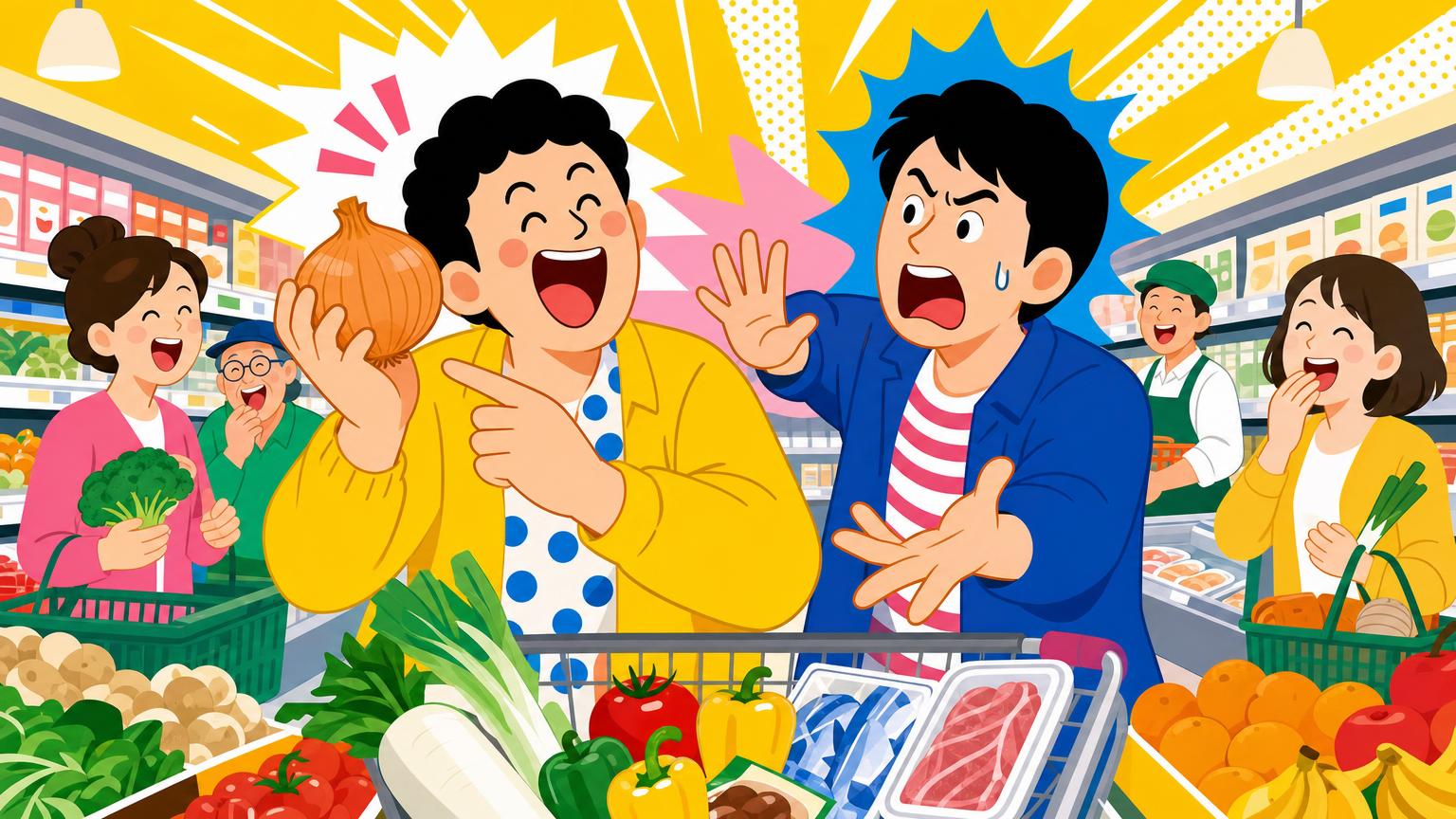
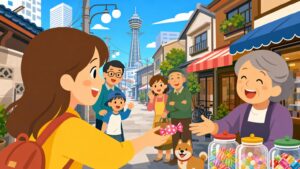
To witness the Boke and Tsukkomi dynamic in its purest and most genuine form, there’s no need to buy a ticket to a comedy club. Simply visit a local supermarket, a neighborhood greengrocer, or a bustling shotengai—the covered shopping arcades that serve as the lifeblood of Osaka’s local commerce. Here, amid neon signs advertising discounted daikon radishes and blaring speakers playing the store’s theme song on a continuous loop, the daily performance of Osaka life takes place.
The Checkout Counter Routine
Picture a scene at a local Tamade supermarket, known for its bright yellow and red neon lights and incredibly low-priced produce. A middle-aged foreign resident approaches the register with a basket of groceries. The cashier, typically an older woman affectionately called an obachan, begins scanning the items. In Tokyo, this interaction would be marked by efficient, polite silence, broken only by standard phrases thanking the customer.
In Osaka, the checkout counter becomes a stage. The obachan scans a pack of pork belly. “Making okonomiyaki tonight, huh?” she might ask, with no prompting at all. The foreigner, caught off guard, nods and replies, “Yes, I am.”
The obachan then deliberately drops a massive cabbage into the bag with a heavy thud. “Well, you’ll need arms like a pro wrestler to carry this one home, brother.”
This is a classic, subtle Boke. She’s exaggerating the cabbage’s weight, creating a mildly absurd moment. The wrong response from the foreigner would be to take her literally and say, “No, I think I’m strong enough to carry it.” That would ruin the rhythm. The correct response—the Tsukkomi—is to play along and gently deflect the absurdity.
“At this rate, I’ll be training for the Olympics by next Tuesday,” the foreigner might reply, or simply smile and say, “Give me a break, it’s just a cabbage!”
The obachan will laugh—a genuine, hearty laugh—and hand over the receipt. In that brief ten-second exchange, a connection is made. The simple act of buying groceries becomes a moment of shared humanity. The foreigner is no longer just a customer; they have become part of the neighborhood’s daily rhythm.
The Neighborhood Obachan as the Ultimate Tsukkomi
The Osaka obachan is a cultural icon, known for her fierce independence, pragmatic worldview, and often her brightly colored attire, famously featuring leopard print. She is the undeniable matriarch of the city’s social fabric and undoubtedly the most formidable Tsukkomi artist around.
An obachan fears no one. She is free from the strict hierarchical rules that govern younger generations or corporate settings. If she sees someone acting foolishly, she will call it out immediately, no matter who they are. If a young man stands in the middle of the bicycle path staring at his phone, an obachan riding by won’t politely ring her bell and wait. She will maneuver past and say sharply, “You’re in the way, brother! Trying to become a hood ornament?”
While this might seem harsh to outsiders, it is fundamentally an act of care. The obachan’s Tsukkomi serves to maintain the neighborhood’s social order. She is the anchor of reality on the street. For foreigners, receiving a Tsukkomi from an obachan is a rite of passage. It means you have been recognized as part of the community—someone worthy of being scolded and engaged with. If you can take the correction with a smile and respond with a gentle retort, you will have earned her lifelong respect.
The Corporate Cabaret: Boke and Tsukkomi in the Office
Transitioning from the bustling aisles of a supermarket to the seemingly austere environment of a corporate office, one might expect Osaka’s comedic banter to disappear, replaced by the strict protocols of Japanese business culture. Keigo, the intricate system of honorific language, governs the Japanese corporate world, determining how to address superiors, clients, and subordinates. Yet, in Osaka, even within the modern office towers of Umeda or Yodoyabashi, the fundamental dynamic of Boke and Tsukkomi remains surprisingly vibrant, serving as a crucial tool for navigating corporate hierarchy.
Breaking the Ice in the Boardroom
In a typical Tokyo business meeting, the atmosphere tends to be tense, formal, and rigidly tied to a set agenda. Participants exchange business cards with practiced precision, sit in seats assigned by rank, and speak in measured, diplomatic tones. Conflict is avoided, and true opinions, or honne, are often masked behind a veneer of polite agreement, known as tatemae.
In contrast, an Osaka business meeting, while still observing the formal business card exchange, is often interrupted by a deliberate effort to forge a personal connection before any business discussion begins. An Osaka executive might start an important meeting by dramatically complaining about his golf swing, the recent performance of the local Hanshin Tigers baseball team, or his wife’s terrible cooking.
This is a purposeful Boke. The executive intentionally lowers his status, making himself seem a bit foolish or vulnerable. He invites the other party, perhaps a younger, more nervous client, to adopt the role of Tsukkomi.
“Well, with a swing like that, President Tanaka, it’s a miracle you even hit the ball!” a bold subordinate might respond.
The room bursts into laughter. The tension dissipates. The strict walls of Keigo and corporate hierarchy have been temporarily breached. By playing the Boke, the executive has created a safe space where genuine, honest negotiations can occur. The humor acts as a lubricant, easing the friction of business interactions. In Osaka, if a business partner remains entirely stiff and refuses to engage in any banter, it is often met with suspicion. The reasoning goes that if you can’t share a laugh, how can you be trusted to share a successful business venture?
Navigating Corporate Hierarchy Through Humor
The Boke and Tsukkomi dynamic is also used internally within Osaka companies to cope with the inherent stress of the Japanese hierarchical system. In a culture where directly criticizing a superior is taboo, humor offers a socially acceptable outlet.
If a manager issues a set of instructions that are contradictory or impossible to carry out, a subordinate in Tokyo might simply bow, say “Understood,” and then quietly panic at their desk trying to find a solution without offending anyone.
In Osaka, the subordinate might deliver a gentle Tsukkomi. “Chief, if I try to do both of those things at once, my brain is going to physically explode out of my ears. Which one should I blow up first?”
The manager catches the Tsukkomi, acknowledges the absurdity of the request, and laughs. “Alright, alright, just do the first one for now, idiot.”
Here, the word “idiot” (aho) is not used as an insult but as an affectionate nod to the subordinate’s cleverness in pointing out the flaw. Through this comedic exchange, the subordinate has effectively corrected their boss, clarified their workload, and avoided causing any loss of face. This dynamic allows a degree of horizontal communication within a vertical hierarchy, making the Osaka office environment feel generally warmer, more direct, and significantly less suffocating than its eastern counterparts.
Classic Tsukkomi Phrases to Listen for in Osaka
For a foreign resident aiming to integrate into life in Osaka, mere passive observation won’t suffice. To truly feel part of the community, one must grasp the vocabulary of the local rhythm. The Kansai dialect abounds with phrases crafted specifically for the Tsukkomi role—these are linguistic scalpels used to dissect absurdities and restore reality. Knowing when and how to use these phrases is essential to unlocking the genuine warmth of the city.
Nandeyanen: The King of Tsukkomi Phrases
If there is one phrase that embodies the spirit of Osaka, it is “Nandeyanen.” It roughly translates to “Why the hell is that?” or “What are you talking about?!” or simply, “No way!” It is the ultimate, universal Tsukkomi.
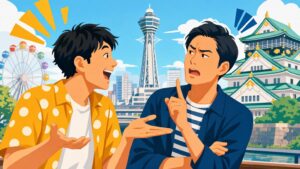
Nandeyanen is a wonderfully versatile tool. It can be used to call out a blatant lie, react to an outrageous price, express disbelief at a wild story, or affectionately scold a friend acting foolishly. The strength of Nandeyanen lies in its delivery, which must be energetic, often accompanied by leaning forward or a swift chopping hand motion.
Imagine you’re at a local izakaya with an Osaka friend who casually mentions he used to be a professional runway model in Paris before returning to Japan to sell insurance.
The only acceptable, culturally fitting response is an immediate, sharp, “Nandeyanen!”
There’s no pause to consider whether he’s telling the truth. No follow-up questions. You instantly recognize the absurdity and strike it down. Your friend laughs, admitting it was a joke, and the conversation flows naturally. Mastering the timing of Nandeyanen will instantly endear you to the locals, showing you’re actively listening, understand the social game, and are willing to join in.
Aho Chauka: The Affectionate Insult
Another essential phrase is “Aho.” While the standard Japanese word for fool or idiot, especially in Tokyo, is “Baka,” which is generally seen as a harsh insult implying a genuine lack of intelligence or ability.
In Osaka, the go-to word is “Aho.” Though it technically means fool or idiot, its emotional tone is entirely different. In Kansai, “Aho” is highly contextual. When used as a Tsukkomi, often in the phrase “Aho chauka?” (Are you an idiot?), it’s almost always a term of deep affection and endearment.
When an Osaka mother calls her son an “aho” for forgetting his umbrella in the rain, she isn’t questioning his smarts but expressing loving exasperation. When a boss calls a subordinate “aho” after a good joke, it’s a badge of honor meaning, “You’re ridiculous, and I appreciate that about you.”
For a foreigner, grasping the difference between baka and aho is crucial. Hearing yourself called an aho by a local shopkeeper or new friend might initially provoke a defensive reaction. But in Osaka, it signals that formal barriers have dropped. You’re no longer treated as a fragile guest who demands polite distance; you’re embraced like family. Conversely, calling an Osaka person “baka” can genuinely offend, as it carries the cold, harsh judgment typical of the east, lacking the warm communal embrace of “aho.”
Shiran Kedo: The Ultimate Escape Hatch
Though not strictly a Tsukkomi phrase, “Shiran kedo” is a vital part of the Osaka conversational toolkit, often used by the Boke to cap off a long, winding, and potentially inaccurate story. It literally means “I don’t know, though.”
An Osaka resident might spend ten minutes passionately recounting the intricate history of a local shrine—detailing the exact year it was built, the warlord who prayed there, and the precise architectural style of the roof—only to finish with “…shiran kedo.”
It’s the ultimate escape hatch, absolving the speaker of responsibility for all the factual accuracy of their story. It tacitly admits the purpose wasn’t to provide peer-reviewed historical data but to entertain, fill the air, and enjoy the act of conversation.
For foreigners used to literal, fact-based communication, “shiran kedo” can be frustrating. They might wonder, “Why tell me all that if you’re not sure it’s true?” But challenging it misses the point. The right response is a gentle Tsukkomi, a laugh, and a retort like, “You don’t know?! You just talked for ten minutes!”
Shiran kedo reflects the Osaka philosophy that the connection forged through storytelling matters far more than the cold, hard facts. It keeps the mood light, preventing any conversation from becoming too heavy or academic.
Timing and Body Language
Words alone don’t make a successful Tsukkomi; physical delivery is just as important. Osaka comedy is a full-body experience.
When delivering a Nandeyanen, Osaka residents often punctuate the phrase with a physical gesture—like a swift, flat-handed chop through the air mimicking a paper fan striking a Boke’s head or leaning dramatically forward to close the distance and emphasize the absurdity.
The reaction to a Tsukkomi is also highly physical. When corrected, the Boke doesn’t just stand still; they physically react to the “blow”—perhaps stumbling backward slightly, widening their eyes in exaggerated shock, or letting out a loud, drawn-out laugh.
For expats trying to fit in, adopting this body language is as crucial as mastering the vocabulary. You must not stand rigidly with your hands at your sides. Use your hands, lean into the conversation, and physically inhabit the shared space. Osaka’s communication style is inherently kinetic—remaining static means remaining an outsider.
Where to Experience Authentic Comedy Culture in Osaka
To truly grasp how this dynamic permeates the city, one must step outside their apartment and into the neighborhoods where Osaka’s rhythm beats strongest. Although the entire city operates on this frequency, certain areas act as concentrated hubs of local interaction, providing ideal observation points for the curious resident.
Catching a Show in Namba
Namba stands as the undisputed historical and cultural core of Osaka’s comedy scene. It is the spiritual home of the Yoshimoto Kogyo entertainment empire. Strolling through Namba’s streets, especially near the Namba Grand Kagetsu (NGK) theater, you can sense the legacy of Manzai embedded in the very architecture. The area buzzes with energy, brimming with tourists, locals, and aspiring comedians distributing flyers for small, underground shows.
While this article is not a travel guide, understanding Namba’s role is crucial for a resident. Namba is more than just the spot to see the famous Glico running man sign; it is a pilgrimage site for the Kansai identity. Attending a show at NGK, even if your Japanese skills aren’t perfect, provides a masterclass in local culture. You don’t just watch the comedians on stage—you observe the audience. You witness how the crowd moves with the performers, anticipating the Tsukkomi, collectively leaning into the jokes. The laughter inside the theater is communal, visceral, and incredibly loud. It lays the foundation for the banter you hear in daily life. You realize that the obachan in your supermarket and the executive in your office are essentially performing amateur versions of the professional acts perfected in these Namba theaters.
Observing Local Interactions in Shinsekai and Dotonbori
For a more raw and unfiltered experience of everyday Osaka interaction, one must head to neighborhoods like Shinsekai. Located south and marked by the iconic Tsutenkaku tower, Shinsekai maintains a gritty, nostalgic Showa-era vibe. It is a neighborhood of cheap kushikatsu (deep-fried skewers) eateries, smoky standing bars (tachinomi), and old men playing shogi (Japanese chess) on the streets.
In Shinsekai, the Boke and Tsukkomi dynamic sheds any corporate politeness; it is fast, loud, and wonderfully abrasive. Here, you can stand at a tachinomi, order a beer, and simply listen. You’ll hear the experts in action. You’ll witness fierce, hilarious disputes between regulars and bartenders over trivial matters—the temperature of the beer, a sumo match’s result, or the ugliness of someone’s shirt. The insults fly thick and fast, heavily laced with “Aho” and “Boke” (used here as playful insults meaning fool).
Yet, beneath the loudness and apparent hostility, there is a strong sense of community. No one leaves angry. The banter is a sport, a way to pass time and affirm one’s place in the neighborhood hierarchy. For a foreign resident, Shinsekai offers a profound lesson in the resilience and warmth of Osaka’s working class. It demonstrates that human connection doesn’t always need polished politeness; sometimes, it just requires a readiness to yell and be yelled at over a cheap fried pork skewer.
Dotonbori, while more chaotic and crowded with tourists, also reveals glimpses of this dynamic, especially if you explore the smaller, older establishments tucked into the narrow side streets and alleys (yokocho) behind the main thoroughfare. In these cramped, ten-seat bars, close physical proximity demands interaction. You cannot sit in isolation. Inevitably, you will be drawn into the orbit of the master behind the counter and the regulars next to you. The moment you’re asked a question, the game begins.
Tokyo Versus Osaka: A Contrast in Frequencies
To truly grasp the distinct character of Osaka’s communication style, it is extremely helpful to directly contrast it with its eternal rival to the east: Tokyo. The differences between the Kanto (Tokyo) and Kansai (Osaka) regions go well beyond geography and food preferences; they reflect two fundamentally different approaches to living within a society. Recognizing this contrast enables foreign residents to understand why Osaka often feels so uniquely un-Japanese compared to the stereotypes commonly portrayed abroad.
The Silence of the East and the Noise of the West
Tokyo is a city founded on the values of order, anonymity, and respecting personal space. It is a vast metropolis where one can easily spend a whole day without engaging in any meaningful interaction with a stranger. The social norms in Tokyo dictate that you should not impose on others. You keep your voice low on the train, avoid initiating unsolicited conversations in elevators, and maintain respectful physical and emotional boundaries. This creates a quietly efficient, highly functional, yet often isolating atmosphere. It is a culture that prioritizes the smooth functioning of the group over individual expression.
Osaka, on the other hand, is based on the principles of friction, engagement, and the breaking down of personal space. Anonymity is not valued here; it is seen as a lost chance. The social expectation in Osaka is that sharing physical space with someone, even temporarily, makes you part of a communal experience. The silence so revered in Tokyo is often perceived as cold, arrogant, or unnatural in Osaka.
If a train is delayed in Tokyo, passengers stand in stoic, suffering silence, focusing on their phones and internalizing their frustration to avoid bothering others. In Osaka, a collective groan usually spreads through the carriage. Someone will likely mutter a sarcastic remark about the railway company, playing the role of the Boke. Another person, often a stranger, will respond with the Tsukkomi, affirming the absurdity of the situation. In that moment, a short-lived bond forms through shared misery. The frustration is expressed, shared, and relieved through communal humor.
The Samurai Bureaucrat versus the Smiling Merchant
This distinction can be traced directly to the historical archetypes outlined earlier: Edo’s samurai versus Osaka’s merchant.
The samurai ethos, which deeply shaped Tokyo’s modern corporate culture, values dignity, stoicism, and strict rule-following. Displaying too much emotion, laughing too loudly, or acting foolishly was considered beneath the warrior class. Communication was serious, tied to honor and duty.
The merchant ethos of Osaka prizes pragmatism, flexibility, and charm. Being overly serious, rigidly adhering to rules at the cost of a deal, or alienating a customer with coldness was seen as business failure. The merchant needed to be a chameleon, able to read the room and shift their persona to suit the moment.
Consequently, when a foreign resident moves from Tokyo to Osaka, the culture shock can be intense. The behaviors that made them a “good” resident in Tokyo—staying quiet, minding their own business, strictly following protocol—may suddenly come across as cold, distant, and unapproachable in Osaka. They must learn to shift from the samurai bureaucrat mindset of silent endurance to the smiling merchant mindset of engaging in banter, negotiation, and shared laughter.
Finding Your Place in the Osaka Rhythm
For non-Japanese residents, navigating the fast-paced, intricate world of Boke and Tsukkomi can feel overwhelming. It demands not only language skills but a deep cultural shift. Yet, the benefits of embracing it are invaluable. Osaka is a city that wholeheartedly rewards participation—not perfection, just genuine effort.
The Expat Experience in the City of Laughter
Many expats who initially find the noise and perceived bluntness of Osaka challenging eventually realize that this city offers a rare and authentic sense of inclusion in Japan. Across much of the country, foreigners are always seen as guests—treated with great politeness, utmost respect, and behind a strict wall of formality. They remain on the outside, watching a culture that guards itself closely.
Osaka, however, does not treat you as a guest; it invites you as a participant. When an obachan calls you an “aho” for dropping your change or a coworker playfully slaps your shoulder with a “Nandeyanen,” you’ve crossed into a new realm. The protective, polite barrier has been broken. You are no longer a delicate outsider to be handled gently; you are a target, a sparring partner, a tribe member.
To reach this point, expats must shed their own defenses and embrace the possibility of mistakes. In fact, errors are often the best thing you can make in Osaka. Mispronouncing words, misunderstanding directions, or unintentionally creating absurd moments makes you the perfect accidental Boke. If you can recognize your missteps, laugh at yourself, and let locals take the role of Tsukkomi, you’ll build bonds more quickly than imagined.
Embracing the Chaos
Living in Osaka means accepting that you cannot control the city’s rhythm—you can only learn to move with it. You must read the room, identify when a Boke moment arises, and find the courage to respond with Tsukkomi. Phrases like “Nandeyanen” and “Shiran kedo” become more than just words; they become tools for connection.
The rhythm of laughter is everywhere: in the takoyaki vendor’s theatrical batter flips, waiting for your comment on his speed; in the office manager’s complaints about humidity that break the morning silence; and in the nonstop, vivid, chaotic energy pulsing through Namba, Dotonbori, and Shinsekai.
Ultimately, understanding Boke and Tsukkomi means understanding Osaka’s heart. It is a city conscious of life’s hardships, work’s exhaustion, and the world’s harshness. Yet, instead of enduring in stony silence, Osaka’s people choose a different route. They confront life’s absurdity with determined, defiant humor. They play the fool to soothe the weary and strike back with sharp affection to keep each other grounded. For those willing to listen, learn, and join in, Osaka offers not just a place to live, but a community that embraces you relentlessly, hilariously, and warmly.