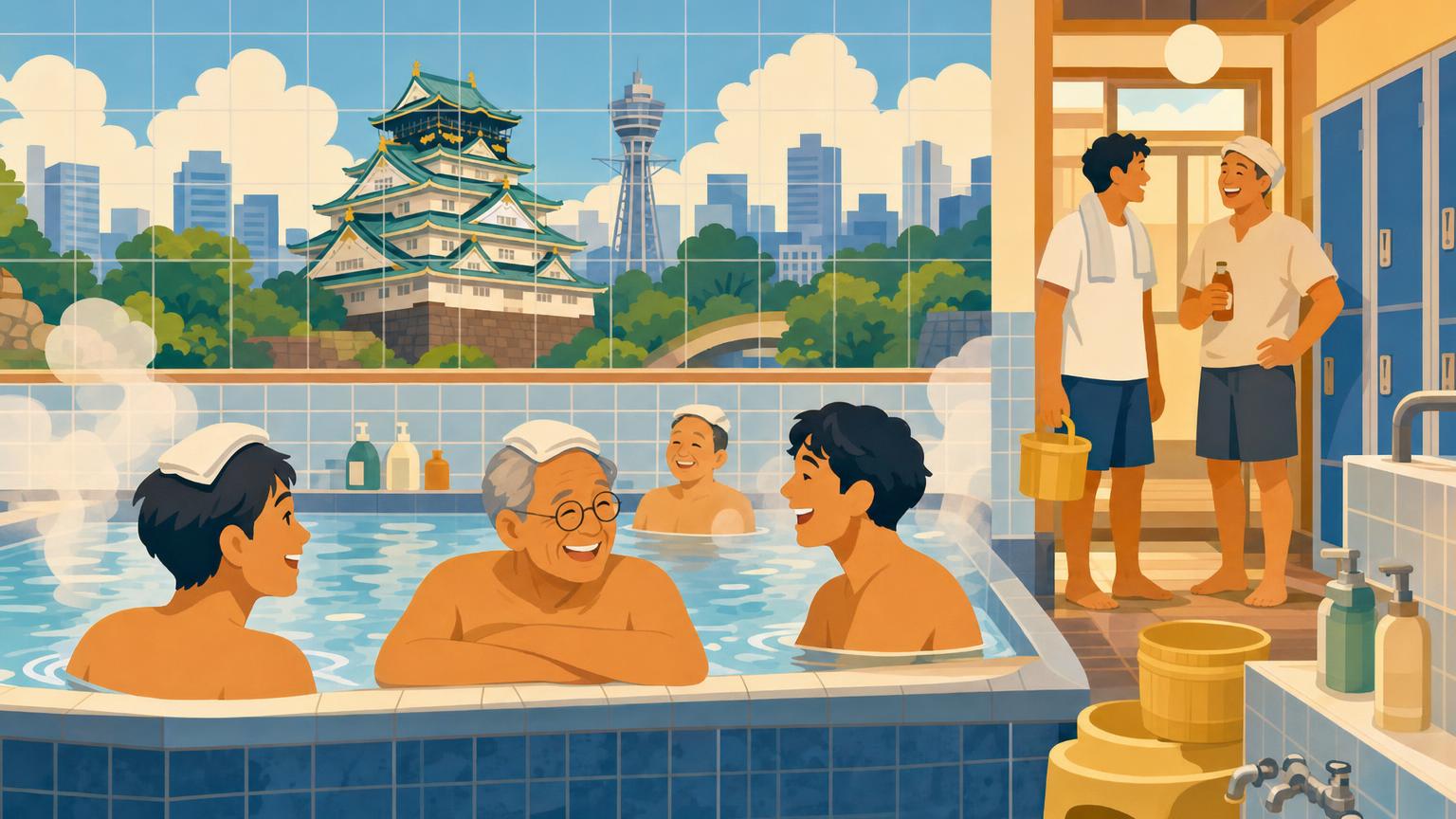
A common question from foreign residents is simple but difficult to answer: How do you actually make friends in Osaka when you are no longer a student, a short-term visitor, or part of an international workplace?
The usual advice is to join a language exchange, attend a meetup, or find a hobby group. Those options can work. But they also create a clear boundary between “the foreign community” and “local Osaka.” You meet people because the event is designed for meeting people. The conversation begins with an explanation of where you are from, what brought you to Japan, and how long you plan to stay.
A neighborhood sento works differently.
You do not enter expecting friendship. You enter because your apartment bathroom is small, because you want to warm up after a wet winter day, because your hot-water bill is rising, or because you have been going there for years. You remove your shoes, pay, wash, soak, and leave. Over time, the same faces appear. Someone recognizes you. Someone asks whether you have been working too hard. Someone complains about the weather. A regular may point out that you are using the wrong tap or that the sauna door should be closed properly.
That may not sound like a dramatic social experience. In Osaka, it can be the beginning of belonging.
A local sento is not a networking venue. It is not automatically a friendly place where strangers become close within one visit. It is a shared neighborhood room with strict physical rules and loose social possibilities. People are together without having to perform sociability. That difference matters, especially for foreigners living in Osaka who are tired of introducing themselves but still want contact with the people around them.
The central idea is not that every sento visitor becomes your friend. Most will not. The deeper point is that repeated, low-pressure contact changes how a neighborhood feels. You stop being an unknown foreign resident passing through the shopping street. You become the person who comes on Thursday nights, the person with the blue towel, the person who understands the old man’s jokes, or the person whose Japanese is still imperfect but no longer surprising.
The map below shows central Osaka as a starting point for understanding the city’s neighborhoods. A sento is usually not found at the most famous landmark. It is found among apartments, small supermarkets, local schools, clinics, workshops, and narrow residential streets—the places where daily Osaka actually happens.
Discovering Osaka’s Bath Culture: Sento, Onsen, and the Neighborhood Room
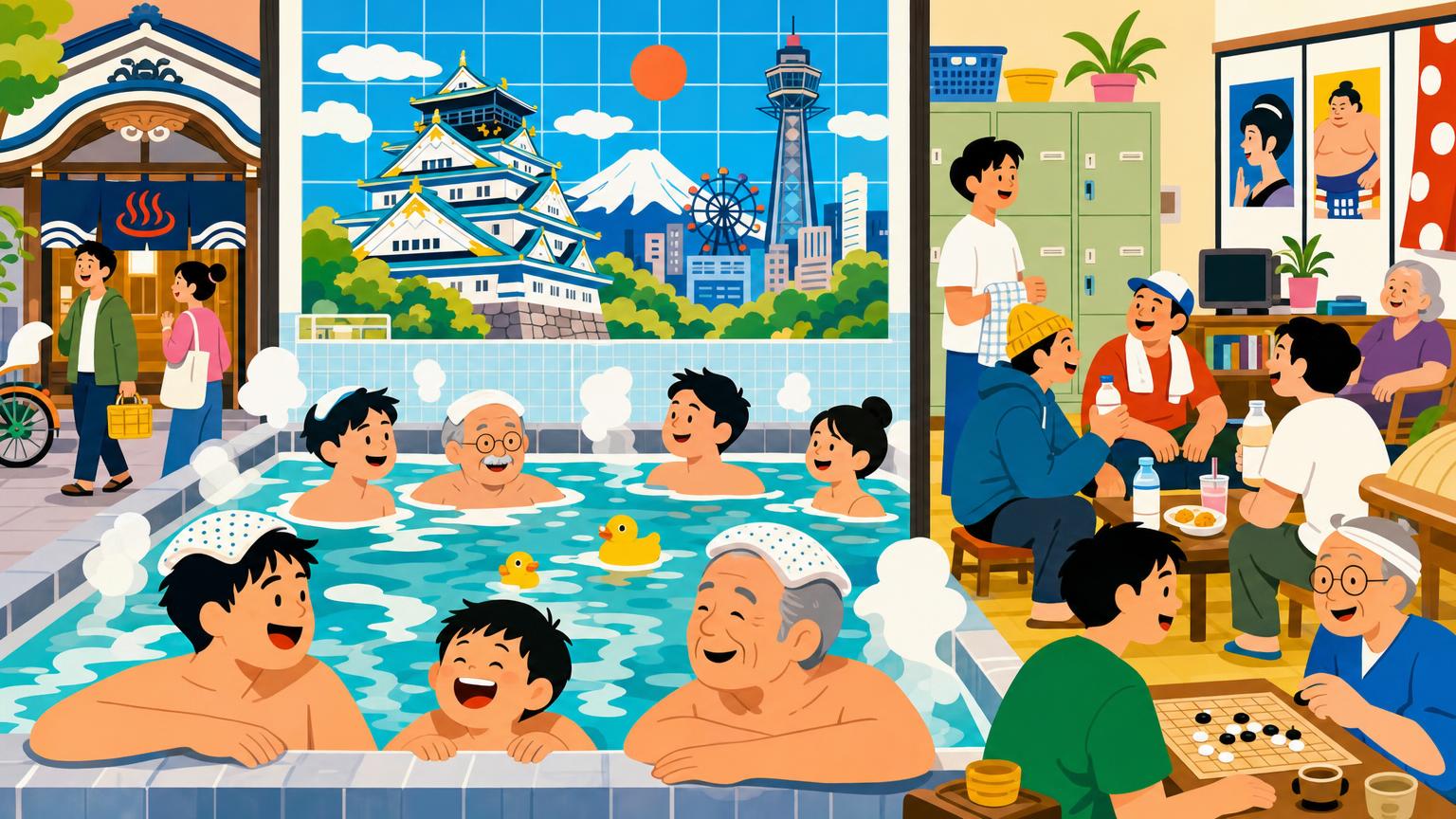
Before discussing friendship, it helps to understand what a sento is—and what it is not.
A sento is a public bathhouse. Its water is generally heated tap water or well water, rather than water supplied by a legally defined natural hot spring. A sento may offer several types of baths, such as a hot bath, cold bath, jet bath, electric bath, or small sauna. The facility serves the surrounding neighborhood. People go because bathing there is practical, familiar, affordable, or comforting.
An onsen uses naturally occurring hot spring water that meets Japan’s legal standards for mineral content and temperature. An onsen may be located inside a hotel, ryokan, large spa facility, or small local bathhouse. The term describes the source of the water, not necessarily the atmosphere of the building.
A super sento is a larger, entertainment-oriented bathing facility. It may include several bathing areas, outdoor baths, saunas, restaurants, reclining rooms, massage services, manga, and relaxation spaces. It is convenient when you want to spend half a day resting. It is generally less intimate than a small neighborhood sento, since visitors may come from across the city.
These categories sometimes overlap in everyday speech. A facility may use “onsen” in its name because it has natural hot spring water, while another may resemble an onsen but use heated ordinary water. A traditional sento may also offer excellent baths and have a loyal community without being an onsen.
For daily life in Osaka, the most important distinction is not the mineral content. It is the social scale.
A neighborhood sento is close enough for people to visit regularly. The same customer may come after work every evening. A mother may bring her child after dinner. An older man may use the bath as part of his regular health routine. A foreign resident may arrive alone and gradually become familiar to the staff and regular customers.
That repetition creates a different kind of public life from what you experience on trains or in shopping centers. On a train, people carefully avoid involvement. In a sento, people share the same water and limited space, but they do so within a strong etiquette system. The rules make closeness possible without requiring personal disclosure.
Why the sento can feel more social than a café
In a café, you may sit near other people, but you are generally expected to remain in your own zone. You have a drink, phone, laptop, or conversation partner. You can leave without anyone noticing.
In a sento, the routine is more visible. Everyone moves through the same sequence. Shoes come off at the entrance. Clothes go into lockers. Bodies are washed on low stools. People enter the bath slowly, sit quietly, cool down, and repeat the process. There is less space for private performance.
You also see people at different stages of life sharing the same ordinary space. The office worker, retired shop owner, construction worker, university student, child, and foreign resident may all be present. This does not erase social differences. Osaka is not a society without hierarchy. However, the sento temporarily reduces the importance of clothing, job titles, and consumer status.
This is sometimes described using the Japanese expression hadaka no tsukiai, or “naked付き合い,” meaning a relationship without formal barriers. The phrase should not be taken too literally. It does not mean that everyone suddenly becomes emotionally honest. Rather, it means that ordinary social distance can soften when people meet in a shared, unpretentious setting.
The experience can be especially meaningful for foreigners because many everyday interactions in Japan remain polite but distant. Your neighbor may bow, your coworker may help you, and the cashier may greet you, yet you may still feel that you are living beside the community rather than within it.
A sento does not solve that problem immediately. It gives you a place to keep returning to until the distance becomes less rigid.
What Osaka changes about the atmosphere
Public baths exist throughout Japan, but the atmosphere is not identical everywhere. Osaka’s local culture often places greater value on directness, verbal play, practical help, and quick reactions. This does not mean that everyone is outgoing. It means that social interaction may begin more abruptly and with less ceremonial preparation than a foreign resident expects.
In Tokyo, a stranger may be careful not to impose. In Osaka, a regular may comment on your hair, towel, slow Japanese, or the fact that you always arrive at the same time. The comment may sound blunt. It may also be an invitation.
This is one of the most important misunderstandings about Osaka. Foreign residents sometimes hear a direct comment and assume they are being criticized or mocked. Sometimes they are. Osaka is not a fantasy of universal kindness. People can be impatient, suspicious, or rude. But in many ordinary encounters, teasing and unsolicited observations are ways of testing whether a relationship can become more relaxed.
A quiet response such as “そうですね” or “ほんまですね,” followed by a smile, can keep the door open. If you want to continue the conversation, ask a simple question. If you do not, a polite laugh followed by a return to your routine is enough.
You are not required to become loud, funny, or fluent in the Osaka dialect. You only need to recognize that a little verbal friction may be part of the city’s social rhythm.
Essential Sento Etiquette and Rules for First-Time Residents
The bathhouse is communal, but it is not casual in the sense that “anything goes.” Its relaxed atmosphere depends on everyone following a clear sequence. When foreigners feel nervous, it is often because they imagine that everyone is watching them. In reality, regulars mainly want the shared space to remain clean, calm, and predictable.
The safest approach is to follow the basic pattern carefully and observe what those around you do.
At the entrance
Remove your shoes before entering the main interior. Look for a raised step, shoe lockers, or a row of small compartments. Place your shoes inside and take the key if the locker has one.
This first step matters because the entrance marks the boundary between the street and the bathhouse. Do not walk farther inside in outdoor shoes, even if the floor looks clean.
At the counter, pay the bathing fee. Traditional sento generally charge a regulated adult bathing price within the relevant area, but prices, sauna surcharges, towel rentals, and other fees may change. Bring cash unless the facility clearly accepts electronic payment. Small neighborhood facilities may have limited English and may not accept foreign cards.
You may be able to buy or rent:
- A small washing towel
- A larger body towel
- Soap or shampoo
- A razor
- A toothbrush
- A plastic bag for wet items
- A sauna entrance ticket or extra key
Some regulars bring everything from home, while others buy a small towel at the counter. Neither approach is unusual.
In the changing room
Enter the changing room for your gender. If you are unsure which side to use, look for the signs 男 for men and 女 for women, or ask at the counter.
Remove all clothing before entering the bathing area. Swimsuits are generally not worn in a traditional sento. Keep your locker key with you as instructed. Many keys attach to a wristband or ankle band, but do not assume that every facility uses the same system.
Place your clothes neatly inside the locker. Keep your phone in the locker and do not take photographs. Photography is especially inappropriate because other people are undressed, and many facilities prohibit phones in the bathing area altogether.
A small washing towel is useful inside the bath area. A larger towel usually stays in the changing room or on a shelf outside the tubs.
At the washing stations
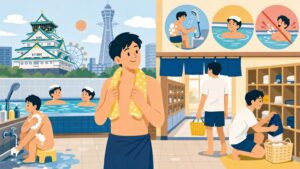
Wash your body before entering any shared bath. Sit on the small stool rather than standing if other people are nearby. Use the shower or tap carefully so that water does not spray onto the person next to you.
Clean your hair and body thoroughly, and rinse away all soap before standing up. If you use a bucket, pour water over yourself in a controlled manner. Do not leave hair, soap, or personal items scattered around the washing station.
If you have long hair, tie it up. Hair should not fall into the bathwater.
This washing step is not merely a symbolic ritual for tourists. It is the basic hygiene system that allows many people to share a tub. Osaka City explains the core rules directly: wash first, do not put a towel in the bathtub, and do not wash your body or hair in the shared bath.
In the bath
Enter slowly. If necessary, test the temperature with your hand or feet before lowering yourself in carefully. Do not jump, splash, or swim.
Keep your small towel out of the water. You can place it on your head, fold it on the edge of the bath, or leave it beside the tub. Do not use it to wash yourself while sitting in the shared water.
The bath may be hotter than you expect. You do not need to stay in the water as long as anyone else. Sit for a few minutes, leave to cool down, and return if you feel comfortable.
Keep your voice low enough that you do not dominate the room. Conversation is allowed in many neighborhood sento, and Osaka sento may feel more talkative than quiet spa facilities. However, the echoing tile room can make a normal voice sound much louder.
Do not bring drinks into the bathing area unless the facility specifically permits them. Drink water before and after bathing, and avoid entering after consuming a large amount of alcohol. Osaka’s public guidance warns that drinking alcohol before soaking can cause physical problems.
Before leaving
Rinse yourself if you wish, dry your body lightly with the small towel, and return to the changing room without dripping water across the floor. Dry yourself properly before getting dressed.
Return rental items according to the facility’s instructions. Take your locker key back if required. At the entrance, put your shoes on only after leaving the indoor bathhouse area.
This sequence may seem formal at first. After a few visits, it becomes almost automatic. The routine is part of the comfort, and you do not have to decide how to behave from the beginning every time.
How Friendship Actually Begins in a Neighborhood Sento
The most useful expectation is also the least romantic: friendship usually starts through recognition before conversation.
You may visit ten times before anyone speaks to you. That does not mean you have failed. Regulars may be watching to see whether you understand the space, respect the rules, and intend to keep coming. A one-time visitor is not necessarily worth the effort of beginning a relationship, especially when language is a challenge.
During your second or third week, someone may nod. Later, a staff member may remember your preferred locker area or ask whether you would like a towel. Another customer may mention that the bath is unusually hot. These small moments matter because they transform you from an anonymous body in the room into a familiar person.
The first conversations are usually practical
Do not open with a serious question about Japanese culture. Do not announce that you came to experience “the real Osaka.” That kind of language can make regulars feel as though their ordinary bathing routine has become an exhibit.
Begin with what is already happening:
- “今日は暑いですね” — “It’s hot today, isn’t it?”
- “このお風呂、熱いですね” — “This bath is hot, isn’t it?”
- “ここは何時までですか” — “What time does this place close?”
- “いつもこの時間に来ますか” — “Do you usually come at this time?”
- “この電気風呂は大丈夫ですか” — “Is this electric bath okay for beginners?”
You do not need perfect grammar. Conversations in a bathhouse are often brief, interrupted, and supported by gestures. You can point, smile, and use simple words.
People in Osaka may respond in dialect. You may hear ほんま, meaning “really” or “truly,” めっちゃ, meaning “very,” or 知らんけど, literally “I don’t know, though,” a playful way of softening a confident statement. You do not need to imitate the dialect right away. Understanding the tone matters more than copying the vocabulary.
The staff are often the bridge
The front desk attendant may understand the social geography of the bathhouse better than anyone. They know who visits every day, who prefers the quieter side, who needs assistance, and which customers are comfortable speaking with newcomers.
A simple greeting at the counter can help. Say “こんばんは” in the evening or “こんにちは” during the day. Say “ありがとうございます” when purchasing a towel or receiving assistance.
If you are uncertain about a rule, ask before entering instead of guessing. “すみません、初めてです” means “Excuse me, it’s my first time.” That single sentence explains a lot. It tells the staff that you may need instructions, not special treatment.
If you have tattoos, ask directly and respectfully about the policy. Do not conceal a large tattoo beneath a towel and hope no one notices. Policies vary by facility, and a small neighborhood bathhouse may not have the staff or space to manage an unexpected dispute. Some places allow tattoos, some ask guests to cover them, and others refuse entry. Confirm before paying whenever possible.
The changing room is often the real conversation space
The bathing area is not always where the longest conversations take place. People may talk while drying their hair, drinking water, sitting beneath a fan, or using the massage chairs. In those moments, you are clothed enough to communicate comfortably and are no longer focused on the temperature.
A common mistake is to leave immediately after bathing. Of course, you can leave whenever you wish. But if you hope to become familiar with the regulars, spend a few extra minutes in the public area when it feels appropriate.
You may notice the same people discussing local baseball, the price of vegetables, a neighborhood construction project, or a child’s school. This is not a formal community meeting. It is background conversation—the kind that shows what people in Osaka actually care about on an ordinary evening.
What Osaka People Are Like Inside This Shared Space
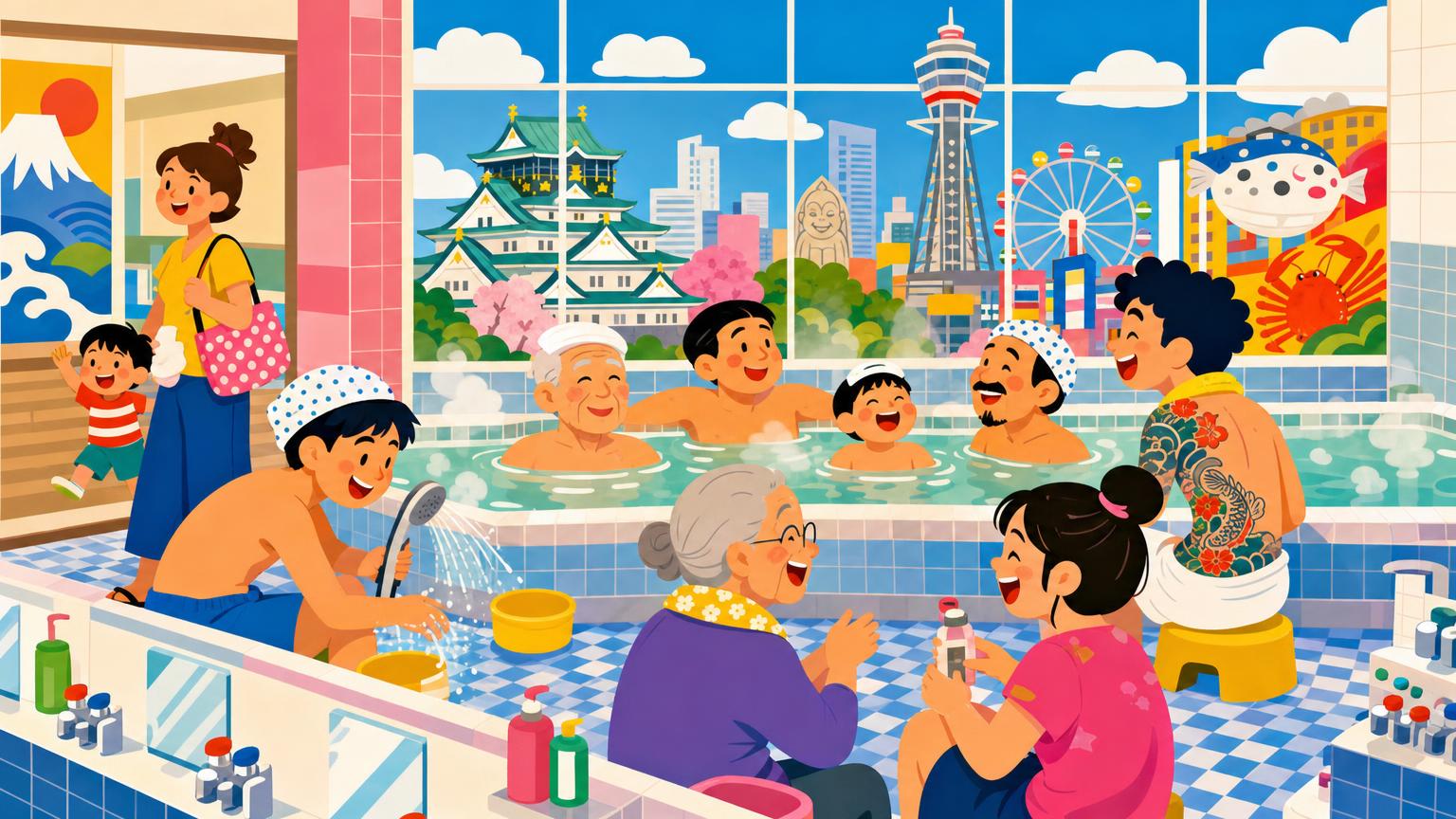
Saying that Osaka people are friendly is too vague to be especially useful. A more accurate description is that Osaka often allows a quicker shift from formal politeness to informal interaction, although that shift depends on rhythm and reciprocity.
Someone may tease you, but they also expect a reaction. Someone may offer advice, but they may not want a long personal story in return. Someone may ask where you live, but that does not necessarily mean they want to visit your apartment or become a close friend.
The relationship develops through a series of small exchanges:
- You greet the staff.
- You follow the washing routine.
- You return at roughly the same time.
- You respond when someone speaks.
- You notice when another person needs space.
- You help keep the room comfortable.
This pattern is very Osaka. Warmth is often practical rather than sentimental. A person may not say, “I hope you are settling into the city.” Instead, they may tell you which supermarket is cheaper, warn you that your apartment’s water heater is making a strange noise, or advise you not to cycle on a certain street during school dismissal.
Advice can sound intrusive if you come from a culture that treats personal independence as the highest form of respect. In Osaka, practical interference is sometimes a form of care. It is not always welcome, but it is worth learning to distinguish between control and concern.
Directness does not mean complete openness
Foreign residents sometimes arrive expecting Osaka to be easy because people are talkative. They then discover that casual conversation does not automatically lead to invitations or deep friendships.
This is normal. Osaka people can be socially expressive while still maintaining strong private boundaries. A person who jokes with you in the bath may never ask for your contact information. A regular who remembers your name may still prefer to keep the relationship within the sento.
Do not measure friendship only by whether you are invited to someone’s home. In Japanese neighborhood life, repeated recognition can be meaningful in itself. The person who saves your usual seat, tells you that the outdoor bath is less crowded today, or asks whether your family is well may already consider you part of the local rhythm.
Humor is a test of comfort
Osaka has a strong culture of humor, but humor is not a permission slip to insult anyone. The most useful distinction is whether the joke creates shared enjoyment or places one person beneath everyone else.
A regular may joke about your Japanese pronunciation because the relationship has become comfortable. If you laugh and respond lightly, the exchange may continue. If the comment becomes repetitive, aggressive, or focused on race, nationality, body, disability, or personal vulnerability, you do not have to accept it as “Osaka humor.”
You can change seats, end the conversation, or speak to staff. Being open to local directness does not mean surrendering your boundaries.
Osaka vs. Tokyo: Why the Sento Can Feel Different
The Osaka-versus-Tokyo comparison is often reduced to “Osaka is friendly, Tokyo is cold.” However, that is not accurate enough for someone deciding where to live.
Tokyo has enormous variation. You can find warm, talkative communities there, just as you can encounter distant or reserved people in Osaka. The more useful differences involve density, anonymity, local identity, and conversational style.
Tokyo’s scale makes anonymity easy. Many people commute long distances, move between neighborhoods frequently, and maintain separate work, home, and social circles. A neighborhood sento can still be community-oriented, but the surrounding city may make it easier to remain unknown.
Osaka also has a large metropolitan population, yet many neighborhoods retain stronger local networks. Shopping streets, school districts, small businesses, family ties, and long-term residents can remain visible in everyday life. The same person may run into someone they know at the supermarket, the station, the clinic, and the bathhouse.
That visibility can feel either comforting or restrictive, depending on your personality. If you want complete anonymity, a small neighborhood sento may feel too intimate. If you want to be recognized, it can become one of the few places where recognition develops naturally.
The conversational difference can also be significant. In Tokyo, a stranger may wait for a clear invitation before speaking. In Osaka, a comment may come first, with the invitation hidden inside it. The words may be casual, but the underlying social question is serious: Can we relax around each other?
A foreign resident who responds only in formal textbook Japanese may unintentionally keep the relationship formal. That is not wrong; it is simply a choice. If you want more contact, try giving a shorter, more natural response. You do not need to become a comedian. A small reaction can be enough.
Neighborhood Sento as a Way to Understand Daily Life in Osaka
If you are considering living in Osaka, the sento reveals several aspects of city life that are easy to overlook from a train, office, or tourist district.
Osaka is practical before it is performative
A neighborhood sento does not have to look luxurious to be valuable. The building may be old, the sign faded, and the changing room equipped with a fan instead of an elaborate climate-control system. Its importance comes from use rather than presentation.
This practical attitude can be seen throughout Osaka. People often care about whether something works, whether the price is fair, whether the owner treats customers well, and whether the experience has character. A polished image matters less than having a good reason to return.
That does not mean Osaka lacks design or ambition. Umeda towers, new apartments, fashionable cafés, and large commercial projects are all part of the city. Yet alongside them, a small sento can remain meaningful because it serves a daily function and preserves local memory.
Osaka relationships are built through repetition
Foreign residents often look for a single breakthrough: one dinner, one party, one language exchange, or one kind person who will introduce them to everyone else.
Neighborhood life is generally slower. You become familiar by showing up repeatedly and behaving predictably. This is true at a sento, a local izakaya, a bakery, a children’s playground, or a community garbage station.
The first stage may feel uneventful. Nobody asks about your life, and nobody invites you to a festival. You simply become part of the visual background. Then someone notices when you are absent.
That is a deeper form of social connection than it may initially seem. It means your presence has become part of another person’s expectations.
Osaka can be generous and nosy at the same time
A local sento may make you feel cared for, but it may also make you feel observed. People may notice your schedule, clothing, language, or the way you wash.
Foreign residents sometimes want the benefits of neighborhood belonging without the visibility that comes with it. That is understandable, but difficult. Community means people may know a little about you. It also means you may learn things about them without being told directly.
The best balance is to share gradually. You can say which area you live in without giving your full address. You can mention your job without explaining your salary. You can answer questions about your country without becoming an unpaid cultural representative every evening.
Polite boundaries are perfectly acceptable. “今日はちょっと疲れています” means “I’m a little tired today.” “また今度” means “another time.” These phrases allow you to stay connected without being constantly available.
Making Friends Without Turning the Sento Into a Social Project
The easiest way to damage the atmosphere is to treat the sento as a friendship machine. Do not enter with the intention of collecting local contacts. Do not view every person as an opportunity to practice Japanese. Do not force conversation in the bath simply because you have decided this is your chance to “integrate.”
The bathhouse belongs to the people who use it as part of their daily lives. Your social hopes matter, but they are not more important than someone else’s quiet evening.
A healthy approach
Choose one neighborhood sento that is convenient enough for regular visits. Convenience matters more than reputation. If the trip takes an hour each way, you are unlikely to become a regular.
Visit at a consistent, though not rigid, time. Early evening may be busy with people returning from work. Later in the evening may be quieter, but opening hours and local patterns vary. Observe the rhythm over several visits.
Greet the counter staff. Follow the rules carefully. Learn the basic Japanese words associated with the facility. Smile when you recognize someone, and respond briefly when spoken to. Let the relationship develop at its own pace.
After several visits, you may ask a practical question. If the response is short, accept it. If the person continues, continue the conversation. Do not interpret every pause as rejection. Bathhouse rooms echo, people may be tired, and some regulars simply prefer silence.
What not to do
Avoid having loud conversations in English in the changing room. Avoid staring at other people’s tattoos or bodies. Do not comment on someone’s appearance unless you already have a relationship that clearly makes it appropriate.
Do not assume that an older person wants to practice English. Do not assume that a younger person wants to practice Japanese with you. Do not treat the Osaka dialect as a performance for foreigners.
Do not bring alcohol into the facility unless it is sold there and permitted in a designated area. Do not enter when you are sick with a contagious condition. Do not use the bath if you have open wounds or a condition that could affect shared hygiene, and ask the facility if you are unsure.
Cleanliness is not something to fear when everyone follows the routine. The body-washing area exists precisely to keep the shared bath clean. Your responsibility is to wash thoroughly, rinse away all soap, keep personal items out of the water, and leave the station orderly.
Finding Your Place in the Local Rhythm
A neighborhood sento can help answer the broader question, “Is Osaka a good place to live?” The answer depends on the kind of belonging you seek.
Osaka may suit you if you value practical relationships, visible neighborhood life, informal conversation, affordable routines, and the chance to become familiar without making a formal appointment. It may be challenging if you strongly prefer privacy, dislike unsolicited comments, or expect every social connection to be clearly defined.
You may also find that your best relationship with Osaka is not built through constant conversation. Perhaps you become familiar with the same train platform, the same supermarket cashier, the same bakery owner, and the same sento staff member. None of these people becomes a close friend, yet the city begins to feel less anonymous.
That feeling matters when you live abroad.
Many foreigners in Osaka experience a long middle period. They are no longer new arrivals, but they have not yet formed deep local ties. Their work may be stable, and their Japanese may be functional. They know how to pay bills, sort trash, register at the ward office, and navigate rush hour. But they still wonder whether anyone would notice if they disappeared for a month.
A neighborhood sento cannot guarantee friendship. It can provide a place where your absence is eventually noticed.
Frequently Asked Questions About Community in Osaka Sento
Do I need fluent Japanese to use a neighborhood sento?
No. You only need enough Japanese to pay, understand basic signs, and ask for help when needed. Many small facilities may have little or no English, so learning a few practical phrases can be useful. Your behavior matters more than your fluency.
A greeting, a thank-you, and an honest explanation that it is your “first time” can get you through most basic situations. Observe first, then follow the general rhythm of the room.
Will people talk to me because I am foreign?
Possibly, but you should not expect it. Some regulars may be curious, while others may be shy or uninterested in conversation. Some might speak to you because they recognize you after several visits, rather than simply because you are foreign.
Being foreign can open the door to conversation, but it can also make you feel more visible. Accept curiosity when it is respectful, and set boundaries when necessary.
Is an Osaka sento a good place to make local friends?
It can be a good place to build familiarity and develop low-pressure relationships, but it is not guaranteed to lead to close friendships. The strongest connections usually grow through repeated visits, shared routines, and brief conversations over time.
If you need immediate social contact, consider combining the sento with a workplace group, hobby, volunteer activity, sports club, or neighborhood event. The sento can support your sense of belonging, but it should not carry your entire social life.
Are neighborhood sento comfortable for foreigners?
They can be, especially if you approach them as ordinary local facilities rather than cultural performances. Some staff and regulars may be curious or cautious. Clear etiquette, a calm manner, and repeated visits usually make the experience more comfortable.
Large super sento facilities may feel less intimidating because they often have more signs, more staff, and a broader range of customers. Small sento provide a closer look at neighborhood life, but they may require more observation and patience.
Can I use a sento if I have tattoos?
Policies vary. Some facilities allow tattoos, some require them to be covered, and others refuse entry. Do not rely on an old blog post or a general statement about Osaka. Check the individual facility’s current policy before visiting, and ask the staff directly if necessary.
A small neighborhood bathhouse may not have a written English policy. Showing a cover patch or asking “タトゥーは大丈夫ですか” can help prevent an uncomfortable situation. Be honest before paying.
Should I bring my own towels and toiletries?
Bring them if you already have them, but many sento sell or rent basic items. Availability varies. A small towel is particularly useful, while a larger towel is needed for drying off after you return to the changing room.
If you plan to visit regularly, keeping a small sento bag with a towel, shampoo, soap, and a plastic bag is convenient. Regulars often develop their own simple system.
Is the shared water hygienic?
The hygiene system depends on everyone washing before entering, keeping towels and soap out of the bath, and avoiding behavior that contaminates the water. These rules are not merely decorative. They are what allow shared bathing to function.
Osaka’s official guidance specifically tells bathhouse users to wash first, keep towels out of the tub, and avoid washing their body or hair in the bathtub.
Can I speak in the bath?
Usually, quiet conversation is acceptable, but the atmosphere varies by facility and time of day. Keep your voice at a moderate level, avoid shouting across the room, and stop if other customers clearly prefer quiet.
In Osaka, you may hear more casual conversation than expected. That does not mean everyone wants to participate. Read the room.
What if I make a mistake?
Most mistakes can be repaired. If you enter the wrong area, forget a step, or misunderstand where to place something, apologize briefly and correct it. “すみません” is enough in many situations.
Do not panic. The bigger problem is usually refusing to adjust after someone explains the rule. Foreigners are often forgiven for not knowing; they are less easily forgiven for ignoring what they have been told.
The Steam Between Strangers
The value of a neighborhood sento is easy to overlook because nothing spectacular happens there. No one announces that a community is forming, and there is no sign saying that today you will make a friend.
Instead, the same people enter the same warm room after ordinary days. They carry the fatigue of work, family care, commuting, aging, money worries, and the weather. They wash in silence, complain about the heat, sit beneath the fans, exchange a few words, and leave through the same doorway to return to the same streets.
For a foreign resident, that repetition can become a quiet lesson in Osaka.
You learn that friendliness may sound like teasing. You learn that practical advice can be a form of care. You learn that people can speak directly while keeping their private lives private. You learn that a city can feel intimate without becoming easy, and welcoming without being free of boundaries.
Most of all, you learn that belonging is rarely created by one impressive interaction. It is built through small acts that others begin to expect from you: showing up, greeting people, washing carefully, making room, answering when spoken to, and coming back again.
The steam clears. The conversation ends. The bathhouse closes for the night. But the next time you walk through the neighborhood, Osaka may feel slightly less like a place where you live and slightly more like a place that knows you are there.