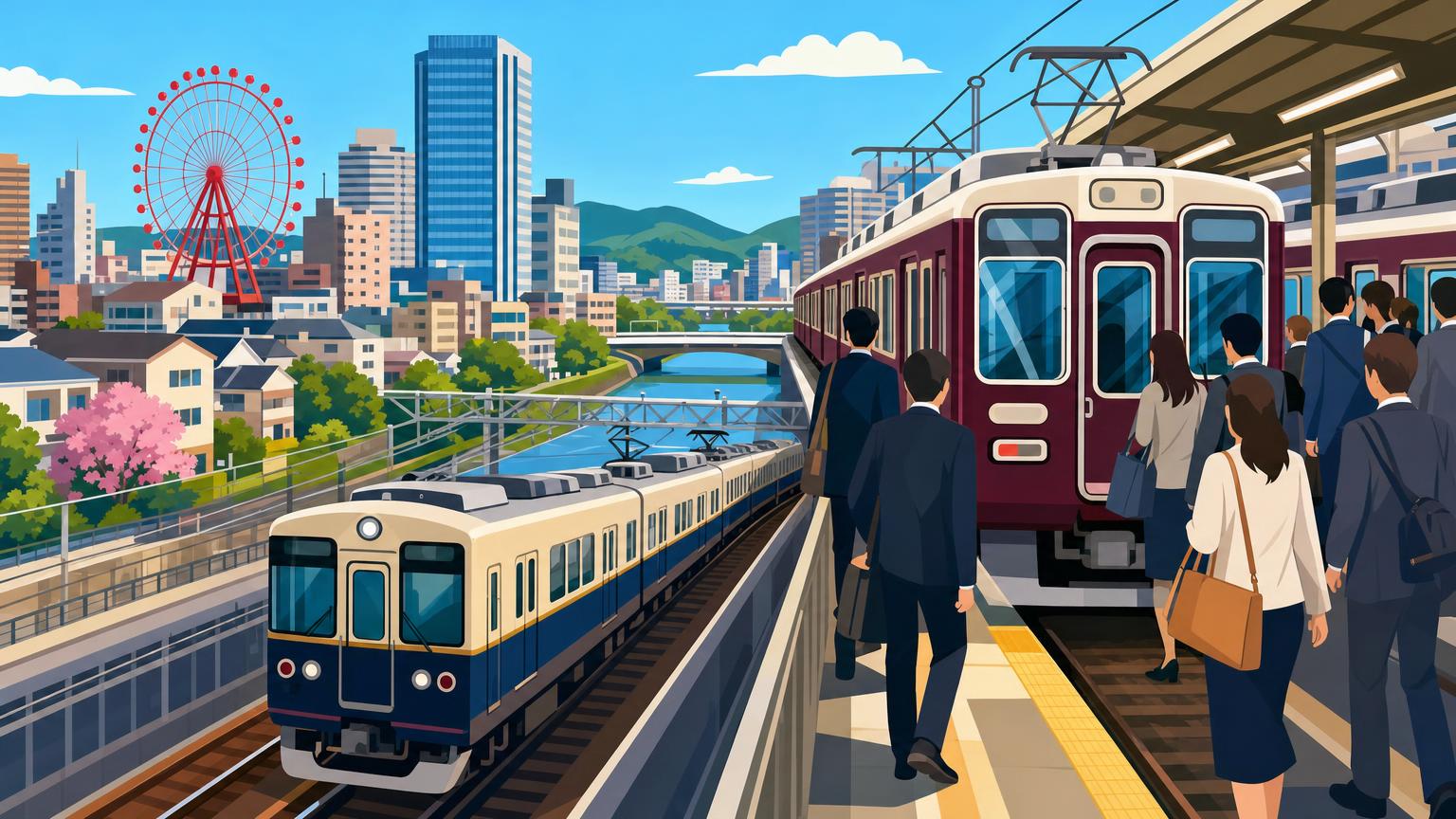
A foreign resident may look at a map of Osaka and ask a simple question: if my office is in Umeda, Yodoyabashi, or Sannomiya, why would I live outside central Osaka at all?
The answer is usually found in the morning train.
For many professionals, living along the Hankyu or Hanshin railway corridors is not a compromise. It is a carefully balanced way of life. They accept a daily train ride in exchange for a quieter apartment, more space, better schools, easier access to parks, or a neighborhood where dinner, groceries, and community life feel less anonymous. The commute becomes part of the household budget, part of the morning rhythm, and sometimes part of a person’s identity.
This is suburban commuting in Osaka: close enough to reach the city quickly, far enough to breathe when the working day is over.
The words “Hankyu area” and “Hanshin area” do not describe official administrative regions. They describe the everyday geography created by two private railway companies. Hankyu generally serves the northern and northeastern side of the Osaka–Kobe corridor, as well as routes toward Kyoto and the northern suburbs. Hanshin runs more directly along the southern Osaka–Kobe corridor, linking Osaka-Umeda with places such as Amagasaki, Nishinomiya, Ashiya, and Kobe-Sannomiya.
The distinction matters because the railway line you choose often shapes the kind of suburban life you lead. A Hankyu commuter may talk about station-front cafés, school districts, hillside neighborhoods, and the polished calm of places such as Nishinomiya-Kitaguchi or Ashiya. A Hanshin commuter may describe a flatter, more industrial, more down-to-earth landscape, with strong connections to Amagasaki, Koshien, Nishinomiya, and the coastal side of Kobe.
Both worlds connect to Osaka’s urban core. They simply carry different moods.
Why Professionals Choose the Hanshin and Hankyu Corridors
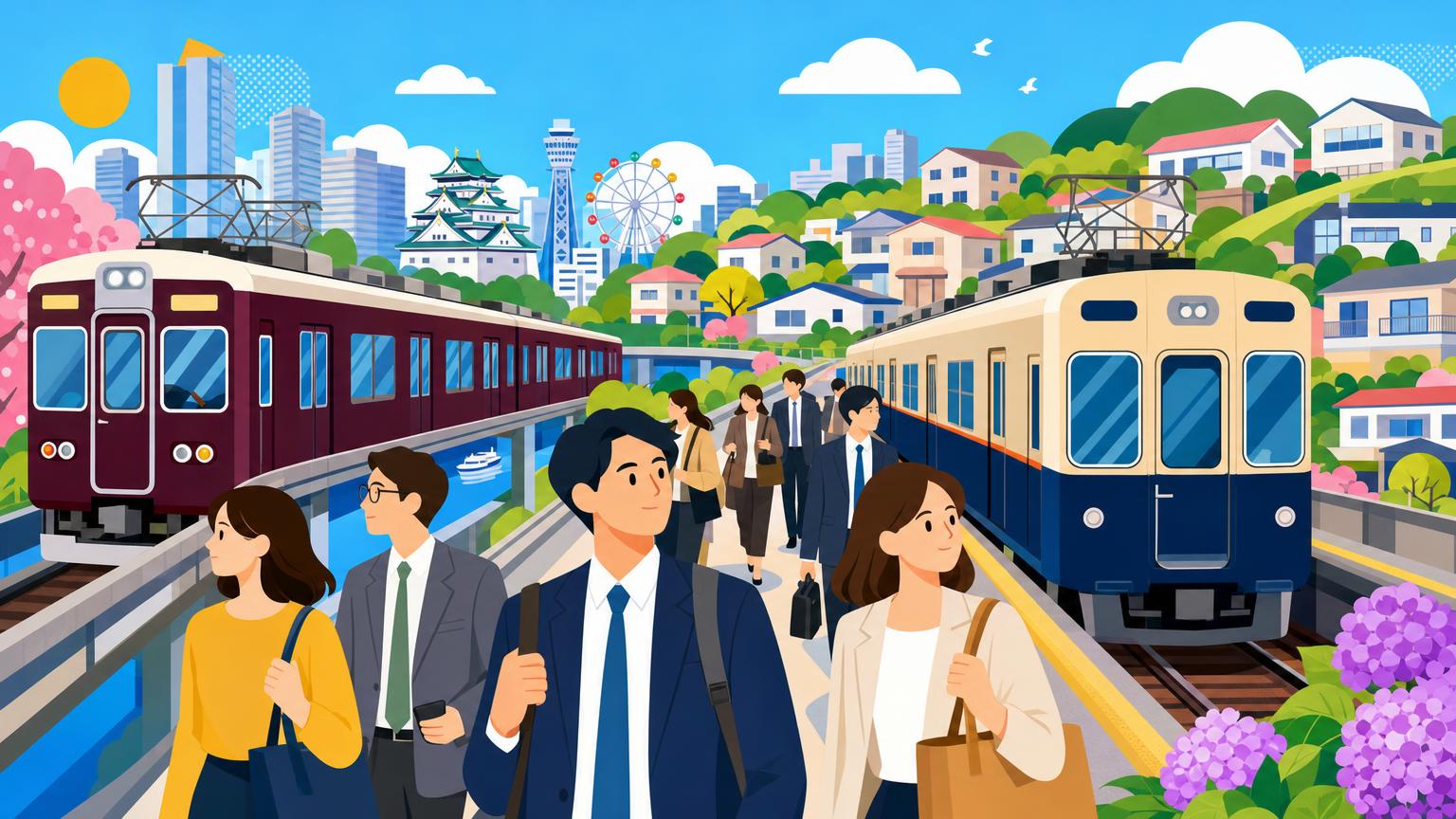
A common misconception is that Osaka residents choose suburban homes simply because central Osaka is too expensive or overcrowded. That is sometimes true, but it is only part of the picture.
The deeper reason is that Osaka allows for a relatively short psychological distance between the city and the suburbs. In Tokyo, moving beyond the central wards can feel like entering a separate metropolitan world. A one-hour commute may be normal, but the daily journey can involve multiple transfers, heavy crowding, and a strong sense that home and work belong to different lives.
In Osaka, many suburban commuters can leave a residential station and reach a major office district by taking one train, or one train plus a simple subway transfer. The journey may take thirty to fifty minutes, but it remains easy to understand. People know where they are going. They know which train door is closest to the stairs. They know which convenience store sells coffee quickly. They know whether it is better to transfer at Osaka-Umeda, Osaka Station, or Umeda Station depending on the weather and their final destination.
That familiarity matters more than the number of minutes shown on the timetable.
A professional living near Hankyu’s Kobe Line may work in Umeda and commute directly to Osaka-Umeda. Someone living near the Kyoto Line may travel to the same terminal before walking to an office in Kita Ward. A Hanshin commuter may use Osaka-Umeda for a short walk to an office near Herbis, the Nishi-Umeda business district, or the west side of Osaka Station. Others continue from Umeda by Osaka Metro to Yodoyabashi, Honmachi, Shinsaibashi, or Namba.
The railway companies are private operators, not branches of Osaka Metro or JR West. This affects fares, commuter passes, station names, delay procedures, and how people plan transfers. At Umeda, Osaka Metro identifies transfer connections to JR, Hankyu, and Hanshin, but these remain separate railway systems with their own ticketing structures.
The suburban decision is about daily friction
When Osaka residents compare apartments, they do not ask only, “How far is it from Osaka?” They also consider practical questions such as:
- Is the station a ten-minute walk or a twenty-minute walk?
- Can I buy groceries on the way home?
- Is the train crowded before or after the major transfer station?
- Can my child reach school without crossing a dangerous road?
- Is the neighborhood quiet at night?
- Do I need to change trains to reach my office?
- What happens if the line stops during bad weather?
- Can I get home after a late dinner without worrying about the last train?
Foreign residents often focus on apartment size or monthly rent first. Local professionals usually think about the entire daily chain: waking up, walking to the station, buying breakfast, boarding the train, transferring, reaching the office, returning, shopping, collecting a parcel, and getting home before the neighborhood becomes silent.
A slightly more expensive apartment near the station may cost less in emotional energy. A cheaper apartment that requires a bus, a long walk, and two transfers may feel expensive every weekday.
What the Hankyu Commuter’s Life Feels Like
Hankyu’s Osaka-Umeda terminal serves as the natural center of the Hankyu suburban world. From here, the railway branches toward Kobe, Takarazuka, and Kyoto. The line names are straightforward, but the lived geography is not. Two neighborhoods with similar travel times can feel entirely different depending on whether they are located along the Kobe Line, Takarazuka Line, or Kyoto Line.
Hankyu commuters often value a particular sense of order. The stations are busy, but the atmosphere can still feel controlled. People queue in predictable places. Regular commuters know the departure patterns and often stand in the same section of the platform each day. There is a quiet culture of efficiency: do not block the escalator, do not stop in the middle of the concourse, and do not form a conversation circle at the ticket gate.
The line’s image is sometimes described as refined, but foreigners should use that word carefully. It does not mean that every Hankyu neighborhood is wealthy or that every resident is formal. Rather, it means that the railway corridor has long been associated with planned residential areas, education, department stores, and a preference for polished presentation. Hankyu’s red-and-cream visual identity also reinforces this impression, as does the connection between the railway, shopping, real estate, and cultural institutions.
A Hankyu commuter may live in a small apartment near Juso, a family home near Toyonaka, a condominium near Nishinomiya-Kitaguchi, or an older house in the hills above Ashiya. These places are not interchangeable. Even so, the morning ritual often follows the same pattern: walk to the station, pass through the gates with an IC card, find the correct platform, and let the train carry the commuter toward Osaka-Umeda.
Hankyu accepts transportation IC cards, including ICOCA, Suica, PASMO, and others, and it also supports contactless payment at eligible gates. ICOCA can be used across participating railways and buses in the Kansai area, including Hankyu, Hanshin, Osaka Metro, Keihan, Kintetsu, and Nankai.
The Kobe Line commuter
The Hankyu Kobe Line serves a corridor that many foreign residents associate with a comfortable suburban lifestyle. Stations such as Nishinomiya-Kitaguchi, Shukugawa, Okamoto, Mikage, and Rokko connect Osaka with western Hyogo while remaining close to urban services.
The daily commuting experience changes as the train travels west. Near Osaka-Umeda, passengers include office workers, students, and people making short trips across the city. Farther along the line, the share of residents commuting to Osaka or Kobe becomes more noticeable. At stations such as Nishinomiya-Kitaguchi, people may be traveling to schools, offices, shopping areas, or another train line. Around Okamoto and Rokko, the atmosphere can feel more residential and academic.
For someone working in Umeda, living near a Hankyu Kobe Line station can provide a direct ride without a transfer. The key question is not just the travel time but whether the train is an express, limited express, or local service. The fastest train may skip the station closest to your home, while a local train may be less stressful even if it takes longer.
A professional may therefore choose a home near a station with frequent local service rather than one offering the shortest advertised express journey. This is one of the small decisions that can make a suburban commute sustainable.
The Takarazuka Line commuter
The Hankyu Takarazuka Line serves northern Osaka and the direction of Takarazuka. It is popular with commuters seeking more space, a quieter residential environment, or easier access to northern Osaka and parts of Hyogo.
The line also highlights one of Osaka’s practical contradictions. A neighborhood can feel calm and suburban while remaining closely connected to Umeda. Residents may enjoy a slower pace in the evening, yet they are still part of the same metropolitan labor market. They can work in finance, fashion, technology, education, medicine, or consulting in central Osaka while living in a place where the evening soundscape consists mostly of bicycles, children, and trains in the distance.
For foreign professionals, the Takarazuka Line can be appealing when the office is near Osaka-Umeda and the home is near Toyonaka, Ishibashi-handai-mae, Ikeda, or farther north. The trade-off is that the commute may be more affected by weather, service disruptions, or the need to travel from a less central station after work.
The Kyoto Line commuter
The Hankyu Kyoto Line is used by people who work in Osaka but live toward Takatsuki, Ibaraki, or Kyoto, as well as by those whose professional lives span the Osaka–Kyoto corridor. It can be a good fit for researchers, university staff, designers, consultants, and employees whose work takes them between the two cities.
This corridor often feels less like a simple suburb and more like a connected regional city system. Someone may live in Osaka Prefecture, work in Kyoto twice a week, spend another day in Umeda, and meet a client in Kobe. The residence is suburban, but the professional life is regional.
That flexibility is valuable, but it also means that commuters must pay attention to which company operates each part of the journey. A Hankyu commuter pass does not automatically cover JR or Osaka Metro. Someone who changes between Hankyu and Osaka Metro every day may need a route-specific commuter pass or separate arrangements. The route that appears cheapest is not always the most convenient once transfers and walking distances are taken into account.
What the Hanshin Commuter’s Life Feels Like
Hanshin Railway runs along a corridor that outsiders often describe in overly simple terms. They may imagine only factories, baseball, and port areas. In reality, the Hanshin corridor includes a wide range of residential environments: dense city neighborhoods, older shopping streets, family districts, coastal apartments, affluent areas, university zones, and highly practical commuter towns.
The Hanshin Main Line connects Osaka-Umeda with Amagasaki, Koshien, Nishinomiya, Ashiya, and Kobe-Sannomiya. Its geography is more linear and coastal than much of the Hankyu corridor. In some areas, the tracks pass through a dense urban landscape where stations, shopping streets, small restaurants, and apartment buildings are packed closely together.
The social atmosphere can feel more openly practical. People may speak more directly, shops may have a less polished presentation, and the line can feel connected to working families as much as to white-collar professionals. This does not mean the Hanshin area is unfashionable or unsophisticated. Rather, its version of comfort is often based on convenience, access, food, and neighborhood familiarity instead of visual refinement.
A Hanshin commuter may leave work in a smart suit, stop at a supermarket beneath the station, pick up prepared food, and arrive home before the evening gets too late. The line supports this kind of compressed daily life.
The Amagasaki commuter
Amagasaki is one of the most misunderstood places in the Osaka metropolitan area. Foreign residents sometimes see its industrial history and assume it is an undesirable place to live. That judgment is too broad.
Amagasaki contains neighborhoods with varying levels of noise, density, convenience, and housing quality. Some areas are intensely urban and practical, while others are quieter and more residential. The city’s proximity to Osaka is a major advantage for people who work in Umeda, Fukushima, Yodoyabashi, or the western side of the city.
A commute from Hanshin Amagasaki to Osaka-Umeda can be short enough to make the suburb feel almost like an extension of central Osaka. That short distance changes how people use their evenings. They may go home for dinner rather than eat near the office. They may return to the station later for a gym session or a drink. They may accept a job change within Osaka without having to move house.
This is a major difference between suburban life in Osaka and the stereotype of suburban life elsewhere. The suburb is not necessarily a retreat from the city; it can serve as a practical platform for using the city whenever necessary.
The Nishinomiya and Koshien commuter
Nishinomiya is particularly useful for understanding how Hanshin and Hankyu identities overlap. The city is served by both railways, but the neighborhoods around their different stations can feel distinct. A resident near Hanshin Nishinomiya may have a daily routine centered on the Hanshin Main Line, while someone closer to Nishinomiya-Kitaguchi may orient their life around Hankyu.
Koshien also has a strong station identity, but daily residents do not experience it solely through major events. On ordinary weekdays, it is a commuter station, a shopping area, and a place where people handle errands. When a large event draws crowds, residents adjust their timing, routes, and expectations. They know which roads become congested and which station exits are best avoided.
This reflects an important local habit: people do not wait for the city to become inconvenient. They learn its calendar and adjust their behavior in advance.
The Ashiya and Kobe commuter
Hanshin Ashiya and the stations toward Kobe connect professional households across the Osaka–Kobe corridor. Some residents work in Osaka, others in Kobe, and some divide their week between both cities. The commute is not simply a movement from “home” to “downtown”; it is a choice between two urban centers with different professional cultures.
Osaka is often experienced as more commercial, conversational, and improvisational. Kobe can feel more compact, international, and visually composed. A person may prefer the energy of working in Osaka while enjoying the pace of living near Kobe. The railway makes that combination possible.
For foreign residents, this is one of the strongest reasons to consider the Hanshin side. You do not have to choose Osaka and Kobe as completely separate lifestyles. You can live between them, provided you understand the train timetable and the reality of the last train.
The Morning Commute: Quiet Rules That Everyone Understands
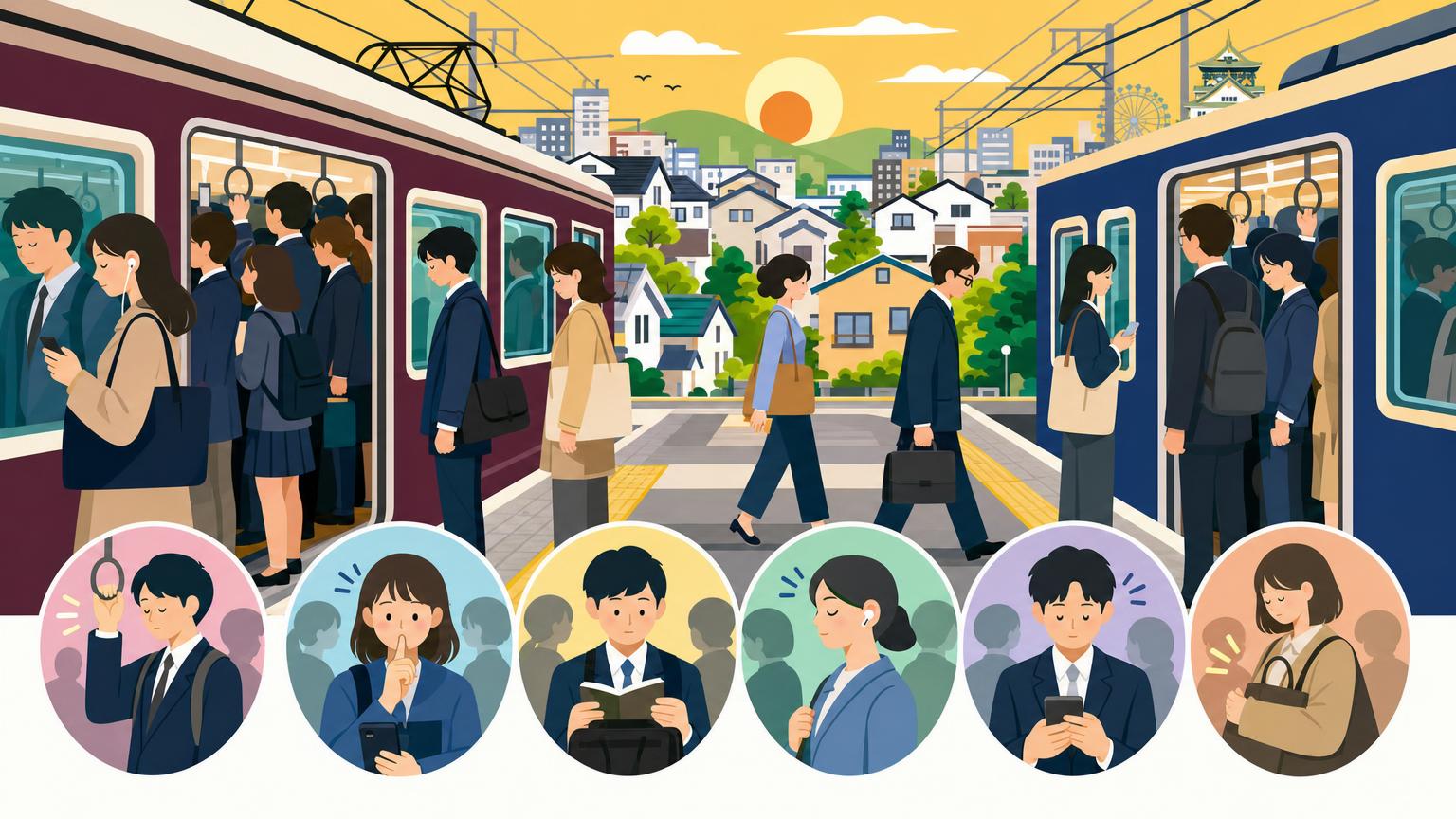
The Osaka morning commute is not silent, but it is strongly governed by unspoken rules.
People generally avoid prolonged eye contact. They refrain from unnecessary conversation with strangers. They form lines even when the platform markings are not obvious. They allow passengers to exit before boarding, although this rule becomes less orderly when a train is crowded. They keep their bags close to their bodies and avoid swinging backpacks into others.
For a foreign resident, the most important rule is not to treat the platform as an open public room. Do not stop at the bottom of an escalator. Do not stand directly in front of a train door when passengers are trying to exit. Do not spread your luggage across a seat. Do not take a video call in a crowded carriage.
Women often develop their own commuting strategies. They may choose a particular carriage, stand near other women, avoid the most crowded boarding position, or use women-only cars during designated morning periods. Women-only car arrangements can vary by railway and time, so residents should check the operator’s current guidance rather than rely on an old map or social media post.
A foreign woman may also notice that safety advice in Japan is sometimes indirect. People may say “be careful” instead of describing a risk openly. If someone tells you not to use a certain platform exit late at night, they may be expressing local knowledge rather than exaggerating. Ask what they specifically mean: poor lighting, few open shops, heavy bicycle traffic, or a history of harassment.
The safest response is practical rather than fearful. Learn the station layout, keep your phone accessible but not visibly loose in a crowded train, use a crossbody bag, and find out where the staffed areas are located.
What “rush hour” really means
Osaka rush hour is not one uniform wall of people. It varies by line, station, day, and direction.
A train heading toward Osaka-Umeda can be crowded in the morning, especially near major residential stations. A train leaving Umeda during the same period may be less crowded because the main flow is toward the city. In the evening, the direction reverses, but not perfectly. Many professionals work late, meet colleagues for dinner, or transfer to another line before heading home.
The busiest period is often roughly from 7:30 to 9:00 in the morning, but workplace schedules have become more diverse. Some offices start earlier. Some companies allow staggered hours or remote work. As a result, the traditional peak remains real, but it is less predictable than it was for every employee before hybrid work became widespread.
For a new resident, the best approach is not to ask whether a line is generally crowded. Ask whether your specific train, station, and direction are crowded at the time you travel.
Try a weekday test commute. Leave home at the time you would actually leave for work. Walk to the station. Stand on the platform. Transfer if necessary. Count the minutes from your front door to your office desk, rather than only from station to station.
That test often reveals the true cost of an apartment.
Osaka-Umeda Is More Than One Station
Foreign residents often become frustrated because “Umeda” can refer to several stations and broad surrounding areas. Osaka-Umeda Station is served by Hankyu and Hanshin. Osaka Station is served by JR West, while Umeda Station is served by Osaka Metro’s Midosuji Line. Higashi-Umeda and Nishi-Umeda serve other Osaka Metro lines.
Although they are geographically close, they are not the same station in practical terms. A commuter transferring from Hankyu to Osaka Metro may need to walk through a long underground passage. In good weather, this may be manageable, but in the rain, with a laptop bag and bicycle helmet, the same transfer can feel like part of the commute itself.
The area around the stations is also divided according to working style. The north side near Hankyu Osaka-Umeda is associated with department stores, offices, fashion, restaurants, and the Chayamachi area. The south and west sides connect more directly to Hanshin Osaka-Umeda, Herbis, Nishi-Umeda, and the offices around the west side of Osaka Station. Osaka Metro’s Umeda Station connects to multiple lines and provides transfer routes to JR, Hankyu, and Hanshin.
This is why local people may give directions using landmarks rather than compass points. They may say “go toward Hankyu,” “take the underground passage,” or “use the Midosuji North Gate.” These phrases are not merely casual expressions; they form a shared navigation system.
Foreign residents should learn which exit corresponds to their final destination, rather than relying only on the station name. Exiting through the wrong gate can add ten or fifteen minutes to a transfer, especially within a large commercial complex.
The Real Cost of the Commute
A suburban commute is more than just a transportation expense. It involves four costs: money, time, physical energy, and mental attention.
Money
The monthly cost depends on the railway company, route, distance, and whether the employer provides a commuter allowance. Many Japanese companies reimburse regular commuting expenses along an approved route, but policies vary by employer. Do not assume that every route or fare difference will be covered.
If your route includes Hankyu, Hanshin, Osaka Metro, or JR, ask the company which route it recognizes. The fastest route may not be the approved one, and the route with the fewest transfers may not be the cheapest. A commuter pass is usually tied to a specific section and operator.
An ICOCA is useful for ordinary travel, but it is not automatically the same as a commuter pass. ICOCA functions as a rechargeable transportation card, while a commuter pass provides unlimited travel within its valid section during the specified period. JR West explains that ICOCA can be used for railways, buses, and participating shops, but the card itself does not make every commute a discounted unlimited journey.
Time
A forty-minute commute each way adds up to more than six and a half hours per week over five workdays, even before including the walk to the station and the transfer inside Umeda. That is why residents care so much about whether a station is truly ten minutes from home, whether the train is direct, and whether the office is close to the correct exit.
People often say that Japanese commuters read, sleep, or work on trains. Some do, while others simply stare at the floor and recover from the day. The train is not always productive time; sometimes, it is decompression time.
Physical energy
Crowding is tiring even when the journey is technically short. Standing for thirty minutes, moving through a large station, carrying a laptop, and walking home in the summer humidity can leave someone far more exhausted than the timetable suggests.
This is why seating matters. A slightly longer local train may be preferable to a packed limited express. Some professionals adjust their departure time by ten minutes to board a train with better conditions. Others choose a station where they can reliably sit during the evening journey.
Mental attention
The most underestimated cost is the constant need to monitor the route. Which platform? Which train type? Which transfer? Which exit? Is the service delayed? Does this commuter pass cover the connection?
After a few months, residents stop thinking about most of these details. The commute becomes automatic. That is one reason locals may appear relaxed in a complex station. They are not processing every sign; through repetition, they have built a personal map.
How Osaka Differs From Tokyo in Commuting Culture
The Osaka–Tokyo contrast is often reduced to personality: Osaka people are supposedly warmer, while Tokyo people are supposedly more reserved. That explanation is too shallow.
The differences are also structural. Osaka’s central business districts are spread across several connected areas: Umeda, Yodoyabashi, Nakanoshima, Honmachi, Shinsaibashi, Namba, and the Osaka Bay area. Tokyo has many centers as well, but the scale and density of its railway network create a different daily experience.
In Osaka, a suburban resident may understand their commute through one main railway line. A Hankyu resident thinks in terms of Osaka-Umeda, Juso, Nishinomiya-Kitaguchi, Takatsuki, or Kyoto-Kawaramachi. A Hanshin resident thinks in terms of Osaka-Umeda, Amagasaki, Koshien, Nishinomiya, Ashiya, or Kobe-Sannomiya. The network is not simple, but it feels emotionally familiar.
Osaka also has a stronger culture of practical complaint. People may openly say that a transfer is inconvenient, a train is late, a station is poorly designed, or an apartment is too far from the gates. This directness does not necessarily indicate hostility. It can simply be a way of sharing useful information.
A Tokyo resident might express the same opinion more indirectly, while an Osaka resident may turn it into a joke. The joke can serve as a social bridge: “You chose the apartment, so now you have to suffer on the bus.” The point is not necessarily to criticize you, but to acknowledge a shared reality.
Foreigners sometimes mistake this directness for aggression. Others make the opposite mistake by assuming that everyone wants an instant friendship. Osaka communication is often warmer than formal Tokyo communication, but warmth does not eliminate boundaries. A station employee may be helpful without becoming personal. A coworker may tease you without inviting you into their private life.
The useful rule is to listen for intention, not just vocabulary.
What Foreign Residents Often Misunderstand
“The shortest route must be the best route.”
Not necessarily. A route with one transfer may involve a long walk through Umeda, while a direct train may be crowded. A slightly slower route may be calmer, cheaper, or covered by your employer’s commuter pass.
“Hankyu, Hanshin, and JR are basically the same.”
They are separate companies with different stations, passes, operating policies, and delay procedures. They may share a terminal area, but that does not mean one pass or ticket works across all of them.
“If a train is late, everyone will be angry at me.”
Japanese commuters may be visibly frustrated by delays, but they generally understand that transport disruptions happen. If you are late because of a railway delay, obtain a delay certificate when necessary and inform your workplace according to company policy. Do not invent a dramatic explanation; a simple, factual message is better.
“People are unfriendly because they do not talk on the train.”
Silence on a crowded train is a form of consideration. People are sharing a very small space, so not speaking is often the polite choice.
“The suburbs are boring.”
Suburban life may be quieter, but it is not empty. Neighborhoods around Hankyu and Hanshin stations often have supermarkets, clinics, schools, cafés, small restaurants, bakeries, gyms, salons, and local shopping streets. Entertainment is less concentrated and less visible than in central Osaka. You need to become a resident rather than wait for the neighborhood to entertain you.
“The train station is the whole neighborhood.”
In Osaka, which side of the station you are on matters. One exit may lead to a lively shopping street, while another may lead to apartment buildings, schools, or a river. Two buildings with the same station name can offer very different levels of daily convenience.
The Evening Commute and the Meaning of Home
The morning commute is functional, while the evening commute reveals what people want from suburban life.
A professional leaving an office in Umeda may first stop at a department-store food floor, a supermarket near the station, or a convenience store. They might buy dinner, a boxed lunch, fruit, or ingredients for breakfast. Others pass through the station without shopping because they know prices are higher around the terminal.
This is where the neighborhood’s design becomes important. A station surrounded by practical supermarkets supports a different lifestyle from one surrounded mainly by offices and restaurants. A resident may accept a longer morning journey if the evening return is convenient.
Some people eat near Umeda because the office day has not yet ended emotionally. Others hurry onto the train because they want to change clothes, cook, exercise, or spend time with family. In Osaka, the commute is often a negotiation between the city’s energy and the quiet of home.
The last train matters more than newcomers may expect. A late dinner in Umeda or Kobe can turn into an expensive taxi ride if you miss the final connection. Last-train times vary by route and day, so check them before accepting a late meeting or social invitation, especially if your trip involves a transfer between Hankyu, Hanshin, JR, or Osaka Metro.
This limitation influences social behavior. People may leave a gathering earlier than foreign residents expect. They may say, “I have to catch the train,” without apologizing. It does not necessarily indicate a lack of interest; rather, it is a practical boundary built into metropolitan life.
Commuting as a Social Class and Lifestyle Signal
The railway line people use can serve as a quiet social signal, although it should not be treated as a fixed map of class.
Some Osaka residents associate Hankyu with education, fashion, peaceful residential streets, and a certain kind of middle-class aspiration. They may view Hanshin as more direct, more urban, more oriented toward working families, or more closely connected to the coast. These impressions are broad and often outdated, but they still influence apartment searches and casual conversations.
Foreign residents may hear comments such as “That area is more Hankyu,” or “You live on the Hanshin side?” The speaker could be referring to architecture, shopping, school culture, income, industrial history, or simply the area’s atmosphere. It is better to ask a follow-up question than to guess.
The distinction is also used humorously. People in Osaka are skilled at turning local geography into light teasing. Someone might joke that one railway line is too serious, too expensive, too crowded, or too proud. Such comments are usually less ideological than they may sound.
The important point is that neighborhoods carry reputations. These reputations influence rent, school choices, marriage conversations, and how people imagine their futures. However, the reality of a place is always more varied than its railway brand.
Practical Strategies for a Sustainable Commute
Test the complete door-to-desk journey
Do not rely solely on a railway app’s station-to-station estimate. Measure the journey from your front door to your office entrance, including elevators, ticket gates, platform walks, and the time required to buy coffee or adjust your umbrella.
Choose one reliable route before optimizing
New residents often search for the fastest route every morning, creating unnecessary decisions. Start with one reliable route. Once you understand the system, compare alternatives for bad weather, delays, late nights, and crowded trains.
Learn the station exits early
Save the exit name in your phone. Osaka-Umeda, Osaka Station, and Umeda Station have numerous exits. Choosing the right exit can turn a confusing underground transfer into a routine walk.
Keep an emergency balance on your IC card
An IC card is convenient, but it may fail when the balance is too low, the card is damaged, or the reader does not register the tap. Keep enough balance for one extra journey and carry a small amount of cash. ICOCA can be charged and used for transportation and participating purchases, but it remains a payment tool rather than a substitute for every ticket type or commuter pass.
Ask your employer about the commuter pass
Before purchasing a long-term pass, confirm the approved route and reimbursement policy. If your work location changes between Umeda, Yodoyabashi, and Nakanoshima, the most practical route may change as well.
Check alternative routes before a problem occurs
A Hankyu commuter should know whether Osaka Metro, JR, or a bus can provide a reasonable backup. A Hanshin commuter should understand whether another Hanshin station, a JR route, or an Osaka Metro connection would be useful. During disruptions, railway operators may provide alternative transportation under specific conditions, but the exact procedures vary. Hankyu publishes detailed guidance on alternative transportation and commuter-pass situations.
Treat walking as part of the commute
A ten-minute walk from the station may be pleasant in spring but exhausting in August. Check the route in the rain, darkness, and hot weather. A covered shopping street or underground passage may matter more than a small difference in train time.
Build a late-night plan
Know the last train, the nearest taxi stand, and whether your residential station has a staffed gate late at night. This is particularly important for people who work in hospitality, media, medicine, events, consulting, or international business.
Is Suburban Commuting in Osaka Worth It?
For many professionals, yes—but it depends on what you want your home to provide.
Living near Osaka-Umeda offers maximum convenience, shorter access to restaurants and offices, and less reliance on a fixed train schedule. The trade-off may include higher rent, smaller rooms, more noise, fewer quiet streets, and a stronger sense that work is always nearby.
Living along the Hankyu or Hanshin lines offers a different balance. You may have more living space, a stronger neighborhood identity, easier access to family services, and a clearer separation between work and home. The cost is a daily commute paid for in money, time, and energy.
The best suburban location is not the one with the most impressive station name; it is the one that supports your actual week.
If you work late several nights a week, prioritize the last train and the walk home. If you work from home part of the week, a longer commute may be acceptable. If you have children, consider schools, parks, clinics, and station crossings. If you travel frequently, compare access to Osaka Station, Shin-Osaka, and Kansai International Airport. If you work in Kobe as well as Osaka, consider whether the Hanshin corridor provides a more balanced regional connection.
Most importantly, do not choose a neighborhood based on its tourist image. An elegant department store, famous station, or popular café tells you almost nothing about the 7:42 a.m. platform, the supermarket queue at 7:30 p.m., or the walk home after rain.
The Osaka Mindset Behind the Commute
The suburban commute reveals something important about Osaka residents: they are often practical romantics.
They may complain about the train, compare fares, criticize a station renovation, and calculate the exact amount of time saved by changing platforms. Yet they also care deeply about atmosphere. They choose a neighborhood because it feels right. They notice the quality of light on a residential street, the friendliness of a small bakery, the view from a train window, or the way a station feels after work.
Osaka residents do not always separate efficiency from enjoyment. The commute must work, but it should also suit the life surrounding it.
This is why someone may reject an apartment that is technically closer to work. The building may be near the station, but the street may feel cold. The route may be fast, but the transfer may be stressful. The rent may be reasonable, but the supermarket may be inconvenient. A local decision often involves several emotional calculations that remain invisible on a map.
For foreigners trying to understand what life in Osaka is really like, the morning train is a better teacher than a sightseeing district. Watch how people move through the gates. Notice how commuters protect their personal space in a crowded carriage. Listen to the brief conversations on the platform. See how the city changes as the train leaves Umeda and enters the residential corridor.
The train is not merely carrying people to work. It is connecting different ideas of what makes a good life.
On the Hankyu side, that life may be orderly, residential, and quietly aspirational. On the Hanshin side, it may be direct, practical, and deeply connected to the working city. In both cases, people are making the same daily calculation: how much city do I want in my work, and how much calm do I want at home?
That question explains suburban Osaka better than any single travel slogan ever could.