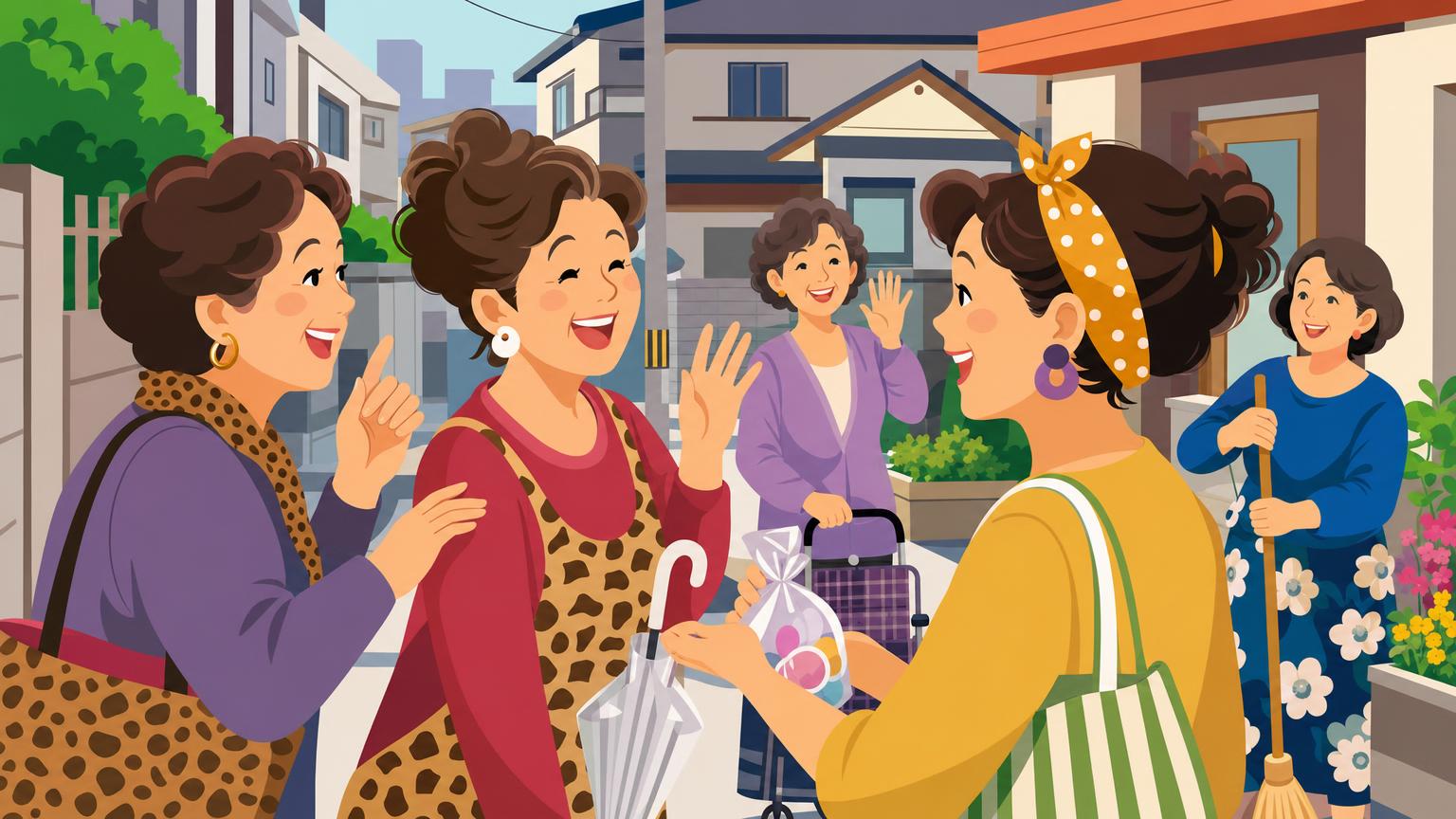
You move into an Osaka apartment building. A woman from two floors below sees you struggling with the garbage rules. She asks where you are from, tells you which collection day applies to your building, complains that the previous tenant never separated cans properly, and then offers you a wrapped candy.
You may wonder what just happened.
Was she being nosy? Was the candy a gift, a test, or simply candy? Were you expected to start a friendship? Should you have accepted it? And if she speaks loudly, laughs at your Japanese, or tells you that your bicycle is parked in the wrong place, is she being rude?
Often, this is one of the first confusing forms of daily life in Osaka: care arriving in the same package as criticism.
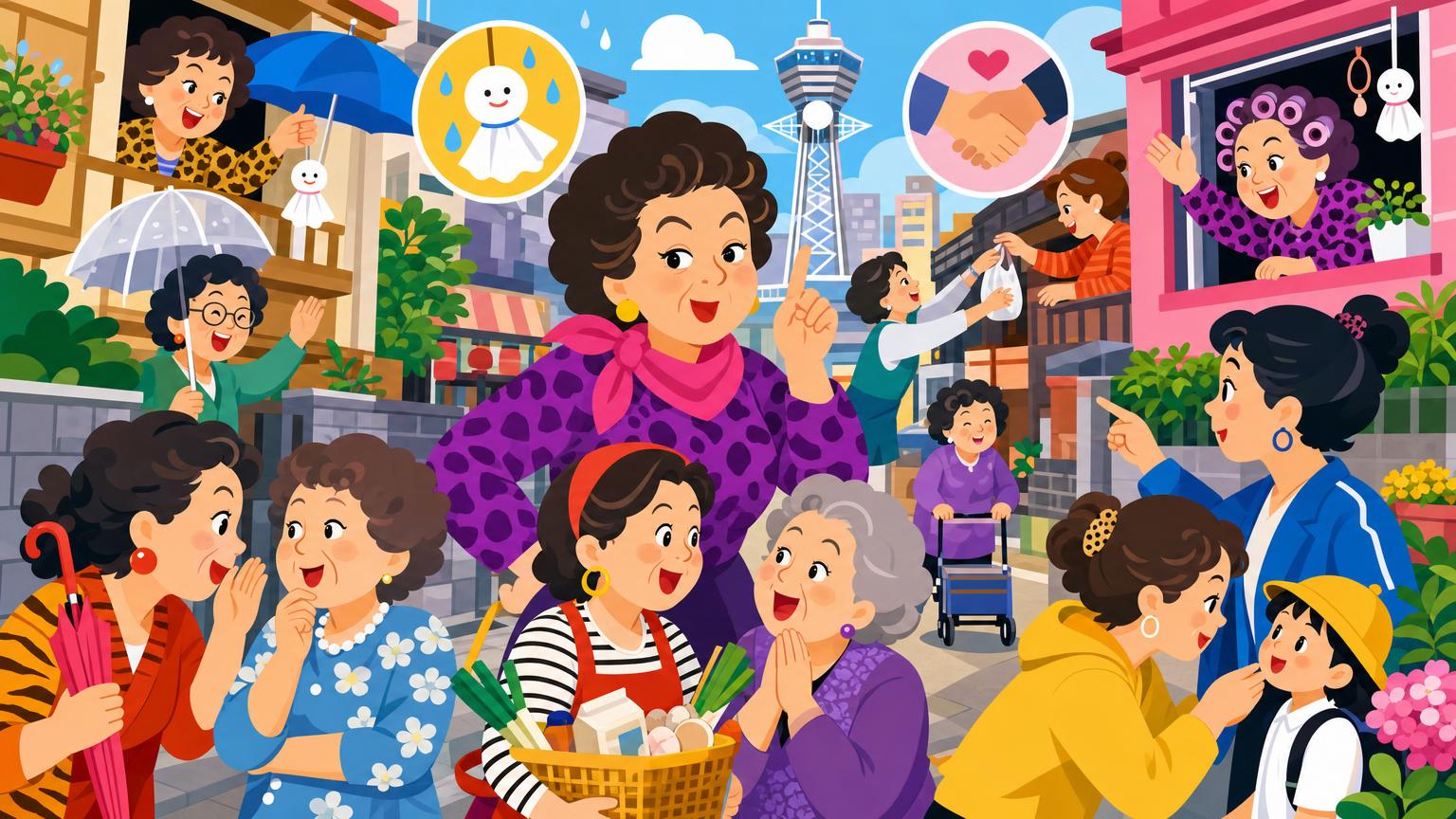
The figure behind this interaction is the familiar Osaka obachan. The word can mean “auntie,” “middle-aged woman,” or “older woman,” but in local conversation it can also describe a social style. An Osaka obachan is often imagined as direct, observant, practical, funny, and willing to speak to people who might otherwise remain strangers. The stereotype includes leopard print, a well-stocked handbag, a strong opinion, and a supply of ame-chan, or candy. Yet the useful part of the stereotype is not the fashion. It is the way small interactions can become an informal support network.
This article is about that network as it appears in apartment districts, residential streets, shopping arcades, garbage collection areas, bicycle parking spaces, small cafés, and community rooms. It is not a guide to tourist attractions. It is an explanation of how local trust is often built in Osaka: through repeated greetings, practical warnings, small favors, shared complaints, and the offer of one inexpensive sweet.
What the Osaka Obachan Network Really Means
Obachan is a social image, not a uniform identity
First, do not assume that every older woman in Osaka wants to be called obachan. In everyday Japanese, obachan can sound familiar, affectionate, comic, or insulting depending on who says it, how it is said, and how well the speakers know one another. A foreign resident should generally use a woman’s name, san, or a polite greeting rather than deciding that “obachan” is her proper title.
The word is most useful when discussing a cultural image. That image centers on an older woman who knows what is happening in the neighborhood and is ready to comment on it. She may know which shop sells the cheapest vegetables, which apartment has a broken intercom, which child belongs to which family, and which day the local volunteer group checks on an elderly resident. She may not describe herself as part of a “support network.” She may simply say that she is helping because she noticed something.
This is an important distinction for foreigners living in Osaka. Community care is not always presented as a formal service. It may take the form of a question asked in an elevator:
“Are you going out?”
“Did you put the trash out already?”
“Your light was on all night. Is everything okay?”
“Have you seen the woman in 305 today?”
These questions can feel personal, especially to someone from a culture where privacy means avoiding unsolicited conversation. Sometimes they are too personal. At other times, they are simply ordinary expressions of neighborhood concern. The difference is usually revealed over time through tone and repetition.
Informal care works through repeated contact
The Osaka obachan network is not a single organization. It is a loose pattern of people who see one another often enough to notice changes. An elderly resident who normally buys groceries every morning may stop appearing. A foreign tenant who usually greets the neighbors may suddenly look lost near the garbage station. A child may be waiting alone near the entrance. A package may remain outside a door for several days.
No single person necessarily assumes responsibility for the whole situation. Instead, information moves through small conversations. One neighbor asks another. Someone mentions it to the building manager. A volunteer, shopkeeper, or local welfare supporter may be contacted if the issue seems serious.
Osaka City itself supports more formal versions of this idea. The city describes resident-to-resident assistance for older people, including shopping, cleaning, taking out the garbage, accompanying someone to appointments, collecting medicine, changing a light bulb, watering plants, and offering conversation alongside practical support. These services do not replace professional care, but they show how ordinary help can exist between private life and formal welfare.
In some Osaka apartment communities, residents have created volunteer groups, weekly coffee salons, paid support for minor repairs and shopping, exercise gatherings, and check-in systems using the building intercom. One documented apartment example describes residents checking on older households through scheduled daily contact and using shared activities to reduce isolation and neighborhood conflict.
That is the practical meaning of the “network.” It does not necessarily involve warm conversation all day. Rather, it is the presence of people who notice, remember, ask questions, and connect one person to another.
Why the network can feel both helpful and intrusive
The same behavior can be experienced in two different ways.
A neighbor who tells you that your garbage bag is wrong may be protecting the building from a collection problem. She may also be enjoying the authority of correcting someone new. A woman who asks whether you live alone may be checking whether you need help. She may also be satisfying her curiosity. Someone who offers candy may be trying to start a conversation. She may also simply carry candy because she always has.
Osaka communication often leaves room for mixed motives. People can be practical and nosy at the same time. They can complain while helping. They can tease you and still remember your preferred coffee. If you expect kindness to arrive in a soft, carefully worded package, you may miss it because Osaka kindness can be noisy, impatient, and wrapped in humor.
This does not mean you must accept every intrusion. Trust does not require you to surrender your privacy. A healthy relationship with local elders includes boundaries. You can smile, thank someone, and decline to answer a personal question. You can accept advice without accepting control. You can be grateful for help while still deciding what information to share.
Why Ame-chan Matters in Osaka Daily Life
Ame-chan means more than “candy”
Ame means candy. Ame-chan adds the affectionate -chan suffix, making the word sound familiar and endearing. In Osaka and the wider Kansai region, adults commonly use affectionate forms for foods and everyday objects, so ame-chan is not baby talk in the way an outsider might assume. The expression reflects a broader local habit of giving ordinary things a personal, friendly quality.
The candy itself is usually small and individually wrapped. It may be a hard candy, fruit candy, mint, caramel, or a familiar local brand. It might come from a handbag, kitchen drawer, café counter, or plastic pouch kept especially for sharing.
Its material value is low. That is precisely the point.
Ame-chan can begin a conversation without creating a serious obligation. An invitation to a meal may feel too significant. A present may call for a return gift. Money could change the relationship. Candy is small enough to offer casually and useful enough to accept without ceremony.
It gives two people a reason to talk.
Candy creates a low-pressure moment of trust
Imagine an older neighbor who has seen you several times but has never spoken with you. She may not know how confident you are in Japanese, or she may worry that a direct question would feel too difficult. Holding out a piece of candy gives her a simple opening:
“Ame-chan, taberu?”
“Would you like some candy?”
The offer lets you respond without having to sustain a long conversation. If you accept, you have created a small shared moment. If you decline, the interaction can still end politely.
This is why ame-chan can serve as a form of informal community care. It is not care because sugar solves a problem. It is care because the offer acknowledges another person. In a small way, it says, “I noticed you,” “You are included,” or “We can speak to each other.”
For an elderly person who spends much of the day alone, a brief conversation by the elevator may matter. For a foreign resident who has not yet learned the neighborhood’s social rhythm, an offer of candy may be the first sign that local people recognize them. The exchange is brief, but repeated brief interactions can gradually create familiarity.
Ame-chan is not a secret Osaka contract
Foreign residents sometimes worry that accepting candy creates an obligation to return a gift, invite the giver inside, or become socially available. Usually, it does not. A simple expression of gratitude is the appropriate response.
You can say:
“Arigatō gozaimasu.”
“Thank you very much.”
If you want to sound more relaxed with a familiar neighbor, you could say:
“Arigatō. Ame-chan, itadakimasu.”
“Thank you. I’ll have the candy.”
A smile and a slight bow are enough. You do not need to immediately offer an expensive souvenir. If the relationship grows, you can later share fruit, cookies, tea, or a small snack from your home country. The return should feel like natural reciprocity, not repayment of a debt.
Ame-chan Etiquette for Foreign Residents
Accepting the candy
If you want the candy, take it with one hand or both, and thank the person. If the exchange takes place in a crowded hallway, avoid making the moment more complicated than necessary. A clear “thank you” is better than a long speech about Osaka culture.
If you do not understand what was offered, ask politely:
“Dō iu ame desu ka?”
“What kind of candy is it?”
If you have an allergy or dietary restriction, say so directly. You can use simple English, Japanese, or a translation app. For example:
“Gomen nasai, taberarenai n desu.”
“I’m sorry, I can’t eat it.”
“Arerugī ga arimasu.”
“I have an allergy.”
You do not have to accept food to show respect for Osaka. A polite refusal is safer than eating something that may contain an ingredient you cannot tolerate.
Declining without creating embarrassment
Some people decline because they do not eat sugar. Others may be fasting, vegan, diabetic, allergic, or simply not hungry. A local elder may insist once or twice. That insistence can be part of the conversational style and does not necessarily indicate serious pressure.
You can repeat your refusal with a smile:
“Daijōbu desu. Arigatō.”
“I’m okay, thank you.”
If necessary, give a reason:
“Amari amai mono o tabenai n desu.”
“I don’t usually eat sweet things.”
The key is to be warm without being ambiguous. A vague response may invite another offer, while a gentle but clear answer will usually end the exchange.
Do not assume the candy is a personal invitation
Ame-chan may be shared with several people in the same building. It can be offered to children, delivery workers, shop staff, visitors, or anyone standing nearby. The giver may be generous by habit rather than singling you out for a special relationship.
At the same time, do not dismiss the interaction as meaningless. In a neighborhood where people see each other repeatedly, small gestures build over time. You may become “the foreign person in 402,” then “the person who likes green tea,” and eventually someone whose absence is noticed.
That progression reflects ordinary trust. It is slower and less dramatic than friendship, but it is often more useful in daily life.
Avoid making a joke about the giver’s age
Do not respond to an older woman’s candy offer by calling her an “Osaka granny,” even if you have read about the stereotype. Do not point to leopard print and ask whether she is a real obachan. Do not photograph her without permission. The cultural image may be entertaining in the media, but the person in front of you is not a costume.
If you become friendly, you may eventually hear how she describes herself. Let her decide how far the joking goes. Respect is not shown by acting formal all the time, but by recognizing where the other person’s comfort ends.
How the Obachan Network Works in an Apartment District
The entrance is a social checkpoint
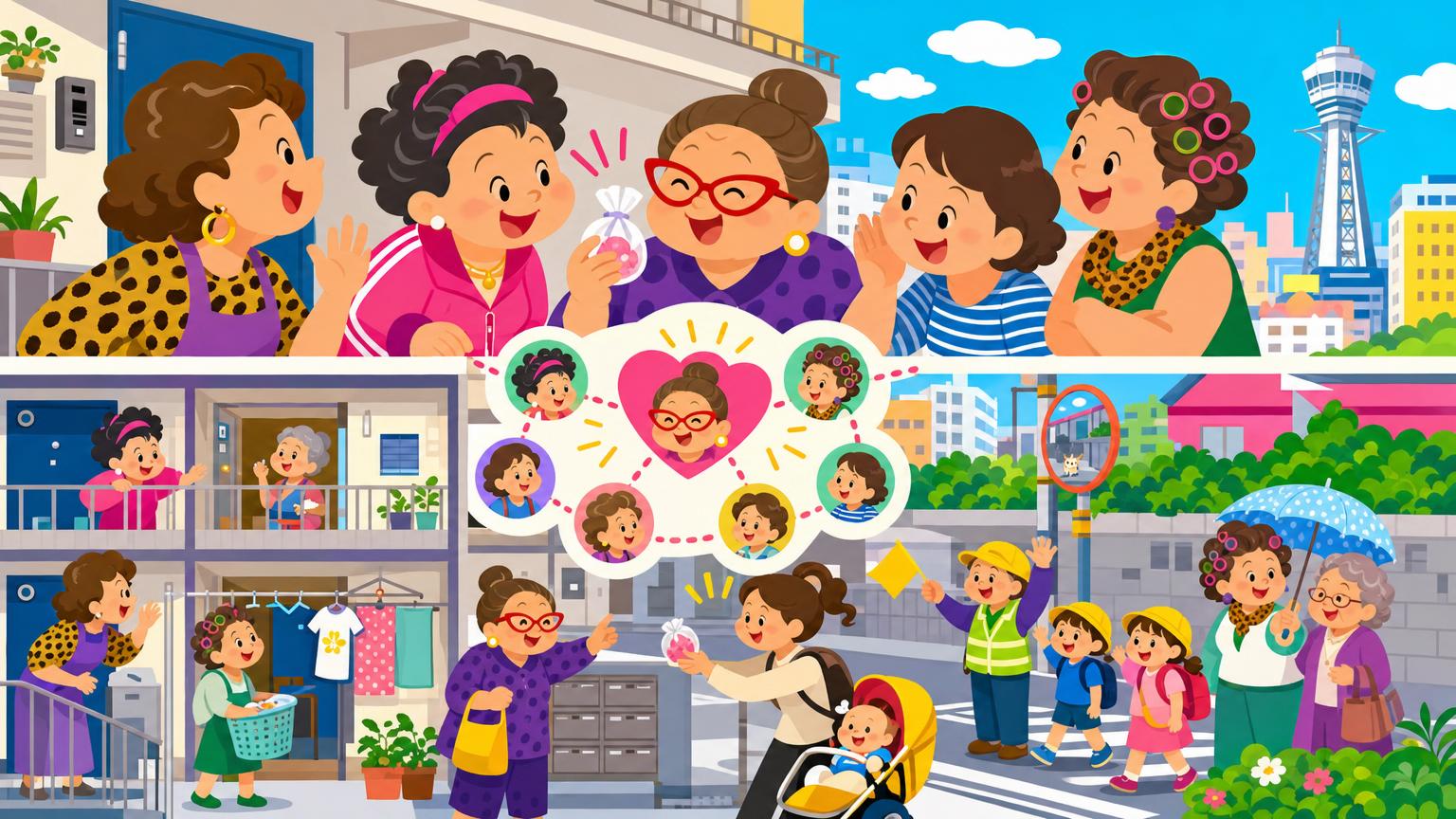
In a Japanese apartment building, the entrance is more than just a passageway. It is where residents collect mail, check notices, park umbrellas, meet delivery workers, wait for elevators, and exchange brief greetings. Older residents often spend more time moving through these shared spaces than busy commuters do.
This makes the entrance a place where information travels.
A neighbor may notice that a light has been broken for weeks. Someone may see that the automatic door is difficult for an older resident to use. A foreign tenant may be asked whether they understand the earthquake drill notice. A parent may learn that the local children’s group is cleaning the street on Sunday morning.
You do not need to stand around and socialize for an hour. Repeated greetings are enough to become recognizable.
Try greeting people you regularly see:
“Ōhayō gozaimasu.”
“Good morning.”
“Kon’nichiwa.”
“Good afternoon.”
“Osaki ni shitsurei shimasu.”
“I’m leaving before you.”
Even a small nod can be useful when your language ability is limited. In Osaka, a greeting may be the first brick in a relationship. You do not build the entire bridge in one conversation.
Garbage rules reveal the local trust system
Many foreign residents first encounter the neighborhood support network at the garbage collection point. The rules may include separate days and bags for burnable waste, cans, bottles, plastic containers, oversized items, and recyclables. The exact system varies by municipality and collection area.
If you make a mistake, someone may tell you immediately. The tone may sound sharper than you expect:
“Chigau, kyō wa kanen no hi ya de.”
“No, today is burnable garbage day.”
“Ashita dashite.”
“Put it out tomorrow.”
This may feel like public criticism. Sometimes it is. But it may also be a practical attempt to prevent bags from being left open, animals from tearing them apart, or the building from receiving complaints.
The best response is not to offer a lengthy defense. Say thank you, ask for clarification, and correct the mistake. If you genuinely do not understand, ask someone to show you the relevant sign. Once you follow the rules consistently, the same neighbor may become more relaxed around you.
A useful phrase is:
“Sumimasen, mō ichido oshiete moraemasu ka?”
“I’m sorry, could you explain it to me once more?”
The request does two things: it solves the practical problem and acknowledges the other person’s knowledge of the neighborhood.
Building notices are invitations to participate
Apartment buildings may post notices about cleaning days, fire drills, elevator inspections, repairs, neighborhood association meetings, mosquito control, bicycle registration, or disaster preparation. These notices can look like administrative background noise, especially when they are written only in Japanese.
Do not assume that every notice is optional or irrelevant to you. Some affect everyone’s use of the building. Others provide opportunities to become known to your neighbors.
You may not be able to attend every event. That is normal. However, if you always disappear when shared tasks arise, local people may interpret your absence as indifference rather than busyness. A brief explanation can help:
“Shigoto de ikemasen. Sumimasen.”
“I can’t come because of work. I’m sorry.”
If you can attend even once, you may learn more in two hours of sweeping, carrying chairs, or sorting supplies than in months of observing from a distance. Community participation is often physical and repetitive. It is less about making a speech and more about showing that you will do your share.
Apartment elders may hold practical authority
In some buildings, older residents have lived there for decades. They may know former landlords, previous repairs, local contractors, neighborhood association leaders, and the history of recurring problems. They may also know how the building actually functions, which is not always the same as what the official notice says.
This does not mean that every older person is correct. Local knowledge can be outdated, and confidence can exceed accuracy. Still, dismissing it is usually unwise. Ask questions, compare information, and verify important matters with the landlord, management company, ward office, or official notice.
A respectful approach sounds like this:
“Wakari mashita. Kanrisha ni mo kakunin shimasu.”
“I understand. I’ll also confirm with the building manager.”
That sentence helps avoid confrontation. It respects the neighbor’s experience without making an unofficial statement your only source of truth.
Osaka Communication: Why Help May Sound Like Complaining
Direct speech can be a form of involvement
People often say that Osaka is friendlier than Tokyo, but that comparison is too simple. The more useful difference is that conversations in Osaka may leave more room for direct responses, teasing, complaints, and informal negotiation.
In Tokyo, a stranger may be more likely to maintain distance through polite silence. In Osaka, a stranger may comment on the weather, the price of vegetables, your umbrella, your Japanese, or the fact that you are carrying too many bags. This does not guarantee kindness, but it does mean that verbal contact can begin sooner.
An Osaka neighbor might say:
“Samui na. Kaze hikan yō ni.”
“It’s cold. Don’t catch a cold.”
Then, without changing expression:
“Demo, sono kutsu, nande sonna yogoreten no?”
“But why are those shoes so dirty?”
The second comment may sound rude to someone from a culture where care is expressed through gentle indirectness. In Osaka, concern and criticism are not always kept separate. A person may feel that being honest is more useful than being elegantly polite.
Humor tests whether the relationship can relax
Osaka is strongly associated with comedy, but everyday humor is not the same as a comedy performance. A local elder may joke about your pronunciation, your cooking, your umbrella, or the number of jackets you are wearing. Sometimes the joke is an invitation to respond playfully; sometimes it is simply an opinion delivered with a laugh.
Foreign residents often make one of two mistakes:
They interpret every joke as hostility.
Or they assume that every joke signals deep acceptance.
Neither assumption is reliable. Watch what happens after the joke. Does the person continue helping you? Do they ask about your life? Do they remember what you said last time? Do they respect your refusal when you set a boundary?
Trust is measured by behavior over time, not by a single laugh in an elevator.
“Friendly” does not mean universally open
Osaka residents can be talkative without wanting an intimate relationship. A conversation at the garbage station may remain just a conversation at the garbage station. A person can offer you candy and still prefer not to know your private affairs. Another person may ask many questions without ever inviting you into their home.
Foreign residents sometimes overinterpret local friendliness. They assume that a neighbor’s lively conversation means they are welcome to drop by whenever they like. In most apartment districts, shared spaces still have rules. Do not enter a neighbor’s home, borrow items, or request personal help simply because the person once chatted with you.
The obachan network is built on mutual awareness, not unlimited access.
Osaka Compared with Tokyo: What Foreign Residents Often Notice
The contrast is about style, not moral character
It is tempting to say that people in Osaka are warm while people in Tokyo are cold. That is unfair to both cities. Tokyo has many generous, direct, and community-minded people, while Osaka has reserved, private, and formal individuals as well. City culture influences people’s default style, but it does not determine every personality.
A more accurate comparison focuses on public interaction.
Osaka often brings a little more energy to everyday conversation. People may speak with a stronger rhythm, display more visible reactions, use more humor, or challenge you more quickly. Tokyo may feel more controlled in crowded public spaces, with a stronger expectation that strangers will avoid imposing on one another.
For a foreign resident, the Osaka style can feel welcoming one day and exhausting the next. You may appreciate being rescued from a confusing garbage rule while disliking being asked why you are not married. Both reactions are valid.
Osaka may make social boundaries more audible
In Tokyo, social boundaries may remain unspoken. In Osaka, someone may state them directly:
“Don’t leave your bicycle there.”
“Move your umbrella.”
“Your package is blocking the door.”
“Are you coming to the cleanup?”
This can be uncomfortable, but it also makes the rules easier to discover. You may receive criticism before you understand the system. If you react defensively to every correction, the relationship can become difficult. If you accept every demand without question, you may lose sight of your own boundaries.
The practical skill is calm negotiation.
Ask what the rule is and whether it applies to everyone. Follow it when it is reasonable. Contact the management company or ward office when the matter involves safety, discrimination, harassment, or an official service.
The Osaka network can be more visible in ordinary places
The informal network is not limited to neighborhood associations. It can appear in a small supermarket, a coin laundry, a local clinic, a school route, a public housing complex, or a family-run café. These places form part of the daily infrastructure. People see the same faces and share practical information.
In central Tokyo, a resident may live in a high-rise building with hundreds of neighbors but speak to almost none of them. In Osaka, some apartment districts still have stronger connections between residents, shopkeepers, and local groups. This is not universal, and newer buildings can be just as anonymous as those anywhere else. But where the network exists, it often develops through repetition rather than formal planning.
Building Trust with Local Elders Without Performing “Osaka-ness”
Begin with reliability, not entertainment
You do not need to become loud, funny, or fluent in the Kansai dialect. You do not need to wear leopard print. You do not need to imitate the television version of Osaka women.
The fastest way to build trust is by being predictable.
Put out your garbage correctly. Keep shared hallways clear. Keep noise under control late at night. Close the entrance door properly. Follow the bicycle parking rules. Greet people you recognize. Respond to notices. Pay attention when someone explains a building custom.
These actions may seem boring, but that is precisely why they work. Community trust is generally built through repeated evidence that you do not create unnecessary problems.
Learn names and small facts
If you regularly see the same older residents, learn their names when possible. Use san. Remember small details without turning the interaction into an interrogation.
“Tanaka-san, good morning.”
“Is your knee feeling better?”
“Did your grandson’s school festival go well?”
You do not need to ask personal questions every time. Sometimes, simply remembering is enough. If someone told you last week that they were visiting a clinic, a simple “Are you feeling better?” can show that you were listening.
This is a form of care that foreigners often overlook. The point is not dramatic assistance, but continuity.
Return small kindnesses in natural ways
If a neighbor gives you ame-chan, you can return the social warmth without making the relationship formal. Bring a small snack from a local supermarket. Offer extra fruit if you bought too much. Share individually wrapped sweets from your home country once you have become familiar with each other.
Avoid giving expensive gifts too soon. Large gifts can create discomfort or make the relationship feel transactional. A small, ordinary item is easier to accept.
If you share food, mention the ingredients when relevant. Nuts, alcohol, gelatin, dairy, and strong spices may matter. Do not assume that someone can eat a food simply because it is small or packaged.
Offer practical help, but ask before acting
Older neighbors may appreciate help carrying a box, reading an English notice, using a smartphone, or understanding a delivery message. However, do not take control of a situation merely because someone is older.
Ask first:
“Daijōbu desu ka? Tetsudaimashō ka?”
“Are you okay? Shall I help?”
If the person declines, accept their answer. Independence matters. Support becomes disrespectful when it takes away someone’s choice.
Likewise, do not enter a neighbor’s apartment during an emergency without following building procedures unless there is an immediate danger. Contact emergency services when appropriate. Inform the building manager, a family member, or a local support contact instead of trying to become an untrained caregiver.
Understand the difference between neighbor help and professional care
An Osaka neighbor may notice a problem, but that does not make her a nurse, social worker, interpreter, or emergency responder. Informal support is valuable precisely because it can identify early signs and connect people with the appropriate service.
Osaka City has local welfare supporters, community comprehensive care centers, senior welfare centers, and other consultation options. In Naniwa Ward, for example, local welfare supporters are described as nearby consultation contacts who help residents connect with salons, professional institutions, monitoring activities, and daily support.
If an older resident appears seriously ill, confused, injured, threatened, or unable to care for themselves, do not rely only on candy, conversation, or your own goodwill. Contact the appropriate professional service, building manager, family member, emergency number, or ward office. Informal care should connect people with support, not conceal a serious risk.
When an Obachan Corrects You
Start by listening to the practical point
Suppose a neighbor tells you that your washing machine is too loud, your bicycle is blocking a fire exit, or you are putting your garbage out too early. Your first response should be to identify the specific issue.
“Where should I put it?”
“What time would be better?”
“Which rule applies here?”
This is more effective than immediately explaining why you did it. The person may be right, partly right, or simply mistaken. You can investigate further once you understand the complaint.
Do not turn every correction into a cultural argument
A common mistake is to say, “In my country, people do not care about this.” That may be true, but it does not resolve the shared problem in your building. Another mistake is to say, “Japanese people are too strict.” This turns one interaction into a judgment about an entire society.
Try giving a practical response:
“Thank you for telling me. I’m still learning the building rules.”
Then check the written information or ask the management company.
Set boundaries when the behavior becomes unacceptable
Directness is not permission to harass someone. You do not have to tolerate racist insults, threats, repeated unwanted visits, sexual comments, intimidation, or attempts to enter your home. You can remain polite while still being firm.
“Yamete kudasai.”
“Please stop.”
“Kore wa komarimasu.”
“This is causing me a problem.”
If the issue continues, document the dates and details, contact the landlord or management company, and seek help from a ward office, consultation service, workplace, school, or police, depending on the situation. The idea of community should never be used to excuse unsafe behavior.
Healthy Osaka neighborliness includes the ability to disagree without damaging the relationship. It also includes the right to be left alone.
Why Small Candy Can Matter in a Large City
Ame-chan bridges the gap between stranger and neighbor
Modern Osaka is a large city. People move often, live alone, work irregular hours, and may spend much of their time with colleagues or online communities. Apartment buildings may house many residents who never learn one another’s names.
A small candy cannot solve urban isolation. However, it can create a moment when two people are no longer completely anonymous.
That moment may lead to a greeting the following week. The greeting may lead to a warning about a typhoon. The warning may lead to a conversation about a local clinic. That conversation may make it easier for someone to ask for help later.
This is how informal networks often develop: not through a grand plan, but through ordinary contact that gradually becomes dependable.
Care in Osaka often takes a practical form
The Osaka approach to community care is not always sentimental. It may come in the form of a complaint about your shoes, a lecture about garbage, or a blunt question about whether you have eaten. It may involve humor, impatience, and a bit of performance.
But beneath the style, there is often a practical question:
Are you managing?
Do you know the rules?
Did anyone notice that you were absent?
Can you get home safely?
Would you like some candy?
Understanding this does not require romanticizing the city. Osaka has loneliness, exclusion, privacy concerns, and neighborhood conflicts. Not every older woman is generous. Not every foreign resident wants to be involved. Informal networks can support people, but they can also become controlling when curiosity is mistaken for entitlement.
An honest view includes both sides.
Daily Habits That Help Foreign Residents Fit Into Osaka Life
Make greetings a regular habit
Greet people you see regularly, especially those in your building. You do not need to greet everyone on a crowded street. Focus on neighbors, shop staff, maintenance workers, and older residents who have started greeting you.
Consistency matters more than perfect pronunciation.
Ask before making assumptions
If you do not understand a notice, garbage rule, bicycle rule, or local custom, ask one reliable person. Then verify important information through official sources. Local advice is useful, but it is not automatically correct.
Keep a small phrasebook on your phone
Useful phrases include:
“Sumimasen, kore wa dō sureba ii desu ka?” — “Excuse me, what should I do with this?”
“Arigatō gozaimasu. Tasukarimashita.” — “Thank you very much. That helped.”
“Kyō wa chotto muri desu.” — “Today is a little difficult for me.”
“Daijōbu desu, arigatō.” — “I’m okay, thank you.”
“Kanrisha ni kakunin shimasu.” — “I’ll confirm with the building manager.”
“Gomen nasai, taberarenai n desu.” — “I’m sorry, I can’t eat it.”
These phrases allow you to participate without pretending to understand more than you do.
Show up from time to time
If your building has a cleaning day, disaster drill, residents’ meeting, or community event, attend when you reasonably can. You do not need to become a committee leader. Even one appearance can help neighbors connect your face with your apartment and name.
Osaka’s neighborhood associations are involved in activities such as cleaning, disaster prevention, crime prevention, community facilities, and local communication. The city also describes neighborhood groups as organizations in which residents share responsibility for maintaining a good local community.
Maintain your privacy without disappearing
You can keep your privacy while still being neighborly. Say hello, answer practical questions briefly, and decline personal questions when necessary. Avoid sharing your work schedule, finances, relationship status, or travel plans with people you barely know.
A simple answer is enough:
“Chotto himitsu desu.”
“That’s a little private.”
Or, more softly:
“Mada yoku wakaranai n desu.”
“I’m not sure about that yet.”
You do not need to explain your entire life to prove that you are a good neighbor.
The Most Important Misunderstandings to Avoid
“Osaka people will automatically help me”
Some people will, but many will not. A lively public culture does not guarantee personal assistance. Build relationships gradually and learn where formal support is available.
“Every direct comment is an insult”
Not necessarily. It may be advice, humor, concern, or simple curiosity. Consider the broader pattern. Still, you are allowed to decide that a comment crossed a line.
“Every candy offer is a deep cultural ritual”
Sometimes it is meaningful; sometimes it is simply someone sharing a candy. Accept it naturally, thank the person, and do not turn the moment into a performance.
“I should imitate the Osaka stereotype”
No. You do not need to act loudly, bargain aggressively, use dialect, or wear unusual clothes. Respectful participation is more valuable than imitation.
“Older women are the whole community”
The obachan image is powerful, but real neighborhoods include men, younger people, children, shopkeepers, building managers, social workers, volunteers, and foreign residents. Older women may be visible connectors, but community care extends beyond a stereotype.
Why the Osaka Obachan Image Endures
The image of the Osaka obachan endures because it combines humor with recognition. People laugh at the candy, the bold clothing, the strong opinions, and the seemingly endless conversation. At the same time, many residents recognize something valuable beneath the comedy: someone who knows who needs help, remembers local history, speaks up when rules are ignored, and refuses to let a neighborhood become entirely anonymous.
The figure is also shaped by media, performance, and exaggeration. Not every Osaka woman behaves this way, and the stereotype can become unfair when it reduces older women to a joke. Still, the stereotype continues to point to a real social possibility: ordinary people can create safety through sustained attention to one another.
That attention can sometimes be annoying. It may be judgmental, unequal, and difficult for people who value complete privacy. Yet it can also be the reason someone receives a warning before a storm, learns how to dispose of a broken appliance, gets connected to a welfare service, or is noticed when they stop appearing in the hallway.
Ame-chan is the smallest expression of this system. One candy. One greeting. One question. One moment of recognition.
Final Advice for Living Near Osaka’s Local Elders
If an older neighbor offers you candy, accept the gesture before analyzing it. Thank her if you are able to accept it, and decline clearly if you are not. Do not joke about her age. Remember that the conversation may contain both kindness and criticism.
If she corrects you, listen for the practical information and check the official rule afterward. If she asks a personal question, share only what you feel comfortable revealing. If she helps you, return the warmth in a small, natural way. If a situation becomes unsafe or controlling, seek formal support and protect your boundaries.
Most importantly, understand that trust in an Osaka apartment district is rarely built through one impressive act. It grows through ordinary reliability:
You greet people.
You follow shared rules.
You notice when someone needs help.
You accept advice without giving up your independence.
You offer help without assuming authority.
You allow small conversations to become familiar over time.
This is what daily life in Osaka can feel like when you live among people rather than merely near them. The neighborhood may not welcome you with a formal ceremony. It may begin with a correction beside the garbage station, a complaint about your bicycle, or a question called across the elevator lobby.
Then, one day, someone holds out a wrapped candy and asks whether you would like one.
You understand that the question is not only about sugar.