
Moving to Osaka, you expect the big things. You brace for the sensory overload of Dontobori, the historical weight of the castle, the glorious, unending symphony of food. What you don’t necessarily brace for is the email. That first, terrifyingly brief email from a local colleague or business partner. It lands in your inbox like a thrown stone, stripped of the usual Japanese conversational padding. There’s no gentle opening about the changing seasons, no polite inquiry about your well-being. It often just starts with the point, delivers the information, and ends. You stare at it, wondering, “Am I in trouble? Did I offend someone?” You haven’t. You’ve just had your first digital encounter with the soul of Osaka: the pragmatic, no-nonsense merchant spirit. It’s a mindset forged over centuries in the bustling markets and counting houses of a city built on commerce, and it dictates everything, right down to how people type on a screen.
This isn’t Tokyo. In Tokyo, communication, both digital and analog, is often a carefully choreographed dance of politeness and protocol. It’s about upholding harmony, respecting hierarchy, and observing the proper forms. But Osaka’s history isn’t one of courtly rituals; it’s one of merchants haggling, artisans pricing their wares, and fortunes being made or lost on the back of a quick, clear deal. This commercial DNA, this shōnin konjō or merchant grit, prizes three things above all else: results, efficiency, and value. Wastefulness, whether of time, money, or words, is the ultimate sin. And in the 21st century, this philosophy has been ported directly into Slack channels, Zoom meetings, and email chains. Forget the delicate art of suggestion; welcome to the world of the direct statement. Understanding this fundamental difference is the key to not just surviving, but thriving in Osaka’s professional and social landscape. It’s about learning to see brevity not as rudeness, but as respect. It’s about realizing that a meeting canceled at the last minute because “we can solve this on LINE” isn’t a slight, but a gift of time. It’s a digital culture that can feel jarring at first, but once you learn its language, you’ll find a level of clarity and efficiency that is, in its own way, refreshingly honest.
To truly grasp this pragmatic communication style, it helps to understand other local customs, such as the unspoken rules of the neighborhood okan.
The Merchant’s Clock: Results Over Rituals
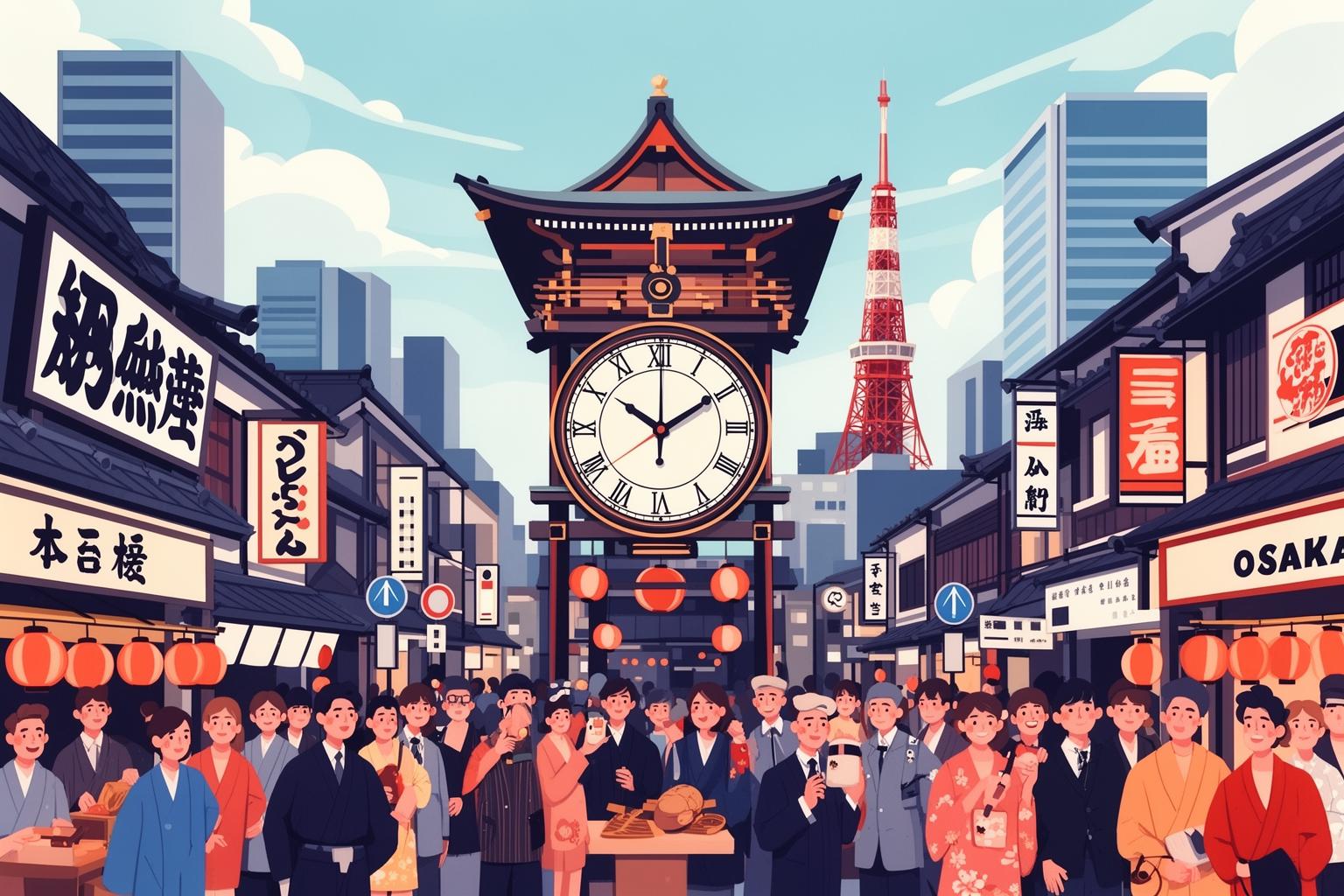
In Osaka, the old merchant adage, “Time is money,” is not just a quaint saying; it’s a fundamental operating principle. This mindset directly influences the city’s approach to digital communication, creating a sharp contrast with the process-oriented culture commonly found in Tokyo. The aim isn’t to execute work elegantly; it’s to complete it efficiently. This is where many foreigners, used to the more nuanced communication styles of their home countries or other regions of Japan, often encounter difficulties.
Kekka ga Subete: The Gospel of the Bottom Line
Central to the Osaka mindset is the phrase kekka ga subete, meaning “results are everything.” For centuries, an Osaka merchant’s reputation relied not on their eloquence but on whether they delivered goods at the right price and on time. This outlook profoundly impacts remote work. While a Tokyo-based company might prioritize a detailed daily report outlining every attempted task, an Osaka manager is more likely to ask, “Did you close the deal? Did you solve the client’s problem?” The process is secondary to the result.
This results-focused approach means digital communication aims squarely at moving the needle. Fluff is eliminated with ruthless efficiency. Take the humble email. A typical business email from Tokyo might be a crafted work of art. It begins with a seasonal greeting, followed by layers of polite pleasantries (osewa ni natte orimasu), a self-effacing introduction, a gentle lead-up to the main point, and a closing filled with warm wishes for continued health and prosperity. This ritual nurtures relationships and shows respect for form.
An Osaka email, however, is a tool. It might read like this:
Subject: Re: Project A Quote
Tanaka-san,
Attached is the revised quote. Please confirm by 3 PM tomorrow.
Yamamoto
That’s it. No flowery language, no apologies for bluntness. To outsiders, it may feel cold or even harsh. But from the Osaka perspective, Yamamoto has given Tanaka the greatest compliment: the respect of not wasting his time. Yamamoto assumes Tanaka is a busy professional who wants only the necessary information as quickly as possible to make a decision. Lengthy pleasantries would be muda—waste. This efficiency is considered the highest form of professional courtesy here.
The Anatomy of a No-Nonsense Message
Let’s examine the elements of Osaka’s digital directness. Whether on Slack, Microsoft Teams, or LINE, communication tends to follow a clear, unwritten code of efficiency. Long, formal paragraphs common elsewhere are replaced by rapid-fire exchanges of practical information. The goal is to mimic the speed and clarity of a market transaction.
The Subject Line as the Entire Message
It’s common to receive an email where the subject line itself conveys the entire message, such as “Meeting tomorrow confirmed for 10 AM” or “Invoice #12345 paid.” The email body is intentionally left blank. Why force someone to open the message when the key information can be delivered instantly? This is peak Osaka efficiency. A Tokyo etiquette coach might recoil at this practice, but here, it’s simply common sense. You’ve received the information. What else do you need?
Action-Oriented Language
Sentences are brief and action-driven. There’s less passive voice and more direct instructions. Instead of “It would be greatly appreciated if the document could be reviewed at your earliest convenience,” you’ll see “Please review the document by Friday.” Ambiguity is eliminated. This isn’t about being bossy; it’s about ensuring clarity. In a fast-moving commercial environment, misunderstandings cost money. The best way to avoid them is to be unmistakably clear about what is needed, from whom, and by when. This system minimizes back-and-forth and gets straight to the action item.
“Honma ni Sore Iru?”: The Great Filter of Necessity
One of the most common phrases you’ll hear in an Osaka office, often muttered quietly during a planning session, is “Honma ni sore iru?” which means, “Do we really need that?” This question serves as the ultimate pragmatic filter, applied to everything from a proposed meeting to a new software tool or an extra column in a spreadsheet. It represents the merchant’s voice from the past, constantly weighing cost versus benefit. Is the effort involved in doing this worth the expected outcome? If the answer is a vague “maybe,” it’s likely to be rejected.
The Meeting That Becomes an Email
This filter is most evident in the attitude toward meetings. Japan as a whole is known for having many meetings, but Osaka has a strong counter-culture. While formal decision-making meetings do occur, there is deep skepticism toward meetings held merely for appearances or vague “discussion.” The question is always, “What is the objective of this meeting, and can it be achieved more quickly by another means?”
This contrasts sharply with Tokyo, where meetings often serve important ritual functions: reinforcing team hierarchy, building consensus through shared experience (nemawashi), and showing that due process is being observed. In Osaka, if the goal is simply sharing information, a group email suffices. If the aim is to get a straightforward “yes” or “no” from three people, a brief group chat on LINE WORKS is much more efficient. A 60-minute meeting to cover what could be handled by a 30-second text is viewed as nearly a criminal waste of resources. Foreigners are often surprised when a scheduled meeting is abruptly canceled with a message like, “Issue resolved via email. Meeting no longer needed.” Don’t take offense—you’ve just regained an hour of your time. This is something to celebrate.
Questioning the Process Itself
This pragmatic filter extends beyond meetings to work processes as well. In many corporate cultures, “the way things are done” can become an unquestioned rule. The Osaka approach is to constantly challenge that rule. “Nande konna mendokusai koto sennna akan no?” —”Why do we have to do it in such a complicated way?”—is a common refrain.
If a workflow requires three levels of approval for a minor decision, someone will inevitably question it. If a reporting template contains redundant fields, it will be challenged. This is not rebellion; it’s about improving efficiency. It’s the spirit of a shopkeeper who changes their store layout overnight after spotting a bottleneck near the cash register. This attitude can be empowering for foreign workers, who are encouraged to share ideas if they find a more efficient approach. Suggesting automation for a tedious task isn’t seen as criticism of the old method but valued as a meaningful contribution to the bottom line.
Embracing Digital Tools
This mindset also shapes how new technology is adopted. While a Tokyo office might implement the latest project management software because it’s the industry standard or looks good in presentations to headquarters, an Osaka team first subjects it to the “honma ni sore iru?” test. Does this tool truly save time? Does it clarify communication? Does it help deliver results faster? Or is it merely another platform to log into, another bundle of notifications to manage?
There is healthy skepticism toward digital fads. A new app is not exciting simply because it’s new; it becomes exciting only if it offers a real benefit. The sales pitch for new software in Osaka should be low on buzzwords and focused on practical use. Show how it reduces a three-step process to one. Demonstrate the return on investment. The merchant needs to see the value before buying in.
Blurring the Lines: When Business Gets Personal, Digitally
One of the greatest paradoxes for foreigners in Osaka is that this highly efficient, no-nonsense digital environment is also unexpectedly informal and, at times, quite personal. The same colleague who sends you a one-word email might soon after flood your LINE with funny stickers and jokes. This isn’t contradictory; it’s simply two sides of the same coin. The aim is always to create the most effective path to a strong working relationship, and sometimes that path requires breaking down formal barriers to connect on a more human level.
From Keigo to Kansai-ben: The Language of Digital Rapport
In standard Japanese business communication, the use of keigo (honorific language) is essential. It’s a complex system that demonstrates respect and maintains social distance. While keigo is indeed used in Osaka, it is often abandoned far more quickly than in other regions of Japan. In digital communication, this shift can happen at remarkable speed.
After a few successful interactions, you might notice your Osaka counterpart switching from formal Japanese to the much more direct and lively local dialect, Kansai-ben (or Osaka-ben). Expressions like “meccha ee yan” (That’s awesome!) or “mōkarimakka?” (Making any money?), a classic merchant greeting, may start appearing in your messages. This is a positive indication—an acknowledgment that you’ve been accepted into the inner circle. They no longer feel the need to keep a formal distance and instead see you as a trusted partner. The most effective way to communicate with a partner is openly and honestly, without the linguistic formality of keigo.
Humor as the Ultimate Social Lubricant
Humor is a core element of Osaka’s identity. As the epicenter of Japanese comedy, its appreciation of laughter deeply influences the business culture. Rather than being suppressed, digital communication has enhanced this. A tense negotiation by email could be lightened by a timely, self-deprecating joke in a follow-up chat. A Slack channel for a high-stakes project will almost certainly feature ongoing jokes.
This isn’t merely about friendliness; it’s a very effective social tool. A shared laugh can build trust faster than numerous formal meetings. It eases tension, softens difficult feedback, and nurtures camaraderie. For Osaka merchants, who have historically depended on relationships and trust, humor serves as a shortcut to establishing that connection. It conveys the message: “We’re serious about achieving results, but let’s not take ourselves too seriously along the way.” Foreigners are encouraged to join in. A little gentle, self-aware humor is often warmly welcomed and can greatly improve working relationships.
The Absence of Digital Tatemae
In Japanese culture, the concepts of honne (true feelings) and tatemae (public façade) are vital. Often, people express tatemae to preserve harmony, even if it contradicts their honne. One might expect digital communication’s anonymity to encourage more tatemae, but in Osaka, the opposite is often true.
The pragmatic mindset leaves little room for the ambiguity tatemae can create. Combined with Osaka’s directness, the digital environment frequently delivers honne straight to your screen. If an idea is bad, you’ll be told so, often bluntly with phrases like “sore wa akan” (that’s no good). This can be startling, seeming to violate the unwritten rule of Japanese harmony. However, it is not intended as a personal attack. It reflects the pure merchant spirit: a bad idea wastes time and money, so the most respectful action is to identify and discard it quickly to move on to better ideas. It’s a harsh but highly effective way of working, sparing you weeks spent pursuing a doomed plan.
The Digital Capital Divide: A Tale of Two Cities
The cultural differences between Osaka and Tokyo spark endless fascination and friendly rivalry within Japan, and these contrasts are most evident in their digital work styles. For any foreigner navigating Japan’s professional landscape, understanding this divide is crucial, as strategies effective in one city may fail in the other.
Formality vs. Functionality: The Fundamental Contrast
At its essence, the difference boils down to this: Tokyo’s digital etiquette mirrors its physical office hierarchy and social customs, whereas Osaka’s reflects the practicality of the marketplace.
In Tokyo, video calls are often treated with the same formality as in-person meetings. Participants are expected to dress professionally, carefully curate their backgrounds, and follow a predictable hierarchical conversational structure. The highest-ranking person speaks first, and juniors wait their turn. The aim is to recreate the office’s order and decorum online.
In Osaka, video calls serve as tools for transactions. The main focus is the quality of the connection and clarity of communication. It’s common for a business owner to take a call from their warehouse with boxes stacked behind them, or for a colleague working from home to appear casually dressed in a t-shirt. Emphasis is placed on the substance of the conversation rather than presentation. As long as participants contribute to the call’s purpose, background and attire are mostly irrelevant. The informal environment underlines the point: the goal is to solve problems, not stage corporate performances.
The Presentation Deck Contrast
This philosophical difference is clearly reflected in the typical PowerPoint or Google Slides presentation. Presentations from Tokyo-based companies are often design masterpieces, with perfectly aligned slides, impeccable corporate branding, harmonious color schemes, and exhaustive data. Such presentations are products in their own right—testaments to the team’s hard work and diligence.
Conversely, Osaka-style presentations tend to be ruthlessly minimalist. They may appear visually unappealing with clashing colors and basic fonts but get straight to the point with remarkable speed. The first slide might be the title, the second the conclusion: “We propose Solution B because it will increase your profit by 15%.” The remaining slides serve as evidence backing the claim. Osaka presenters assume their audience is busy and wants the conclusion first; if convinced, there’s no need to dwell on details, and if not, the data is there for scrutiny. It’s a sales pitch, not an academic dissertation.
Digital Nemawashi: Preparing the Groundwork
Nemawashi is the informal consensus-building process that happens behind the scenes before formal meetings. In Tokyo, it is a delicate, often slow art involving private conversations, carefully crafted emails, and one-on-one calls to gauge opinions and gain key stakeholder buy-in. The aim is to ensure that by the time the meeting occurs, everyone is aligned, avoiding surprises or open conflict.
Osaka’s version of nemawashi is quicker, louder, and more transparent. Rather than a series of private messages, it might be a single group chat post: “I’m thinking of proposing a shift of our marketing budget from X to Y. I believe it will generate better leads. Here’s the data. Any issues?” This invites direct and immediate debate. People are expected to voice objections openly and promptly. Discussions happen in the group forum; once a conclusion is reached, the formal meeting simply ratifies it. The process emphasizes open debate and speed over maintaining surface-level harmony.
A Foreigner’s Field Guide to Osaka Digital Comms
Navigating this distinctive digital environment may seem intimidating initially, but with the right attitude, it can be remarkably freeing. It requires unlearning certain ingrained politeness habits and adopting a new, efficient communication style. Here are some practical suggestions for interacting effectively with your Osakan colleagues.
Appreciate Brevity
Above all, don’t mistake brevity for rudeness. A concise, direct message doesn’t indicate anger or dismissal. On the contrary, it shows respect for your time and intelligence. Your colleague assumes you are busy and capable, and they won’t insult you by dressing a simple request in excessive politeness.
When you get such a message, focus on the main action item. Avoid searching for hidden meanings or emotional undertones—there usually aren’t any. The message is precisely what it seems. Your best reply is equally clear and efficient. Something like “Understood, I will have it done by then” works perfectly. You confirm receipt and understanding, completing the exchange.
Lead with Your Point
When initiating communication, follow the local style. State your purpose in the first sentence. Don’t hide your request at the end of a lengthy email. Think like a journalist and put your main point up front.
Poor: “I hope this email finds you well. I was reviewing the quarterly reports and had a few thoughts about the data from our recent campaign. After looking it over, I was wondering if you might have a moment to send me the raw data for Q3?”
Better: “Could you please send me the raw data for the Q3 campaign? I need it to complete the quarterly analysis. Let me know if you have any questions.”
The second example is straightforward, direct, and immediately communicates what is needed. It respects the recipient’s time by enabling them to understand the request within seconds.
Don’t Hesitate to Ask “Why?”
In many hierarchical cultures, questioning a superior’s process or decision can hinder your career. In Osaka’s pragmatic environment, however, a thoughtful question is often welcomed. If asked to do something inefficient or illogical, it’s perfectly fine to seek clarification, provided you phrase it constructively.
Instead of saying, “This is a waste of time,” try, “I want to make sure I understand the goal. Is there a reason we do it this way? I have an idea that might speed it up.” This shows engagement and concern for the company’s bottom line—the ultimate goal. You’re not challenging authority, but contributing to a shared aim of efficiency and profitability. Often, this proactive stance is appreciated and rewarded.
Adopt the “Akan Mon Wa Akan” Mindset
This phrase, meaning “What’s no good is no good,” exemplifies Osaka’s blunt feedback style. You’ll hear it when an idea is rejected, a product is flawed, or a proposal isn’t financially sound. It’s vital not to take this personally. It’s not a judgment of you as an individual but rather a clear, objective evaluation of a specific idea.
The advantage of this approach is its speed. You quickly learn whether your proposal has potential. There’s no drawn-out, ambiguous “maybe” that leaves you in limbo for weeks. You get a clear “no,” which allows you to shift focus and energy to a more promising solution. Learning to accept this feedback gracefully, and even offer it when appropriate, is an essential skill. It shows you understand that finding the best solution matters more than protecting personal egos.
Beyond the Office: Pragmatism in Daily Digital Life
The merchant spirit extends beyond the office, influencing how people in Osaka engage with technology in their daily lives. From community groups to online shopping, the same values of efficiency, practicality, and straightforward communication prevail.
Community and Social Media
If you join a local Facebook group for your Osaka neighborhood, you’ll witness this pragmatism firsthand. These groups are extremely useful but rarely warm or sentimental. They function as practical information hubs. Someone might post a precise question like, “Does anyone know a 24-hour dry cleaner near Namba station?” and within minutes, they are likely to receive several direct and helpful replies. What you won’t find is much off-topic chatting or prolonged debates. Irrelevant posts are often quickly and bluntly discouraged.
The group’s purpose is clear—to share practical local information—and anything that strays from that is considered noise. It functions more like a digital community bulletin board than a social club.
The Art of Online Shopping
Osakans are well-known for their savvy shopping skills, which carry over into e-commerce. They excel at kosupa (cost performance), making purchases only after thorough research. Reviews are scrutinized not just for star ratings but for detailed feedback on product quality and seller reliability. Price comparison sites are widely used. People don’t hesitate to buy from small, lesser-known online shops if they offer better value than large retailers.
Negotiation is also common, even online. On platforms like Mercari or Rakuma, buyers often message sellers to haggle over prices. The digital marketplace remains a marketplace, and securing a good deal is always worth the effort.
A Healthy Skepticism of Digital Fads
Lastly, there is a clear skepticism toward digital trends that lack obvious, immediate value. While Tokyo embraces the latest social media apps or productivity tools quickly, Osaka tends to wait and observe. The prevailing mindset is, “Prove its usefulness and effectiveness, and then I’ll consider it.” People care less about being early adopters and more about adopting only what genuinely improves upon existing methods.
This practical, outcome-focused approach defines the digital ethos of modern Osaka. It’s a culture that can be blunt, direct, and occasionally intimidating. But beneath that is a deep respect for time, intelligence, and common sense. It’s a place where clarity is valued over ceremony, and results carry more weight than words. Once you understand this mindset, you’ll discover a way of living and working that is not just efficient but refreshingly, powerfully authentic.