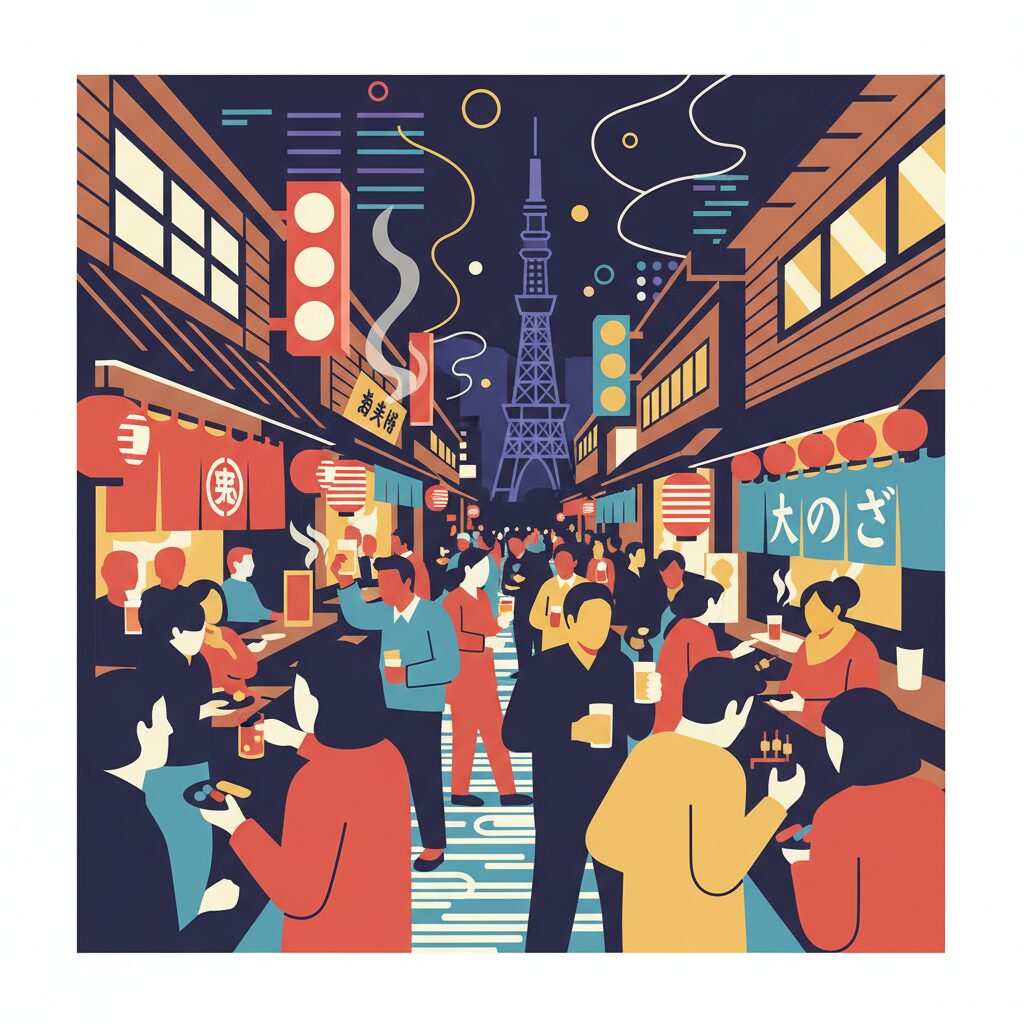
The first time you see it, it’s a sensory puzzle. Tucked under the rumbling train tracks of Kyobashi or spilling out of a Tenma side street, a sliver of light cuts through the evening gloom. Inside, a dense tapestry of human beings, packed shoulder-to-shoulder, wreathed in steam and cigarette smoke. There are no chairs. There is no space. Yet, there is a palpable, buzzing energy. This is the Osaka tachinomi, the stand-and-drink bar, and your first thought might be, “How does anyone even get in? And why would they want to?” This isn’t just a place to grab a cheap beer; it’s a living, breathing institution, a nightly performance of Osaka’s most fundamental social codes. Forget the polite, spacious izakayas you might know from Tokyo. This is something else entirely—more direct, more chaotic, and infinitely more revealing about the city’s true character. To understand the tachinomi is to understand the unspoken rhythm of daily life in Osaka. It’s where the city’s pragmatism, its love of a good deal, and its unique brand of communal intimacy are all distilled into a single, crowded room. Learning to navigate one isn’t just a drinking skill; it’s a crash course in becoming part of the city itself. So, let’s peel back the curtain and decode the beautiful, unwritten rules of this essential Osaka experience.
For a more relaxed and contemplative social space, consider exploring the unique atmosphere of Osaka’s kissaten.
What is a Tachinomi, Really? More Than Just a Standing Bar
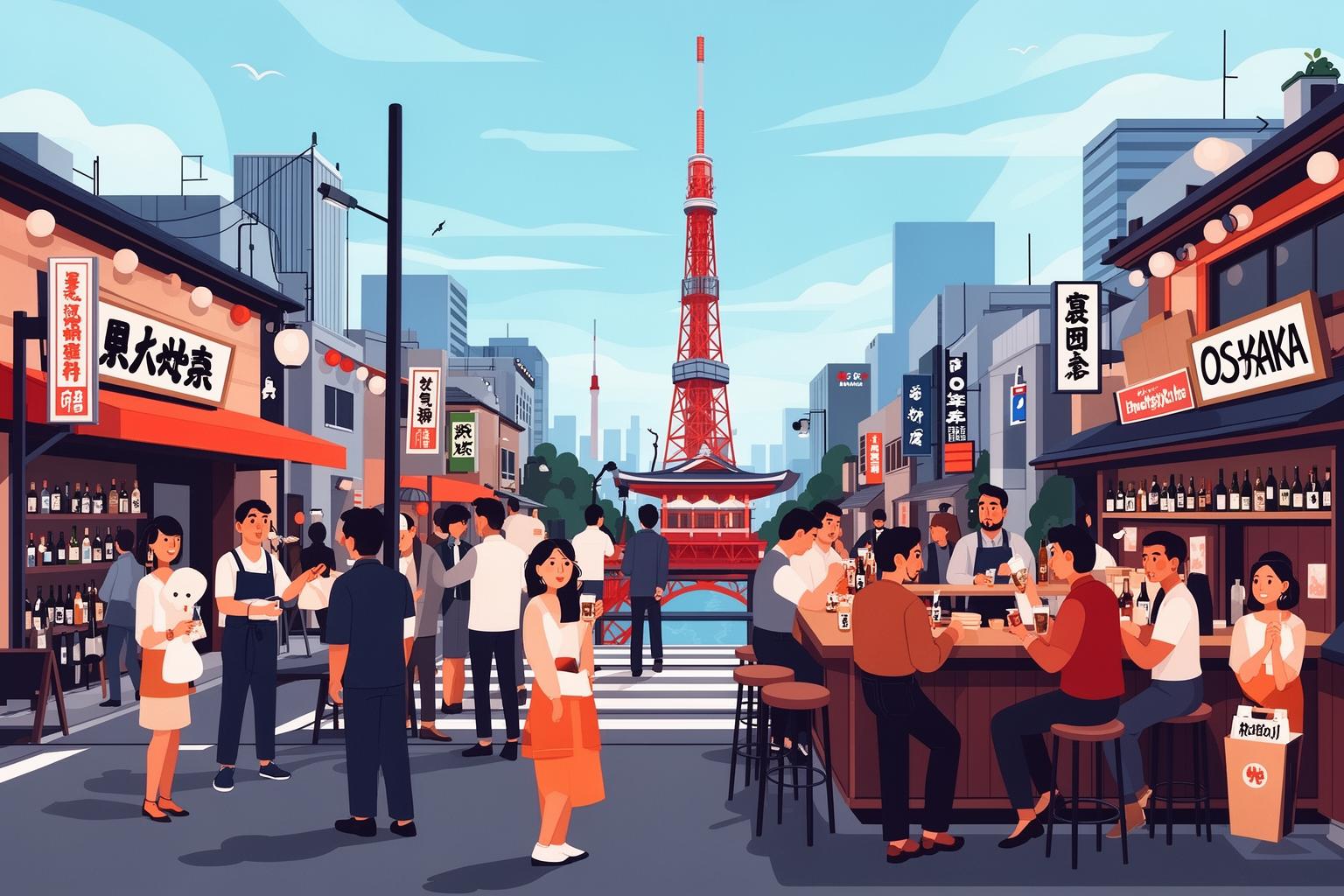
At first glance, the concept appears strikingly simple: a bar with no seats. However, the absence of chairs is not a flaw; it’s the defining feature. It shapes the entire flow and philosophy of the space. A tachinomi is meant for transience, serving as a temporary stop for the city’s workers and residents. It’s a space purpose-built for a specific function, embodying an Osaka mindset that prioritizes efficiency even in leisure. You don’t settle in for the night at a tachinomi; you mark your day with it.
The Philosophy of “Sakutto Nomu” (A Quick Drink)
The core principle of any tachinomi is sakutto nomu, roughly meaning to have a quick, crisp drink. It’s about dropping in, enjoying one or two glasses and a small plate of food, then moving on. You might stop by on your way home from work before facing the family, or pop in for a beer while waiting for a friend. The whole system revolves around this fast turnover. It’s not a setting for long, soul-searching conversations. The standing posture naturally discourages lingering—after some time, your feet get tired. Drinks are affordable, food is served quickly, and payment is often immediate. This reflects a fundamental part of Osaka’s merchant culture: time is money, and efficiency is valued. While a Tokyoite might schedule a drinking session weeks ahead and reserve a private room, an Osakan decides at 6:05 PM to have a beer at 6:10 PM, and the tachinomi is ready to accommodate that spontaneous desire. It’s a social interaction with no commitments, perfectly suited to a city that’s always in motion.
A Democratic Space: Salaryman Meets Artisan
Look inside any typical tachinomi, and you’ll see a snapshot of Osaka society rarely found mingling elsewhere. A salaryman in a sharp suit loosens his tie beside a construction worker in dusty pants. A young couple on a budget shares a plate of fried skewers, while a retired man, the bar’s unofficial mascot, sips shochu and chats with the owner. The lack of seating and the cramped space act as an equalizer. There are no VIP areas, no private booths, no special seating arrangements signaling status. Everyone stands equally at the counter. This physical closeness fosters a sense of casual equality. You find yourself literally rubbing elbows with a wide cross-section of the city. In Tokyo, social circles can be more stratified, with drinking spots catering to specific corporate or social groups. The tachinomi, in its raw simplicity, is a genuinely democratic space. It’s a place where your job title and social rank are left behind, and for a brief half-hour, everyone is just another customer enjoying an inexpensive drink.
The Unspoken Rules of the Tachinomi Universe
Like any finely tuned social ecosystem, the tachinomi functions according to a complex set of unspoken rules. Breaking them won’t get you kicked out, but it will brand you as an outsider. Mastering these rules is essential to unlocking the authentic experience. They all stem from one core principle: communal consideration within a confined space.
Rule #1: Respect Your Personal Space (and Everyone Else’s)
In a room packed to the brim, personal space becomes the most precious currency. The first challenge is to find a spot. You don’t push or shove; instead, you hover politely, waiting for a natural gap as someone leaves. When one opens up, you slide in, making yourself as small as possible. This is called the “Tachinomi Shuffle.” Backpacks are a major no-no; these should be held in front of you or placed by your feet, flush against the counter. Coats are folded neatly. Your entire presence should be compressed into a narrow vertical column. You don’t spread out or save a spot for a friend arriving in twenty minutes. You claim only the space your body occupies. When you need to pass someone to leave, a soft “suimasen” (excuse me) and a slight bow, paired with a sideways shuffle, do the trick. It’s a delicate dance of mutual respect, a constant, subconscious negotiation of territory that lets dozens coexist peacefully in a space built for ten.
Rule #2: The Art of Ordering
Efficiency reigns supreme. Don’t expect a waiter to approach you with a warm towel and a patient smile. The staff—often just the owner (taisho) and maybe one helper—is constantly on the move. Your role is to make their job easier. Know what you want before catching their attention. Make eye contact during a lull, raise your hand slightly, and state your order clearly and concisely. The classic starter is “Toriaezu biru” (Beer for now), buying you time to check the menu on the wall. Payment methods vary. Some places operate on a kyasshu on (cash on delivery) system, where you place money in a small tray on the counter, and the staff takes the exact amount with each order. Others keep a tab, sometimes managed with a traditional abacus. The key is to be prepared. Fumbling for change or staring blankly at the menu while the taisho waits slows down the entire system. This direct, no-nonsense commerce style is quintessentially Osaka—not rude, but respectful of everyone’s time.
Rule #3: The Social Contract: To Chat or Not to Chat?
This is the most subtle rule. Should you talk to strangers? The answer is a cautious maybe. Unlike a quiet Tokyo bar, where unsolicited conversation may be seen as an intrusion, the Osaka tachinomi is more open. The close quarters and shared experience foster an atmosphere where conversation can ignite spontaneously. Often, a shared interest sparks it: the baseball game on the small TV, an unusual dish someone ordered, or a comment about the weather. The owner often acts as the social hub, a master conductor orchestrating light banter. Engaging with them is usually a good way to become part of the room’s social fabric. Osaka’s communication style, known for its humor and light teasing (tsukkomi), thrives here. A stranger might good-naturedly comment on your drink choice—not as an interrogation but as an invitation. A simple smile and brief reply suffice. Yet it’s equally fine to stand quietly, nurse your drink, and simply absorb the atmosphere. The key is to read the room. If your neighbor is deeply focused on their phone or thoughts, respect their space. But if they make eye contact and nod, conversation might be welcomed. The tachinomi offers connection without obligation.
Tachinomi vs. Tokyo’s Izakaya: A Tale of Two Cities
The difference between an Osaka tachinomi and a typical Tokyo izakaya perfectly illustrates the cultural gap between Japan’s two largest cities. It’s a contrast between spontaneity and planning, between lively community and reserved privacy.
Spontaneity vs. Reservation
Life in Osaka often feels more spontaneous and flexible compared to Tokyo, and the drinking culture reflects this. The tachinomi embodies this spirit. It’s a walk-in-only setting where the idea of reserving a spot at a standing bar is unheard of. You go whenever the mood strikes. This stands in sharp contrast to Tokyo’s social scene, which frequently centers around carefully planned group outings. Securing a table at a popular Tokyo izakaya may require booking days or even weeks ahead. The scene is inherently group-oriented, and going alone can sometimes feel isolating. The Osaka tachinomi, on the other hand, caters to individuals, though small groups are also common. This difference reveals a fundamental divergence in social philosophy: Tokyo often values the orchestrated harmony of the group, while Osaka embraces the spontaneous freedom of the individual.
The Price and the Portion: “Senbero” Culture
The concept of senbero—getting pleasantly tipsy for 1,000 yen (about $7-8 USD)—is a point of pride in Osaka. While not unique to the city, it reaches its peak within the tachinomi culture. This isn’t just about being economical; it’s about being savvy. It’s a challenge to see how much enjoyment can be squeezed from a single coin. This mindset traces back to Osaka’s history as a merchant city, where kosupa (cost performance) is the ultimate yardstick of value. Tachinomi menus reflect this philosophy. A beer might cost 300 yen, a plate of grilled chicken skin 150 yen, and a bowl of simmered beef tendon (dote-yaki) 250 yen. Portions are small, encouraging sampling of multiple dishes without overspending. Many Tokyo establishments, by contrast, have higher prices and larger portions intended for sharing among groups who plan to linger. The tachinomi’s economic model relies on volume and speed, delivering maximum value with minimal commitment.
The Sound of the City: Noise Levels and Communication
Step into a classic Osaka tachinomi, and the first thing you notice is the wall of sound. It’s not only music; it’s the roar of conversations, clatter of plates, sizzle of food on the grill, and the boisterous laughter bouncing off tiled walls. Osakans are known for being more direct, expressive, and louder than their Tokyo counterparts, and their bars are an auditory reflection of this. Communication is open and uninhibited. In contrast, many Tokyo izakayas foster a quieter atmosphere. Conversations are kept at a respectful murmur, and loud talking is often viewed as disruptive. This isn’t a judgment on which is superior but highlights a clear difference in the accepted social ambiance. The noise of a tachinomi is not chaos; it’s the sound of a community at ease, a city comfortable with openly expressing itself without pretense.
How to Conquer Your First Tachinomi Like a Local
Armed with this knowledge, you’re ready to take the leap. Your first visit might still feel intimidating, but with a few key strategies, you can approach it with the confidence of a seasoned regular.
Choosing Your Spot: From Rough to Refined
Tachinomi come in many forms. They range across a spectrum. At one end are the old-school, gritty joints beneath train tracks, filled with smoke and grizzled regulars. These spots embody the heart and soul of the culture, but can be overwhelming for newcomers. At the other end, you’ll find a newer wave of more stylish tachinomi, serving craft beer, wine, and gourmet food. These places tend to be brighter, cleaner, and more welcoming to first-timers. For your initial experience, try to find a place that looks lively but not overly packed, perhaps in slightly more modern neighborhoods like Umeda or Namba before moving on to the classic hotspots of Tenma or Kyobashi. A good indicator is a visible menu outside and a clear view inside, so you know what to expect.
Your First Steps
Enter with confidence. Hesitation at the door suggests uncertainty. Look along the counter for an open spot. Found one? Slide in. If it’s crowded, a simple nod to the people you’re squeezing past is polite. Once seated, make eye contact with the staff—no waving or frantic gestures needed. A calm, direct look suffices. The easiest and most common opening phrase in the Japanese drinking scene is your trusty friend: “Nama-biru, kudasai” (A draft beer, please). This marks you as a customer and gives you a moment to relax and take in your surroundings. Observe what the regulars are eating. If something appeals to you, saying “Are, onegaishimasu” (I’ll have that, please) while pointing is perfectly fine and often welcomed. It shows you’re interested and engaged.
The Smooth Departure
One of the greatest charms of tachinomi is how easy it is to leave. There’s no lengthy goodbye routine. When you’re ready, finish your drink, catch the owner’s eye, and say, “Okanjo onegaishimasu” (Check, please). If it’s a cash-on-delivery place, you can simply leave once you’ve paid. Offering a sincere “Gochisousama deshita” (Thank you for the meal/drinks) to the staff as you exit is the polite standard. You slip out with the same quiet grace you used to enter. From arrival to departure, the whole experience can take less than twenty minutes. You arrive unassumingly and leave just the same, a brief participant in the nightly rhythm of the city.
Why It Matters: Tachinomi as the Heart of Osaka
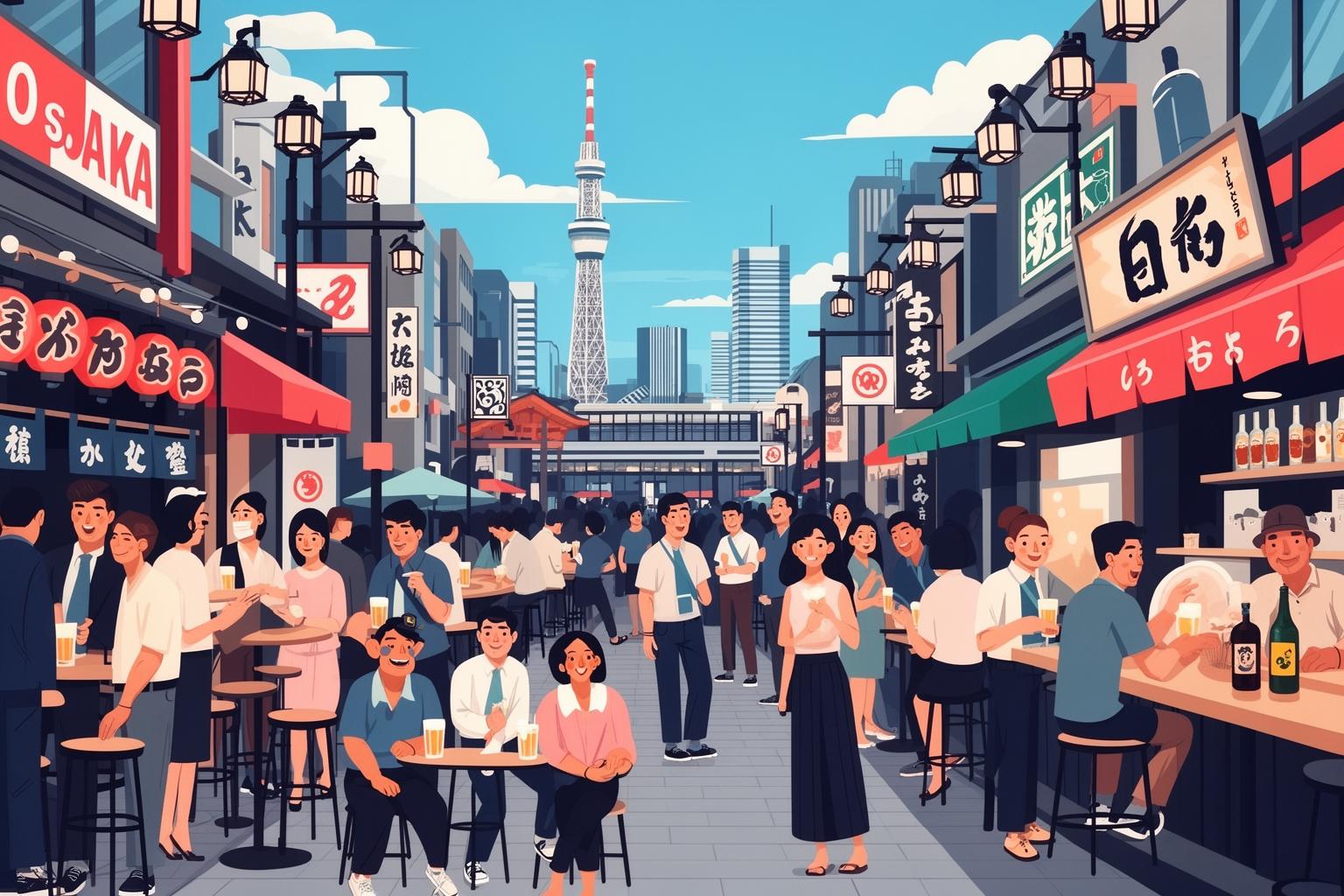
Ultimately, the tachinomi is far more than just a bar. It embodies a microcosm of Osaka itself—a place that honors the city’s cherished values: pragmatism, affordability, straightforwardness, and a rugged, unpretentious sense of community. The unwritten rules of the tachinomi mirror those of navigating everyday life in Osaka. You learn to be mindful of your own space and that of others. You learn to communicate clearly and efficiently. You discover that social barriers can be surprisingly thin if you’re willing to engage. A foreigner who dismisses a tachinomi as merely a crowded, uncomfortable bar is missing the essence. They are perceiving only the surface, not the complex social dynamics operating just beneath. The cliché that “Osaka people are friendly” truly comes to life here. It’s not a warm, hug-you-on-sight friendliness; rather, it’s a practical kind of friendliness, born from sharing a small space and common experience. It’s the gruff nod from the elderly man at the counter, the quick tip from the salaryman beside you, the owner recalling your drink on your second visit. To stand in a tachinomi, to grasp its rhythm and honor its code, is to experience the genuine, unfiltered pulse of Osaka.