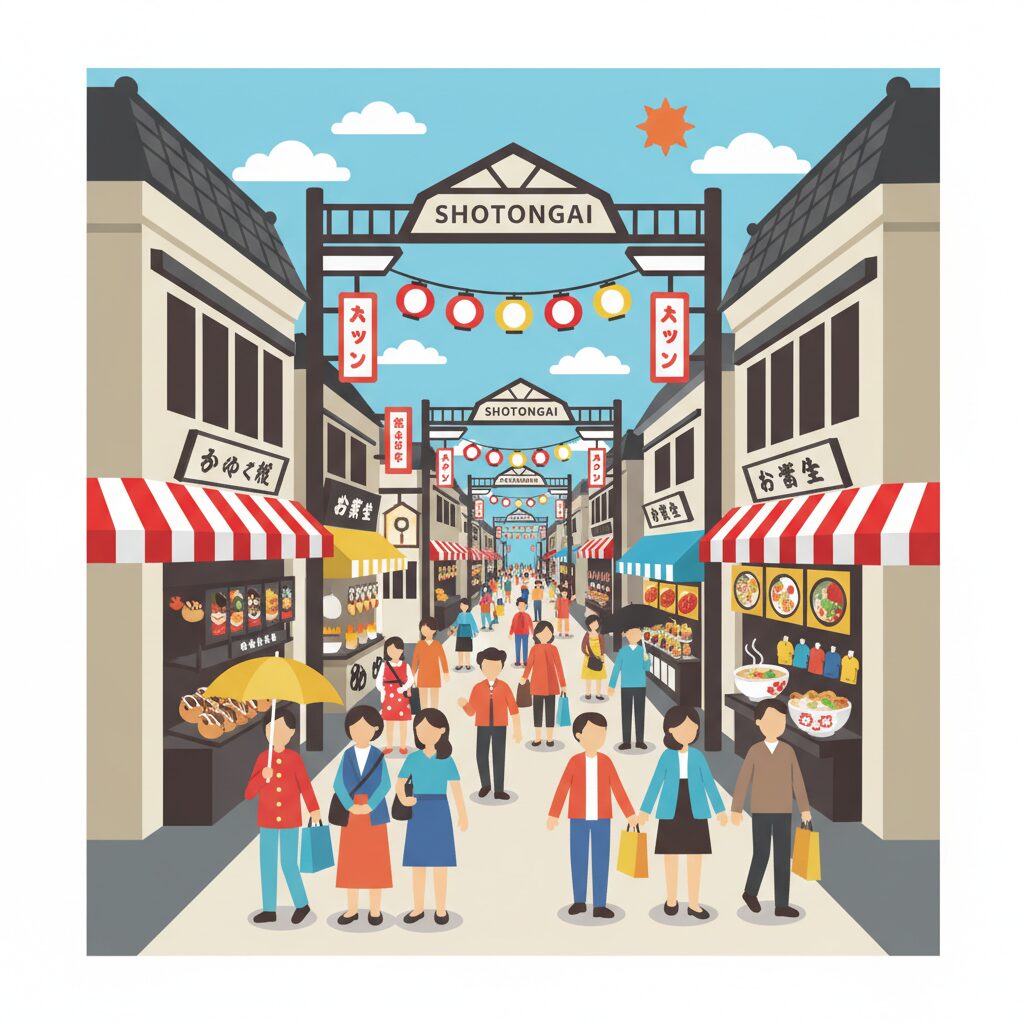
Step off the train in Osaka, and the city hits you with a wall of pure, unadulterated energy. It’s a city of gleaming towers, of neon rivers reflecting in canals, of a relentless forward momentum that feels both exhilarating and overwhelming. This is the Japan of the future, the postcard image sold to the world. But if you want to understand what makes Osaka truly tick, you need to ignore the skyscrapers and look for the low-slung, covered arcades that snake through its residential neighborhoods. You need to get up early and witness the daily ritual of the Shotengai, the local shopping street.
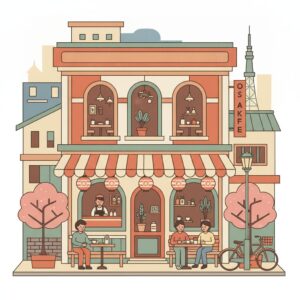
For many foreigners, and even for many Japanese from other regions, these places can seem like relics, charming but anachronistic holdovers from a bygone era. They’re a collection of small, family-run shops—a butcher, a fishmonger, a tofu maker, a pickle stand—all huddled together under a common roof. In an age of pristine, 24-hour convenience stores and hyper-efficient supermarkets where you can buy everything from fresh tuna to toilet paper under one roof, what purpose do they serve? Why would anyone choose this seemingly inefficient, old-fashioned way of shopping? This is the question that unlocks the very soul of Osaka. The Shotengai isn’t a museum piece. It’s the city’s living room, its canteen, and its most honest stage. It’s where the famous Osakan character isn’t just on display; it’s forged, tested, and reinforced every single morning. Forget what you think you know about Japanese politeness and reserved interactions. To understand the rhythm of life here, you have to walk the tiled floors of the Shotengai and listen to its chaotic, beautiful music.
To truly appreciate this dynamic, one must also understand the concept of Osekkai, the friendly meddling that defines daily interactions in these community spaces.
The Symphony of the Morning Rush
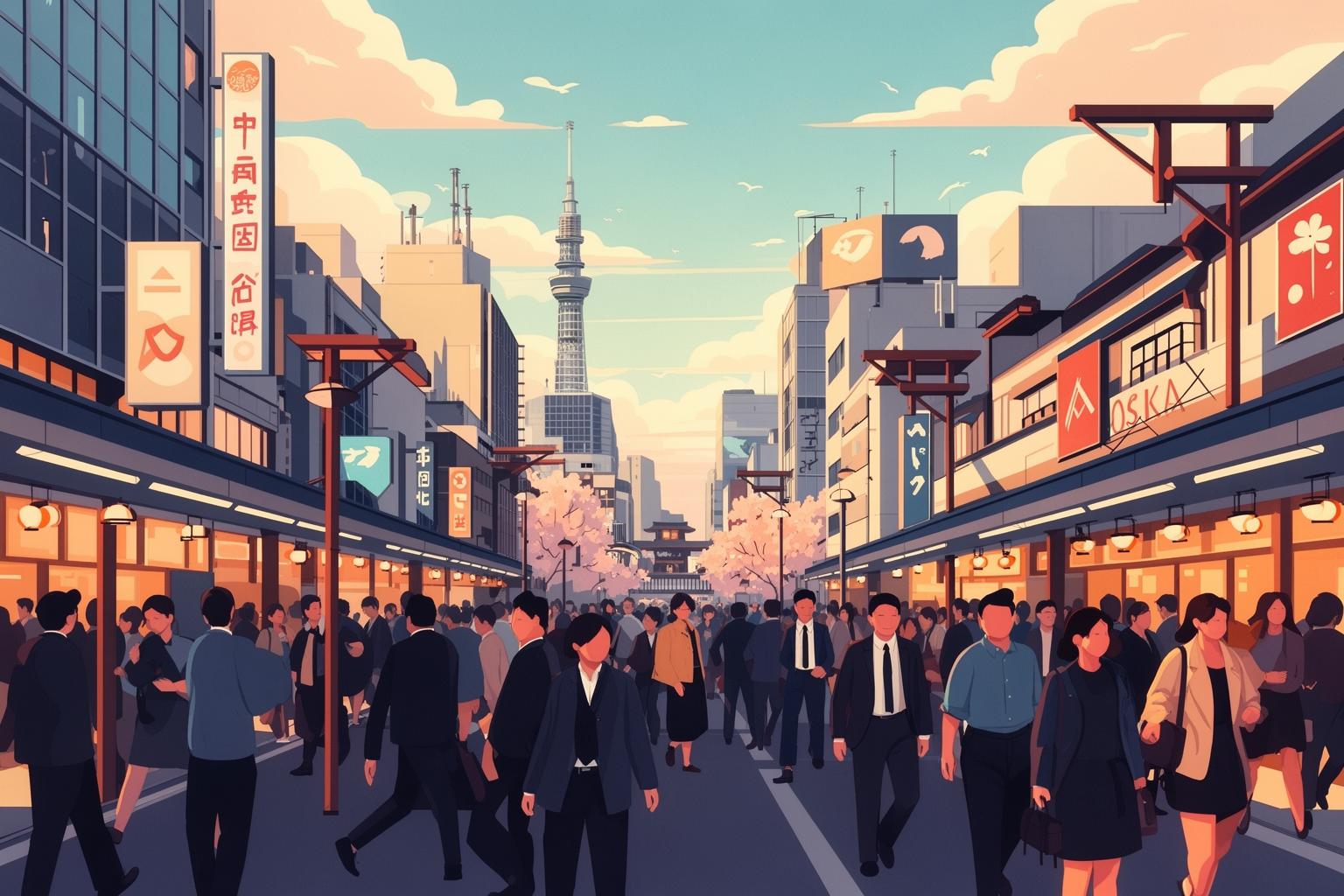
The day at the Shotengai doesn’t begin with a gentle awakening. Instead, it starts with a crash. The staccato clatter of steel shutters being rolled up echoes throughout the arcade, serving as the neighborhood’s alarm clock. This is followed by the rumble of handcarts, the hiss of gas stoves igniting in small eateries, and the splash of water as shopkeepers hose down the pavement outside their stores. The air, which was cool and still moments before, quickly fills with a rich blend of aromas: the sweet, earthy scent of simmering dashi broth, the sharp, briny smell of fishmonger’s ice beds, the yeasty warmth from the local bakery, and the tangy fragrance of a hundred kinds of pickles at the tsukemono stand.
By 9 AM, the scene is fully alive. The main players are the shop owners, experts of their tiny domains. There’s the butcher, a sturdy man with a blood-stained apron and forearms like tree trunks, methodically sharpening his knives. There’s the tofu lady, her hands always damp, carefully arranging blocks of pristine white tofu in a shallow pool of water. And there’s the fruit-and-vegetable vendor, his voice already a booming baritone as he calls out the day’s specials, arranging his produce into a vibrant, edible mosaic. These aren’t anonymous workers; they are proprietors, their family names proudly displayed on the signs above their shops.
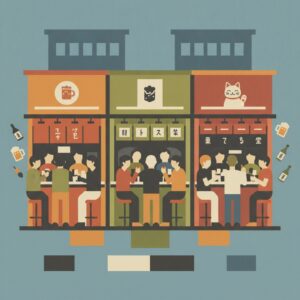
The customers are just as much part of the performance. Elderly women, affectionately called obachan by everyone, navigate the narrow lanes with their pushcarts, moving with practiced efficiency. They are the commanders of their household economies, eyes sharp for the best quality at the fairest prices. Young mothers, with toddlers strapped to their chests or seated on bicycles, weave through the crowd, gathering ingredients for the evening meal. You’ll even spot local chefs, recognizable by their white jackets or clogs, making their daily rounds, personally selecting the fish or vegetables that will appear on their menus that night. This isn’t just shopping; it’s a choreographed dance, a daily ritual of sourcing, socializing, and sustaining the community.
The Unspoken Language of Commerce
If you’ve spent any time in Tokyo, you’re likely familiar with the script of Japanese customer service. It’s a ballet of formal, honorific language, deep bows, and an almost sacred reverence for the customer. Impeccably polite, professional, and often completely impersonal, it creates a certain distance. But the Shotengai in Osaka discards that script entirely and sets it ablaze. Here, the interaction between buyer and seller is not a transaction between a superior (the customer) and a subordinate (the clerk). Instead, it’s a conversation between equals, governed by its own unique, unwritten rules.
The language is direct, quick, and infused with playful, teasing humor that can catch the uninitiated off guard. Point at a fish and ask the seasoned owner, “Is this fresh?” and you won’t receive a polite “Yes, of course, sir.” More likely, you’ll hear a booming, “Of course it’s fresh! I caught it myself this morning! What do you take me for?” This will be followed by a hearty laugh, signaling that you’re part of the game. This isn’t rudeness; it’s quite the opposite. It’s a form of engagement—a sign that the shopkeeper sees you as a person, not just a walking wallet. The banter is the lubricant of commerce.
From this dynamic spring two quintessentially Osakan practices: nebiki and omake. Nebiki is haggling, a concept that makes many foreigners—and even other Japanese—uncomfortable. But in the Shotengai, it’s not about aggressively lowballing. It’s a subtle dance. You might say, “Can you make it an even 500 yen for these three?” The shopkeeper might grimace theatrically, suck air through their teeth, then say, “Alright, for you, just this once.” It’s a performance that strengthens the relationship. Even more common is omake, the art of the freebie. Buy a few apples, and the owner might toss an extra one into your bag with a, “Here’s one for the road.” Purchase some minced meat, and the butcher might add an extra handful, saying, “This is for service.” This isn’t a calculated discount; it’s a gesture of goodwill, a way of saying, “I appreciate your business, come back again.” It transforms a simple purchase into a moment of human connection. In Osaka, value is measured not just by the yen on the price tag, but by the quality of the relationship.
More Than a Market: The Shotengai as a Social Safety Net
To view the Shotengai as simply a collection of shops is to overlook its most vital role. In a country grappling with an aging population and the gradual decline of multi-generational households, the Shotengai often functions as a de facto community center and informal social safety net. It is the original social network—a tangible, analog system for staying connected.
Shopkeepers act as nodes in this network, custodians of local knowledge. They know who just had a baby, whose son is taking university exams, and which elderly resident hasn’t been seen for a day or two. A purchase at the tofu shop is never just about tofu—it’s a check-in. The owner will ask about your family, comment on the weather, and share a tidbit of local gossip. You’ll hear them call out to an elderly woman shuffling by, “Sato-san, you’re looking well today! Don’t forget, it’s supposed to rain this afternoon!” This isn’t small talk; it’s a casual wellness check. It’s a system where people look out for one another—not out of formal obligation, but as a natural byproduct of daily trade.
This is the reality behind the familiar cliché that “Osaka people are friendly.” It’s not an abstract, bubbly friendliness—it’s a practical, grounded, and deeply human sense of mutual reliance. It’s born from centuries of living and working in close quarters, where your reputation and relationships are your most valuable currency. In the anonymous, transient world of a megacity, the Shotengai provides an anchor of stability and belonging. People feel seen. Their presence is noted, and their absence felt. You simply cannot put a price on that kind of community infrastructure.
A Case Study: The Holy Trinity of Daily Staples
To truly understand the Shotengai’s role, consider the process of shopping for a simple evening meal. You don’t go to just one place; you make the rounds, assembling your dinner from a team of trusted specialists.
First, you visit the butcher, the niku-ya. You don’t just grab a pre-packaged tray of mystery meat from a refrigerated case. You approach the counter and have a conversation. “I’m thinking of making tonkatsu tonight.” The butcher, leaning on the glass case, will nod. “Okay. Then you want this pork loin. See the marbling? It’ll be juicy. How thick do you want the slices? Eight millimeters is best. I’ll cut them for you now.” He’s not merely a vendor; he’s a consultant, sharing his expertise to ensure your meal is a success—because your success reflects the quality of his product.
Next, you head to the fishmonger, the sakana-ya. The air is cool and smells of the sea. Whole fish with bright, clear eyes are displayed on beds of crushed ice. The owner, often a man with a booming voice and rubber boots, will notice you browsing. “The horse mackerel (aji) is fantastic today! Just came in from Awaji Island this morning. Perfect for grilling with a bit of salt.” You’re buying more than just fish—you’re buying his professional judgment and a direct link to the day’s catch. He’ll ask if you want it cleaned, scaled, and filleted, and his hands will move with the swift precision of long practice. There’s an implicit trust: he won’t sell you anything less than peak quality.
Finally, you stop at the sozai-ya, the prepared side dish shop. This is perhaps the most essential shop in modern Japanese life. Behind a glass counter are dozens of trays of home-style dishes: simmered pumpkin in dashi, sweet and savory kinpira gobo (braised burdock root and carrot), hijiki seaweed salad, glistening potato salad. Here, you purchase small portions—100 grams of this, 200 grams of that. This isn’t about laziness; it’s smart outsourcing. It enables a busy working parent to provide a varied, nutritious, and traditionally flavored meal without spending hours cooking from scratch. It’s a collaboration between your kitchen and the Shotengai’s kitchen, preserving traditional flavors in a contemporary context.
Why This Model Survives in the 21st Century
Amid intense competition from corporate giants, the resilience of the Shotengai appears almost miraculous. Its endurance is not driven by nostalgia or sentimentality but grounded in practical, hard-headed advantages that perfectly reflect the renowned Osakan pragmatism.
The first advantage is hyper-specialization. Each shop focuses on a single craft, passed down through generations. The rice merchant understands the distinct traits of dozens of rice varieties, while the tea seller can blend leaves to suit your precise taste. This profound, narrow expertise delivers a level of quality and curation that large supermarkets, with their extensive but shallow inventories, can never match. Osakans deeply value honmono—the “real thing”—and know exactly where to find it.
The second advantage is sharp economic insight. Although it may seem counterintuitive, putting together a meal from several specialty shops often costs less and reduces waste compared to a supermarket trip. You purchase only what you need—two slices of pork, one fish fillet, 100 grams of salad—avoiding the overbuying encouraged by giant shopping carts. Osakans are famously value-conscious, sometimes stereotyped as kechi (stingy), but more accurately described as waste-averse. The Shotengai model embodies this mindset perfectly: maximum quality, minimal waste, fair pricing.
Lastly, there’s the focus on human-centered design. The covered arcade offers an all-weather pedestrian haven. It serves as a “third place,” neither home nor work, where people can walk, meet, and connect. Built on a human scale and integrated into local neighborhoods, it eliminates the need for a car—just bring a shopping bag and a willingness to converse. This nurtures a sense of community and physical engagement that sprawling, soulless suburban malls cannot replicate.
Misunderstandings and Realities
To an outsider, the Shotengai can seem confusing. A tourist might regard it as a quaint setting for Instagram photos, a charming yet inefficient relic. Someone new from a more reserved region of Japan might find the constant chatter and direct questions intrusive or even rude. Both perspectives miss the true essence.
The Shotengai is not a living museum. It functions as a highly efficient, decentralized system that serves a dense urban population. What appears as chaos is actually a finely tuned social and economic machine. That “loudness” is not hostility; it is the sound of life, engagement, and a community actively communicating. In Osaka, a silent shop is often a struggling one. The energy, banter, and constant movement are signs of a healthy, functioning ecosystem.
The greatest misunderstanding is interpreting the interactions through a Western or even conventional Japanese view of customer service. The aim is not to simply defer to the customer but to build a relationship. The butcher who jokes about your cooking is also the one who will reserve a special cut for you. The vegetable vendor who asks where you’re from will also teach you how to properly pickle daikon radish. It’s a trade-off: you forsake a degree of formal politeness and anonymity in exchange for expertise, quality, and a sense of belonging.
The Pulse of the City
Ultimately, the Shotengai endures because it perfectly mirrors Osaka itself. It is practical, modest, deeply human, and utterly devoted to good food. It is a place where commerce and community merge seamlessly into one. It stands as proof that efficiency need not be cold, and that the most effective way to build a strong community remains a simple, face-to-face conversation.
So, if you really want to experience the essence of this city, venture beyond the tourist spots. Find a neighborhood Shotengai on a Tuesday morning. Observe the interplay between shoppers and shopkeepers. Buy freshly fried croquettes from the butcher, get a recommendation for a seasonal vegetable, and share a few words with the person behind the counter. You won’t just be purchasing your dinner—you’ll be connecting with the true, persistent, and wonderfully human heartbeat of Osaka.