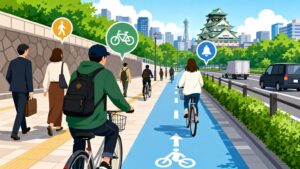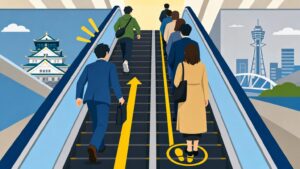
The first thing you notice isn’t the neon signs of Dotonbori or the sheer scale of Umeda Station. It’s the bikes. They’re everywhere, a silent, swirling river of steel and rubber flowing through every artery and capillary of the city. They lean in dense, metallic forests against station railings, they glide past you on crowded sidewalks with inches to spare, and they carry an impossible amount of life—two kids, a week’s worth of groceries, a full bag of nursery school bedding—all balanced with the casual grace of a circus performer. Coming from a world of car-centric suburbs, my first few weeks in Osaka felt like being dropped into a real-life video game where the bicycles were the main characters, and I was just a bewildered non-player character trying not to get in their way. It’s a world away from Tokyo, where life pulses to the metronomic rhythm of the train schedule. Here in Osaka, the city’s heartbeat is the whir of a bicycle chain and the gentle chirin-chirin of a bell. To live here is to cycle. But learning to ride a bike in Osaka isn’t about mastering balance; it’s about mastering a complex, unwritten language of movement, space, and social negotiation. There are the official traffic laws, printed in neat pamphlets at the ward office, and then there are the ‘Osaka Rules,’ the living, breathing code of the street that dictates how this city truly moves. Understanding them is your key to unlocking the rhythm of daily life in this vibrant, pragmatic, and beautifully chaotic place.
Combining the art of Osaka cycling with everyday local discoveries can be as essential as learning shotengai shopping insights to fully embrace the city’s vibrant rhythm.
The Mamachari: Osaka’s Family SUV
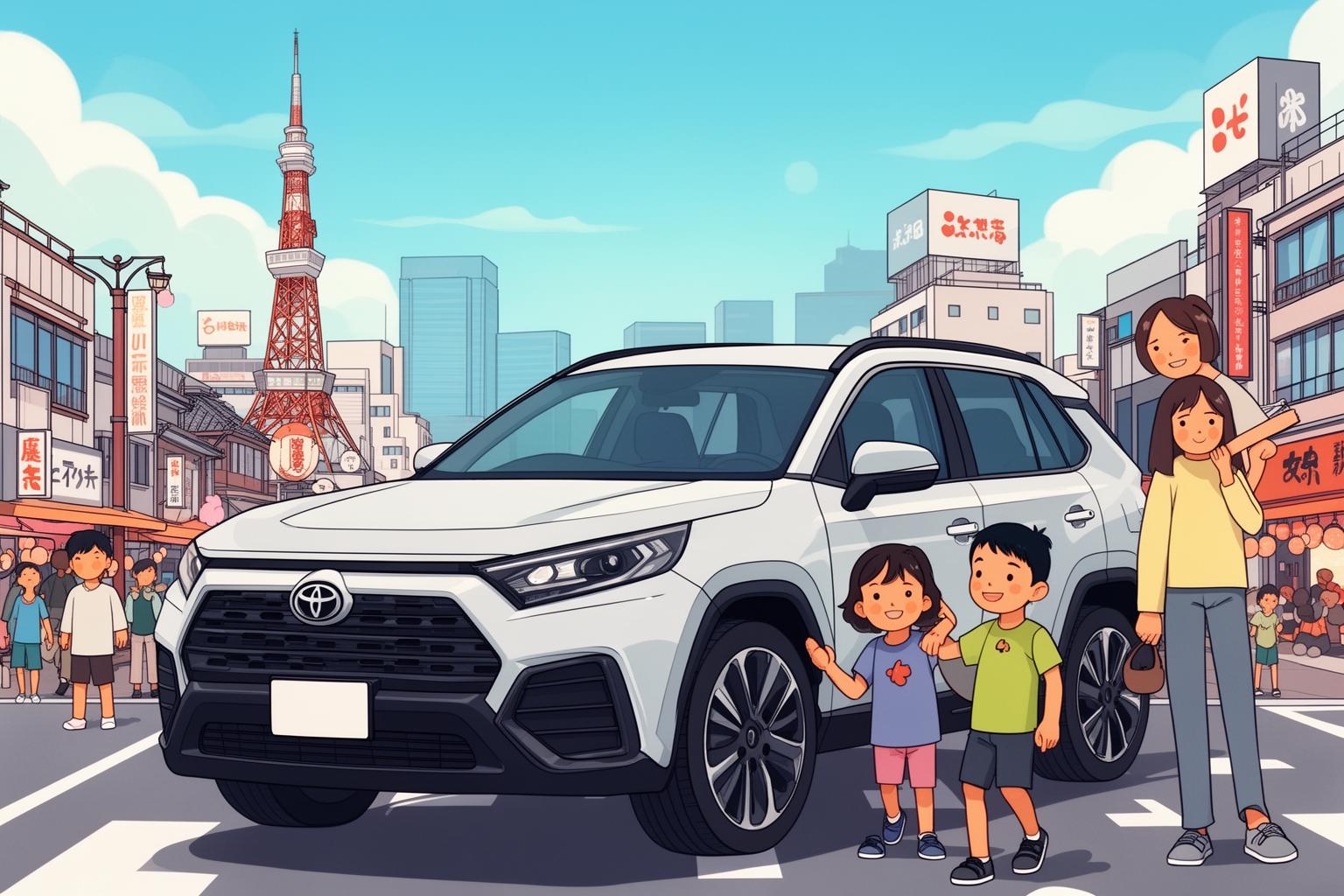
Before you can grasp the rules, you need to first understand the vehicle. Forget sleek road bikes or rugged mountain bikes. The undisputed champion of Osaka’s streets is the mamachari—the “mom’s chariot.” This is more than just a bicycle; it’s a workhorse, a family vehicle, and a mobile command center all in one. Designed for stability rather than speed, the mamachari features a low, step-through frame for easy mounting, even when wearing a skirt. It includes a wide, comfortable saddle, a built-in lock on the rear wheel, a dynamo-powered headlight that automatically turns on at dusk, and a sturdy kickstand that keeps the bike upright and steady when loading a squirming toddler. But its true brilliance lies in its cargo capacity. The front basket is enormous, easily swallowing a load of groceries that would normally require a shopping cart. The real magic, however, happens at the back. A heavy-duty rear rack comes fitted with a securely mounted child seat, complete with leg guards and a harness. For families with two little ones, a second, smaller seat is often placed between the handlebars, safely cradling the younger child between the parent’s arms. In recent years, the electric-assist mamachari has become the gold standard, granting parents the superhuman strength to conquer hills and bridges without breaking a sweat, even with 30 kilograms of children and shopping onboard. Watching an Osaka mother navigate a narrow, bustling shotengai (shopping arcade) on one of these bikes is a lesson in physics and nerve. She glides past vegetable stalls, weaves around elderly shoppers, and comes to a perfect stop—all while carrying on a conversation with the child in the back seat. The mamachari embodies the Osaka spirit: it’s incredibly practical, fiercely efficient, and completely unpretentious. It’s not about style; it’s about getting the job done. It’s the tool that makes the city’s high-density, car-free lifestyle not just possible, but preferable for countless families.
Sidewalks, Streets, and the Unspoken Dance
The single biggest source of confusion and anxiety for any newcomer is the deceptively straightforward question: where am I supposed to ride this thing? Officially, the law classifies bicycles as vehicles, which means they belong on the left side of the road alongside cars. However, some sidewalks are officially designated as bike-friendly. In reality, it’s a fluid, ongoing negotiation between both options, guided not by signs but by a shared, intuitive sense of flow.
The Sidewalk Shuffle
In most residential neighborhoods and along many main roads, the sidewalk effectively serves as the bike lane. This isn’t the aggressive, bell-ringing entitlement seen in some other countries; rather, it’s a delicate dance of shared space. The fundamental, non-negotiable rule is that pedestrians have priority. As a cyclist, you are a guest in their domain. You must reduce your speed to a walking pace, especially when the sidewalk is crowded. You need to anticipate the unpredictable movements of children, the slow, steady progress of elderly people, and the sudden stops of those engrossed in their phones. The bicycle bell is used sparingly: a single, gentle chirin is a polite “excuse me, I’m behind you.” Repeated frantic, angry ringing signals inexperience or a lack of understanding of this shared space. The aim is to weave and flow around people, like water moving around stones in a stream. You develop an almost instinctive sense for gaps and a peripheral awareness that tracks every pedestrian, stroller, and shopping cart nearby. It’s a system built on high trust that can feel intimidating at first, but it works because everyone operates from the same mutual understanding.
When the Street is the Stage
When do you ride on the street? You take to the road when the sidewalk is too crowded to navigate safely or politely. You ride on the road when no sidewalk exists. You also ride on the street on wider roads where you can maintain pace with slower traffic. This demands a different kind of confidence. You keep close to the left side, making your movements predictable to cars, buses, and trucks, all of which are surprisingly accustomed to sharing the lane. Osaka drivers may have a reputation for assertiveness, but they are also highly skilled at coexisting with the city’s abundant bicycles. They give you space, anticipate your moves, and recognize that you are part of the traffic ecosystem. The real skill lies in mastering the transition—knowing when to smoothly mount the sidewalk at a dropped curb, or when to merge back into the road to avoid a heavily congested stretch of pavement. It’s a constant, subconscious balancing act of risk, efficiency, and courtesy. This pragmatic approach is quintessentially Osaka. It’s not about abstract rulebooks; it’s about what makes the most sense and creates the least disruption (meiwaku) for everyone, right here and now.
The Art of Parking: Organized Chaos
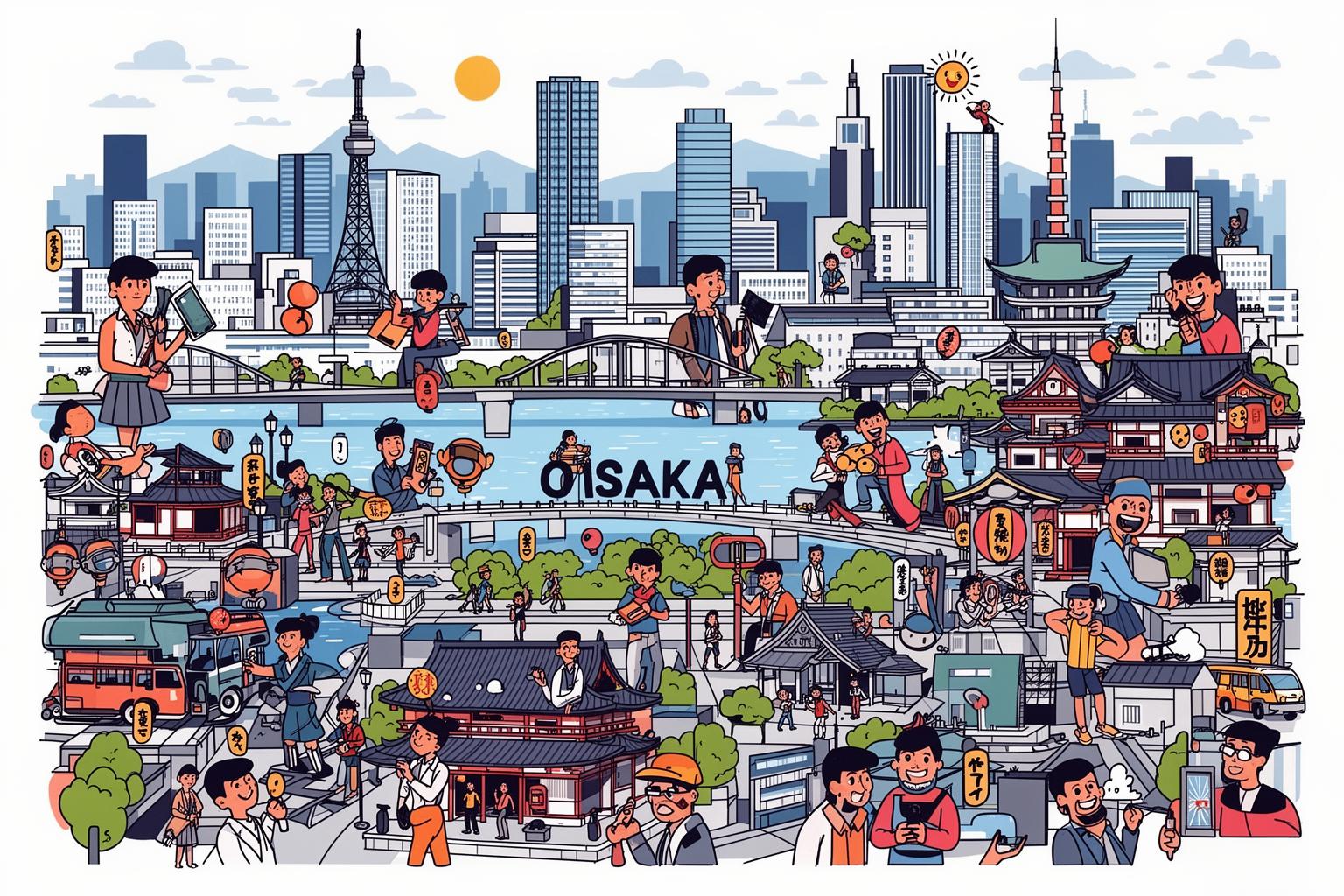
If riding a bike is a dance, then finding a parking spot is a high-stakes game of Tetris. The sheer number of bicycles makes parking a constant challenge, with the city balancing delicately between official solutions and unspoken, community-enforced rules.
Official Parking (Churinjo)
Near every train station, major supermarket, and public facility, you’ll find designated bicycle parking lots called churinjo. These range from simple open-air lots with metal racks to futuristic, multi-story automated garages that store your bike in an underground silo. Many offer free parking for the first hour or two, then charge a small fee (usually around 100-150 yen) for the rest of the day. Monthly passes provide commuters with a guaranteed spot and peace of mind. Using these official lots is the safest and most hassle-free option: your bike is secure, you’re not causing obstruction, and you’re following the rules. This system represents the city’s official effort to manage the bicycle overflow, and for the most part, it’s a reliable and widely used solution.
The ‘Gray Zone’ Parking Method
Then there’s the reality. For a quick ten-minute stop at the bakery or a dash into the post office, no one wants to go through the hassle of registering their bike in an official churinjo. This is where the ‘gray zone’ comes in. Bikes are often lined up neatly against building walls, tucked into alleyways, or clustered near shop entrances. This isn’t random—there’s an unspoken code to follow. You must avoid blocking store entrances, keep tactile paving for the visually impaired clear, and park parallel to the wall to take up as little sidewalk space as possible. Essentially, you’re betting you’ll return before your bike causes trouble or draws unwanted attention. The risk is real. City contractors periodically drive around in silver trucks, efficiently rounding up illegally parked bicycles by cutting cheap locks and loading dozens of them in minutes. They leave a small laminated notice on the ground telling owners where to find their impounded bikes. Retrieving a bike means a trip to a distant lot and paying a fine of several thousand yen. Every long-term resident has a story about the silver truck, yet people continue to park in the gray zone daily. It’s a calculated risk—a classic example of the Osaka mindset: “If I’m not really bothering anyone and I’m quick about it, it should be fine.”
Osaka vs. Tokyo: The Bicycle Culture Clash
The contrast between Osaka and Tokyo is most evident when seen on two wheels. In Tokyo, there is a stronger sense of order and a stricter adherence to the law. More cyclists stick closely to the road, and more adults wear helmets. Riding on the sidewalk feels more rebellious and likely to attract disapproving looks. The city’s energy is funneled through its world-class train system, and while many own bikes, they often serve as a complement to the main transport network. In Osaka, the bicycle is the primary mode of local transport. The approach is grassroots, organic, and occasionally chaotic. Rules are treated as flexible guidelines, interpreted with common sense and situational awareness. An Osakan cyclist resembles a jazz musician, improvising through the urban landscape and responding dynamically to others. A Tokyo cyclist is more like a classical musician in a large orchestra, playing their part exactly as written. Neither style is inherently superior, but they reflect two very different attitudes toward public space and social order. The Tokyo way reduces ambiguity; the Osaka way requires constant engagement and social intelligence.
Essential Gear and Unwritten Etiquette
To thrive as a cyclist in Osaka, you must embrace a few essential pieces of gear and adopt the subtle etiquette that prevents the entire system from falling apart.
Rain, Umbrellas, and the ‘Sasube’
It will rain—often. You might assume this would discourage cycling, but you’d be mistaken. Instead, you’ll witness an impressive display of skill: cyclists riding with one hand while holding a full-sized umbrella in the other. For those who prefer to keep both hands on the handlebars, there’s the sasube—an ingenious and somewhat quirky device that clamps onto your handlebars and holds your umbrella, creating a mobile, personal canopy. Is it legal? Technically, no. Authorities advise wearing a raincoat instead. Is it widely accepted and used? Absolutely. The sasube exemplifies Osaka pragmatism—a clever, homegrown solution to a common problem.
Lights, Locks, and Registration
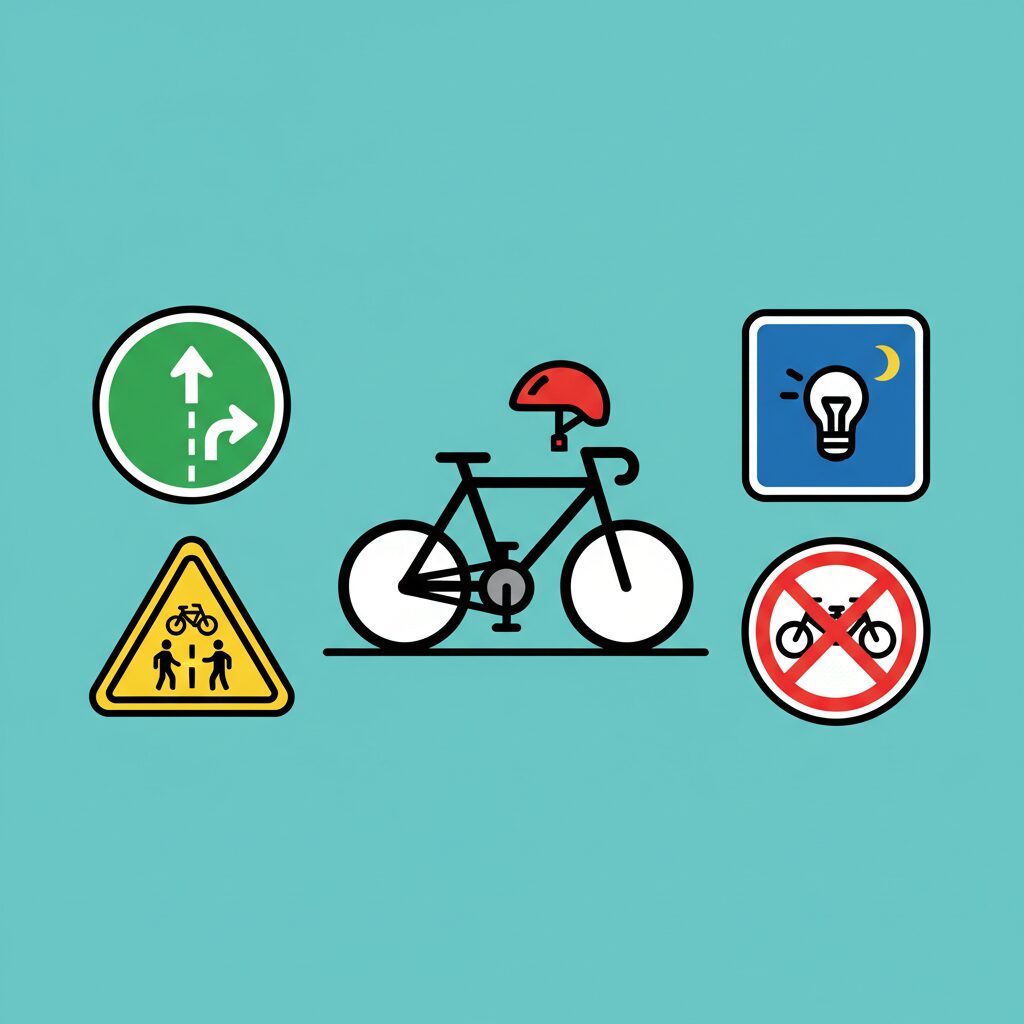
While some rules are flexible, others are strict. When you buy a bicycle in Japan, you are legally required to complete a bouhan touroku, or anti-theft registration. The bike shop typically handles this for a small fee and places a sticker with a registration number on your frame. Police can and do stop cyclists to verify this, so it is non-negotiable. At night, using a front light is mandatory and one of the most common reasons for being stopped by police—it’s a simple yet crucial safety measure. Lastly, always lock your bike. Although Japan is generally safe, bicycle theft is common. The built-in wheel lock on a mamachari deters quick thefts, but for longer periods, securing the frame to an immovable object with a heavy-duty chain or U-lock is essential. Batteries from electric-assist bikes are also a prime target, so many riders take them along when parking for extended times.
The Nod, The Weave, The Apology
Beyond equipment, the most important tools are social. It’s the slight nod to a pedestrian who steps aside to let you pass. It’s the quick, soft “sumimasen” (excuse me) when you misjudge a gap and get too close. It’s reading the body language of the cyclist ahead to anticipate their next move. It’s the shared understanding that everyone is navigating this crowded space together. This subtle social grace is the invisible lubricant that keeps the city’s gears turning smoothly. Without it, chaos and frustration would take over. With it, the system becomes a chaotic yet oddly beautiful urban ballet.
Why It Works: The Mindset Behind the Madness
So why doesn’t this seemingly chaotic environment lead to constant collisions and conflicts? Because it’s not chaotic at all. It’s a highly refined system based on immense personal responsibility (jiko sekinin) and shared spatial awareness. In a city shaped by merchants and traders, efficiency and practicality are paramount. The aim is to get from A to B, with your children and groceries, with minimal fuss. The unwritten rules of cycling perfectly reflect the broader Osaka character: straightforward, resourceful, somewhat impatient with unnecessary formalities, and naturally skilled at reading situations and choosing the most logical path forward. Mastering the ‘Osaka Rules’ of cycling means more than just navigating the city; it means learning its native language, sensing its rhythm, and moving in harmony with its wonderfully practical, human-powered spirit. The moment you find yourself effortlessly weaving through a crowded sidewalk, offering a subtle nod to a grandmother who has paused for you, while calmly assessing the risk of parking in a ‘gray zone’ for just five minutes, is when you can truly say you’re beginning to understand life in Osaka.