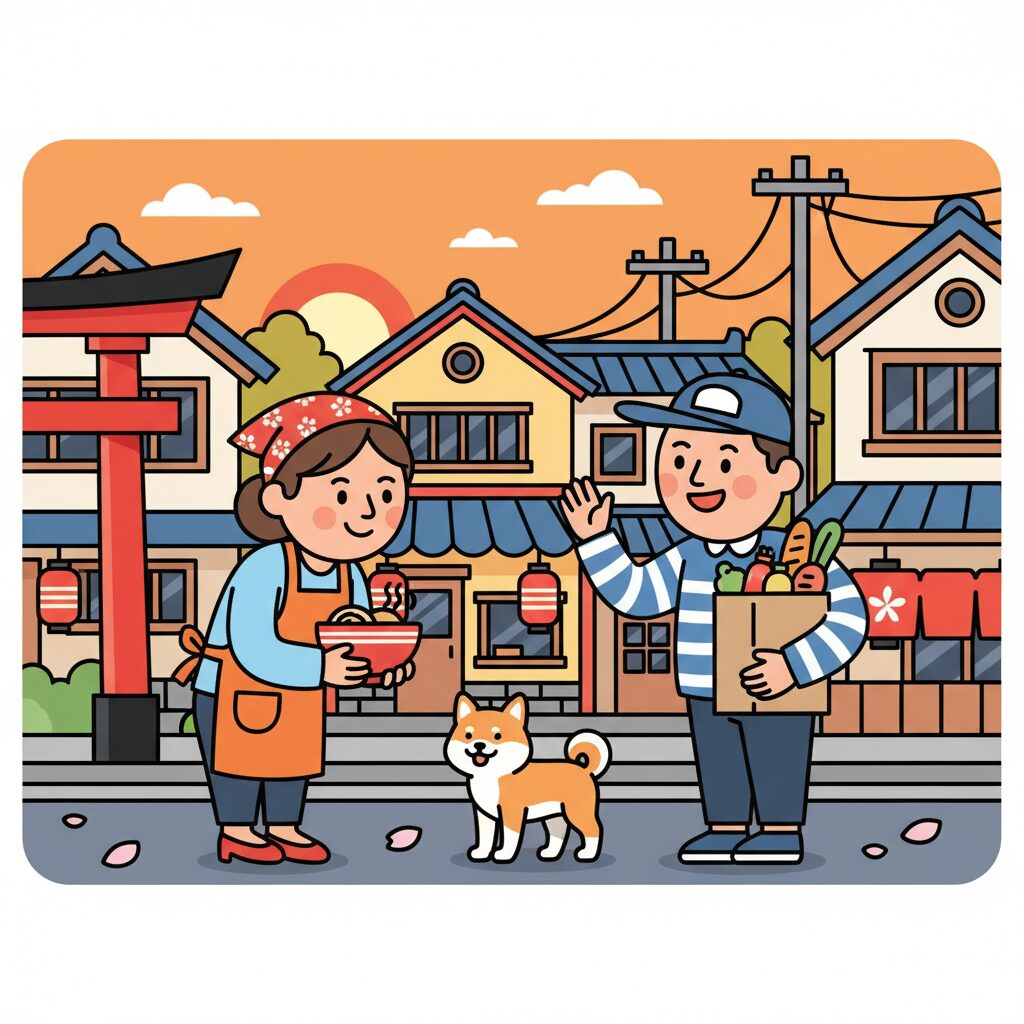
You learned it in your first Japanese class. You practiced it on the plane. “Konnichiwa.” The universal, fits-all-situations Japanese greeting. You arrive in your new neighborhood in Osaka, ready to deploy it. You see your neighbor watering her plants. You give a polite bow and a clear, friendly “Konnichiwa!” She smiles, nods, and replies with something that sounds like, “Ah, ma, atsui na~.” Wait. That wasn’t in the textbook. Later, you pass a man walking his Shiba Inu. You try again. “Konnichiwa.” He gives you a quick grin and says, “Maido.” Maido? Isn’t that what the takoyaki guy says? You start to notice it everywhere. The greetings are shorter, more varied, and seem to be about anything but a formal hello. This isn’t a failure of your Japanese skills. It’s your official welcome to the subtle, unwritten, and deeply human world of neighborhood communication in Osaka. Forget the rigid phrases you memorized. Here, greetings are less about formality and more about rhythm, a shared acknowledgment of the moment that stitches the community together, one brief encounter at a time. It’s a language spoken in nods, weather complaints, and playful jabs, and understanding it is the key to feeling less like a visitor and more like you actually belong here.
Embrace the intricacies of Osaka’s community vibe by exploring Osekkai insights, which uncover the unexpected kindness woven into everyday interactions.
The Morning Ritual: More Than Just ‘Ohayo’
The day in any Japanese city begins with “Ohayo gozaimasu.” It’s crisp, polite, and standard. In a Tokyo office building, you’ll hear it delivered with clockwork precision. But on a residential street in Osaka at 7:30 AM, the atmosphere is different. The air is filled with the sounds of shutters rolling up, bikes being unlocked, and bottles clinking at the recycling collection point. Here, the full “Ohayo gozaimasu” is often saved for first meetings or more formal encounters. Between neighbors, what you’ll actually hear is a clipped, almost mumbled “Ohayo-san,” or just a quick “Ohayo” accompanied by a sharp nod. The gesture does half the work. It’s an efficient, low-energy acknowledgment that means, “I see you. We’re both starting our day. Let’s get on with it.”
But the real Osaka character shows in the follow-up. As you walk toward the station, a neighbor walking their dog might catch your eye and, after the initial nod, ask, “Docchi iku no?” or “Odekake desu ka?” Both translate to “Where are you heading?” To a foreigner, this can feel quite forward, almost intrusive. My first few times, I felt a sudden panic, like I had to explain my whereabouts. Was I expected to disclose my entire schedule? The answer is a clear no. This question isn’t an interrogation; it’s a conversational gesture. It’s the Osaka way of extending the greeting a moment longer, reinforcing the shared context of the neighborhood. You both live here. You’re both headed somewhere. The question simply acknowledges this common reality.
The expected reply is deliberately vague. “Chotto soko made” (Just over there) is the ideal all-purpose answer. It’s friendly, non-committal, and keeps the exchange flowing smoothly. You can add detail if you wish—“Eki no ho e” (Towards the station)—but it’s not necessary. The point isn’t the factual exchange; it’s the ritual of checking in. This small verbal dance subtly affirms community. It contrasts with Tokyo, where neighbors in a sprawling apartment complex might live side by side for years and never exchange more than a silent bow in an elevator. In Osaka, your daily movements, even simply leaving your home, are part of the neighborhood’s living fabric, and people will gently, casually acknowledge your thread in it.
The Afternoon Encounter: The ‘Weather’ Opener and Its Variations
As the day progresses, “Konnichiwa” becomes technically appropriate, but within the close confines of a neighborhood, it can come across as oddly formal. You’ve already seen these people earlier in the morning. A formal greeting feels repetitive. So, what takes its place? The most effective tool in the Osakan small talk toolkit: the weather. Complaining about, or occasionally complimenting, the weather serves as the ultimate social lubricant. It’s a universally shared experience that requires no personal revelation and invites easy agreement.
The classic phrase is, “Atsui desu na~” (It’s hot, isn’t it?). The trailing “na~” is essential. It’s not a mere statement of fact; it’s an invitation to agree. The proper response is a wholehearted agreement: “Honma ni, iya ni naru wa” (It really is, it makes you sick of it). This shared complaint, this mutual recognition of suffering under the oppressive humidity, creates a small but fleeting bond. You’ve just affirmed that you are both humans enduring the same reality. The same applies to any weather condition. “Yoku furimasu na~” (It’s raining a lot, huh?). “Samu narimashita ne~” (It’s gotten cold, hasn’t it?).
This might appear to be trivial chatter, but it serves an important social purpose. It’s a low-pressure way to maintain social connections throughout the day. In Tokyo, you might simply offer a silent nod or a quiet “Domo” (a versatile short-form for ‘thanks’ or ‘hello’) when passing a neighbor in the afternoon. The interaction is often more reserved, prioritizing personal space over social engagement. The Osaka style, in contrast, actively seeks a moment of shared understanding. It assumes a baseline connection that can be activated through a simple, shared observation. This is what makes the city feel less anonymous. You’re not merely a person walking down the street; you’re another soul facing the same heat, the same rain, the same biting winter wind. And within this shared experience, there is a subtle warmth, even when you’re complaining about being cold.
The ‘Otsukare-sama’ Spectrum: Beyond the Office
Every Japanese learner is taught that “Otsukare-sama desu” is what you say to colleagues at work. It roughly translates to “Thank you for your hard work” or “You must be tired.” This phrase is deeply ingrained in Japanese work culture. However, in Osaka, it transcends the workplace and becomes a versatile expression for neighborhood communication, serving as a way to acknowledge the effort and labor of everyday life.
Gokuro-san: The Casual ‘You’re Working Hard’
You’ll often hear a variation, “Gokuro-san” or “Gokuro-sama,” used when addressing people providing services within the neighborhood. When the mail carrier delivers a package, an older resident might call out as they leave, “Maido, gokuro-san!” Here, “Maido” means “as always,” and “gokuro-san” recognizes their effort. The same applies to delivery drivers from Co-op, city workers repairing potholes, or gas company employees conducting safety checks. While in other parts of Japan this phrase can sometimes imply a superior speaking to a subordinate, in the egalitarian atmosphere of an Osaka neighborhood, it is a general, respectful acknowledgment of someone’s work. It expresses, “I see your effort for the community, and I appreciate it.” This vocal recognition of everyday labor helps foster mutual respect and interdependence.
The Neighborly “Otsukare-san”
The phrase also adjusts for peer-to-peer interactions. If you see a neighbor arriving home in the evening, looking tired from their commute, a simple “Otsukare-sama” conveys empathy. It’s a greeting meaning, “I see you. Welcome back. You’ve had a long day.” It feels much more personal and connecting than a mere “Konbanwa” (Good evening). It’s also used to acknowledge physical effort. Spot someone struggling with heavy grocery bags? “Otsukare-sama desu.” Notice a neighbor finishing intense gardening? “Otsukare-san.” This usage recognizes that life itself involves labor. Running errands, commuting, maintaining a home—it all requires effort. Saying “otsukare” aloud validates that effort in another person. Though small, it contributes to a sense that people don’t just live in isolated spaces but form an ecosystem where daily struggles and successes are noticed and appreciated. This continual, gentle expression of empathy helps make daily life in Osaka feel more connected than in many more anonymous cities around the world.
Decoding the Small Talk: The Art of the ‘Tsukkomi’
If weather complaints form the basis of Osaka small talk, then the playful exchange of boke and tsukkomi is the intricate structure built on top. This dynamic lies at the core of Osaka’s communication style, derived from the city’s renowned manzai comedy tradition. The boke plays the fool, making silly or absurd remarks, while the tsukkomi acts as the straight man, promptly pointing out the absurdity with a sharp, witty comeback. In everyday conversation, this isn’t a staged act but a fast-paced, lighthearted way of engaging that values humor and connection over literal meaning.
The Grocery Store Banter
Imagine this: you’re at the neighborhood supermarket, purchasing ten blocks of tofu because they’re on sale. The cashier, an obachan (a middle-aged or older woman) with a constant sparkle in her eyes, starts scanning your items. A typical Tokyo interaction would be quietly efficient. The Osaka style? She might glance at your pile of tofu, then back at you, deadpan, “Anata, o-tofu-ya-san demo hajimen no?” (What, are you opening a tofu shop?). This is the boke. She has created an absurd scenario. Your role is to respond with the tsukkomi. A poor reply is to be defensive or literal: “No, they were on sale.” A good one is to retort with a smile, “Sou nen! Moukarimasse!” (That’s right! Business is booming!). Although this exchange adds no efficiency to the transaction, it accomplishes everything in terms of human connection. It transforms a mundane interaction into a shared moment of lightheartedness. This playful teasing signifies affection; it’s a way of saying, “I’m comfortable enough with you to joke around.”
Responding to a Compliment
The boke-tsukkomi interaction also sheds light on the local way of handling compliments. In many cultures, the appropriate reply to “I love your sweater!” is simply “Thank you.” In Osaka, that can feel like a conversational dead end. Instead, a self-deprecating or humorous deflection is often favored. You might say, “Sono se-ta- eえ na” (That’s a nice sweater). The reply could be, “E, honma? Uniqlo de 990-en yatta de” (Oh, really? It was 990 yen at Uniqlo). This isn’t false modesty; it’s a way to deflect attention and keep the conversation flowing. By revealing the sweater’s modest origin, they’re essentially making themselves the boke, inviting you to respond with the tsukkomi: “Uso ya! Jozu ni kiyoru na~” (No way! You wear it so well, it looks expensive!). The exchange becomes a lively back-and-forth rather than a simple compliment and acceptance. Understanding this rhythm is essential. It’s not about dishonesty or difficulty accepting praise; it’s about engaging in a more playful, interactive, and collaborative style of communication.
The Misunderstanding: Friendliness vs. Intrusiveness
This is where many foreigners often stumble. The casual questions about your destination, the remarks on your groceries, the unsolicited advice from the woman at the fruit stand—is it friendliness or just plain nosiness? From a Western viewpoint, where personal privacy and individualism are highly prized, this kind of casual inquiry from near-strangers can seem like an intrusion on personal boundaries. Even compared to Tokyo, where greater social distance is typical, Osaka’s neighborhood chatter can be surprising.
It’s important to grasp the cultural context behind it. This way of communicating comes from a mindset in which the community is viewed as a shared space, almost like an extension of one’s own home. People’s lives are more visibly connected. The question “Where are you going?” isn’t about tracking your movements; it reflects a shared sense of place. The comment “You bought a lot of beer!” isn’t a judgment of your drinking habits; it’s a lighthearted observation of a fellow human participating in life’s moments. It’s essentially saying, “Ah, he’s stocking up for the weekend, just like I might.” It’s relational, not informational. The intention is to establish a connection, however brief.
The practical advice for handling this is to adjust your expectations. Don’t take these questions literally. You are almost never expected to give a detailed, factual answer. The social ritual is completed simply by responding warmly and vaguely. “Where are you off to?” can always be answered with “Just out for a bit.” “What are you cooking tonight?” can be met with a laugh and “Something easy!” The person asking rarely cares about the actual details. They are opening a door for a brief interaction to acknowledge that you are both present and part of the same local community. Once you see it as a low-cost, high-reward gesture of community bonding rather than an intrusive personal query, the entire social landscape of Osaka becomes less intimidating and much, much warmer.
The Farewell: Not Just ‘Sayonara’
Just as greetings are nuanced, so too are farewells. The word “Sayonara” is rarely used in casual, everyday conversation. It carries a heavy sense of finality, similar to “farewell,” and is reserved for moments when you don’t expect to see someone for a very long time, if ever. For everyday neighborhood goodbyes, a completely different, much warmer set of expressions is used.
“Ja, mata” / “Hona, mata na”
This is the go-to phrase for casual goodbyes. “Ja, mata” is the standard Japanese way of saying “Well, see you.” In Osaka, you’ll often hear the local dialect version, “Hona, mata na” or simply “Hona.” It’s simple, friendly, and implies that you’ll meet again. It’s the perfect way to end a brief chat at a corner store or a chance encounter on the street. It’s like a verbal friendly wave.
“Ki o tsukete na”
This phrase, which means “Take care” or “Be careful,” adds warmth and concern to the farewell. You might hear it when leaving a friend’s house, especially in the evening. A shopkeeper might say it as you step out into the rain, or a neighbor might call it after you as you get on your bike. It’s a small expression of care, wishing you a safe journey to your next destination. This is another example of how Osakans express looking out for one another vocally. It’s more than just a polite farewell; it’s a sincere, casual expression of concern for your well-being.
“Maido!”
Returning to “Maido,” while its main use is by merchants to mean “Thanks for your continued patronage,” its catchy rhythm has helped it spread into general use as both a greeting and a goodbye. A quick “Maido!” when passing a familiar face can mean “Hey,” “Thanks,” and “See ya” all at once. It’s especially common among men and carries a lively, bustling merchant-town vibe. It emphasizes ongoing relationships, suggesting that this is just one of many encounters to come. It’s the sound of a community that’s always in friendly motion.
Why It Matters: Building Your Place in the Neighborhood
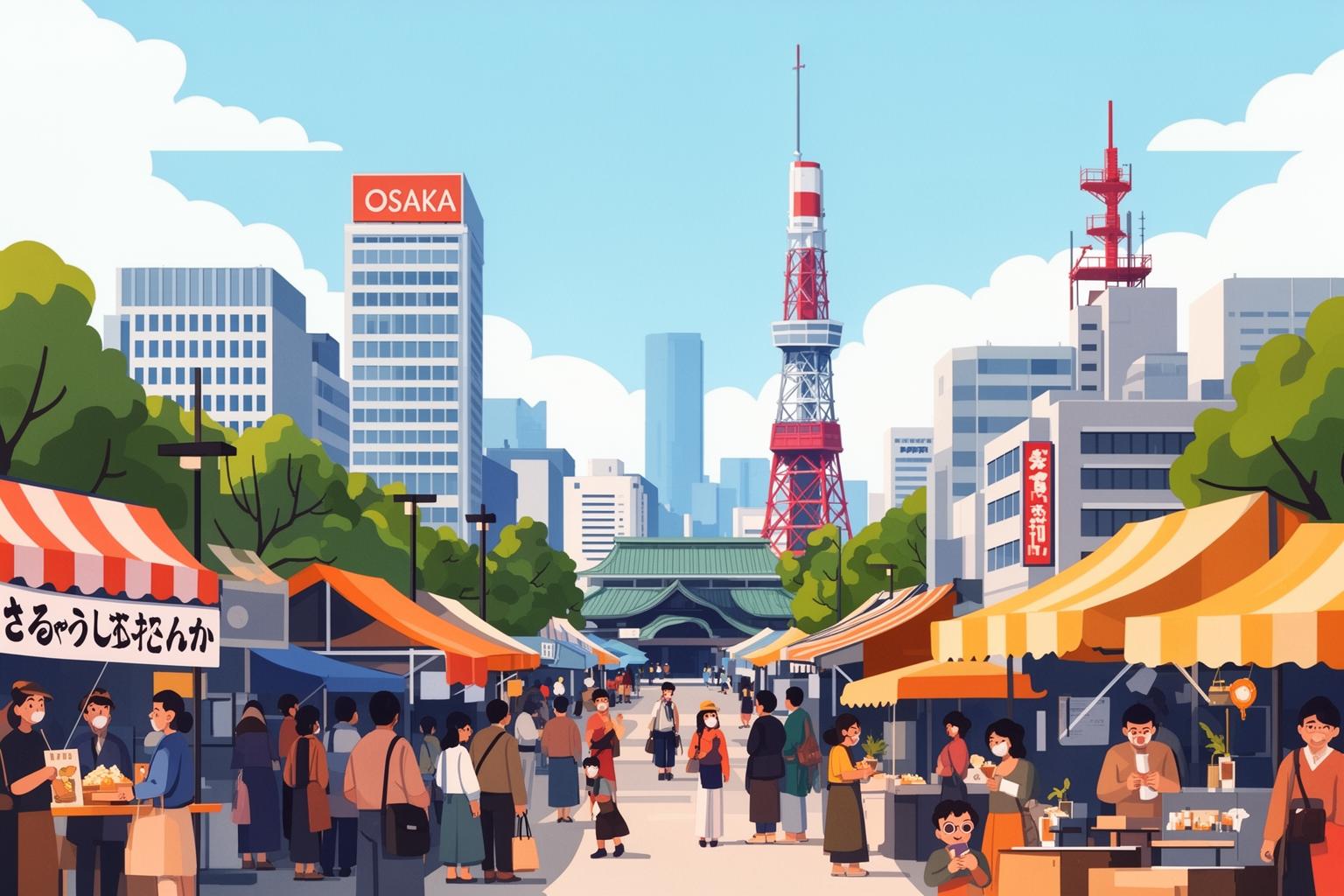
Mastering the subtleties of neighborhood communication in Osaka isn’t about learning a new set of phrases. It’s about grasping a fundamentally different way of relating to social space. In many places, the default is privacy and non-interference. In an Osaka neighborhood, the default is a low-level, ambient awareness of one another. The steady flow of greetings, weather remarks, playful jokes, and expressions of care fuels that awareness. It’s the city’s social heartbeat.
This is the true reason Osaka is often described as “friendly.” It’s not about grand displays of hospitality. It’s about the countless small, everyday interactions that keep anonymity at bay. It’s a participatory culture. You are not just an observer; through these conversational cues, you are invited to join the daily rhythm. Foreigners who don’t understand this may find Osaka overwhelming or intrusive. They might withdraw, keeping to themselves, and miss out on the very thing that makes life here so special.
But for those who learn to interpret these signals, something wonderful happens. You begin to feel recognized. The nod from the tofu-ya owner, the weather complaint from the woman sweeping her doorstep, the “Otsukare-san” from your neighbor—these stop feeling like random noise and become a comforting, reassuring soundtrack to your daily life. They are the threads that connect you to a place. So, the next time you step outside, give it a try. See an elderly man trimming his bonsai. Rather than a formal “Konnichiwa,” offer a simple nod and say “Kirei ni shitemasu ne” (You’re making it look beautiful). You might be met with a surprised smile and a conversation in return. That is the moment you cease merely living in Osaka and begin to truly belong.