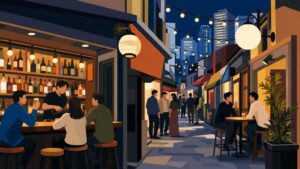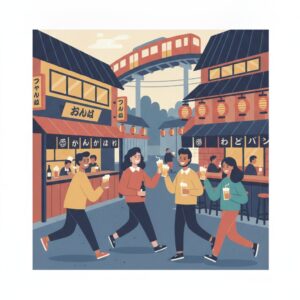
The train doors hiss open at JR Tenma Station, and the evening air hits you. It’s different from the air you were breathing just a minute ago on the Osaka Loop Line. This air is thick with the promise of release, heavy with the scent of charcoal smoke and sizzling oil. The sun dips below the Umeda skyscrapers just a station away, but here, under the train tracks, a different kind of light is just beginning to flicker on. Red lanterns, like low-hanging fruit, start to glow in the deepening twilight. The river of dark-suited salarymen and office ladies that flows out of the station doesn’t disperse; it diverts, trickling into a labyrinth of impossibly narrow alleyways, each one a universe of its own.
This is Tenma, Osaka’s living, breathing, drinking heart. It’s not pretty. It’s not polished. It has none of the curated charm you might find in a Kyoto backstreet or the futuristic gloss of a Tokyo entertainment district. It’s a chaotic, beautiful mess, a sprawling ecosystem of tiny stand-up bars, smoky yakitori joints, and bustling izakayas, all crammed together in a delightful defiance of personal space. For a newcomer, it can feel impenetrable, an insider’s game played by rules you don’t understand. You see the joy, you hear the roaring laughter, but you’re on the outside looking in. The question isn’t where to go, but how to be. How do you tap into this current of energy? You do it by understanding the ritual that powers this entire neighborhood: ‘hashigo-zake’.
Literally translating to “ladder sake,” it’s the art of bar-hopping. But calling it a bar crawl is like calling a tea ceremony just a cup of tea. It misses the point entirely. ‘Hashigo-zake’ is the Osakan philosophy of a good night out, a social ballet of movement, taste, and conversation. It’s a skill, a mindset, and a window into the soul of this city’s working class. Forget the tourist guides and the top-ten lists. To understand Tenma, you need to understand the rhythm and reason behind the ladder. This is the story of how to climb it, one delicious rung at a time.
As the night deepens and Tenma’s raw energy gradually subsides, you might find a welcome contrast in the retro cafes north of Umeda where creative spaces offer a quieter urban pulse.
The Unspoken Rules of the Salaryman’s Playground

First, you need to understand who this place is meant for. At its core, Tenma is a haven for the Japanese ‘salaryman.’ The term might feel somewhat outdated, evoking images of identical gray suits, but in reality, these are the men and women who keep the city’s offices running. They spend their days navigating the strict hierarchies and unspoken pressures of corporate Japan. Tenma stands in direct contrast to that world. It acts as a pressure-release valve, a space where ties can be loosened, formal language set aside, and the true self, the ‘honne,’ can surface over a shared plate of fried chicken.
This purpose defines the entire experience and gives rise to its unwritten rules. In Tokyo, you might visit a bar to see and be seen, network, or enjoy a specific, high-concept atmosphere. In Tenma, the aim is unwinding. That aim shapes a culture built on two principles: speed and value.
The Gospel of Speed
Stroll along any of Tenma’s main streets, and you’ll notice them everywhere: ‘tachinomi,’ or standing bars. There are no chairs. You are allotted a small section of counter or a portion of a shared high-top table, which becomes your spot. The absence of seating isn’t a design oversight; it’s deliberate. It promotes turnover. It keeps the energy vibrant. You’re not expected to linger for a long, drawn-out conversation. The idea is to have a quick drink, maybe two, enjoy a few small, expertly crafted dishes, and move on. This transient nature is what makes the system function. It ensures you can always find a place, even on a crowded Friday night. You just need to wait for a small opening in the human barrier at the counter and slip in. This constant movement is the heartbeat of the neighborhood. It’s a dance of coming and going, a fluid exchange of people and energy.
The Religion of ‘Kosupa’
If speed sets the pace, then value provides the soul. People in Osaka are passionate about ‘kosupa,’ a shorthand for “cost performance.” Understanding this is essential and often misunderstood by outsiders. ‘Kosupa’ doesn’t mean being cheap. Being cheap is simple. ‘Kosupa’ is about receiving outstanding quality at a fair price. It’s an art and a source of great local pride. An Osakan might proudly share tales of a place where the tuna sashimi is as fresh as at a high-end restaurant but costs half as much, or where a draft beer is perfectly poured for just 300 yen. This isn’t stinginess; it’s a deeply held belief that good things shouldn’t be pretentious or overpriced. In Tenma, this philosophy reigns supreme. A bar serving mediocre food at high prices won’t last a month. That would insult the collective wisdom of its patrons. The market is ruthlessly efficient, eliminating any establishment that fails to offer maximum satisfaction for each yen spent. This sharply contrasts with Tokyo, where branding, location, or interior design can often justify a premium, regardless of the product’s inherent quality. In Osaka, and especially in Tenma, only the taste truly matters.
What ‘Hashigo-zake’ Really Means
The term ‘hashigo-zake’ is beautifully evocative. Picture a ladder—you don’t linger on a single rung; instead, you climb, moving from one level to the next. That’s the essence of a night out in Tenma. It’s a thoughtfully curated journey, a culinary progression disguised as a casual stroll. A Western-style pub crawl often has one primary aim: intoxication. It’s a steady march from one pint to another. ‘Hashigo-zake’ is more refined. It’s a multi-course meal distributed across several venues.
The Flow of the Ladder
A typical ‘hashigo’ follows a natural, unspoken rhythm. You don’t begin with heavy ramen; you ease in gently.
Rung One: The Opener. The first stop is usually a ‘tachinomi’ focused on seafood. The goal is something fresh, clean, and quick. You squeeze into a spot at the counter overlooking an array of fresh fish. The classic order is “Toriaezu biru,” meaning “Beer for now.” It’s the universal starting signal for a night out. With that beer comes a small plate of sashimi or lightly grilled scallops. You’re in and out within twenty minutes. Your palate is awakened. The night has officially begun.
Rung Two: The Substance. Next, you head to something a bit more substantial. You follow the aroma down a side alley to a yakitori joint, recognized by the fragrant smoke wafting from its entrance. The atmosphere changes here—louder, with a thicker air. You might switch from beer to a highball or a lemon sour. You order skewers one by one: tender chicken thigh with leek, crispy skin, savory meatballs. Each skewer offers a perfectly contained bite. This is the core of the evening, the main course.
Rung Three: The Pivot. After the smoky satisfaction of yakitori, you may desire a shift in texture. This calls for a tempura bar. Everything here is light and crisp. You watch the chef batter and fry individual pieces of shrimp, lotus root, and shiitake mushrooms right before you, placing them on your plate straight from the hot oil. It’s interactive and deeply gratifying, a textural reset from the previous stop.
This is just one possible route. The charm lies in the improvisation. Maybe you detour for gyoza. Maybe you stumble upon a bar dedicated to sake. The key is the movement—the ever-changing scenery and flavors. This structure also serves a social purpose. It keeps conversations fresh. Each new venue is a new chapter, a fresh beginning. It allows a natural ebb and flow within the group, as people can join for one or two “rungs” and then slip away to catch their last train home without disrupting the whole evening.
Navigating the Chaos: Tenma vs. Tokyo

Your first impression of Tenma might be an overwhelming sensory experience. It’s a cacophony of sound, from the rumble of trains overhead to the chorus of “Irasshaimase!” shouted from every doorway, alongside the clatter of plates and glasses. The visual landscape is just as crowded: a forest of vertical banners, hand-written menus taped to walls, flickering fluorescent lights, and the warm glow of countless red lanterns. The atmosphere feels organic, almost alive, as if the alleys themselves have grown this way over decades.
This contrasts sharply with many nightlife districts in Tokyo. While places like Shinjuku’s Omoide Yokocho share a similar historical charm, there’s often an underlying sense of order. There might be clearer queues, more defined entrances, and a more predictable flow of foot traffic. Tenma operates on a more fluid, almost chaotic logic. The idea of a queue is unfamiliar. Entry involves peering inside, making eye contact with the staff, and silently indicating the number of people in your party. If there’s a small opening, they’ll beckon you in. You learn to compress yourself, occupying the absolute minimum physical space possible. This isn’t rudeness; it’s a shared understanding that space is the most precious resource, and sharing it lets more people join the fun.
The energy is participatory. When you leave a bar, no matter how small or crowded, you’re expected to call out a loud, hearty “Gochisousan!” or “Gochisousama deshita!” This phrase means “Thank you for the meal,” but here, it means more. It’s a closing statement, a signal to the entire venue—staff and patrons alike—that you enjoyed yourself. The staff will respond with a roaring thank you, and for a brief moment, the bar’s ambient noise gathers around your departure. It’s a small ritual of connection that strengthens the communal atmosphere. You weren’t just a customer; you were part of the scene, and your exit is acknowledged. It’s a piece of social theater that feels uniquely warm and Osakan.
The Language of the Counter
In Tenma, the bar counter doesn’t serve as a barrier between you and the staff; rather, it’s a shared stage. Some of the best experiences occur when you’re shoulder-to-shoulder with strangers, all focused on the activity in the kitchen. This closeness breaks down social barriers in a way that’s less common in other areas of Japan.
Although unsolicited conversations with strangers remain uncommon, the shared context of food and drink offers a natural opening. A casual remark to your neighbor, such as “That looks delicious,” or asking the staff for a recommendation, can easily lead to a conversation. Osaka locals often take pride in their city’s food culture and are genuinely eager to share their knowledge with interested visitors. This is the true meaning behind the “Osaka is friendly” stereotype. It’s not a general friendliness but a specific, situational openness—a willingness to engage when there’s a mutual passion—and in Tenma, that passion is always good food and drink.
Mastering a few key phrases can enhance your experience. As mentioned, “Toriaezu biru” is a good opening line. When it’s time to pay, a simple “Okaikei onegaishimasu” (the check, please) will suffice. But more important than the words is the attitude. Be decisive. The pace is quick, and the staff is busy. Have an idea of what you want before catching their eye. This isn’t the place for hesitation over the menu. Confidence and efficiency go a long way.
And watch the masters at work. The person behind the counter is more than just a cook; they are an artisan. Notice the effortless grace of a yakitori chef flipping dozens of skewers over hot coals, fanning the flames precisely, glazing them with sauce at just the right moment. A nod of appreciation or a simple “Oishii!” (Delicious!) when you take a bite shows respect for their skill. It signals that you’re not merely consuming but truly paying attention. This small gesture transforms the interaction from a simple transaction into a moment of shared human connection.
Beyond the Beer: What Tenma Reveals About Osaka
If you spend enough time in Tenma, you begin to realize that you’re not merely in a collection of bars. You’re witnessing a philosophy of life in motion. The neighborhood encapsulates the essential qualities that define Osaka and distinguish it from the rest of Japan.
It’s a celebration of substance over style. There is no pretense here. A place with plastic stools, a worn-out counter, and walls stained from decades of smoke will be packed to the brim every night if its grilled intestines or stewed beef tendons are renowned. Conversely, a venue with fancy decor and a slick logo will be empty if the food doesn’t satisfy. This is Osaka’s merchant spirit laid bare. For centuries, this city thrived on commerce, where the quality of your product was your promise. Reputation meant everything, built on tangible results rather than flashy marketing. Tenma carries on that ethos today. It’s a genuine meritocracy of taste.
It also showcases a fierce spirit of independence. The great majority of these establishments are not corporate chains but small, family-run businesses. The owner is often the one pouring your beer or grilling your skewers. This creates a strong sense of community and accountability. The people working there are deeply invested in their craft. It’s their livelihood, their passion, and their name on the line every night. This cultivates resilience and authenticity that’s difficult to replicate. By being there, you’re supporting a local family and participating in a grassroots economy that truly shapes the city’s character.
This is the real Osaka. It’s not found in the shiny shopping malls or famous tourist spots. It’s in the cramped, smoky, noisy alleys, where people gather to share something simple and genuine. It stands as proof that the best things in life don’t have to be expensive or exclusive; they only need to be good and honest.
Your First ‘Hashigo-zake’: An Initiation
So, how do you take your first step onto the ladder? Forget about searching for the “best” place. The spirit of ‘hashigo-zake’ is about exploration, not checking boxes. Instead, here’s a guide to adopting the right mindset.
Show Up at the Right Time
The magic begins early. As soon as office workers finish around 5:30 or 6:00 PM, bars start to fill up. This is the prime time. Go then. The energy is fresh, and it’s easier to find a spot. By 8:00 PM, you’ll be facing peak crowds.
Follow the Lanterns and the Locals
The red lantern, the ‘akachochin’, is your guiding light. It’s the universal symbol for a simple, welcoming izakaya. Walk through the alleys and look inside. Is it lively? Are locals laughing and enjoying themselves? That’s your cue. The best recommendation in Tenma is a packed house. Don’t worry if there’s no English menu. Pointing at what your neighbor is having is a time-honored and very effective way to order.
Cash is King
Many of these traditional, small-scale spots only accept cash. Come prepared. It also speeds up payment, which is crucial for smooth hopping.
Embrace the One-One Rule
As a beginner, a handy rule for your first few stops is the one-drink, one-dish approach. Enter, order one drink and the bar’s signature dish. Savor it. Enjoy the vibe. Then, pay your bill and move on. This keeps you flexible and lets you sample more places without getting too full or too intoxicated too quickly.
Know When to Call It a Night
A proper ‘hashigo-zake’ experience ends with a ‘shime’. This is the final, closing dish meant to settle your stomach and formally conclude the culinary journey. It’s usually something carb-based, like a small bowl of ramen, ochazuke (rice with tea), or onigiri. Finding a good ‘shime’ spot is the last step on the ladder—a satisfying end to the night’s adventure. After that, it’s time to head to the station, full, happy, and with a deeper understanding of how Osaka truly works.