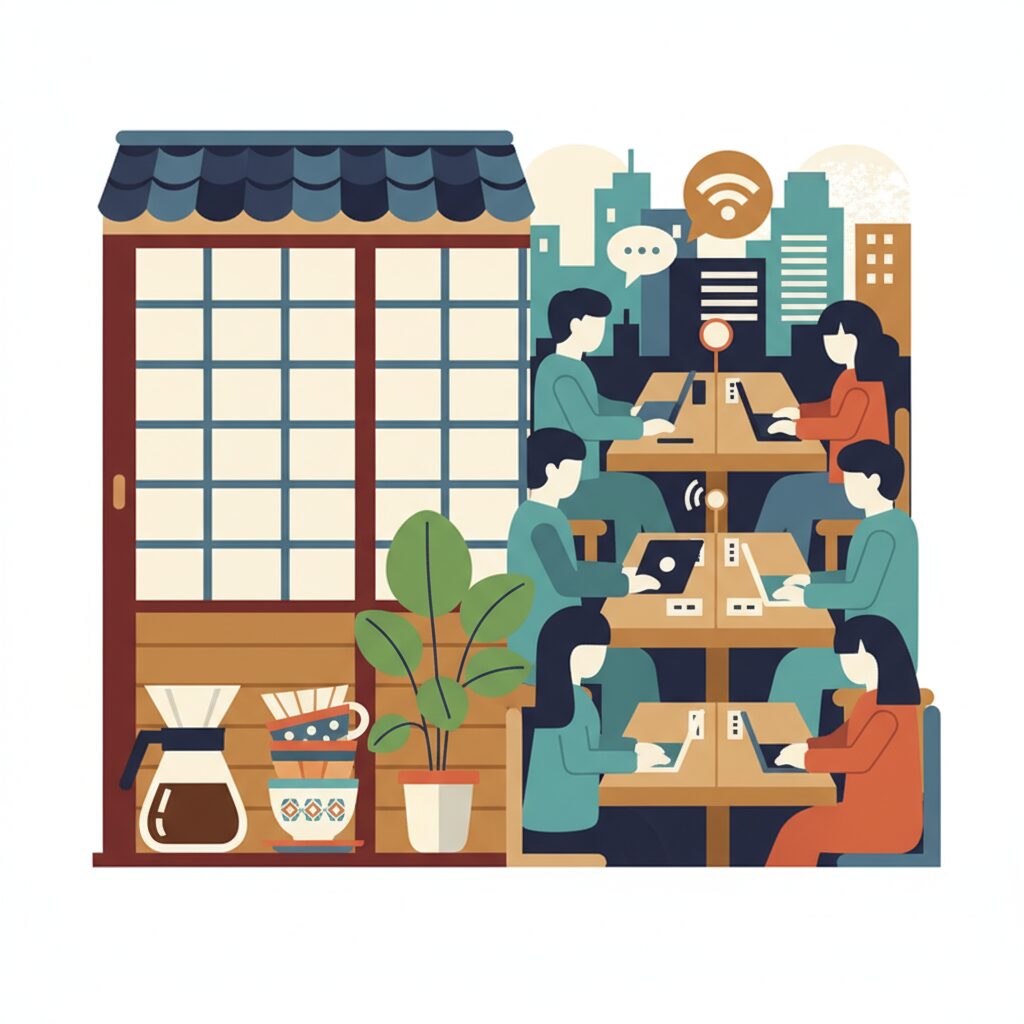
Forget the sleek, silent cubes of modern coworking. Forget the minimalist decor, the artisanal single-origin pour-overs, and the hushed symphony of fingers tapping on MacBooks. To understand where Osaka really gets its work done, you need to step back in time. Push open a heavy wooden door, hear the tinkle of a tiny brass bell, and breathe in an atmosphere thick with the ghosts of a million cigarettes and the rich, dark aroma of siphon-brewed coffee. This is the kissaten, Osaka’s living, breathing, original coworking space. It’s more than a cafe; it’s a public office, a neighborhood living room, and a key to decoding the city’s pragmatic, unpretentious, and deeply human soul. When you first arrive in Osaka from somewhere like Tokyo, the sheer number of these Showa-era time capsules can be jarring. They feel less like businesses and more like extensions of someone’s home, stubbornly resisting the tide of globalized cafe culture. But spend enough time here, and you realize they aren’t just relics. They are vital, functional hubs that explain exactly how this city thinks, works, and connects, one cup of deeply-brewed coffee at a time.
Discover how these timeless spaces not only serve as nostalgic cafes but also function as vibrant community hubs, as detailed in Osaka’s local kissaten community hubs.
The Unofficial Annex of the Osaka Office
Step into a kissaten in Umeda or Honmachi around ten on a Tuesday morning. You won’t see laptops displaying lines of code or graphic design programs. Instead, you’ll observe something far more essential to Osaka’s economy. Men in slightly wrinkled suits, ties loosened, speak in quiet but urgent tones into enormous flip phones seemingly preserved from 2002. They aren’t making casual calls. They’re closing deals, checking stock, and arranging deliveries. These are the city’s eigyouman—the salesmen, the frontline workers of commerce. For them, the kissaten is not a luxury; it’s a tactical resource. It’s a place to kill twenty minutes between meetings, a neutral spot to meet clients, or a quiet corner to complete paperwork without the cost of renting office space.
This is the first lesson kissaten imparts about Osaka: relentless pragmatism. Why would a small-to-medium enterprise, the backbone of this city’s economy, invest in a large central office when its employees are always on the move? The city itself becomes the office, and the kissaten network acts as its satellite branches. A single 500-yen cup of coffee buys you a desk, a temporary phone booth, and a moment of shelter from the stifling summer heat or the biting winter chill. Osaka’s famed value-consciousness isn’t just about scoring good deals on takoyaki; it is ingrained in the very fabric of its business culture. The kissaten embodies this perfectly: maximum utility at minimal cost.
Then there’s the iconic “Morning Service.” This is not the brunch you might expect. It’s a simple, highly efficient meal set. For the price of a coffee—or a little more—you receive a thick slice of toasted shokupan, a hard-boiled egg, and perhaps a small salad. This formula, with slight variations, is repeated across thousands of shops. While Tokyo cafes might tempt you with avocado toast or elaborate pastries, an Osaka kissaten provides fuel. It’s a deliberate offering that says, “We know you need to start your day, we know you’re watching your budget, and we won’t waste your time with unnecessary options.” This is more than breakfast; it’s a declaration of purpose, a mutual understanding between owner and customer that the day is for work, and this is how it begins.
The Art of Being Left Alone, Together
In a Tokyo Starbucks, there’s an unspoken pressure. The space is bright, the music upbeat, and the steady stream of customers makes you feel like you’re on a schedule. You buy your drink, do your work, and leave. Staying too long seems like breaking an invisible social contract. The Osaka kissaten exists on a completely different level. Here, the main service isn’t just coffee; it’s the offering of time and space without question. This is where genuine “coworking” takes place, in a way that modern venues with their membership fees and booking requirements can’t replicate.
At the heart of this environment is the “Master,” the owner who is almost always present behind the counter. The Master is not an overly cheerful barista. They might be a gruff man in his sixties, polishing glasses with stern focus, or a reserved woman who has been serving the same coffee blend for four decades. Their communication is often sparse—a nod of recognition, a grunt of agreement. Yet they quietly orchestrate the entire space. They know the regulars, the jōren, by sight. They understand that the man in the corner is reading the horse racing pages and should not be disturbed. They observe how the two women by the window meet every Thursday for exactly one hour. They know the salesman in the back booth requires a water refill but is on an important call and can’t be interrupted.
This fosters an atmosphere of shared, silent understanding. You are free to simply exist. You can spread out your papers, nap with your head on the table, or stare off into space for two hours after finishing your coffee. No one will bother you. This isn’t poor service; it is the highest kind of service. It represents a deep, unspoken respect for personal autonomy within a communal setting. This contrasts sharply with the more group-oriented, harmony-driven culture found elsewhere in Japan. In an Osaka kissaten, you belong to a collective, but your personal space is inviolable. You are left alone, together. This reflects Osaka’s character itself: fiercely independent yet deeply embedded in a network of trusted relationships. The Master is a trusted node in that network, and their cafe is a safe harbor where the outside world’s pressures are momentarily lifted.
The Aesthetics of Functionality
Outsiders often mistake the look of a traditional kissaten for neglect. The velvet on the chairs might be threadbare, the wallpaper lightly yellowed by decades of cigarette smoke, and the décor might seem stuck in 1975. But this isn’t a defect; it’s the point. In Tokyo, interiors are often a performance. Cafes are carefully designed to be photogenic, to fit a particular trend, to be showcased on social media. The space itself is as much the product as the coffee.
In Osaka, the space functions as a utility. A kissaten’s value lies not in novelty but in consistency. The worn-in chair is comfortable because it has shaped itself around thousands of patrons before you. The dim lighting is gentle on the eyes. The dark wood paneling absorbs sound, creating a private, womb-like atmosphere. Nothing is meant to impress you. Everything serves a purpose. This is Osaka’s well-known absence of pretense, or kazarike no nasa. Why replace a perfectly good vinyl booth simply because it’s thirty years old? It still works. It’s comfortable. The emphasis is on substance over style, a principle guiding everything from business dealings to personal exchanges in this city.
This approach carries over to the menu. You won’t find deconstructed tiramisu or cold-brew nitrogen infusions. Instead, you’ll find Mixed Sandwiches with the crusts neatly trimmed, a bright green Cream Soda topped with a scoop of vanilla ice cream, and the signature dish of all kissaten foods: Napolitan spaghetti. This sweet, ketchup-based pasta, often served on a hot cast-iron plate, is the ultimate Japanese comfort food. It’s neither fancy nor authentically Italian, but it’s delicious, filling, and deeply nostalgic. These dishes aren’t meant to be innovative; they’re meant to be dependable. They serve as anchors to a simpler era, offering stability in a rapidly shifting world. The kissaten declares, “The outside world is chaotic and unpredictable, but here, the Napolitan will always taste the same.”
The City’s Living Room

While the kissaten serves as an essential workspace, it is much more than that. It acts as the unofficial community hub for the neighborhood. Between the morning rush and afternoon meetings, the clientele evolves. It becomes a sanctuary for retirees who indulge in reading the newspaper from start to finish, a luxury earned with time. Local shopkeepers take their midday break there, exchanging gossip and venting about the economy over coffee. Housewives gather after grocery shopping, their voices forming a soft, melodic hum that becomes the café’s midday soundtrack.
Here, you witness the texture of daily life in Osaka, away from the neon glow of Dotonbori and the corporate polish of Umeda. You observe relationships cultivated over decades. The Master knows his customers’ children, their health issues, and their small triumphs. These connections are not merely transactional; they are the intricate, interwoven threads creating the fabric of the community. In a city as vast and impersonal as Osaka, the kissaten offers a point of human connection, a place where you’re more than a customer—you’re a recognized part of the local fabric.
This role sharply contrasts with experiences in many other large cities, including Tokyo, where urban life often feels more fragmented and anonymous. The continued presence of the kissaten in Osaka highlights a deep-rooted need for third spaces—places neither home nor work—where people can simply be themselves in quiet companionship. It reflects an attitude that embraces community not as an abstract ideal but as a tangible, everyday practice. It serves as a reminder that before social media, people connected face-to-face, slowly, over a simple cup of coffee.
Ultimately, the kissaten perfectly encapsulates Osaka itself. It is pragmatic, efficient, and indifferent to fleeting trends. It prioritizes substance over style and reliability over novelty. It nurtures a culture of fierce independence while supporting a strong, interconnected community. Though it may appear gruff and old-fashioned from the outside, once you are welcomed in, you discover a deep, quiet comfort. To understand why an Osakan businessman prefers meeting in a smoky, fifty-year-old café rather than a sterile, modern conference room is to understand the city’s soul. It’s a city that works hard, but on its own terms—a city that builds its future not by erasing its past, but by finding new ways to honor it. The kissaten is not a relic; it stands as a testament to an enduring way of life, a workspace and heartspace, humming with the steady, rhythmic pulse of Osaka.