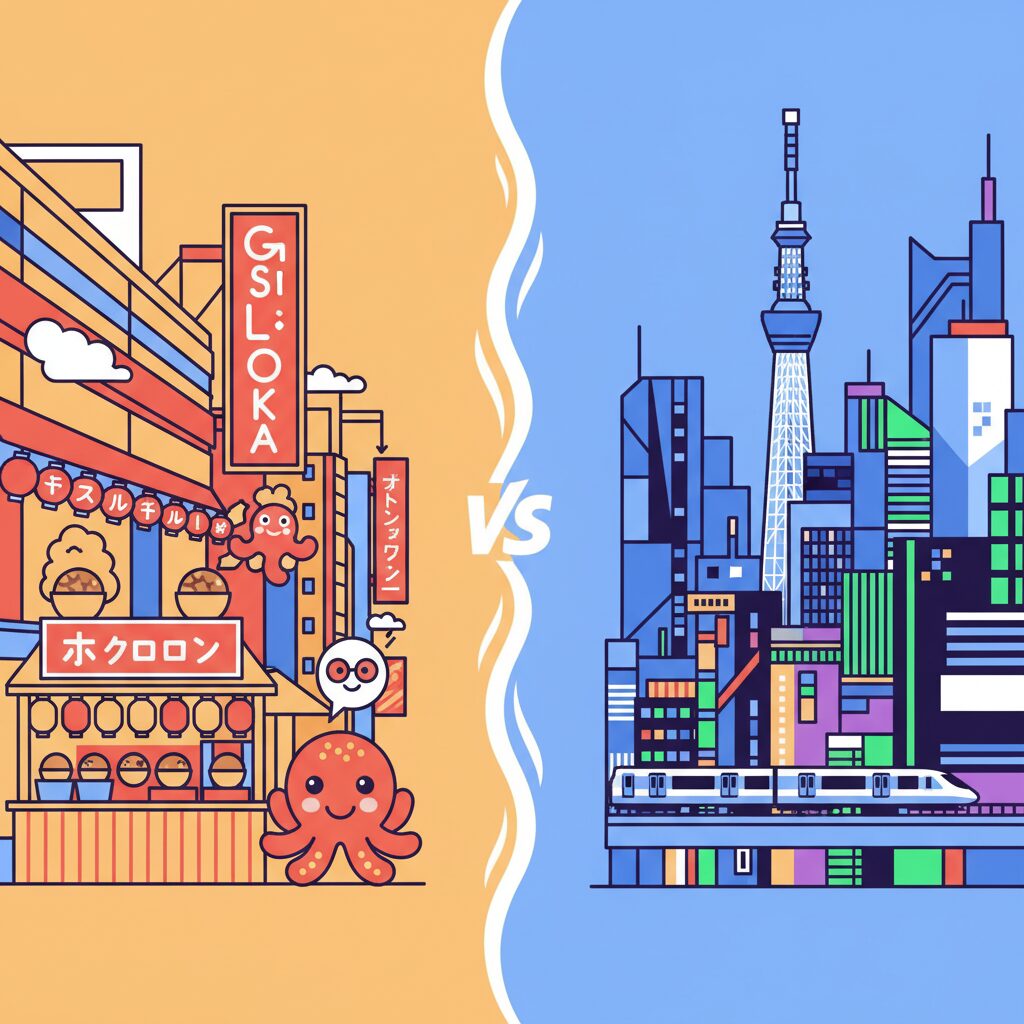
Step off the Shinkansen at Shin-Osaka Station, and the first question hits you: which way do you go? Head south for a few minutes and you’re in Kita, the gleaming northern hub of Umeda, a world of towering glass, luxury department stores, and commuters moving with a sharp, determined rhythm. Go a little further down the city’s main artery, the Midosuji line, and you’ll tumble out into Minami, the southern center. Here, the city explodes into a chaotic, neon-drenched carnival of sound, smell, and relentless energy. This isn’t just a geographical divide; it’s a psychological one. For anyone trying to get a handle on living in Osaka, understanding the fundamental difference between Kita and Minami is the first, most crucial lesson. It’s the key to decoding the city’s dual personality—a personality that stands in stark, fascinating contrast to the more monolithic hubs of Tokyo. This isn’t about choosing a favorite tourist spot. It’s about figuring out where you, as a resident, will find your rhythm in a city that dances to two very different beats. It’s about understanding the people, the unspoken rules, and the mindset that flows from these two urban hearts.
Residents eager to further grasp Osaka’s dual character might also enjoy delving into its distinctive kuidaore lifestyle, which reveals even more about the everyday magic behind the city’s contrasts.
Decoding the North: Kita, Where Commerce Wears a Suit
Kita, meaning “north,” is centered around the vast urban hub of Umeda and Osaka Station. This area represents Osaka’s corporate identity. Imagine wide, pristine boulevards lined with the impressive facades of Hankyu, Hanshin, and Daimaru department stores. Sunlight reflects off the Umeda Sky Building and the modern towers of Grand Front Osaka. The atmosphere here is distinct—crisper, more serious. The background sound is a synchronized click-clack of heels on polished floors and the steady hum of escalators ferrying purposeful commuters. The people you encounter sharply contrast the common stereotype of loud, flamboyant Osakans. Instead, you see executives in tailored suits heading to their next meeting, shoppers carrying discreetly branded bags, and office workers enjoying upscale lunches at chic bistros. Kita is aspirational—where business happens, careers are forged, and success is expressed through quiet confidence and quality goods. This is Osaka in business mode: an efficient, pragmatic engine of commerce. The energy isn’t boisterous; it’s a powerful, steady pulse of ambition.
For those familiar with Tokyo, Kita is best understood as a blend of Marunouchi and West Shinjuku. The area immediately surrounding Osaka Station, with its upscale corporate offices and refined retail, reflects the polished, prestigious air of Marunouchi, Tokyo’s financial core. It’s Japanese corporate culture on full display. At the same time, the enormous scale of the Umeda station complex—a sprawling, multi-level labyrinth often nicknamed the “dungeon”—and the concentration of skyscrapers evoke West Shinjuku. This is a major transportation and commercial hub drawing people from across the Kansai region. But here’s the essential Osakan twist. While projecting corporate sophistication, Kita never fully sheds Osaka’s fundamental pragmatism. Prestige matters, but value for money—or “cospa” (cost performance)—remains paramount. A business lunch may take place at an upscale restaurant, yet the choice is always backed by excellent quality-to-price balance. In Tokyo, form can rival substance; in Kita, substance reigns supreme, even when dressed in a designer suit.
Living near Kita means embracing an exceptionally convenient lifestyle. Your world is interconnected. Being close to Osaka Station means Kyoto, Kobe, and Nara are just a short, direct train ride away. Daily life is streamlined. You can shop for groceries at a luxury department store’s food hall, enjoy a quick yet high-quality standing-bar dinner, and be home within minutes. The unspoken rule here is that time is precious. People walk briskly, rarely lingering on the main streets. They have places to be. This is perfectly embodied by the Umeda “dungeon.” To newcomers, it’s an intimidating maze; to locals, it’s a highly efficient system designed for swift passage, a subterranean world with its own logic. Mastering its shortcuts is a rite of passage. Yet life around Kita isn’t all corporate seriousness. Just a short walk away are neighborhoods like Nakazakicho, a delightful enclave of bohemian cafes and vintage shops housed in pre-war buildings, offering a peaceful retreat. To the east, Tenma comes alive after 6 PM, its endless lantern-lit alleys and bustling izakayas serving as a release for the area’s office workers. Living in Kita’s orbit means having this polished, efficient core at your fingertips, complemented by character-rich pockets just beyond the station’s hum.
Embracing the South: Minami, the City’s Raw, Beating Heart
The Vibe: Energetic, Unfiltered, and Relentlessly Human
If Kita is a symphony, Minami is a rock concert. While the name simply means “south,” it embodies a completely different state of mind. Centered around Namba, Shinsaibashi, and the iconic Dotonbori canal, Minami delivers a full-on sensory overload in the best possible way. The moment you step out of Namba station, you’re greeted by the aroma of grilled takoyaki and savory okonomiyaki, the visual frenzy of flashing neon signs and massive mechanical crabs, and the overwhelming soundscape from competing shops, street vendors, and throngs of people. This is the Osaka of popular imagination—loud, untidy, and bursting with life. The crowd is a vibrant, eclectic mix: teenagers in cutting-edge streetwear exploring Amerikamura’s boutiques, tourists marveling at the Glico Running Man sign, local families out for an inexpensive, cheerful dinner, and shopkeepers calling out a friendly “Maido!” (Welcome!) from their stalls. This isn’t chaos for chaos’ sake; it’s the result of centuries as a hub for merchants and entertainment. Minami is home to Bunraku puppet theater, lively comedy halls, and the philosophy of “kuidaore”—eat until you drop. It doesn’t aim to impress with polish; it grabs you by the collar and insists you have a great time.
The Tokyo Parallel: Minami as Shibuya, Shinjuku East, and a Dash of Ueno
Finding a single Tokyo equivalent for Minami is impossible; it’s a mix of several. Amerikamura, with its concentration of youth culture, vintage shops, and trendsetting crowds, stands as Osaka’s counterpart to Shibuya’s vibe. It’s where new styles emerge from the streets. The neon-lit nightlife and entertainment scene around Dotonbori and its alleys carry the same raw energy as Shinjuku’s Kabukicho, yet with a vital difference—it feels more like an enormous, open-air food festival than a foreboding red-light district. The vibe is more theatrical, more inviting. Then there’s the merchant spirit. The covered shopping arcades such as Shinsaibashi-suji and the kitchenware-focused Doguyasuji, with their haggle-friendly atmosphere and focus on good deals, closely resemble Ueno’s Ameya Yokocho market. Minami blends the trendsetting youth power of Shibuya, the nightlife of Shinjuku East, and the market-stall grit of Ueno into one dense, intoxicating experience. It’s Tokyo’s subcultures combined and amplified through an Osakan megaphone.
Daily Life in the Minami Maze
Living in or near Minami means plugging directly into the city’s main power line. It’s for those who thrive on urban energy and spontaneity. Daily life is a nonstop adventure in food and social interaction. Dinner isn’t a quiet, reserved affair; it’s a lively meal at a bustling izakaya where you might find yourself chatting with the owner or the people at the next table. Shopping isn’t just about transactions; it’s a performance. The “akindo” (merchant) spirit remains alive and well. A shopkeeper at Kuromon Market won’t just sell you fish; they’ll share the best way to cook it, ask where you’re from, and crack a joke. This personal connection is crucial. Value in Minami isn’t defined by luxury brands—it’s about scoring an incredible meal for 800 yen, discovering a unique jacket in a second-hand store, and feeling that you’ve gotten a solid deal from a real person. The unspoken rule in Minami is to engage: be open, share a laugh, and embrace the chaos. It’s a lifestyle that can be exhausting if you crave peace and quiet, but for those wanting to live in the heart of Osaka’s vibrant soul, there’s no better place.
The Kita-Minami Mindset Divide: How It Shapes Osaka Life
Business vs. Banter: The Communication Code
The way people speak and interact arguably reveals the clearest distinction between Kita and Minami. In a Kita business meeting, communication is straightforward, efficient, and notably pragmatic. It lacks the formal, layered introductions common in Tokyo settings. Conversations are concise and outcome-focused. The traditional Osaka-ben is moderated, with a professional tone. By contrast, a chat in a Minami tachinomi (standing bar) turns communication into the main attraction. It’s a lively exchange of jokes, teasing, and stories. The language is authentic Osaka-ben, rich with its distinctive rhythms and expressions. The purpose isn’t just to order a drink but to foster a shared moment of enjoyment. This isn’t impoliteness; it’s a matter of cultural priorities. In Kita, respect is shown through efficiency. In Minami, respect is shown through warm engagement.
Style and Substance: What People Value
This contrast is evident in personal style as well. In Kita’s cafes and offices, the look favors understated quality. People convey success through well-crafted, often internationally recognized brands. The aim is to appear “shutt-to shiteru”—sharp, polished, and composed. It’s a style that signals competence and cosmopolitan refinement. Over in Minami’s Amerikamura, the emphasis shifts. Here, style expresses individuality and personality. It manifests in flamboyant leopard-print coats, carefully selected vintage outfits, or bold, locally designed pieces. The highest compliment isn’t looking expensive but looking distinctive. The concept of “meccha medatsu” (standing out a lot) is a point of pride. It’s not about blending in; it’s about boldly declaring your uniqueness. Kita’s style announces, “I am successful.” Minami’s style declares, “This is who I am.”
A Tale of Two Commutes: Navigating the Hubs
The daily commute highlights the practical differences between the two districts. Transferring trains at Umeda involves navigating a controlled chaos. It’s an extensive, intricate system of underground tunnels, color-coded lines, and multiple station names that seem to refer to the same area (Umeda, Osaka, Higashi-Umeda, Nishi-Umeda). Newcomers often get lost, while regular commuters move with near-instinctive precision, flowing swiftly through predetermined streams of foot traffic. Namba station presents a different experience. Although it is also a major hub linking JR, Nankai, Kintetsu, and subway lines, its layout is more chaotic and closely connected with the streets above. You don’t feel like you’re in a sterile transit environment. Upon exiting a ticket gate, you’re immediately immersed in the vibrant world of Namba Walk underground shopping or exposed to the sensory overload of Dotonbori. Umeda is somewhere you pass through. Namba is somewhere you arrive.
Beyond the Stereotypes: Where Foreigners Get It Wrong
Misconception 1: “All of Osaka is Loud and ‘In-Your-Face'”
This is the most common misunderstanding about Osaka, stemming from the popular image of Minami. Many foreigners arrive expecting every local to be a fast-talking comedian ready with a joke. While the people are generally more open than in other parts of Japan, the loud friendliness is very much situational. The boisterous chatter you hear in a Minami izakaya fits that environment. The same person is likely to be quiet and reserved during their morning commute to the office in Kita. The city has different faces. Assuming the Minami persona is the only one is like visiting New York and believing the entire city is like Times Square. Kita shows that Osaka also has a refined, professional, and much quieter side.
Misconception 2: “Kita is Just a Boring Version of Tokyo”
When looking at the skyscrapers and department stores of Umeda, it’s easy to dismiss it as a dull copy of Shinjuku or Marunouchi. But this misses the point entirely. The core operating system is different. Kita runs on Osaka’s pragmatism and value-driven mindset. The intense competition between department stores, the ongoing sales, and the focus on quality at a reasonable price are all distinctly Osakan traits. There is less focus on strict formality and more on achieving good results. You sense a more straightforward, practical energy even in the most upscale settings. It’s Tokyo’s hardware with Osaka’s merchant-minded, pragmatic software inside.
The Real Unspoken Rule: It’s All About Practicality
If there is one principle that unites the polish of Kita and the grit of Minami, it is a steadfast commitment to practicality. Whether it’s a high-stakes business deal or buying takoyaki, Osakans prioritize value. They respect competence, honesty, and fair pricing above all. They appreciate things that work well, taste good, and make sense. This is the clearest contrast with Tokyo, where maintaining surface harmony (tatemae) and observing proper form can sometimes seem more important than the genuine reality (honne). In Osaka, the honne is always just beneath the surface, whether expressed through a tough business negotiation in Kita or a friendly heckle in Minami. People say what they mean, and they value others who do the same. This pragmatism is the true essence of the city.
Choosing Your Osaka: Practical Takeaways for Residents
Who Thrives in Kita’s Orbit?
If you’re a career-driven professional who values efficiency, convenience, and a modern urban lifestyle, Kita is your gravitational center. It’s ideal for those seeking a sleek, comfortable home base with quick connections to the rest of Japan. You appreciate having world-class shopping, dining, and art right at your doorstep. You prefer a faster pace and a more cosmopolitan, international atmosphere. Living near Kita means embracing a life that is organized, ambitious, and connected to the main currents of Japanese commerce, all with that distinctly practical Osaka flair.
Who Feels at Home in Minami’s Energy?
If you’re a creative, entrepreneur, foodie, or anyone energized by the street scene, Minami is your spiritual haven. It’s for people who thrive on spontaneity and human connection, and who’d rather eat at a legendary hole-in-the-wall than a Michelin-starred restaurant. Noise and crowds don’t bother you; in fact, you find them invigorating. You want to live in a place with a strong, unmistakable personality. Choosing Minami means embracing a life full of sensory richness, endless discovery, and a connection to the raw, pulsating heart of Osaka’s iconic culture.
Finding the Balance: Life Between the Two Poles
The great thing about Osaka is that you don’t have to choose one side exclusively. Most residents find themselves living between these two poles. Neighborhoods along the central Midosuji subway line, such as Honmachi, Yodoyabashi, or even Tennoji further south, offer a balance, providing easy access to both Kita’s corporate world and Minami’s cultural playground. The key is understanding that Osaka is not a monolith. It’s a city shaped by the dynamic tension between its two centers. By recognizing the contrast between Kita’s polish and Minami’s grit, you move beyond clichés and start to see the city as its residents do: a complex, fascinating, and deeply practical place with two powerful, contrasting, and equally compelling hearts.