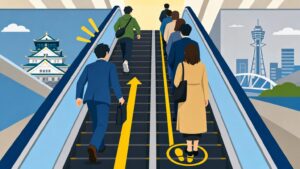
So, you’ve settled into Osaka. You’ve mastered the Midosuji subway line, you can navigate the Umeda dungeon with only a moderate sense of panic, and you’ve developed a strong opinion on which takoyaki stand reigns supreme. You’re feeling the city’s pulse, its relentless, vibrant, commercial heartbeat. But then the weekend comes. The energy that fuels your weekdays starts to feel like a low-grade hum you can’t escape. You look at a map and see Nara, you hear whispers of Ise, and you think, “I need a break.” Your first instinct, conditioned by a lifetime of travel logic, might be to look for the big, official-sounding Japan Railways (JR) line. It’s the national carrier, the default, the one you see on all the tourist passes. But if you want to understand how Osaka really breathes, how its people manage their own rhythm of life, you need to turn your attention to the other railway, the private powerhouse humming beneath the Namba crowds: the Kintetsu Railway.
Understanding the Kintetsu line is more than just learning a new train schedule. It’s a window into the Osaka psyche. It’s an object lesson in pragmatism, regional pride, and the art of the well-planned escape. For Osakans, the choice between JR and Kintetsu isn’t just about logistics; it’s a subtle declaration of identity and a testament to a deeply ingrained cultural calculus of value. This isn’t about grand, sweeping journeys on a sleek Shinkansen to another metropolis. This is about connecting to the spiritual and historical backyard of the Kansai region, using a network built by and for the people who live here. The sleek, wine-red Hinotori and the classic orange-and-blue express trains aren’t just modes of transport; they are the arteries that carry the city’s lifeblood out to places of quiet reflection and natural beauty, allowing Osakans to recharge before diving back into the glorious chaos of their city. Planning a trip on these rails is your first step to moving through the region not as a visitor, but with the savvy and intention of a local.
Embrace your journey with the mindset of a true local by exploring Gokinjo-zukiai to uncover the subtle neighborhood dynamics that make Osaka unique.
The Kintetsu Mindset: More Than Just a Train Ticket
In Tokyo, the train system often feels like a vast, impersonal, yet relentlessly efficient machine. The JR Yamanote Line stands as a cultural icon, an unspoken link uniting the city’s diverse wards. The system is the system, and you simply adapt to it. In Osaka, however, the atmosphere feels different. There’s a sense of competition and choice, most evident in the quiet rivalry between JR and private rail companies like Kintetsu, Hankyu, and Hanshin. This choice isn’t just background noise—it’s the very essence. It reflects a core Osaka belief that there’s always a better way, a smarter deal, a more clever route if you take a moment to figure it out.
Value Over Prestige: The JR vs. Kintetsu Debate
Speak with an Osakan about traveling to Nara, and the discussion will invariably involve a quick, almost automatic calculation. “Ah, Nara, eh? Well, you can take the JR Yamatoji Line, sure. It’s fine. But the Kintetsu line drops you right at the park. Right there. You step out of the station, and boom, deer. With JR, you’ve got a bit of a walk. And the price… gotta check the price.” This little spiel captures the Osaka spirit perfectly. It’s not about being cheap, a stereotype often unfairly assigned to the city’s residents. It’s about being ken’yaku, meaning frugal and resourceful. It’s about maximizing value.
JR is the government-built, national network. It carries an air of officialness, of being the default choice. Kintetsu, meanwhile, is a private enterprise born from Kansai’s own commercial spirit. It had to be clever to compete. Its tracks were laid with strategic precision, not just to connect cities, but to bring passengers to the most convenient locations possible. The positioning of Kintetsu-Nara station versus JR Nara is a prime example of this approach. Why walk for fifteen minutes when you can be there in one? This practical mindset is central to daily life in Osaka. You see it in how people shop at shotengai arcades, comparing prices between vegetable stalls, and in how they select their train. Prestige is secondary; practical results come first.
This attitude also underpins the local approach to rail passes. While the Japan Rail Pass is a well-known offering for tourists, locals carefully analyze options like the Kintetsu Rail Pass. If planning a weekend trip involving multiple stops around Nara or Ise-Shima, you can bet they have a mental (or digital) spreadsheet calculating whether the pass offers savings over individual tickets. Optimizing the journey is, in itself, a rewarding part of the experience. It’s the joy of uncovering the clever solution, the best deal. It’s not just about saving yen; it’s about winning the game.
Regional Arteries, Not National Highways
Boarding a Shinkansen at Shin-Osaka is like plugging into the national grid. The destinations—Tokyo, Fukuoka, Hiroshima—are major hubs in a vast nationwide network. It feels expansive, and somewhat anonymous. Boarding a Kintetsu Limited Express at Osaka-Namba feels entirely different. It’s more intimate. The destinations displayed—Nara, Yoshino, Ise-Shima, Nagoya—map the historical and cultural heartland of Kansai and its surroundings. It feels like traveling within a self-contained world, a region with its own distinct identity.
This feeling is rooted in history. Kintetsu’s network connects the key cities of the old Kinai region: Osaka, the merchant’s capital; Nara, the first permanent imperial capital; Kyoto, the long-standing imperial capital (served by Kintetsu, though Hankyu is the more direct Osaka-Kyoto line); and Ise, home to the nation’s most sacred Shinto shrine. Traveling on Kintetsu feels less like leaving Osaka and more like exploring its extended cultural living room. This fosters a strong sense of Kansai identity that contrasts with Tokyo’s centralizing influence. People in Osaka take great pride in their region’s history, cuisine, and dialect, and the Kintetsu line is the physical infrastructure reinforcing this regional consciousness daily. It’s the locals’ railway, connecting places of local significance, powered by a local company. Choosing Kintetsu is a subtle, often unconscious, affirmation of that identity.
Decoding the Fleet: Your Guide to Osaka’s Travel Calculus
Standing on the Kintetsu platform at Namba can be overwhelming at first. The digital sign displays a dizzying variety of train types: Local, Semi-Express, Express, Rapid Express, and the sought-after Limited Express. To a newcomer, it’s a confusing jumble. To a local, it’s a well-organized menu of choices, each offering a different balance of time, cost, and comfort. Learning to navigate this menu means understanding the everyday, spontaneous decision-making that defines life in a city obsessed with efficiency and value.
The Hierarchy of Speed and Comfort
Let’s break down the options. A Local train (各駅停車, kakueki-teisha) stops at every station. It’s slow, but serves as the baseline. An Express (急行, kyūkō) or Rapid Express (快速急行, kaisoku-kyūkō) are the system’s workhorses. They bypass smaller stops, significantly reducing travel time to major destinations like Nara, and cost the same as a Local train. This is the typical choice for most commuters and day-trippers. The unspoken social rule here is that you may have to stand, especially during rush hours. You trade personal space for speed and affordability.
Here’s where the Osaka mindset comes into play. Is the 40-minute ride to Nara worth standing to save the 520 yen Limited Express fee? On a weekday commute, definitely. On a Saturday morning with the family? Maybe not. Can I get a seat by lining up at a specific spot on the platform at the departure station? A seasoned local knows the answer. This ongoing, fluid calculation feels natural. It’s about gauging the situation—your energy, your budget, the time—and making the best choice. It’s a reflection of the resourcefulness that characterizes Osaka culture.
The Limited Express: An Affordable Luxury
Then there’s the star of the Kintetsu fleet: the Limited Express (特急, tokkyū). This is where Kintetsu truly excels and where Osaka’s concept of value is most evident. For an extra fee, you get a reserved, comfortable, reclining seat and the fastest travel time. This isn’t viewed as an unnecessary luxury; it’s regarded as a smart investment. You’re buying time, comfort, and the assurance of a relaxing start to your trip. For the roughly two-hour journey to Ise, the Limited Express is a clear choice for most.
Consider the flagship trains, like the Hinotori heading to Nagoya, with its premium cars and spacious seating, or the Shimakaze sightseeing express to Ise-Shima, featuring café cars and private rooms. These trains are elegant, comfortable, and experiences in their own right. But they don’t come across as elitist like a plane’s First Class cabin might. They feel like a well-earned, sensible upgrade. An Osakan might say, “Why stand cramped for two hours when, for the price of a fancy coffee and cake, I can sit back, enjoy the view, and arrive refreshed? It’s just common sense.” This illustrates the difference between mere cheapness and genuine value. You spend money where it truly counts. You don’t squander it on status, but you do invest in tangible benefits like comfort and time. This practical, results-driven approach to luxury is a hallmark of the city.
The Weekend Ritual: From Concrete Jungle to Sacred Deer
The true charm of the Kintetsu network lies in how effortlessly it weaves these getaways into everyday life. For Osakans, Nara isn’t just a far-off historical capital visited once during a school trip. Ise isn’t merely a mythical site known only from stories. They are accessible, tangible parts of their world, with the Kintetsu train serving as the essential vehicle that enables these frequent pilgrimages.
The Nara Run: An Extension of the City Park
From the bustling energy of Osaka-Namba, you can find yourself in the peaceful expanse of Nara Park in roughly 40 minutes aboard the Rapid Express. This closeness fundamentally alters how Osakans relate to the ancient capital. It’s not a grand expedition—it’s a spontaneous afternoon outing. It’s like a New Yorker deciding to visit Central Park, but on a larger, more historically rich scale. This ease of access means it doesn’t feel like ticking off a tourist checklist.
That’s why, when you visit Nara Park, you’ll notice a different kind of visitor alongside the international tourists rushing to tour every temple before their bus departs. You’ll see local families enjoying picnics, students sketching the landscape, and elderly couples sitting quietly, savoring the air. They move at their own pace, without fear of missing out, confident they can return next month or the one after. Kintetsu’s direct and convenient connection has transformed a national treasure into a familiar local retreat.
The strategic brilliance of the Kintetsu-Nara station location cannot be overstated. When you leave the JR station, the first thing you encounter is a provincial city’s main street, requiring navigation through traffic and sidewalks before you reach the park. In contrast, exiting Kintetsu-Nara places you on a flight of stairs that leads directly to the park’s entrance and the Higashimuki shopping arcade. The shift from urban hustle to peaceful nature is immediate. This kind of thoughtful design is deeply valued by pragmatic Osakans—efficient, intelligent, and getting you to the best part quickly.
The Ise Pilgrimage: A Journey with Purpose
Taking a trip to Ise is quite different. While Nara offers a casual escape, visiting Ise Grand Shrine (Ise Jingu) carries more profound cultural and spiritual significance. Known as the spiritual heart of Japan, a visit to Ise is often planned with greater intention. Here, the Kintetsu Limited Express becomes part of the pilgrimage itself.
The two-hour ride from Osaka marks a transition. As the train leaves behind the dense urban sprawl and winds through the mountains and countryside of the Kii Peninsula, there’s a tangible sense of leaving the mundane world of business and daily concerns and entering a sacred realm. Choosing to travel on the comfortable Ise-Shima Liner or the luxury Shimakaze is a way to honor the journey. It’s about arriving in a calm, contemplative state, ready to embrace the deep serenity of the shrines.
Again, the Osakan fondness for a smart, all-inclusive deal shines through with options like the “Mawaryanse” pass. This Kintetsu pass grants round-trip Limited Express travel and unlimited use of trains, buses, and even ferries in the Ise-Shima area for four days, plus entry to many attractions. For anyone intending to explore thoroughly, it offers unbeatable value. Appealing perfectly to Osaka sensibilities, this single, clever purchase unlocks a whole weekend of stress-free adventure. You feel both savvy and at ease. It eliminates travel hassles and constant ticket buying, letting you focus entirely on the experience—a flawless blend of pragmatism and pilgrimage.
Practical Tips for the Aspiring Local Planner
Adopting the Kintetsu mindset involves more than simply picking the right line. It’s about mastering the subtle skills of local travel—the unspoken rules and clever tricks that make every journey smoother, cheaper, and more enjoyable.
The Art of the Unreserved Seat
When riding the Express or Rapid Express, securing a seat is a game of strategy rather than chance. The key rule is to board at a major starting station like Osaka-Namba or Tsuruhashi—this is your best bet. Observe where the locals line up; they instinctively know which sections of the platform align with the train doors. On busy days, they arrive a few minutes early to claim prime spots in the queue. There’s an unspoken etiquette—no aggressive pushing, just a quiet, orderly contest. Mastering this subtle dance is a rite of passage.
Food, Drinks, and the Onboard Experience
While the Shinkansen has its well-known culture of ekiben (station bento boxes), the Kintetsu experience tends to be more casual and spontaneous. The classic pre-trip ritual is a visit to the depachika (department store food hall) in the Kintetsu Department Store above Osaka-Namba station. Picking up some high-quality sushi, a fancy sandwich, or yakitori to enjoy on the Limited Express is the quintessential way to start a weekend trip. It feels both indulgent and incredibly practical. On the Limited Express trains, a charming snack cart often circulates, selling coffee, ice cream, and Kintetsu-branded souvenirs. It’s a small touch that elevates the journey from a mere commute to a genuine travel experience.
Beyond the Ticket Gate: The Kintetsu Ecosystem
Finally, remember that in Japan, major private railway companies often encompass much more than just trains. Kintetsu is a prime example—it’s a complete ecosystem. The company owns department stores, hotels, theme parks (such as the quirky Shima Spain Village), and bus networks. A savvy local planner knows how to leverage this ecosystem, perhaps booking a travel package including a stay at a Kintetsu-affiliated hotel in Ise, using their Kintetsu points card at the department store, and purchasing souvenirs from Kintetsu-owned shops. This isn’t corporate brainwashing; it’s a practical recognition that sticking within one ecosystem often means the best deals and a smoother experience. It’s one-stop shopping for an entire weekend getaway—an approach that perfectly fits Osaka’s preference for efficiency and integrated, well-executed plans. Learning to navigate and utilize this network is the final step in turning your weekend trip from a simple train ride into a masterclass in local travel artistry.