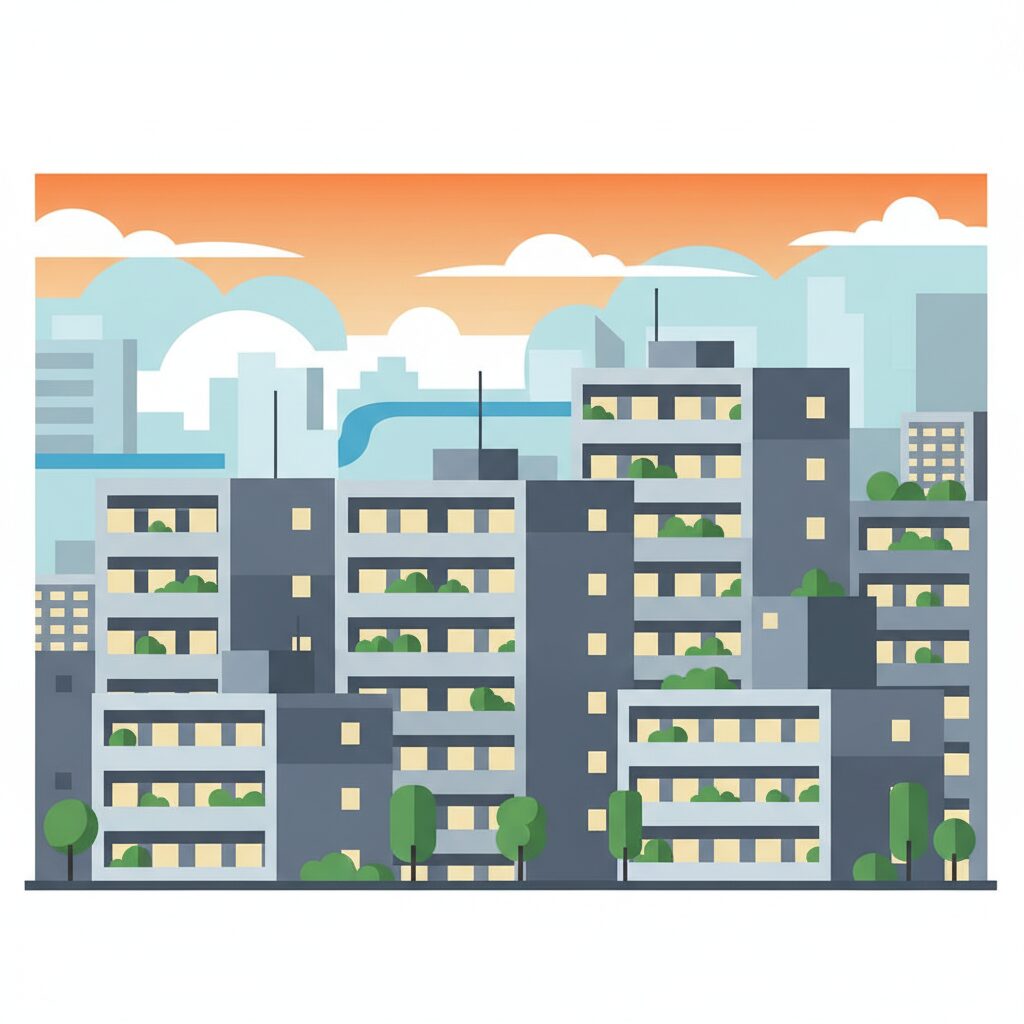
You see them from the train window, rolling out from the dense urban cores of Umeda or Namba. They rise from the plains in orderly rows, vast collections of concrete blocks, uniform and imposing. They are the danchi, Japan’s public housing complexes, and they form a distinct and unmissable part of Osaka’s landscape. For the uninitiated, they might look like forgotten relics of a bygone era, grim and utilitarian. The immediate question that forms in your mind is probably, “Who lives there, and why?” It’s a fair question. In a country obsessed with the new, these structures from the 1960s and 70s seem like an anomaly. But to dismiss them as just old, cheap housing is to miss a fundamental piece of the Osaka puzzle. These concrete giants are not just apartments; they are living ecosystems, time capsules of a hopeful past that are now being rediscovered by a new generation. They represent a different kind of urban dream, one built not on luxury and isolation, but on space, community, and a very Osakan sense of pragmatism. Understanding the danchi is understanding a deeper, more grounded layer of life in this city, far from the neon glow of Dotonbori. It’s a story about how people in Osaka actually live, day in and day out.
For readers intrigued by the interplay of social and economic forces in Osaka’s urban landscape, a closer look at the hidden costs of the shiki-biki rental system offers valuable context.
The Soul of the Showa Era in Concrete Form
More Than Just an Apartment
To understand the danchi, you need to go back to the post-war boom. Japan was rebuilding, and its cities were swelling with people seeking new jobs and new lives. The government had to provide housing quickly. The solution was the danchi. But this was more than just putting up four walls and a roof. The vision was, in a way, utopian. These were intended as self-contained “new towns,” small cities crafted for the modern nuclear family. Architects designed them with intention. Buildings were spaced widely apart, unlike the cramped private developments of today. In between, they planted trees and created expansive parks, playgrounds, and public squares. Each danchi complex included a shopping arcade, a clinic, a post office, and a school. The idea was that residents could live their entire lives within this community. It was a comprehensive package, representing a new middle-class ideal—a bright, clean, and modern life far from the cramped chaos of the old city. This design philosophy nurtured a distinct environment. The open spaces became communal living rooms where children played freely and neighbors naturally interacted—a stark contrast to the anonymous lobbies and long, silent hallways of modern high-rise manshon.
The Osaka Spin: Pragmatism Meets Community
This model fit seamlessly in Osaka. The city has always been known for its practical, straightforward approach. The danchi was the embodiment of function over form. It was efficient, affordable, and effective. It addressed a huge housing shortage while offering a quality of life that was revolutionary at the time. But Osaka’s embrace of the danchi went beyond mere functionality. The very design of these complexes reinforced a cultural emphasis on community that feels stronger here than in Tokyo. In Tokyo, you might live next to someone for a decade without ever learning their name. That level of anonymity is a source of pride for some. In Osaka, although people do value their privacy, there’s an underlying expectation of gokinjyo-zukiai, or neighborly relations. The danchi’s architecture made this inevitable in the best way. You encountered the same faces daily at the local co-op, on benches beneath the zelkova trees, or during the morning rush to the train station. This created a strong, if unspoken, social fabric. You knew who lived above you. You recognized the elderly woman in building C who tended the community rose bushes. You knew whose children played in the sandbox. This fostered a sense of collective ownership and safety that’s difficult to find in newer, more isolated housing developments.
The Danchi Revival: From Dated to Desirable
The UR Revolution and the Rise of Renovation
For many years, danchi were considered either as residences for the elderly or temporary housing for young families saving for a home. Over time, they aged, and the “new town” dream began to fade. But then a change occurred. The Urban Renaissance Agency, or UR, the public corporation managing a large portfolio of these properties, launched a major effort to modernize them. This went far beyond a simple facelift. They started stripping the interiors of vacant units and completely redesigning them for modern living. Walls dividing small, cramped rooms were removed to create bright, open-plan living-dining-kitchen areas. They installed sleek new bathrooms, system kitchens with gas cooktops, and air conditioning units. They recognized that the key attraction was the “hardware”—the solid concrete structures and the generous green spaces—but the “software” needed upgrading. This initiative reached new heights when UR partnered with brands like MUJI and IKEA. Suddenly, you could rent a danchi apartment with minimalist, thoughtfully designed interiors that looked like something from a lifestyle magazine. The concrete shell remained, but inside, it was a 21st-century home. This blend of vintage exterior and modern interior formed a fresh aesthetic and renewed appeal.
Why Young People and Foreigners are Moving In
This renovation wave coincided with changing preferences among younger generations and foreign residents. The attraction is multi-faceted. First and foremost is the financial aspect. Renting through UR is a revelation for anyone familiar with the typical Japanese rental process. There is no “key money,” that notorious non-refundable gift to landlords. There are no agent fees, no contract renewal fees, and for many properties, a personal guarantor is not required—an important barrier lifted for foreigners. The savings can equal several months’ rent, a truly game-changing factor. Secondly, there is the exceptional value in terms of space. For the same cost as a cramped one-room apartment in a new downtown building, you can often rent a two- or three-bedroom danchi unit featuring a proper balcony and ample storage. As someone who enjoys hiking and needs space to store gear, that extra room is invaluable. Lastly, the environment plays a big role. After a day in the concrete jungle of central Osaka, returning to a neighborhood filled with mature trees, chirping birds, and the sounds of children playing in a park is a refreshing contrast. It offers a balance between urban convenience and suburban peace that is increasingly rare and desirable.
The Reality Check: Living the Danchi Life
The Good, The Bad, and The Concrete
Naturally, the picture isn’t entirely perfect. Choosing a danchi involves trade-offs, so it’s important to stay realistic. The positives are truly significant. The sense of community is genuine. Many danchi hold annual summer festivals, mochi-pounding events for New Year’s, and have vibrant community centers. There’s a strong feeling of safety that comes from so many people looking out for each other. The neighborhoods tend to be quiet at night and are well-connected by bus to major train lines. On the downside, the age of the buildings presents some challenges. The concrete structures are sturdy, but they were constructed before modern insulation standards. This means they can be harshly cold in winter and oppressively hot in summer. Heating and cooling costs might be higher than anticipated. Sound insulation is also inconsistent; you may find yourself overhearing more of your neighbors’ daily routines than you’d like. Then there’s the concrete reality: many older five-story buildings lack elevators. If you’re considering a top-floor unit, be ready for a daily stair workout. It’s excellent for fitness, but less convenient when carrying a week’s worth of groceries.
Navigating the Unspoken Rules
Living in a danchi means integrating into an existing community, complete with its own formal and informal rules. The most well-known is garbage duty. Japan’s recycling regulations are notoriously complex, and strict compliance is crucial in a danchi. Garbage collection points are communal, and maintaining their cleanliness is a shared obligation. Some older complexes also use a toban system, a rotating duty roster for cleaning common areas like stairwells and corridors. Typically, this isn’t demanding—perhaps a quick sweep every couple of months—but it’s expected. Then there’s the jichikai, the neighborhood association. You’ll likely be invited to join and pay a small monthly fee, usually a few hundred yen. These funds support community festivals, grounds maintenance, and other local activities. While attending events is usually optional, membership in the jichikai is regarded as part of being a good neighbor. It acts as the engine that keeps the community functioning. For foreigners, these systems can seem intimidating, but they also offer an insightful window into how Japanese civil society operates on a small scale. It’s about shared responsibility for the common space you live in.
Osaka Danchi vs. The World: A Different Kind of Urban Living
Not Your Tokyo High-Rise
The danchi lifestyle offers a striking contrast to the prevailing image of urban living in Japan, especially that of Tokyo. The ideal home in Tokyo is often seen as a sleek, high-tech tower apartment equipped with auto-locking security gates, a concierge, and delivery boxes. The attraction lies in privacy, security, and a detached, anonymous sense of luxury. Residents pay a premium to avoid interaction with their neighbors. The Osaka danchi, on the other hand, represents the opposite. It’s somewhat rough around the edges, unpretentious, and encourages a level of social engagement. Its value lies elsewhere. It reflects the Osakan preference for jitsuri, or tangible, practical benefits. Why pay for a doorman you never speak to when you can enjoy a larger living space and a park right outside your door for half the cost? There is a mindset here that regards community as a valuable resource rather than an inconvenience. It’s a more communal and less isolated way of urban living, echoing Osaka’s history as a city of merchants who depended on tight-knit networks to prosper.
What Foreigners Often Miss
When foreigners first encounter a danchi, their viewpoint is often influenced by Western stereotypes of public housing, which tend to carry negative connotations. They see an old concrete building and might assume it’s run-down, undesirable, or unsafe. They overlook the history and pride many older residents feel toward these communities, which once represented the pinnacle of modern living. They may also feel daunted by the community responsibilities, viewing them as a burden instead of as a support system. In truth, neighborhood associations serve as an essential safety net. During typhoons, they check in on elderly residents; when you’re new to the area, they’re the ones who can recommend the best doctor. A common misconception is viewing the danchi merely as budget housing. While affordability is a factor, for many newcomers, choosing a danchi is a deliberate lifestyle decision. It’s a choice to sacrifice the polished anonymity of a new building in favor of more space, more character, and stronger human connections. It offers a way to experience a side of Japan that is rapidly fading in the ultra-modern centers of Tokyo.
Finding Your Concrete Castle in Osaka
If the danchi lifestyle appeals to you, you’ll find these communities clustered in the expansive suburbs surrounding the city. The most renowned are the “New Towns” constructed during the 60s and 70s. Senri New Town, located between the cities of Toyonaka and Suita in the north, was the first of its kind in Japan. It’s a vast, green area celebrated for its excellent parks and family-friendly environment. To the south, in Sakai, lies Senboku New Town, another large development with a similarly spacious, leafy atmosphere. These neighborhoods aren’t the bustling center of the city; they are peaceful and residential. Yet, they are well connected by train and bus lines that offer direct and convenient access to downtown areas. They provide a different pace of life. Choosing to live in a danchi ultimately depends on your priorities. If your ideal lifestyle includes the latest amenities, spotless interiors, and minimal contact with neighbors, then a modern manshon is likely your best choice. However, if you prioritize space over polish, seek a bit of greenery within the urban sprawl, and are open to seeing a home as part of a community rather than just a private space, then the modest danchi might be the most genuine, practical, and truly Osakan home you can find. It’s a strong, enduring option in a city that has always prized substance above all else.