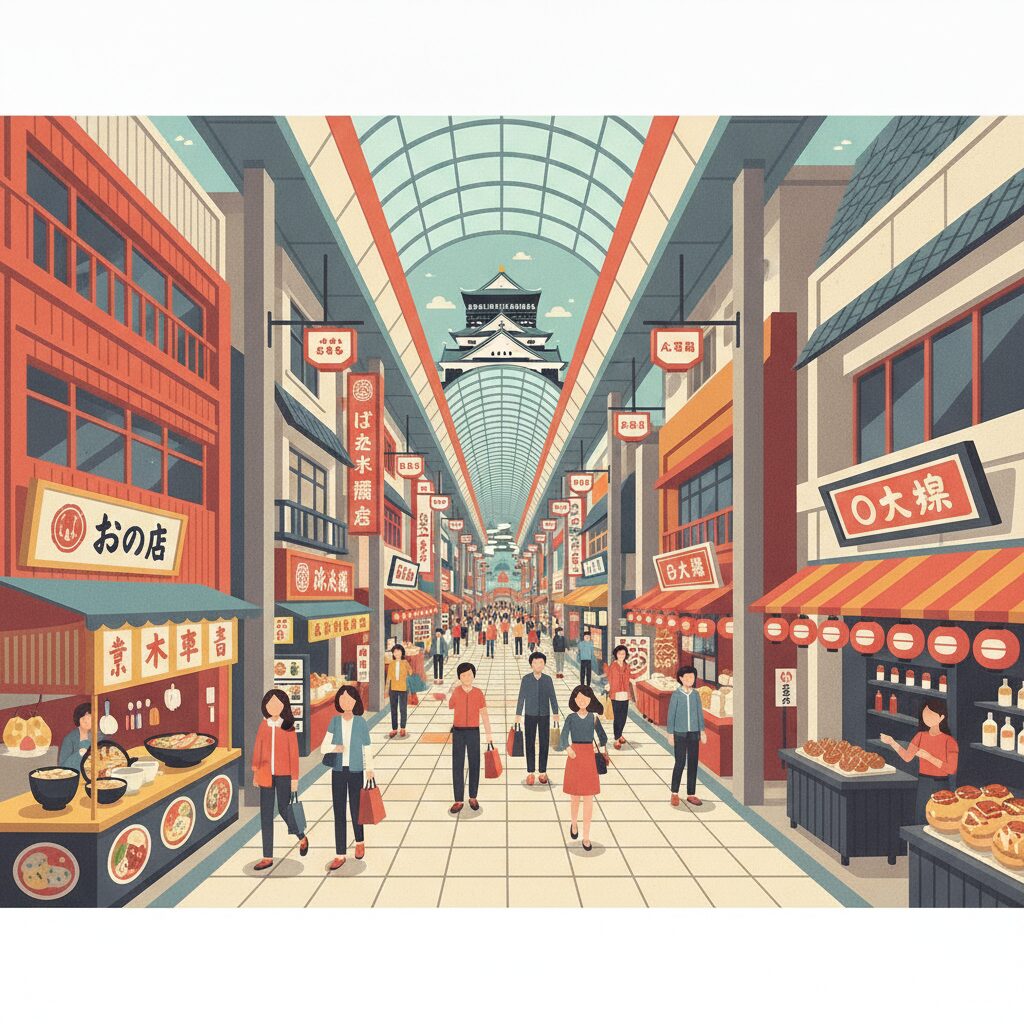
When I first moved to Osaka, the shotengai felt like a puzzle. These long, covered shopping arcades, stretching for blocks, were a riot of noise and color. Loud, gravelly voices hawked everything from bright red tuna to cheap pajamas. Bicycles weaved through crowds of shoppers with a casual precision that seemed to defy physics. My first thought, coming from a world of sleek malls and silent, one-click online shopping, was that this was all about the hustle. It was a place you went for a deal, a chaotic, old-fashioned marketplace where the primary goal was to save a few yen on your groceries. I saw it as a relic, a charming but ultimately transactional space fighting a losing battle against the convenience of the 21st century.
I was completely wrong. It took me months of walking these same streets, not as a bargain hunter but as a resident, to understand. The shotengai isn’t Osaka’s answer to Amazon. It’s the antidote. It’s not just a place to buy things; it’s a place to belong. These arcades are the city’s public living rooms, the arteries through which its unique, community-centric culture flows. They are where the abstract idea of Osaka being “friendly” becomes a tangible, daily reality. To understand the shotengai is to understand the social contract of Osaka itself—a world away from the polite, beautiful distance of Tokyo. It’s a place built on relationships, where commerce is the excuse for conversation, and every purchase is a small act of community building.
These dynamic communal spaces find a harmonious echo in local cafes where Kissaten serve as third places, further illuminating the vibrant social fabric of Osaka.
The Unspoken Contract: Commerce as Conversation
In much of the modern world, and certainly in other regions of Japan, a shopping trip is a task focused on efficiency. You enter, collect your desired items, pay a cashier who delivers a flawlessly polite but rehearsed greeting, and leave. The aim is to be seamless. In an Osaka shotengai, however, friction is intentional. The transaction serves merely as the basis for the interaction. It’s a performance, a ritual, and a conversation all at once.
It’s Not Just a Sale, It’s a Relationship
Observe the exchange at a local tofu shop. An elderly woman doesn’t simply point and pay. She leans on the counter. The shop owner, wiping her hands on her apron, inquires about the woman’s husband’s health. The customer comments on the sudden chill in the weather. The owner nods in agreement and then holds up a block of firm tofu. “This one’s especially good today,” she might say. “I’ll give you a nice big piece.” The purchase itself takes ten seconds. The conversation around it lasts a minute. That minute is everything.
This isn’t merely casual friendliness. It’s a deeply rooted aspect of Osaka’s merchant culture, a form of social glue. It distinguishes being a customer from being a neighbor. In Tokyo, customer service emphasizes impeccable politeness and maintaining respectful distance. In Osaka, service involves bridging that gap. It may feel almost intrusive to an outsider. The butcher might remark on how little you’re buying today, asking if you’re eating alone. The lady at the fruit stand might ask where you’re from and then mention she has a cousin who visited your country thirty years ago. This isn’t an invasion of privacy; it’s an invitation. It’s a way of saying, “I see you. You are a person in this neighborhood, not just a source of revenue.”
The Language of the Deal: Banter, Not Bargaining
A frequent question from foreigners is, “Can you haggle in the shotengai?” The answer requires nuance. This isn’t a bazaar where you’re expected to lowball the first offer. Attempting to do so would likely provoke confusion or even offense. The “deal” in an Osaka shotengai isn’t achieved through negotiation; it’s earned through loyalty.
The true bargain is the omake—the small extra something the shopkeeper adds for free. You buy five croquettes, and the owner slips in a sixth. You buy a bag of oranges, and she includes a persimmon that’s perfectly ripe. This isn’t a discount; it’s a gift. It’s a gesture of recognition, a reward for being a regular, a jouren-san. It says, “Thank you for choosing my shop instead of the large supermarket down the road.” This small act strengthens the relationship, transforming a simple purchase into a moment of mutual appreciation.
The soundscape also plays a role in this agreement. The constant calls of “Irasshai, irasshai!” (Welcome!) and “Yasuide, yasuide!” (It’s cheap!) are more than advertisements. They are the ambient rhythm of the street, a declaration that this is a place of active, living commerce. You’ll hear the iconic Osaka business greeting, “Mokarimakka?” (Making any money?), followed by the typical, self-deprecating reply, “Bochi bochi denna.” (So-so, bit by bit.) This exchange is pure performance. It’s not a genuine inquiry into financial status. It’s a cultural script that reaffirms shared identity and mutual understanding of a merchant’s life. It’s a way of connecting through the shared language of commerce.
A Living Ecosystem, Not a Curated Mall
Modern shopping malls exemplify corporate curation. Each store is carefully selected to align with a brand identity, ensuring a seamless and predictable experience. A shotengai, however, is quite the opposite. It is a chaotic, sometimes illogical, yet deeply human ecosystem that has evolved organically over decades. Its makeup directly reflects the community it serves.
The Anatomy of a Shotengai
Stroll down any major shotengai, and you’ll witness this charming disorder. A generations-old seaweed shop, with its earthy, oceanic aroma, stands beside a brightly lit drugstore chain. Nearby, a small stall sells handmade warabi mochi, right next to a pachinko parlor flashing with noisy lights. There’s the fishmonger, the butcher, the greengrocer—the cornerstones of daily Japanese home cooking. But you’ll also find a trendy third-wave coffee shop run by a young couple, a 100-yen store, and an old-fashioned lingerie shop displaying beige undergarments that appear unchanged since the 1970s.
This assortment isn’t by design; it has developed naturally. It meets the needs of everyone in the neighborhood. The elderly resident can purchase pickles and fish. The young family can find diapers and vegetables. The student can grab an affordable meal. This diversity is its greatest strength. Unlike malls that target specific demographics, the shotengai aims to serve an entire community, in all its messy, multi-generational complexity. Some shops prosper, others close, and new ones open. This constant flux makes the street feel alive—an ongoing project rather than a completed product.
The Shotengai as a ‘Third Place’
Sociologists describe the “third place” as a space separate from home (the first place) and work (the second place), where people gather, connect, and build community. For many Osakans, especially older generations, the shotengai represents the ultimate third place. It’s more than just a shopping arcade; it’s the neighborhood’s main social hub.
You see this everywhere. Two grandmothers might stop their carts mid-arcade, blocking traffic without concern, to catch up on the latest gossip. During quiet moments, a shopkeeper might wander over to chat with the neighboring store owner. Children, heading home from school, use the covered street as their playground. It’s a safe, familiar, and supervised space.
This is why a trip to the shotengai can take an hour, while grocery shopping at a supermarket might take only fifteen minutes. The purpose isn’t solely efficiency. It’s about seeing familiar faces, exchanging a few words, and sensing the rhythm of your neighborhood. You’re not an anonymous shopper pushing a cart through a sterile aisle—you’re an active part of a living community. This intentional inefficiency is exactly what makes the shotengai vital to Osaka’s social fabric.
Navigating the Social Rules: A Guide for Newcomers
For a foreigner, entering this world can feel daunting. The rules are unwritten, conversations move quickly, and the language is thick with the local dialect. However, becoming part of this community isn’t as difficult as it appears. It simply requires shifting your focus from efficiency to engagement.
How to Become a ‘Regular’ (Jouren-san)
Becoming a familiar face, a jouren-san, is the key to truly experiencing the shotengai. It’s a status earned gradually through small, consistent efforts.
First, pick your favorite spots and remain loyal to them. Choose one fruit stand, one butcher, and one tofu shop. Visit them repeatedly. Shopkeepers have remarkable memories for faces. By your third or fourth visit, you will no longer be seen as a stranger.
Second, engage. Fluency in Japanese isn’t necessary. Start with a cheerful “Konnichiwa!” when you arrive and a clear “Arigatou gozaimasu!” when you leave. Then, move on to simple remarks about the weather. “Atsui desu ne.” (It’s hot, isn’t it?) Next, try asking for a recommendation. “Kyou no osusume wa nan desu ka?” (What do you recommend today?) This shows you trust their expertise and value their opinion, transforming you from a passive buyer into an active participant.
Third, show that you remember. If the butcher suggested a particular cut of pork, tell him the following week that it was delicious. This simple gesture of closing the loop is incredibly meaningful. It confirms that the interaction mattered. It’s not just about politeness; it’s about demonstrating your investment in the relationship, however small. In Osaka, this is the currency that counts most.
What Foreigners Often Get Wrong
There are a few cultural pitfalls for newcomers. The first is misinterpreting Osaka’s directness. A shopkeeper might bluntly say, “Anata, chotto tsukareteru nchau?” (You look a bit tired, don’t you?) For those used to more indirect communication, this can seem rude. It’s not. It’s a sign of familiarity. It means they see you well enough to notice how you’re feeling. It’s a form of connection, very different from the formal, impersonal politeness found elsewhere.
Another common mistake is clinging to anonymity. In a large Tokyo supermarket, you can be a ghost, interacting only with a self-checkout machine. In an Osaka shotengai, trying to do this feels strange and cold. Your presence is noticed. Your habits are observed. Embracing this visibility is essential. Smile, make eye contact, offer a greeting. Resisting it is like refusing to dance at a party—you can do it, but you’ll miss the whole point.
Finally, avoid treating the shotengai like a tourist attraction. While some, such as Kuromon Market, have become major tourist spots, most are working marketplaces and community centers. Walking slowly down the middle of the aisle snapping photos and treating shopkeepers and their goods as quaint photo opportunities without buying anything breaks the social contract. These are proud vendors, not museum exhibits. Be a participant, not just an observer. Buy a single orange, a fresh croquette, or a small bag of tea. Engage with the space on its own terms—as a place of commerce and community.
The Shotengai’s Future in a Changing Osaka
It would be misleading to present an entirely rosy picture. Many shotengai are facing difficulties. They are under immense pressure from chain supermarkets, large drugstores, and the unavoidable convenience of online shopping. This struggle is visible in the growing number of closed storefronts, sometimes sadly referred to as “shutter-gai.” The shopkeepers are aging, and often their children pursue different career paths.
However, declaring the shotengai a dying breed underestimates Osaka’s pragmatism and resilience. Those that succeed are the ones embracing their unique strengths. They don’t try to compete with Amazon on price or convenience. Instead, they provide something that can’t be packaged and shipped: human connection. They organize local festivals, offer specialty products unavailable elsewhere, and deliver a personal touch that no algorithm can replicate.
More and more, younger entrepreneurs recognize the value of these spaces. They are opening modern bakeries, specialty coffee shops, and craft beer bars in old, neglected storefronts, attracted by the low rents and the inherent community atmosphere. They are revitalizing the old arcades, blending retro charm with contemporary sensibilities.
Thus, the shotengai is not a static relic of the past. It is an evolving model for a more human-centered urban lifestyle. In an era marked by growing isolation and digital anonymity, it stands as a resilient, vibrant testament to the importance of face-to-face interaction. It’s a place where you are more than just a data point or consumer — you are a neighbor. It is the noisy, chaotic, warm-hearted, and stubbornly beating heart of Osaka.