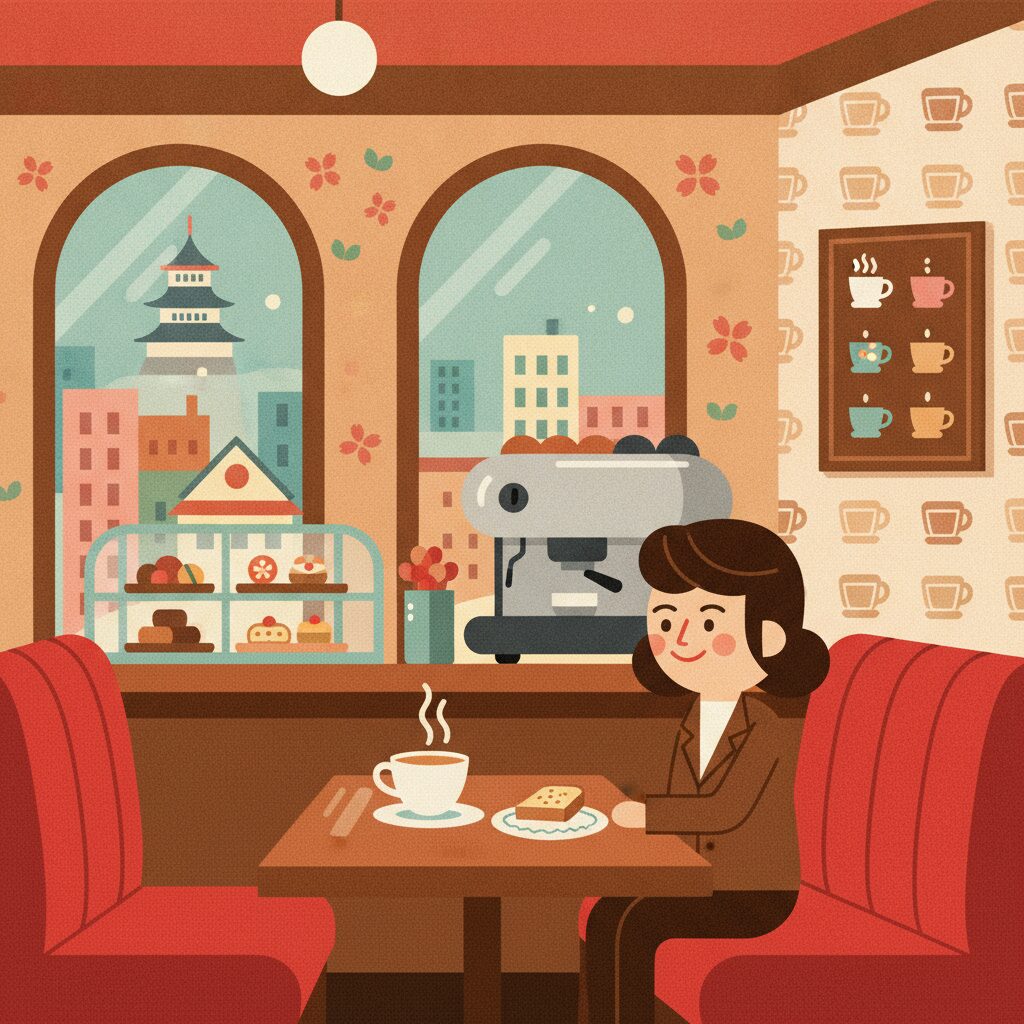
When I first moved to Osaka, I walked past them every day. Tucked between gleaming convenience stores and modern apartment buildings, these little shops felt like relics from another time. Faded awnings, plastic food models in the window showcasing a perfectly unnatural-looking melon soda, and dark, wood-paneled interiors I could only glimpse from the street. They were called kissaten, coffee shops, but they looked nothing like the bright, airy cafes I knew. They seemed quiet, a little intimidating, and always filled with the same older gentlemen reading newspapers through a haze of cigarette smoke. My initial thought was simple: Are these just old-fashioned coffee shops for retirees? It took me months to understand that I wasn’t just looking at a place to get caffeine. I was looking at the living rooms of Osaka’s neighborhoods.
These kissaten are the city’s true “third places”—a term sociologists use for the crucial anchors of community life that exist between the first place (home) and the second place (work). While you can find this concept anywhere in the world, in Osaka, it’s not found in sleek coworking spaces or trendy bars. It lives and breathes in these Showa-era time capsules. This is where the city’s rhythm slows down, where conversations unfold without a deadline, and where community isn’t an abstract idea but a tangible reality built over countless cups of coffee. To understand Osaka, you have to understand why a decades-old kissaten with velvet chairs and a gruff but kind “Master” behind the counter is more vital to its neighborhood than any shiny new Starbucks. It’s a window into the city’s unpretentious, deeply human soul.
Moreover, the city’s communal spirit is mirrored in its bustling business districts where the salarymen’s lunch culture offers another intimate glimpse into Osaka’s enduring traditions.
Not a Cafe, It’s a Community Hub
Step into a typical third-wave cafe in any major city, and you’ll encounter a familiar scene: people wearing headphones, typing rapidly on laptops, accompanied by a quiet hum of productivity. The interaction is transactional and efficient. You order, pay, find a plug socket, and isolate yourself. An Osaka kissaten operates on a completely different social frequency. It’s not a workspace; it’s a social hub. The primary product being sold isn’t coffee; it’s a sense of belonging.
The “Master” and the Regulars: An Unspoken Contract
At the heart of every kissaten is the owner, universally called the “Master.” This is more than a title; it’s a role. The Master is the conductor of the neighborhood orchestra. They are part barista, part therapist, part community bulletin board, and part guardian of local culture. They know who recently had a grandchild, whose business is faltering, and who takes their coffee with exactly one sugar and a splash of cream. They’ve stood behind that same counter for thirty, maybe forty years, watching the neighborhood evolve and the children of their first customers grow up.
This relationship is forged with the jyouren, the regulars. These are not merely repeat customers; they form the foundation of the establishment. They have their designated seats and their usual orders etched in the Master’s memory. Their presence brings a steady, predictable rhythm to the day. For them, the kissaten is an extension of their home—a place to start the day, take a break, catch up on local gossip, or simply sit in comfortable silence among familiar faces. This creates an unspoken pact: the regulars provide stable business, and in return, the Master offers a stable, welcoming space where they feel known and valued. It’s a dynamic that a chain cafe, with rotating staff and a focus on efficiency, could never replicate.
The Sound of an Osaka Kissaten
Forget the curated indie-pop playlist. The soundtrack of an Osaka kissaten is a rich mosaic of life itself. It’s the clatter of ceramic cups on saucers, the rustle of a sports newspaper being folded, the low hum of a television in the corner, almost certainly tuned to a Hanshin Tigers baseball game or a daytime talk show. Above all, it’s the sound of conversation. Not just any conversation—it’s the sound of Osaka-ben, the local dialect. It’s faster, more direct, and more expressive than standard Japanese. You’ll hear laughter, passionate debates about baseball, and quiet, serious discussions between business partners.
This is essential for any foreigner trying to understand the city. You don’t learn about Osaka by reading guides; you learn about it by listening. In a kissaten, you’re immersed in the city’s unfiltered dialogue. You observe how people interact, joke, and complain. It’s a live language lesson and a cultural studies class combined. The atmosphere is not one of hushed reverence for coffee; it’s a lively, sometimes chaotic, and always deeply human buzz. It’s the sound of a community checking in with itself.
The Kissaten Economy: More Than Just a Morning Set
From the outside, it’s easy to question how these establishments manage to stay in business. The prices are low, and customers often linger for hours. This is where a foreigner’s perspective on a cafe’s business model can lead to a complete misunderstanding of the kissaten. Its economic foundation rests on ritual and loyalty, not rapid turnover.
A Place for Business and Pleasure
The well-known “Morning Service” or mo-nin-gu is a key element of the kissaten economy. For the price of a single cup of coffee, you receive a small meal: thick toast, a boiled egg, and occasionally a small salad or yogurt. In a city known for its practical, value-conscious residents, this is an unbeatable offer. But it’s more than just an affordable breakfast. It’s a daily ritual that centers the entire neighborhood. It’s where retirees gather for their first social interaction of the day. It’s where local shop owners meet before opening their shops. It’s where salesmen in suits fuel up before their first client meeting.
Throughout the day, the kissaten acts as an unofficial office and meeting space for the community. Small business deals are closed with a handshake over tables cluttered with ashtrays and empty coffee cups. Friends meet to catch up, escaping the confines of their small apartments. It’s neutral ground, a comfortable and affordable place for all of life’s little negotiations and celebrations. It serves as an essential part of the local economic ecosystem, supporting the small-scale commerce and social bonding that keep a neighborhood connected.
The Art of Lingering: No Pressure to Leave
Perhaps the most unfamiliar idea for those used to modern city cafes is the art of lingering. In a busy cafe in New York or London, overstaying your welcome after finishing your drink can earn you a cold glance. There’s a constant, unspoken pressure to either order more or leave. In an Osaka kissaten, this pressure is completely absent. In fact, lingering is the entire point.
It’s perfectly acceptable to savor a single 400-yen coffee for two hours while reading the entire newspaper the shop provides. No one will disturb you. The Master understands that they are offering more than just a drink; they are offering a space. This is possible because the business isn’t based on maximizing revenue per square foot per hour. It’s built on the lifelong loyalty of regular customers. Profits from the busy morning rush of jyouren subsidize the quiet afternoons when a student can study for hours or a retiree can simply watch the world go by. This relaxed pace is an intentional feature, not a business flaw. It’s a quiet resistance against the relentless speed of modern urban life, a sanctuary of slowness in an ever-moving city.
Osaka vs. Tokyo: A Tale of Two Coffee Cultures
To truly understand the role of the kissaten in Osaka, it’s helpful to compare it with the cafe culture of Tokyo. While both cities boast a mix of traditional and modern cafes, their overall atmospheres feel completely different, reflecting the deeper cultural distinctions between Japan’s two major metropolises.
Functionality vs. Personality
Tokyo’s cafe scene often centers around aesthetics and specialization. You’ll find minimalist sanctuaries dedicated to third-wave coffee, where the bean’s origin is treated with the reverence reserved for fine wine. There are also ultra-stylish spaces perfect for Instagram, designed for a chic, cosmopolitan crowd. Additionally, functional cafes intended for solo work, with every seat facing a wall and equipped with power outlets, are common. While the experience can be refined, it may also feel impersonal and distant. The focus is on enjoying the coffee or getting work done, rather than fostering connections with others.
In contrast, Osaka’s kissaten culture emphasizes personality. The decor is not minimalist but accumulated—a mix of mismatched furniture, vintage posters, photos of regulars, and perhaps a dusty trophy from a local baseball league, all gathered over decades. Its charm lies not in sleek design but in authenticity. It feels lived-in because it truly is. The coffee is typically a simple, dark-roast blend, strong and straightforward, much like the city itself. You don’t visit for a lecture on Nicaraguan tasting notes; you come to feel at home. The kissaten has a soul, a unique personality shaped by its Master and its patrons over many years.
The “Kecchi” but Generous Spirit
There is a common stereotype that people from Osaka are kecchi, meaning stingy or frugal. It’s true that Osakans appreciate a good deal—the city’s entire commercial history is built on shrewd merchants. The widespread popularity of the “Morning Service” demonstrates this practical mindset. Why pay for coffee and breakfast when you can get both for the price of one? This pragmatism is often misinterpreted as mere cheapness by outsiders.
Yet, within the kissaten, you see the other side of this coin: a profound generosity. The kecchi attitude is about seeking value, but value isn’t only financial. It’s also about human connection. The Master who remembers your usual order delivers value. The regular who shares a piece of their newspaper offers value. The small plate of complimentary crackers (otsumami) that comes with your coffee embodies this spirit. It’s a small gesture, a service, that says, “We’re glad you’re here. Stay awhile.” This mix of frugal pragmatism and warm, informal generosity captures the essence of Osaka’s character. The kissaten is where this spirit shines most brightly.
How to Navigate an Osaka Kissaten Like a Local
For a foreigner, stepping into a traditional kissaten for the first time can feel like barging into a private gathering. The air is thick with smoke, all eyes may briefly turn to you, and the menu might be a handwritten scroll of kanji. However, overcoming that initial hurdle is the key to a genuinely rewarding local experience.
Decoding the Unspoken Rules
First, be mindful of the smoking. Many old-fashioned kissaten proudly hold on to the era when smoking indoors was common. If you’re sensitive to smoke, look for a sign outside or take a quick glance inside before committing. For many regulars, coffee and a cigarette form an inseparable ritual.
Upon entering, the Master will likely greet you warmly with an “Irasshai!” and indicate an open seat. Don’t hesitate to sit at the counter, often the best spot to watch the Master in action. The menu is typically simple. The house “blend coffee” (burendo kōhii) is always a reliable choice. For something uniquely Osakan, try the “mix juice” (mikkusu jyūsu), a sweet, creamy blend of fruits and milk that locals adore. Ordering is straightforward, and no one expects perfect Japanese.
Regarding payment, the system can differ. Sometimes you pay when your coffee arrives, but more often, you receive a small bill to take to the register near the door when you’re ready to leave. Just observe what others do, and you’ll catch on quickly. The most important rule is to relax. Don’t rush. You’re on kissaten time now.
Stepping Out of Your Comfort Zone
My advice is to be bold. Choose the one that looks the oldest and most intimidating. The one with the noren curtain so faded the name is barely readable. That’s where you’ll find the most authentic experience. These aren’t tourist spots; they’re active community hubs that just happen to serve coffee. As a foreigner, you might be a novelty, but a polite smile and genuine interest in the space are almost always met with warmth and curiosity.
Don’t enter expecting conversation. Come with the intention to listen and observe. Nurse your coffee. Read a book. Watch the interactions between the Master and regulars. Feel the unique, unhurried rhythm of the place. This is your chance to witness the real Osaka, the city beyond the bright lights of Dotonbori and the tourist crowds at Osaka Castle. It’s in these quiet, smoke-filled rooms that you can truly begin to sense the city’s heartbeat.
Ultimately, a kissaten is much more than a coffee shop. It’s a time capsule, a living museum of the Showa era, and a testament to a lifestyle that values community over convenience and character over polish. It’s where the hectic energy of one of Japan’s largest cities fades, replaced by a slower, warmer, more human pace. To understand why people love living in Osaka and what makes its spirit so distinct from Tokyo’s, you need to look beyond the well-known landmarks. You have to find a small, unassuming kissaten in a quiet neighborhood, take a seat, and simply be. In the simple act of drinking a cup of coffee, you’ll discover the entire story of the city.