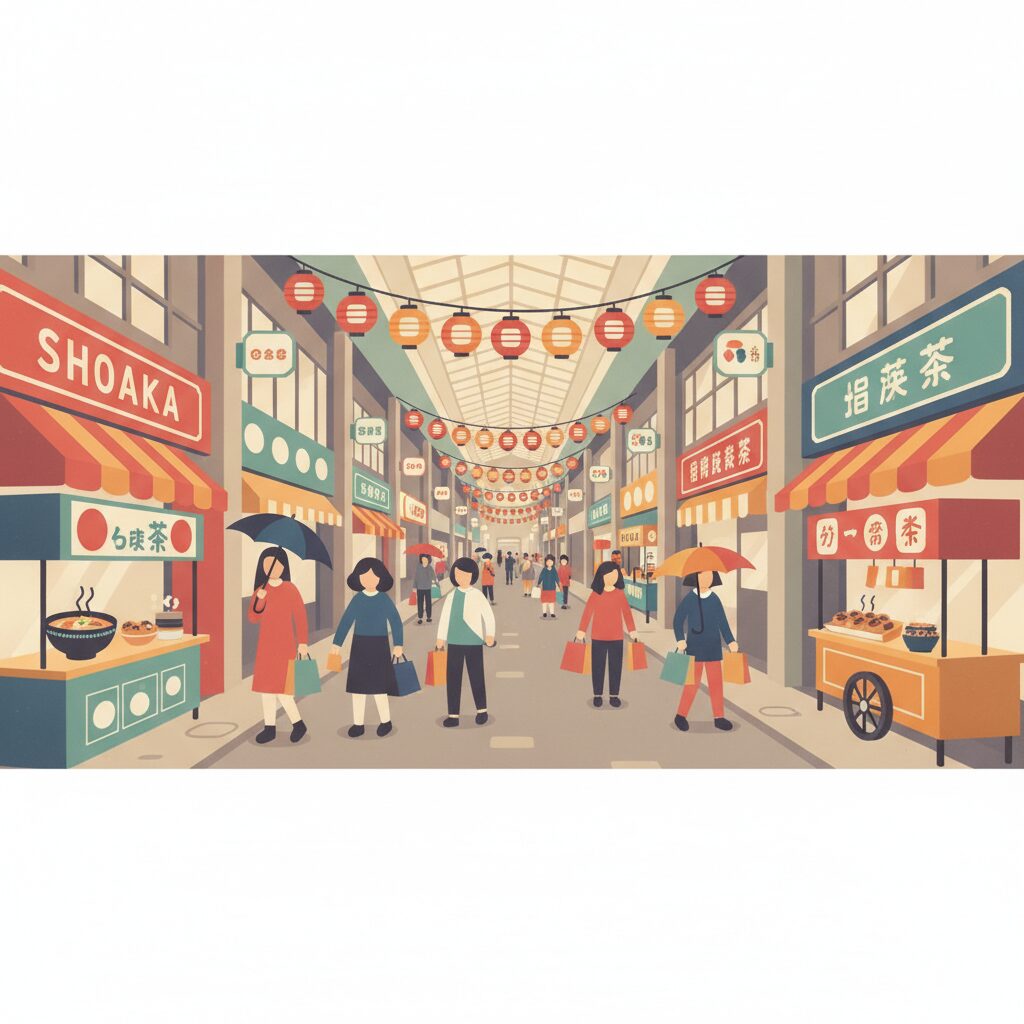
When you first move to Osaka, you notice the city’s unique textures almost immediately. It’s not just the grand scale of Umeda’s skyscrapers or the electric glow of Dotonbori. It’s something more grounded, more human. You’ll be walking down a perfectly normal residential street, quiet and orderly, when you suddenly stumble upon it: a long, covered arcade buzzing with a different kind of energy. A chaotic, vibrant, and utterly captivating world-within-a-world. This is the shotengai, the local shopping arcade, and it’s far more than just a place to buy your groceries. To the uninitiated, it might seem like a relic, a chaotic jumble of old shops and noisy vendors. But to understand the shotengai is to understand the very pulse of daily life in Osaka. It’s the city’s communal living room, its kitchen, and its front porch all rolled into one. Forget what you think you know about Japanese retail—the silent, pristine department stores or the hyper-efficient convenience stores. The shotengai operates on a different set of rules, a social code written over generations of commerce and conversation. It’s here, under these weathered roofs, that the true character of Osaka reveals itself: pragmatic, personal, and profoundly community-oriented. If you really want to know how this city works, how its people connect, and why it feels so fundamentally different from Tokyo, your education starts right here.
For readers eager to uncover more about Osaka’s vibrant social scene, our standing bars guide offers an engaging look at how these intimate venues quickly become catalysts for friendship.
The Anatomy of a Shotengai: A World Under One Roof
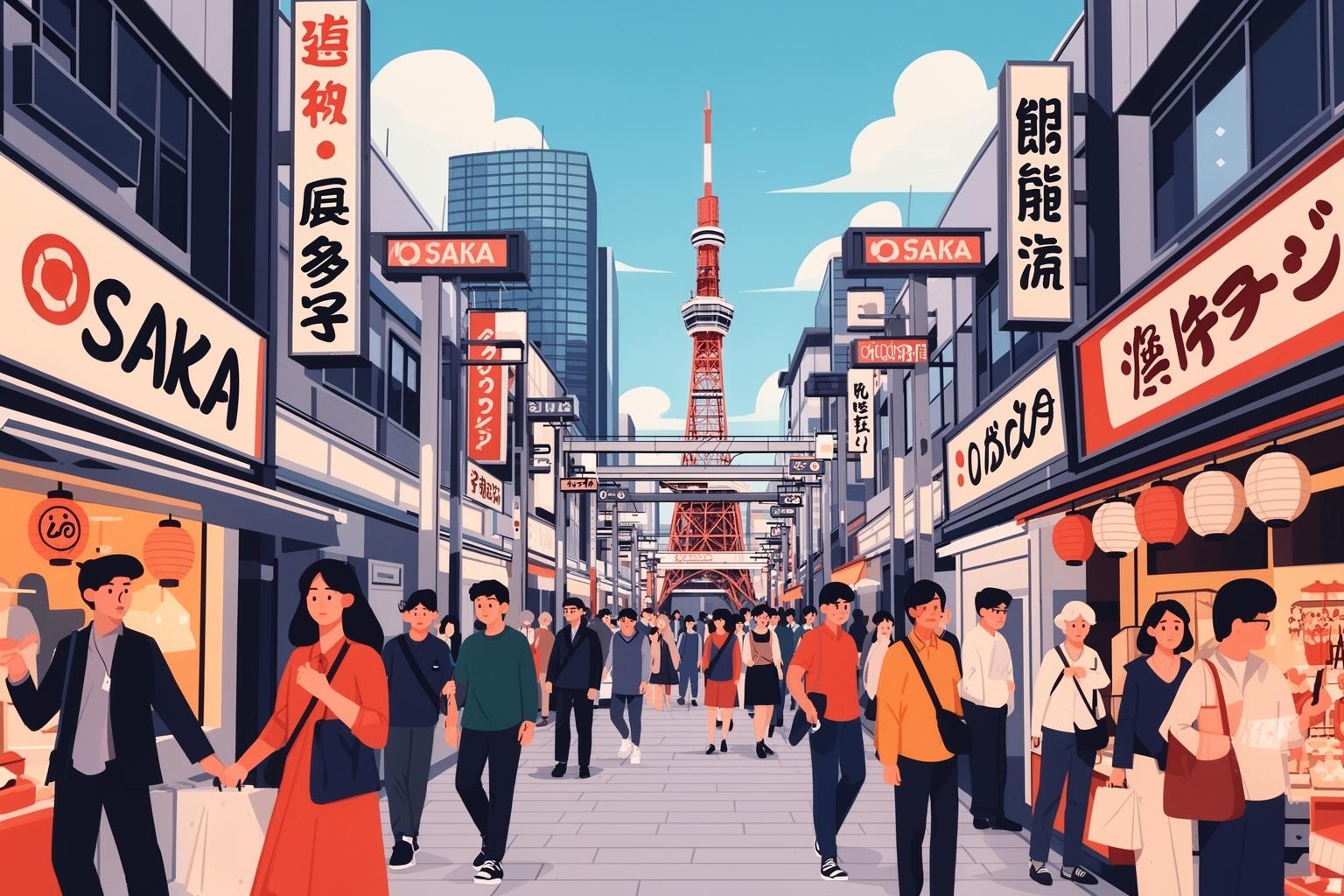
Step into a typical Osaka shotengai, and the first thing that strikes you is the vibrant density of life. It’s a sensory delight in the best sense. This isn’t a curated collection of boutiques; it’s an expansive, organic ecosystem encompassing everything a neighborhood could possibly require. The physical structure plays a crucial role—the iconic arched roof, or ākēdo, is a functional masterpiece. It forms a semi-public space, protecting visitors from Osaka’s scorching summer heat, sudden rain showers, and cold winter winds. Life here doesn’t halt because of the weather. You’ll see elderly couples on their daily walks, mothers with strollers, and schoolchildren chasing one another, even as a typhoon might be raging outside. This climate-controlled thoroughfare serves as a lifeline, an all-weather town square where everyday routines unfold comfortably.
More Than Just Shops: The Mix is the Magic
The true brilliance of the shotengai lies in its seemingly chaotic, yet perfectly sensible, blend of tenants. There’s no strict zoning here. A small, family-run stall selling freshly made tofu and aburaage might sit right beside a modern drugstore illuminated by bright fluorescent lights. Nearby, a butcher with a lightly stained white apron skillfully chops meat while chatting with a customer he’s known for decades. Further along, you’ll find a greengrocer with produce stacked high in artful, precarious arrangements, a shop selling crunchy senbei rice crackers, a dusty bookstore, a small clinic, and perhaps even a pachinko parlor, whose doors open with a sigh, releasing a cacophony of electronic sounds and cigarette smoke. Scattered among these staples are Showa-era coffee shops known as kissaten, where elderly patrons read newspapers over weak coffee and thick toast, alongside newer, trendy bubble tea stands appealing to younger crowds. This isn’t a mall designed by committee; it’s a living organism that has evolved over decades to meet the genuine, unvarnished needs of the local community. People don’t just come here to buy one thing; they come here to live their lives.
A Symphony of Sounds and Smells
Close your eyes for a moment in a shotengai, and you can orient yourself by sounds and scents alone. There’s the rhythmic clatter of metal shutters being rolled up in the morning. The sizzle and sweet, savory aroma of stalls frying korokke (potato croquettes) and menchi katsu (minced meat cutlets) fill the air—an unmistakable scent that serves as the unofficial fragrance of the Osaka shotengai. You’ll hear the cheerful, repetitive jingles of different shops, each one a distinct audio signature. Above it all rises the voices—not the hushed, polite tones of a Tokyo department store, but a lively chorus of human interaction. Vendors’ calls of “Irasshai!” (Welcome!) ring out energetically, but more common is the ubiquitous “Maido!”, a merchant’s greeting roughly meaning “Thanks, as always,” a verbal shorthand recognizing an ongoing relationship. These sounds embody the spirit of community commerce.
The “Osaka Way” of Commerce and Communication
If Tokyo‘s customer service is characterized by flawless, almost robotic precision and formality, Osaka’s approach is defined by personality and pragmatism. The interactions in a shotengai go beyond simple exchanges of money for goods—they are conversations, negotiations, and affirmations of social connections. This is often what foreigners, used to a more anonymous style of shopping, find either charming or somewhat perplexing. The unspoken rule here is that business is personal. You’re not just a customer; you’re Tanaka-san from down the street, the one whose son just started elementary school.
The Art of the Chat: Business as Conversation
Watch closely and you’ll notice it everywhere. A woman buying fish might spend five minutes discussing the best way to cook it with the fishmonger. The owner of the fruit stand will inquire about an elderly customer’s husband’s back. This isn’t idle chit-chat; it is the glue that holds the local economy together. Trust serves as the primary currency. People frequent these shops not necessarily because they are the cheapest, but because they have a relationship with the person behind the counter. That person knows their preferences, offers reliable advice, and treats them like a neighbor, not just a customer. This stands in sharp contrast to the efficiency-driven, minimal-interaction model typical of supermarkets or online retailers. In the shotengai, the human connection is part of the experience.
Haggling? Not Really. Value? Absolutely.
A common misconception about Osaka’s merchant culture is that it revolves around aggressive haggling. While Osaka residents are famously value-conscious (meccha kechi ya na!—“so stingy!”—often said with a peculiar sense of pride), the shotengai isn’t a bazaar where you are expected to lowball every price. The true art lies in the subtle dance of value and loyalty, best illustrated by the concepts of sābisu and omake. Sābisu—derived from the English word “service”—usually means something is free, a little extra added in. Omake is a bonus, a gift. Buy five tomatoes, and the vendor might throw in a sixth for free, saying “Kore wa omake!” This isn’t a discount to be demanded; it’s a gesture of goodwill offered by the seller to a regular or friendly customer. It conveys, “I appreciate your business, so here’s a little something extra.” It turns a simple purchase into a positive social exchange and encourages you to return next week.
Shotengai vs. The Mall: The Soul of the Neighborhood
Osaka boasts numerous large, gleaming shopping malls. Locations like Grand Front in Umeda or Namba Parks are architectural wonders, packed with international brands, immaculate food courts, and an atmosphere of polished anonymity. They are convenient, comfortable, and cater to the modern, globalized shopper. Yet, the shotengai not only endures but flourishes alongside them, as it fulfills a fundamentally different role. The mall serves as a place for consumption; the shotengai is the heart of a community.
A Human-Scale Economy
When you spend money in a shotengai, you’re engaging in a genuinely local, human-scale economy. The person selling to you is often the owner, and their family may have operated that same shop for two or three generations. The money doesn’t flow to a distant corporate office; it remains within the neighborhood, covering the shopkeeper’s groceries, their children’s school supplies, or perhaps a beer at the local izakaya after work. There’s a clear connection between your purchase and the community’s well-being. These streets stand as proof of the resilience of small, independent businesses. They might show signs of wear—the paint could be chipped, the signage faded—but this patina represents authenticity and history, not neglect. It physically symbolizes that the neighborhood has a past and a story.
The Unspoken Social Safety Net
Perhaps the shotengai’s most vital role, and one that often goes unnoticed by casual visitors, is its function as a passive social safety net. In an aging society like Japan’s, social isolation, especially among the elderly, is a serious issue. The shotengai offers an essential, informal network of care. For many seniors, the daily walk through the arcade is a ritual. It provides light exercise, social interaction, and most importantly, visibility. The butcher, the tofu maker, the pharmacist—they all recognize their regular customers. If an elderly patron misses a day or two, someone notices. Someone might call or ask a neighbor to check in. It’s a low-tech yet highly effective system of community monitoring. Likewise, children walking home from school often cut through the arcade, surrounded by familiar, watchful eyes. It’s a safe space, a shared environment where the unspoken rule is: we look out for each other here.
What This Means for You, the Foreign Resident

For anyone wanting to build a life in Osaka and genuinely connect with the city, the shotengai is more than just a resource; it’s a roadmap. It can seem intimidating at first, with its tight spaces and rapid-fire Japanese. But once you break through that initial barrier, you’ll discover the true Osaka.
Finding Your “Third Place”
Sociologists describe the “third place” as a spot that is neither home (the first place) nor work (the second place), where people gather to connect and build community. For many Osakans, the shotengai serves as that place. As a foreign resident, you can claim it as your own, too. The key is to break the habit of anonymous consumption. Instead of shopping at a different supermarket every week, find a shotengai nearby and start becoming a regular. Choose a fruit stand, a butcher, or a bakery. Visit there consistently. Make eye contact. Learn the owner’s name. Use your simple Japanese—a “Konnichiwa” when you arrive, an “Oishikatta desu!” (It was delicious!) the next time you visit. It might feel awkward at first, but this is the entry price for becoming part of the neighborhood fabric. Soon enough, your “Konnichiwa” will be met with a warm “Maido!”, and you’ll know you’ve been accepted.
Decoding Osaka’s “Friendliness”
The cliché that “Osaka people are friendly” can be misleading. It’s not the bubbly, unconditional friendliness you might expect. Rather, it’s a practical, relationship-based friendliness rooted in the merchant culture. An Osakan might not smile at you for no reason on the subway, but the shopkeeper you visit every week will remember you, ask about your day, and give you an omake. Their friendliness is earned through mutual recognition and active participation in the community. It’s about creating a pleasant and functional society through a network of small, daily interactions. Understanding this helps you navigate the social landscape. You’ll realize that building connections here is an active process—a series of small deposits into a community bank of goodwill.
A Living History Lesson
Lastly, embracing the shotengai means embracing Osaka in all its unpolished glory. These arcades are living museums. They embody the history of the post-war economic boom, the challenges of shifting demographics, and the resilience of local culture. They are not sanitized tourist attractions. Sometimes gritty, a little loud, and wonderfully unapologetic, they are real. When you choose to shop there, you’re not just buying groceries. You’re investing in a way of life. You’re supporting a system that values human connection over corporate efficiency. You’re learning to see the city not as a collection of landmarks, but as a vast, interconnected network of neighborhoods, each with its own rhythm, character, and heart, beating strongest right beneath the shotengai’s roof.