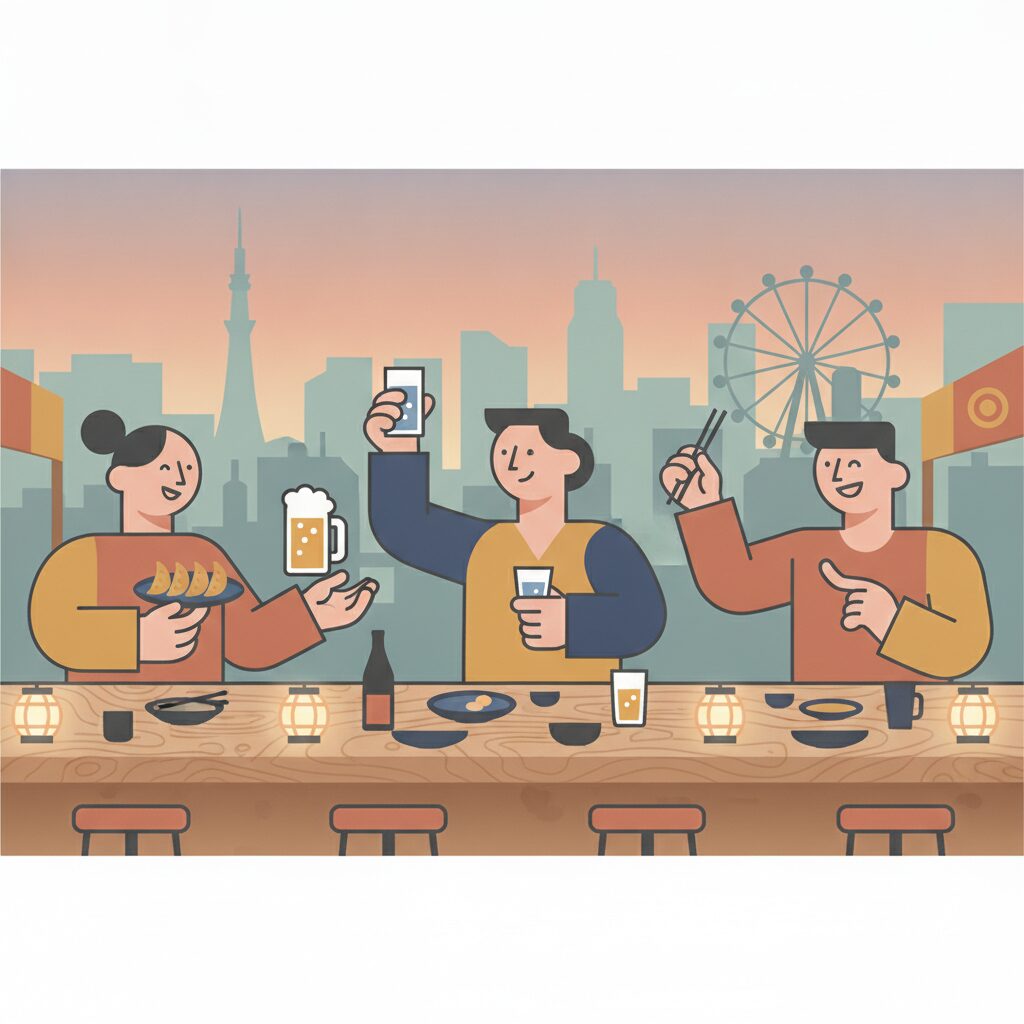
Welcome to Osaka, a city that moves to its own beat, a rhythm you can feel pulsing from the subway platforms to the neon-drenched arteries of Namba. My name is Ami. By day, I navigate the world of fashion apparel, but my real passion is decoding the DNA of cities, one street corner at a time. And in Osaka, the most vital, chaotic, and revealing street corners are often inside its standing bars, the legendary tachinomi. Forget the serene temples and manicured gardens for a moment. If you truly want to understand what makes this city tick—its impatience, its warmth, its bluntness, its deep-seated love for community—you need to step inside one of these crowded little rooms, grab a drink, and hold on tight. For a foreigner planting roots here, the tachinomi presents a tantalizing paradox. It feels like the city’s social cheat code, a direct portal into conversations and friendships that might otherwise take months to build. But it’s also an arena of unwritten rules, lightning-fast dialect, and social cues so subtle they can feel invisible. It’s a place where you can feel like a beloved regular in five minutes, or a clumsy outsider for an entire evening. So, is this the authentic Osaka experience you’ve been searching for, or is it a social gauntlet best avoided? Let’s pour a drink, find a spare patch of floor, and figure it out together. This isn’t just about cheap beer and fried skewers; it’s a deep dive into the heart of Osakan identity.
For those moments when Osaka’s high-energy standing bars feel overwhelming, you might find a refreshing change of pace at a sento social club, where relaxed, local connections are forged over a timeless communal ritual.
What a Standing Bar Actually Is (and Isn’t)

Before you get started, let’s set your expectations. A tachinomi is, at its core, a temple of efficiency. The name itself says it all: tachi (standing) and nomi (drinking). There are no chairs. The space is often comically small, sometimes no larger than a spacious walk-in closet. The business model relies on rapid turnover. You come in, have a drink or two, a couple of small plates, and then you leave. It’s a social pit stop, not a place for a long, leisurely evening. This is a fundamental shift from the Western idea of a bar or pub. You’re not paying for comfort or ambiance in the usual sense. You’re paying for speed, value, and access to the social energy in the room.
What it isn’t—and this is crucial for newcomers to grasp—is a nightclub or a lounge. Music is usually absent or just a tinny radio playing in the corner. There’s no dance floor. It’s not a spot to impress a date with fancy cocktails. Nor is it a quiet, contemplative space for a solitary drink with a book. The entire point of a tachinomi is the communal, slightly chaotic buzz. Treating it like a Starbucks will only lead to disappointment and perhaps a few odd looks.
So, how does this take shape in an Osakan style? While standing bars exist in Tokyo, they often feel more clinical, more part of the rigid corporate unwind-and-commute routine. In Osaka, the tachinomi is woven into the very fabric of daily life. You’ll see shoppers with grocery bags stopping by for a single beer at 3 PM. You’ll see elderly couples sharing a plate of sashimi before heading home. It’s less a post-work ritual and more an all-day social tool. The atmosphere mirrors Osaka’s merchant spirit: pragmatic, no-frills, and relentlessly focused on human connection. There’s less pretense here. The goal isn’t to be seen; it’s to connect, even if only for a few minutes, over a shared plate of something tasty and affordable.
The Upside: Fast-Tracking Your Social Life in Osaka
For anyone new to the city and facing the first wave of loneliness, the tachinomi can seem like a godsend. It’s a social catalyst, a spot where the usual Japanese reserve melts away in a haze of steam and cigarette smoke. If you play your cards well, you might leave with a handful of new acquaintances and a much deeper insight into the local mindset.
Instant Community, Just Add Beer
The charm of the tachinomi lies in forced closeness. When you’re standing shoulder-to-shoulder with strangers, the social barriers that shape most interactions in Japan simply vanish. It almost feels rude not to acknowledge those next to you. This is where the famous Osakan friendliness comes alive, but it’s not some vague, abstract trait. It’s a practical reaction to the physical setting. A conversation can ignite from the smallest thing. Imagine this: you’re squeezed into a corner, and the man beside you gets a plate of kushikatsu (deep-fried skewers). He points to the communal dipping sauce on the counter. “Nido-zuke kinshi ya de!” he says with a grin. “No double-dipping!” You’ve just learned your first, most sacred lesson in Osaka cuisine, and just like that, you’re in conversation. You ask which skewer is best. He asks where you’re from. His friend joins in. Within ten minutes, you’re part of the group. This kind of spontaneous, easygoing interaction is incredibly rare in the more formal, divided spaces of a typical Tokyo izakaya, where starting a conversation with another table would be a major social faux pas.
The Great Equalizer: No Status, No Problem
Japanese society is, in many respects, built on hierarchy. You see it in the language, in business manners, in seating arrangements at formal dinners. The tachinomi is a wonderful exception. In this cramped spot, the company president in a tailored suit stands elbow-to-elbow with a plumber in his work clothes. The university student sips a cheap chu-hai beside a retired grandmother. All external signs of status are stripped away. Everyone is just a customer, equal in their quest for a good drink and a quick bite. This reflects Osaka’s history as Japan’s merchant capital. Here, value was placed on shrewdness, humor, and a good bargain, not on inherited titles or rigid social hierarchies. For a foreigner, this is freeing. You’re not an outsider to be politely tolerated; you’re simply another body at the bar. Your accent isn’t a barrier; it’s a curiosity, a conversation starter. People aren’t judging your social rank; they’re genuinely interested in your story. They want to know what you think of the food, if you can hold your sake, and what brought you to their city. This egalitarian spirit is perhaps the most welcoming feature for any newcomer trying to find their place.
Your Japanese Tutor is a Drunk Uncle
Forget pricey language schools and sterile classrooms. The tachinomi is arguably one of the best places in the city to practice your Japanese. The atmosphere is incredibly low-pressure. People are relaxed, eased by alcohol, and generally in a forgiving and encouraging mood. You can try out that new grammar point you just learned, and no one will judge you for mistakes. In fact, it’s likely they’ll find it charming. I’ll never forget the time I tried to order simmered daikon radish (daikon no nimono) and completely bungled the pronunciation. The whole bar burst out laughing—not in a mean way, but with warm, inclusive humor. The master patiently corrected me, the guy next to me made me repeat it three times until I got it right, and when the dish finally arrived, they all applauded me. You can’t buy that kind of interactive, real-world lesson. It’s in moments like these, surrounded by the rapid-fire cadence of the Osaka dialect, that the language stops feeling like an academic challenge and starts to become a living, breathing means of connection.
The Downside: Navigating the Unspoken Rules
For all its apparent disorder and friendliness, the tachinomi operates under a complex system of unspoken rules. It’s like a dance, and a newcomer unfamiliar with the steps can easily end up stepping on toes, both literally and figuratively. This is where the initial welcome can turn awkward if you’re not careful. The social contract is implicit, and understanding it is essential for a successful experience.
The “Bubble” and How to Burst It (or Not)
Even in the busiest bar, you’ll notice people forming invisible social units. A trio of coworkers, a couple on a date, two old friends catching up—they create a subtle “bubble” around themselves. While the overall atmosphere is communal, invading a private bubble is a serious faux pas. The challenge for newcomers is learning to gauge the energy. Is that group of laughing regulars open to newcomers, or are they immersed in an inside joke-filled conversation? Misreading this can be uncomfortable. You might try to join in, only to be met with a polite but firm wall of silence as they angle their bodies slightly away. It’s a gentle yet clear message: this is a private gathering. The key is to observe before you engage. Look for solo drinkers or pairs who face outward, toward the bar’s general activity. Position yourself at the counter, where the owner or master often serves as a social hub, introducing people and facilitating conversations. Your safest approach is to wait for someone to reach out to you. A simple question or comment aimed your way is an invitation to burst their bubble and join the fun.
“Kuki Yomenai”: The Crime of Not Reading the Air
Kuki wo yomenai (or KY) literally means “cannot read the air.” It’s a crucial concept in Japanese society, describing someone socially oblivious. In the tight quarters of a tachinomi, the air is thick with cues, and missing them can earn you the label of a nuisance. The rules here differ from Tokyo—they focus less on formal politeness and more on practical community sense. Breaking them won’t provoke icy silence but rather a blunt, Osakan-style correction.
Here are some typical KY mistakes:
- Territorial Overreach: Taking up too much space is the cardinal sin. Your bag should be on the floor or a designated hook, never on the counter. Keep your elbows tucked in. Always be mindful of your physical footprint. This includes the “tachinomi shuffle,” the subtle skill of compressing yourself to let someone pass to the restroom or leave.
- Lingering: A tachinomi is not your living room. The business depends on a steady customer flow. Ordering one beer and nursing it for two hours when the place is full and people are waiting outside is highly inconsiderate. The unspoken rule is to stay roughly an hour, maybe 90 minutes at most. When finished, pay and leave. Simple and straightforward.
- Monopolizing the Master: The owner (taishou or master) is the heart of the bar, but they’re also running a business. Engaging them in a lengthy one-on-one chat while they’re trying to take orders, pour drinks, and cook is selfish. Keep your interactions brief, friendly, and to the point.
The Language Barrier is Real, and So is the Dialect
While people are generally encouraging, let’s be honest: if you have no Japanese at all, you’ll struggle. Menus often consist of handwritten strips of cursive Japanese taped to the wall. No pictures, no English translations. You’ll need to manage at least “Kore, kudasai” (This one, please) while pointing at someone else’s food or stick to basics like “Biru” (beer) and “Edamame.”
Beyond the language barrier is the formidable challenge of Osaka-ben, the local dialect. Even those fluent in standard Japanese often find it like a foreign language. The intonation differs, vowels are lengthened, and entire words change. Standard Japanese for “I don’t know” is wakarimasen. In Osaka, it becomes wakarahen. “It’s really good” shifts from totemo oishii to meccha umai. You’ll be surrounded by rapid-fire chatter dotted with phrases like “Nande ya nen!” (What the hell?!) and “Honma ni?” (Really?). Although fascinating to hear, it can be isolating. You’ll see the whole bar erupting with laughter at a punchline while you smile politely, clueless about what just happened. This can be the most frustrating aspect of the tachinomi experience—to be so close to the city’s social core, yet separated by a barrier of incomprehensible slang.
A Woman’s Perspective: Safety and Social Dynamics

As a woman, navigating the tachinomi scene requires an added level of awareness. The good news is that many, if not most, are safe and welcoming. In fact, the emergence of modern, brighter tachinomi specializing in wine or stylish cuisine has made them increasingly popular among groups of women or solo female drinkers. The open, public nature of these spots, along with the watchful eye of the master, often fosters a sense of collective security. Seeing other women inside is always reassuring.
That said, it would be dishonest to overlook the other side. Some older, grittier, more traditional tachinomi can be overwhelmingly male-dominated, testosterone-driven spaces. Entering one alone as a woman can feel like stepping onto a stage. Conversations might pause briefly as all eyes turn to you. The attention is rarely hostile; more often, it’s a mix of surprise and curiosity from old-timers (ojisan) unaccustomed to seeing a woman, let alone a foreigner, in their local spot. You may receive well-meaning but potentially unwanted attention—questions about your marital status, offers to buy you drinks, or overly familiar compliments. It can be tiring to stay “on” all night, politely deflecting these advances.
My advice is to start smart. Begin your tachinomi exploration in the busy, well-lit arcades of Tenma or in the basements of major department stores (depachika), where the crowd tends to be more diverse. Go with a friend the first few times to get a sense of the atmosphere. And always, always peek inside before committing. What’s the gender ratio? What’s the vibe? Does it look lively and fun or grimy and tense? Trust your intuition. Learning a few polite but firm Japanese phrases like “Kekkou desu” (I’m fine/No, thank you) or “Hitori de daijoubu desu” (I’m okay by myself) can be incredibly empowering tools to uphold your boundaries while still enjoying the experience.
How to Succeed at Your First Tachinomi
Ready to take the plunge? Don’t be intimidated. With a bit of preparation, you can handle your first tachinomi experience like a pro. Think of it as a mission with a few straightforward steps.
Step 1: Choose Your Arena Wisely
Location is key for a first-timer. Avoid starting at a dark, tucked-away bar on a quiet backstreet. Instead, go for a busy area where the tachinomi are accustomed to a varied crowd. The maze of bars beneath the elevated tracks at Tenma Station is an excellent training ground. The basements of the Ekimae Buildings near Osaka Station also offer dozens of options. Pick a place with an open front so you can see inside. Aim for somewhere lively yet not packed with a line out the door. A half-full bar is the ideal starting point.
Step 2: The Confident Entry
The most awkward moment is the first ten seconds. Don’t hesitate at the entrance—that signals uncertainty. Take a deep breath, slide the door open (if there is one), and step inside with confidence. Look around for an empty spot at the counter; that’s your target. Walk over, claim your little piece of space, and make brief eye contact with the staff. A simple nod and a quiet “Konbanwa” (Good evening) is all it takes. You’ve arrived.
Step 3: The Order and the Payment
Keep it simple. For your first order, stick to the basics. Saying “Toriaezu, nama” is the magic phrase throughout Japan, meaning “For now, a draft beer.” It shows you know how it works. For food, watch what others nearby are having. If it looks good, politely get the staff’s attention and say, “Sumimasen, are to onaji no, kudasai” (Excuse me, the same as that, please). Many tachinomi operate on a cash-on-delivery basis, called kyasshu on. You’ll notice a small tray or bowl on the counter in front of you. Place a 1,000 or 5,000 yen bill there. Each time you order, the staff will take the payment from the tray and return your change. It’s an elegantly efficient system with no need to wait for a final bill.
Step 4: The Art of Interaction
Now, just be present. Take a sip of your beer. Observe. The master might ask where you’re from—that’s your opening. The person next to you might comment on the baseball game playing on the tiny TV. Be open and receptive. A smile goes a long way. Don’t force conversation, but be ready when it comes to you. Ask simple questions like “Oishii desu ka?” (Is it delicious?) or “Osusume wa nan desu ka?” (What do you recommend?). People in Osaka love chatting about food and sharing opinions—it’s the city’s universal language.
Step 5: The Clean Exit
Knowing when to leave is just as important as knowing how to enter. When your glass is empty and you’ve finished your food, start thinking about leaving, especially if the bar is filling up. There’s no need for a long goodbye. Simply catch the staff’s eye, give a slight nod, and say clearly, “Gochisousama-deshita.” This versatile phrase means “Thank you for the meal/treat,” and is more polite and fitting than a simple arigatou. Then, gather your belongings, and head out. You’ve successfully completed your first mission.
So, Are Standing Bars for You?
After all this, we come back to our original question: Is the tachinomi a friendly social hub or a daunting insider’s club? The honest answer is that it’s both. It reflects the essence of Osaka itself: loud, efficient, sometimes abrasive, yet also incredibly warm, straightforward, and communal. It rewards those willing to observe, take a small social risk, and embrace a bit of chaos.
These spots aren’t for everyone. If you seek quiet conversation, personal space, and predictable social settings, the standing bar will probably feel like your own personal version of hell. But if you’ve come to Osaka to experience its raw, unfiltered character, there is no better place to do so. In the tachinomi, you’ll hear the genuine stories, unfiltered opinions, and the hearty, uninhibited laughter of the city. It’s where you can go from being a faceless foreigner to “Ami-chan, the American who likes mackerel” in just one evening.
My advice to any newcomer is to try it at least once. See it not just as a bar, but as a cultural classroom. Be ready to feel a bit uncomfortable, confused, and maybe out of your depth. But also be ready to be welcomed into conversation, to share a laugh with a stranger, and to taste the true, everyday spirit of this magnificent city. If you learn to navigate the beautiful chaos of a tachinomi, you haven’t just learned how to drink in Osaka—you’ve learned a little about how to live here, too.