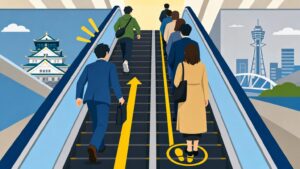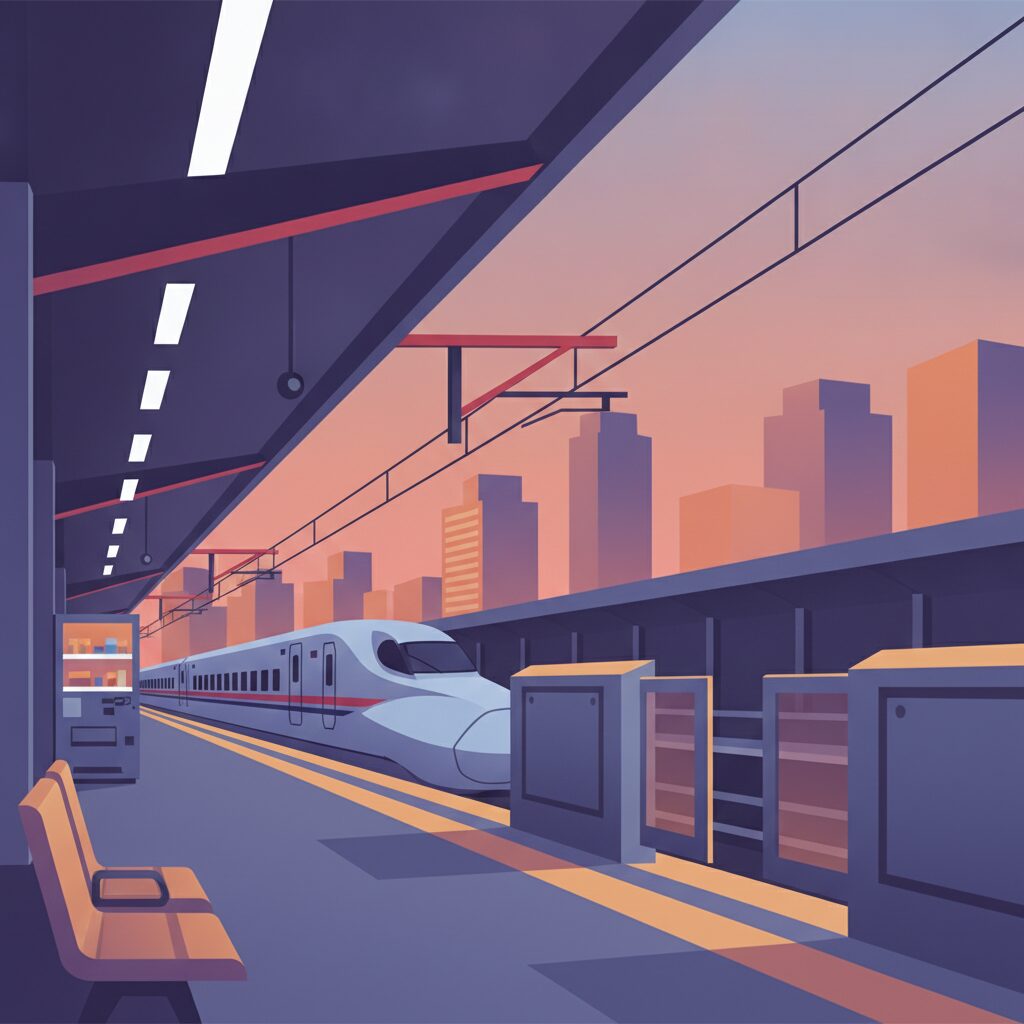
Your first real welcome to Osaka won’t be a castle, a plate of takoyaki, or a neon sign. It will happen on an escalator. You’ll step off the Shinkansen at Shin-Osaka Station, tired but excited, and join the river of people flowing towards the local lines. You get on the escalator, naturally moving to the left to let people pass on the right, just as you’ve done everywhere else in Japan. And then it happens. A gentle pressure from behind. A sigh. Someone squeezes past you on the left. You turn and see a solid wall of people standing patiently on the right, while the left lane flows past like a swift current. In that moment of confusion, you’ve just had your first lesson in Osaka’s unwritten rules. This city moves to its own beat, and nowhere is that rhythm more apparent than in the daily dance of its public transit. Forget the guidebooks for a moment. To truly understand Osaka, you have to understand how its people navigate the arteries of their city. It’s a system built on a foundation of fierce practicality, unspoken cooperation, and a regional pride that dictates everything from which side you stand on to how you claim a seat. This isn’t just about getting from Umeda to Namba; it’s about participating in a daily ritual that defines the very character of this vibrant, unapologetic metropolis.
The local transit rituals segue naturally into experiencing the vibrant shotengai culture that turns everyday Osaka streets into a community living room.
The Great Escalator Divide: Why Osaka Stands on the Right
A Rule That Defines a Region
Let’s begin with the most striking difference, the one that acts as an invisible boundary between Kansai and the rest of Japan. In Tokyo, Sapporo, and Fukuoka, people stand on the left side of the escalator. It’s a custom as ingrained as removing your shoes indoors. But in Osaka, and more broadly in the Kansai region including Kyoto and Kobe, you stand on the right side, with the left side reserved for walking. This isn’t a mere suggestion; it’s a deeply rooted social agreement. Ignoring it quickly marks you as an outsider. You’ll sense the subtle, collective impatience of those behind you—a silent pressure that says, “You’re blocking the flow.” This simple practice is a powerful symbol of Osaka’s unique identity. It’s a quiet statement of independence, a constant, moving reminder that this place follows its own rules. For locals, it’s instinctive. For newcomers, it requires a fundamental rewiring of muscle memory. You’ll spend your first few weeks silently repeating a mantra—right, right, right—each time you approach an escalator.
The Unspoken Logic of a Merchant City
So why the difference? Why would an entire region collectively reverse a nationwide norm? There’s no official law or government mandate. The truth is nobody knows for sure, but prevailing theories all trace back to Osaka’s essence: a city of merchants, defined by efficiency and practicality. One popular theory links the custom to the 1970 World Expo held in Osaka. To handle the massive international crowds, organizers reportedly adopted the global standard of standing on the right, and the habit simply stuck. It was a practical solution for a global event that became a permanent local quirk. Another theory offers a historical angle, connecting it to the city’s merchant, rather than samurai, culture. In samurai-dominated Edo (now Tokyo), warriors kept left to avoid their sword scabbards clashing, keeping their right hand free. In Osaka, a commerce-driven city, this concern didn’t exist. The flow of people and goods mattered more than warrior etiquette. Perhaps the most convincing explanation lies in the city’s architecture itself. The Hankyu Umeda Station, a vast terminal and an urban transit masterpiece, has a layout where standing on the right arguably ensures a smoother, more efficient human traffic flow. Whatever the true origin, the underlying principle remains: Osaka picked the approach that worked best. It’s a subtle form of defiance, a statement that Tokyo’s way isn’t the only way. This isn’t about being difficult; it’s about a dedication to common sense and an unyielding pursuit of the most logical solution, even if it sets you apart.
The Platform Dance: More Than Just Lining Up
Precision Queuing, Osaka Style
After mastering the escalator, you reach the platform, where a new set of unspoken rules takes effect. Like the rest of Japan, people in Osaka line up for the train, standing in neat, orderly rows behind the painted ground markings. At first glance, it appears identical to a Tokyo station scene. But if you observe closely, you’ll sense a different kind of energy—quiet, focused intensity. People aren’t merely waiting; they’re positioning themselves. They seem to have an almost instinctive sense of where the train doors will align, adjusting their stance by millimeters to secure an advantage. There’s a mutual understanding that the aim is to board smoothly and quickly, creating a tangible pre-boarding tension. It’s less about strict formality and more about collective, strategic readiness for when the doors slide open. Your place in line is sacred, yet it also serves as a springboard. The person ahead of you isn’t just an individual; they’re the first link in a fluid, human chain reaction about to start.
The “Gasshiri Noru” Mentality: Boarding with Purpose
When the train arrives, the dance begins. The phrase that captures this is gasshiri noru, roughly meaning “boarding firmly” or “boarding with commitment.” This doesn’t imply aggressiveness or pushing others aside. Rather, it signifies a decisive, confident movement. As the doors open, the lines on either side part like curtains, forming a channel for passengers exiting the train. This is the crucial moment. In Tokyo, you might take a full step back to give enough space. In Osaka, movements are subtler. People hold their ground, leaving just enough room for others to pass through. It’s a calculated act of accommodation. Once the stream of disembarking passengers thins, boarding begins immediately—no hesitation. Boarding is a swift, purposeful shuffle into the car. This efficiency stems from necessity. Lines such as the Midosuji subway line are extremely crowded, and even a minor delay can have a domino effect. Osaka commuters grasp this instinctively. They don’t wait for a formal invitation to board; instead, they seize the opportunity, trusting that everyone will follow suit, collectively maintaining a system that, against all odds, operates with remarkable efficiency. It’s a perfect example of organized chaos—a leadershipless system running on pure, unfiltered street smarts.
The Art of the “Sui-Sui” Maneuver
The secret to this process is the sui-sui—a smooth, gliding step. When the doors open, you don’t step back. Instead, you perform a small, lateral shift—a lean to the side—that opens the necessary pathway. This gesture signals, “I see you, I’m making space for you, but I’m not giving up my position.” Foreigners often err by taking a large step backward, unintentionally surrendering their queue spot to more experienced locals behind them. Mastering the sui-sui is a rite of passage, indicating you’ve learned the local rhythm. You’re no longer a fixed obstacle but an active participant in the flow. You become part of the solution, not the problem. It’s a subtle move but one rich with social and cultural significance.
Inside the Train Car: Unspoken Rules of Personal Space
The Soundscape of an Osaka Commute
Once aboard, the atmosphere subtly shifts compared to other Japanese cities. While the fundamental rule of not speaking loudly on the phone remains, the ambient noise level inside an Osaka train car tends to be slightly higher. You’re more likely to catch the soft murmur of friends chatting, shared laughter over something on a phone screen, or even a cheerful greeting between acquaintances who have just bumped into each other. It’s not disruptive, but it feels more human. The silence is less absolute, less sterile. This extends to the train staff as well. Conductors on private lines such as the Hankyu or Keihan often speak with a distinctive, melodic rhythm to their announcements—a personal style that feels less like a recorded message and more like a real person driving the train. This slight easing of silence rules contributes to a sense that the train car is a shared public space, not a quiet, moving library.
“Chotto Sumimasen”: The Magic Words for Movement
Maneuvering through a crowded train at your stop requires another kind of skill. The crucial phrase is chotto sumimasen—“excuse me, just a little.” It’s the universal key to moving in packed Japanese spaces, but in Osaka, it works especially well. Spoken softly, almost under one’s breath, accompanied by a slight bow of the head and a subtle guiding hand gesture (palm open, not pointing), it’s the only tool you need. The response is usually immediate. People instinctively shift, compress, and create a path. There’s no irritation or grumbling. Instead, there’s a shared, unspoken understanding: this person needs to get off, so we’ll make room. It’s a beautiful, fleeting moment of communal cooperation. This reflects the sekkachi (impatient, hurried) character of the Osakan. People want to get on with their day, and they recognize that helping you off the train also helps them. It frees up space and keeps the system flowing. This is politeness in its most practical form.
The Case of the Mysterious Gap
Even seating etiquette has its own Osaka twist. On bench-style seats, a common pattern throughout Japan is the creation of a one-person gap between two strangers. People often prefer to stand rather than sit in that middle spot as a way to preserve personal space. In Osaka, however, that gap doesn’t stay empty for long. An elderly person, a student with a heavy bag, or simply a tired commuter will quickly take that space with little hesitation. There’s a prevailing attitude that a seat is meant to be sat in. Leaving a perfectly good spot empty out of social awkwardness is seen as inefficient. This isn’t rudeness; it reflects the city’s practical, down-to-earth mindset. Practical needs consistently outweigh performative or overly cautious politeness. If you need to sit, you sit.
What This Tells You About Living in Osaka
Practicality is King
Each of these behaviors—standing on the right, the purposeful boarding shuffle, the swift occupation of an empty seat—links back to the same core idea: in Osaka, practicality is paramount. This city thrives on commerce, where time has always equated to money and efficiency is highly valued. The people of Osaka don’t adhere to tradition merely for tradition’s sake. If a rule seems illogical or if there’s a quicker, better method, they’ll embrace it. Outsiders might sometimes mistake this approach for abruptness or impatience, but it actually reflects a profound respect for everyone’s time. The intricate, unwritten guidelines of the transit system aim to move the maximum number of people with minimal friction. This system has been refined not by committees, but through millions of daily, individual decisions.
A Different Kind of Politeness
This brings us to an essential understanding of the Osaka mindset. The city’s well-known friendliness doesn’t always show itself through warm smiles or cheerful greetings to strangers. On the train, it emerges as practical cooperation. Osaka’s politeness is less about formal, strict etiquette and more about a flexible, results-driven social contract. People give you room to exit the train not because of a rulebook, but simply because it makes sense. They expect you to board with purpose, knowing that hesitation delays everyone. It’s a collective spirit grounded in a shared goal. This can feel surprising if you’re used to the more reserved, form-focused politeness found elsewhere. But once you grasp the rationale, it comes across as a different yet equally valid form of social courtesy.
Embracing the Flow
For anyone living in Osaka or considering it, learning to navigate the trains is the first and most vital cultural lesson. The best advice is to watch carefully, adjust, and move with confidence. Stand on the right. Hold your position on the platform. Offer a quiet sumimasen and trust a path will open. Don’t hesitate to take an empty seat. When you start moving in harmony with the city’s rhythm, you cease to be a mere observer and become a participant. You’re no longer resisting the current; you are part of the flow. In that moment, standing on the right side of the escalator, you’ll begin to understand what drives this city. You’ll be on your way to feeling at home.