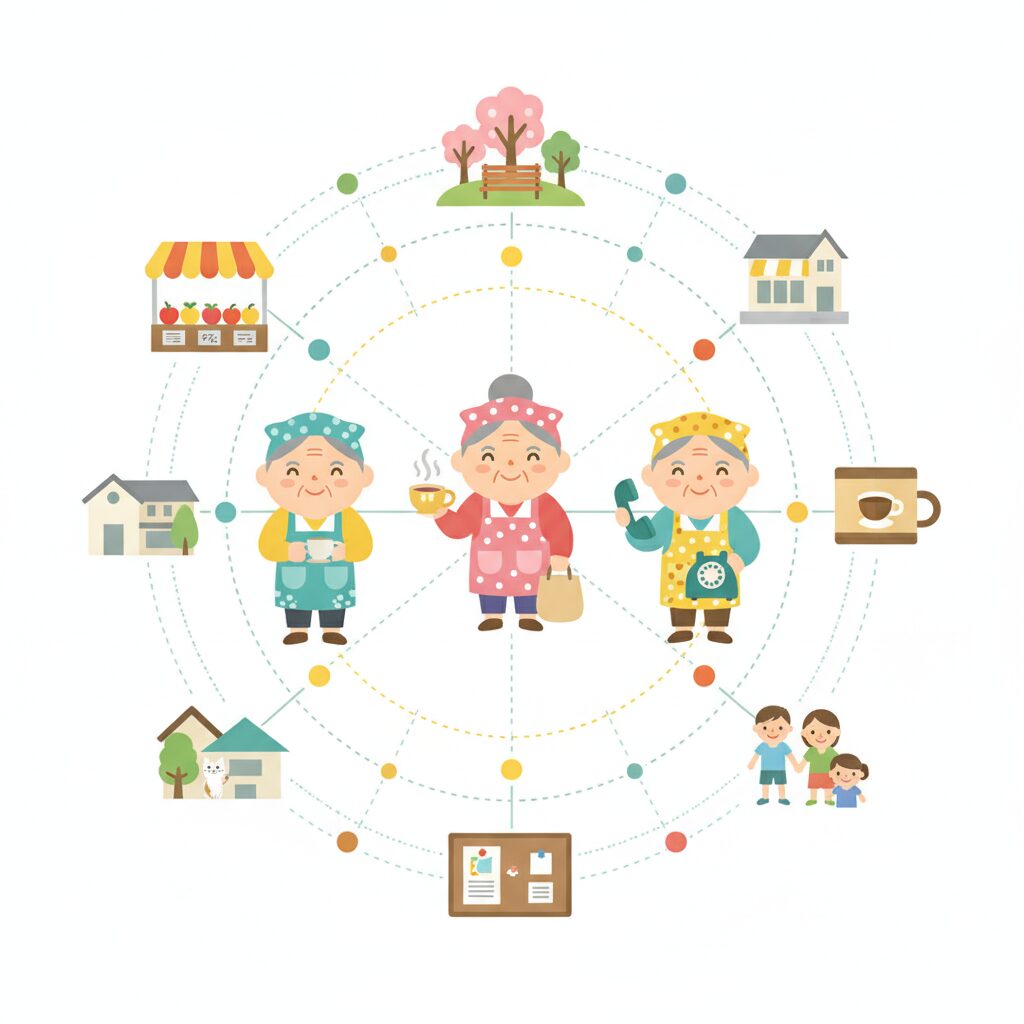
The first time it happens, you’ll probably freeze. You’re standing in the aisle of a local Tamade supermarket, comparing two brands of soy sauce, when a woman you’ve never seen before taps you on the shoulder. She’s probably in her sixties, with a practical perm and a brightly colored blouse. “こっちの方が安いわよ,” she says, pointing decisively at one of the bottles. This one’s cheaper. Before you can even stammer a thank you, she might lean in closer, inspect your basket, and ask if you’re eating enough vegetables. Your mind, conditioned by the polite anonymity of most big cities, races. Is this a criticism? A sales pitch? A scam? In Tokyo, this interaction would be almost unthinkable. It would violate a dozen unspoken social codes about personal space and minding one’s own business. But you’re not in Tokyo. You’re in Osaka, and you’ve just had your first encounter with the city’s most powerful social force: the obachan. This isn’t rudeness; it’s a dialect of community, a unique form of social currency that keeps the city’s neighborhoods humming. Understanding the art of obachan communication isn’t just a fun cultural quirk; it’s your key to unlocking the true, lived-in texture of Osaka, a city built not on distance, but on connection. It’s about tapping into a human network that operates faster than any app, a web of information, care, and candy that flows through the city’s veins.
Experience another side of Osaka’s vibrant charm by exploring the city’s distinctive cycling dynamics in our guide on the sidewalk ballet.
Who Exactly is the Osaka Obachan?
First, let’s challenge the stereotype. The term obachan literally means “aunt” or refers to a middle-aged or older woman, but in Osaka, it carries its own unique significance and mythos. The typical image is of a woman with a loud voice, dressed in leopard print, aggressively haggling for a discount. While you might come across a few like that, the truth is far more complex and meaningful. The Osaka obachan serves as the living, breathing custodian of the city’s legacy as a shonin no machi, a merchant town. For centuries, Osaka’s economy thrived on commerce, where reputation, trust, and the swift exchange of information were worth more than gold. Business wasn’t conducted through cold, formal contracts; it was built on relationships nurtured by decades of daily conversations in the marketplace. That tradition continues today, not in corporate boardrooms, but in the everyday interactions of these women.
They act as the unofficial mayors of their neighborhoods, guardians of local knowledge. They know which butcher offers the best cuts today, which elementary school is hosting its sports festival, and whose cat recently had kittens. They serve as the neighborhood watch, social welfare network, and information hub all rolled into one. In Tokyo, the typical social norm is a polite, respectful distance. You can live next to someone for years without ever learning their name. The city’s vast size fosters a kind of protective anonymity. In Osaka, especially in residential areas and the expansive shotengai (shopping arcades), the opposite holds true. Community is an active engagement, a verb, and the obachan are its most dedicated practitioners. They are the nodes connecting everyone, the human routers managing the flow of gossip, advice, and mutual aid. Overlooking them is not just missing out on a cultural experience; it’s like trying to navigate the internet without a search engine.
Decoding the Language of the Obachan
Communicating with an Osaka obachan means unlearning typical social norms and tuning into a different wavelength. Their questions and remarks, which might come across as blunt or intrusive to outsiders, follow a unique local logic. It’s a language of practical care, where efficiency and connection take precedence over formality.
The Opening Salvo: “Anata, Doko no Ko?”
This phrase literally means “You, whose child are you?” or more generally, “Where are you from?” When an obachan asks this—whether at a bus stop or while you’re watering your plants—it’s not an interrogation. It’s a way of mapping. She’s not seeking your life story or visa status but trying to place you within the detailed, invisible map of the community in her mind. Are you the new resident in apartment 3B? The student renting from the Tanaka family? The foreigner teaching at the local English school? By locating you, she’s not prying; she’s preparing to include you. It’s the first step in recognizing your presence in the neighborhood’s ecosystem. A vague answer leads to more specific questions until she can place you. The right response is a straightforward, local answer about where you live or what you do. Once she has that information, you’re no longer a stranger: you’re a neighbor, and therefore someone to watch out for.
Unsolicited Advice as a Form of Care
This is a common stumbling block for many foreigners. An obachan might notice you buying a pre-cut package of cabbage and say, “You should buy the whole head! It’s more economical and lasts all week.” Or if she sees you shivering in a thin jacket, she might comment, “You’ll catch a cold dressed like that!” This isn’t a critique of your intelligence or choices. It’s a straightforward sharing of practical, lived wisdom. In Osaka’s merchant culture, getting good value (otoku) is a matter of pride, and sharing such knowledge is a community duty. She treats you as she would her own child or a longtime neighbor, offering a shortcut to local know-how. In a more hierarchical place like Tokyo, giving unsolicited advice to a stranger might be seen as presumptuous or condescending. In Osaka, it signals that you’ve been accepted into the community. The obachan sees you not as a foreign “other,” but as a fellow resident who might benefit from helpful tips. The best way to accept this advice isn’t defensively but with a simple “Honto desu ka? Arigato!” (Really? Thank you!). You don’t have to follow the advice, but acknowledging it is what counts.
The Candy Connection: “Ame-chan”
One of the most well-known obachan traditions is their habit of carrying and handing out candy, or ame-chan. The “-chan” suffix is a term of endearment, turning a simple piece of candy into a small, warm gesture. You might be in line at a bank, on a train, or just walking, when an obachan suddenly presses a hard candy or wrapped chocolate into your hand with a smile and a “Hai, douzo” (Here you go). This isn’t just a random act of kindness—though it is kind. It’s a small social transaction of goodwill. The ame-chan helps break down barriers between strangers. It’s an icebreaker requiring no words, a tiny gift saying, “I see you. We’re sharing this space.” It creates a brief connection, softening the edges of city life. Accepting the candy is important; refusing it closes off the connection, building a wall where the obachan was trying to create a small bridge. This gesture perfectly reflects the Osaka mindset: life is better when we’re a little more connected, a little more familiar, even with new acquaintances.
The Shotengai: The Obachan’s Natural Habitat
To truly experience the obachan network at its best, you need to visit a shotengai. These covered shopping arcades, stretching for kilometers through Osaka’s neighborhoods, serve as the heartbeat of the city’s communities. They are much more than mere commercial streets; they act as the city’s communal living rooms. Here, shopping takes a back seat to the social role the space plays. This is the obachan’s territory, and observing her navigate it offers a masterclass in community building.
She doesn’t simply purchase fish from the fishmonger; she exchanges local news as well. She’ll spend several minutes chatting about his son’s exams and the rising cost of mackerel. Then she moves on to the tofu maker, asking about his wife’s health and sharing a tip she heard about a new doctor. At the fruit stand, she’ll engage in playful haggling over melon prices—a ritual less about saving money and more about maintaining long-standing relationships. Each stop strengthens a social bond. This explains why many small, family-run shops still thrive in Osaka despite the presence of massive supermarkets nearby. They’re not just selling products; they’re sustaining an essential social network. If you become a regular at these shops, you’ll soon find yourself woven into this web. The obachan might introduce you to the shop owner, describing you as “the nice foreigner who lives upstairs.” Suddenly, the owner may include a small extra, an omake, with your purchase. You haven’t just bought vegetables; you’ve been embraced by the network. You have become part of the local story.
How to Navigate (and Benefit from) Obachan Communication

For many non-Japanese residents, the natural reaction to this level of directness is to withdraw into a shell of polite reserve. However, this is a mistake. Engaging with the obachan network, even in small ways, can deeply enrich your life in Osaka. The key is to adjust your expectations about social interaction.
Embrace the Interaction, Don’t Run Away
When an obachan starts a conversation with you, your initial response might be to smile awkwardly, nod, and look for the closest exit. Resist that impulse. You don’t have to be fluent in Japanese to connect. Make eye contact and return a genuine smile. A simple “Konnichiwa” or “Arigato gozaimasu” often suffices to show you are open and friendly. They aren’t expecting a deep conversation; they’re just checking if the communication channel is open. By responding warmly, you signal your willingness to be part of the community – exactly what they want.
Learn to ‘Receive’ Gracefully
Whether it’s advice, a question about your groceries, or a piece of candy, interacting with obachan involves learning to receive. In many Western cultures, independence and self-reliance are highly valued, and accepting help or advice can sometimes feel like admitting weakness. But in Osaka’s community-oriented world, receiving is just as important as giving. It completes a social exchange. When an obachan offers a tip, she’s investing social capital. By accepting graciously, you acknowledge her role as a knowledgeable community elder and reinforce your mutual connection. You show that you trust the local network.
The Payoff: Becoming a ‘Local’
What do you gain from navigating these unfamiliar social dynamics? The benefits are immense and practical. Once recognized and accepted by the local obachan network, you stop being an anonymous foreigner and become a neighbor. This means people look out for you. If a package arrives while you’re out, an obachan might tell the delivery person to leave it with her. If you fall ill, someone might knock on your door with a container of okayu (rice porridge). They’ll inform you about secret sales at the local drugstore or warn you when a typhoon is approaching so you can take in your laundry. This is the real meaning behind the cliché “Osaka is friendly.” It’s not a passive warmth but an active, reciprocal, and highly practical system of mutual support. This friendliness is earned through participation, with the obachan serving as both gatekeepers and guides.
The Misunderstanding: Intrusive vs. Inclusive
Ultimately, the greatest challenge for any foreigner trying to understand Osaka is to rethink the idea of personal boundaries. The questions and remarks from an obachan that might seem deeply personal or intrusive by Tokyo or Western standards are actually expressions of inclusion. They aim to break down the barriers of anonymity that characterize much of modern urban life. They are not attempting to invade your privacy; rather, they are trying to close the gap between you and the community.
Their straightforwardness comes from a worldview where being connected is the norm, and isolation is a problem that needs fixing. When an obachan asks you a personal question, she is attempting to resolve the “problem” of you being a stranger. She is gradually weaving you into the social fabric. This is perhaps the most significant difference between living in Osaka and living in Tokyo. Tokyo provides the freedom of anonymity, while Osaka offers the warmth of community. Neither is inherently better; they simply require very different mindsets. To thrive in Osaka, you need to learn to view the outstretched hand of an obachan, holding a piece of candy or pointing out a cheaper daikon radish, not as an intrusion but as an invitation.