The laptop is open, the cursor is blinking, and the low-grade panic of a looming deadline is starting to set in. You need caffeine, Wi-Fi, and a place to just exist for a few hours. The immediate, globally-recognized answer flashes in your mind: Starbucks. There’s one on every corner in Umeda, a beacon of predictable coffee and reliable internet. But as you sit there, sipping a Frappuccino amidst the churn of students and shoppers, you can’t shake the feeling that you could be anywhere. London, New York, Sydney. The experience is frictionless, efficient, and utterly devoid of place. This isn’t the real Osaka. This is the international waiting room. For those of us building a life here, not just passing through, the question becomes more urgent: where do you go to actually be in the city while you work? The answer, my friends, is hiding in plain sight, behind smoke-stained glass doors and noren curtains, in the quiet, velvety booths of the traditional Japanese kissaten. These old-school coffee houses are more than just a place for a caffeine fix; they are living rooms for the neighborhood, time capsules of a bygone era, and, if you know how to navigate them, the ultimate remote work haven. They offer a window into the true Osakan mindset, one that values substance over style, community over corporate anonymity, and getting a damn good deal for your time and money. Forget the frantic pace of the global chain; it’s time to slow down and plug into the city’s real rhythm.
Many traditional kissaten now marry time-honored ambiance with modern culinary twists by offering dairy-free and gluten-free options that cater to a range of contemporary tastes.
The Starbucks Default vs. The Kissaten Reality
Let’s be honest. The charm of a Starbucks or a Tully’s lies in its predictability. You know exactly what to expect. The Wi-Fi password is clear, ordering is a straightforward process, and no one minds if you sit for two hours with your headphones on. It’s an environment designed for efficiency. But that efficiency has a downside. It’s impersonal. You are treated as a customer unit, occupying a seat for a set amount of time before the next person takes your place. The background music follows a corporate-approved playlist, and the overall atmosphere is one of constant motion. It serves a purpose, but it doesn’t nourish the soul. It doesn’t reveal anything about the city you’re in.
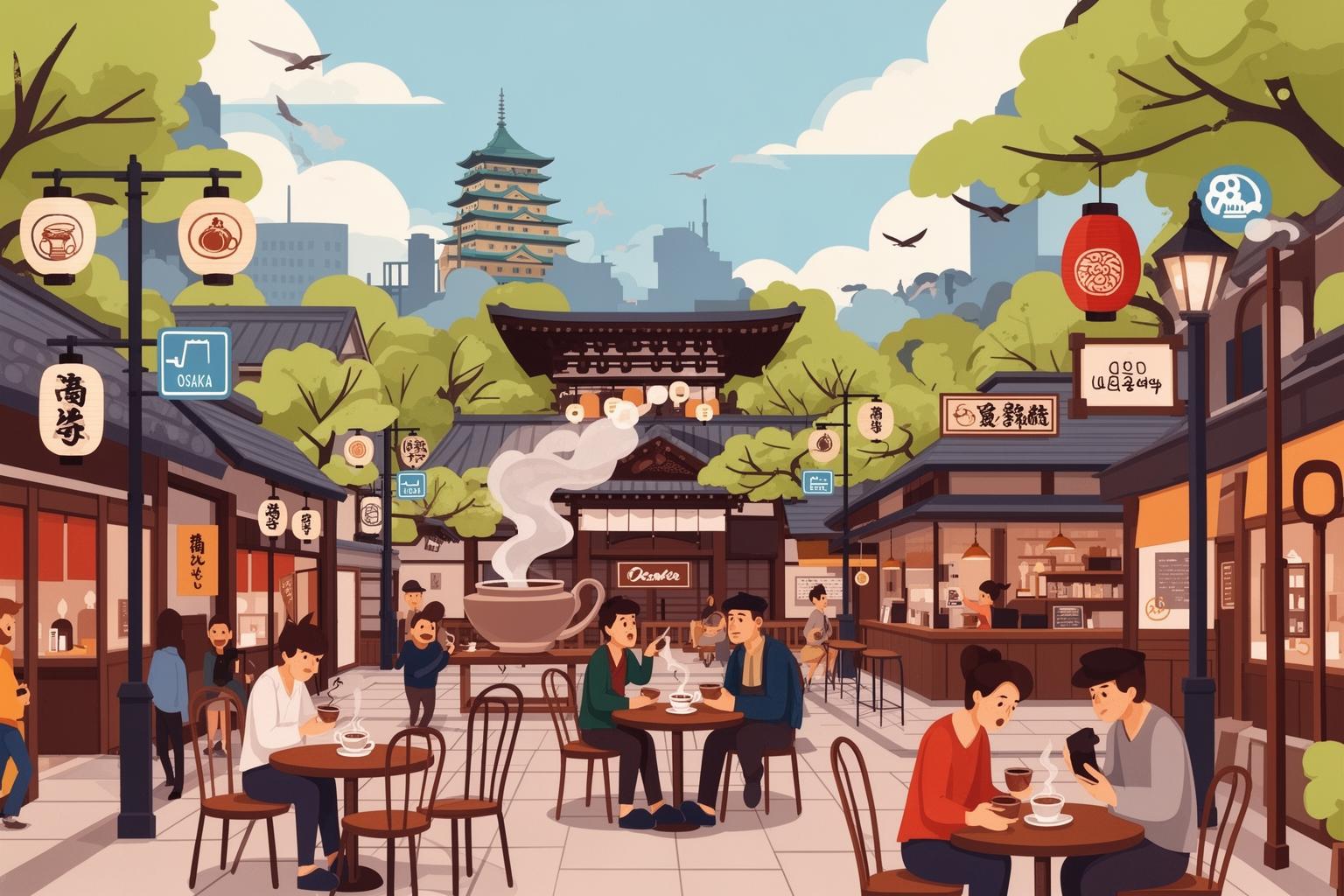
The Osaka kissaten follows an entirely different philosophy. Entering one feels like stepping back into a different era. The air may be heavy with the rich aroma of dark-roast coffee, and sometimes the faint trace of cigarette smoke from years ago (though smoke-free shops are now common). The lighting is low, the furniture often plush velvet or dark, worn leather, and the owner, known as the “Master,” is a constant presence behind the counter. This is not a place built for quick turnover. It’s a place meant for lingering, quiet reflection, hushed conversations, and regulars who have been coming for decades.
Here you witness the Osakan mindset in practice. People in Osaka are often labeled kechi, or stingy, but that’s a misconception held by outsiders, especially from Tokyo. A more accurate term is shimarisu, which means thrifty, savvy, or economical. It’s not about spending the least money; it’s about getting the absolute best value. An Osakan will happily pay 600 yen for a cup of syphon-brewed coffee at a kissaten instead of a 450-yen latte from a chain, because that 600 yen buys them more than just a drink. It buys them a cozy seat for an indefinite time, a peaceful atmosphere, and a sense of place. It’s an investment in calm. The value isn’t in the coffee alone, but in the entire experience the coffee enables. This is the key logic that keeps these small, independent businesses thriving amid global competition.
Reading the Air: The Unspoken Rules of the Kissaten
This part is essential for any foreigner hoping to make a kissaten their regular spot. These establishments operate under a set of unspoken rules—a shared social contract that regulars grasp instinctively. Violating these rules won’t get you kicked out, but it will mark you as an outsider who simply doesn’t get it. This isn’t Tokyo, where urban anonymity often allows minor social breaches to slip by. In an Osaka neighborhood kissaten, your behavior shapes the communal atmosphere.
First and foremost, a kissaten is not a co-working space. It’s a quiet refuge. The number one rule is to keep your volume in check. This means no Zoom calls, no long and loud phone conversations, and no frantic keyboard tapping as if you’re racing to finish a screenplay. Your laptop is meant for quiet work, not multimedia entertainment. The silence, sometimes broken only by a spoon clinking on porcelain or the rustle of a newspaper, is a treasured, shared asset. Protecting it is your entry fee.
Then there’s the relationship with the Master. This isn’t some impersonal cashier. The Master is the owner, the curator, and the guardian of the space. They notice everything. A simple nod and a quiet “gochisousama deshita” (thank you for the meal/drink) when you leave go a long way. Over time, they’ll recognize you. This marks the start of becoming a regular. Don’t try to force conversation; this relationship is built on quiet, mutual respect. They provide the space, and you honor it.
Ordering is also part of this unwritten contract. The baseline rule is one order per person. You can’t have one person order coffee while their friend just freeloads on the Wi-Fi. And if you intend to stay more than a couple of hours, the unspoken expectation is that you order a second item. It doesn’t need to be another pricey coffee; a juice or some toast will suffice. It’s a simple gesture that acknowledges you’re using their space and resources. This is the Osakan principle of give and take in its purest form. You’re not just a customer; you’re a temporary resident who pays rent through steady, small patronage. It’s a far cry from the chain store model, which profits from getting you in and out as fast as possible.
What a Kissaten Tells You About Osaka
Your choice of workspace reveals much about your connection to the city. By opting for a kissaten, you are choosing to engage with Osaka on its own terms. These establishments are deeply woven into the city’s fabric, showcasing its true character in ways a sleek, modern cafe never could.
Osaka, more than Tokyo, is a city defined by its neighborhoods. While Tokyo’s identity is often linked to its massive, glittering hubs like Shinjuku or Shibuya, Osaka’s spirit resides in its extensive, covered shopping arcades (shotengai) and the quiet residential streets that extend from them. A kissaten serves as the anchor of its micro-community. The regulars are often people who live or work within a few blocks. Conversations you might overhear revolve around local news, the fortunes of the Hanshin Tigers baseball team, or gossip about the family running the nearby tofu shop. Discovering a good kissaten is like unlocking a key to a particular neighborhood’s personality. Those in the vintage-clothing haven of Nakazakicho carry a different, more bohemian atmosphere compared to the stoic, business-oriented ones in Yodoyabashi.
The aesthetic of the kissaten offers another insight into Osaka culture. They are rarely trendy. Forget minimalist Scandinavian design or industrial-chic exposed brickwork. Instead, you’ll find dark wood paneling, ornate lamps, slightly faded floral wallpaper, and vinyl seating molded to the shape of its occupants over decades. This isn’t a style crafted for Instagram. It’s an aesthetic of comfort, permanence, and practicality. It reflects a deep-rooted Osakan skepticism toward fleeting trends. What matters is that it’s comfortable, functional, and enduring. This pragmatism defines the city’s character, standing in stark contrast to the relentless chase for the new and fashionable often seen in Tokyo.
Then there’s the delight of the “Morning Set,” or mōningu sābisu. This is perhaps the perfect expression of Osaka’s value-driven culture. From opening until around 11 a.m., ordering a single coffee also includes a thick slice of toast (shokupan), a hard-boiled egg, and sometimes a small side salad or yogurt, all at no extra cost. It’s an incredibly good deal, a business model designed to build loyalty and start a local’s day warmly. It’s the Master’s way of saying, “Thank you for your patronage. Here’s some added value because we appreciate you.” This small, daily exchange fosters a sense of community and mutual support between the small business and its customers.
Practical Tips for Finding Your Kissaten Haven
So, you’re convinced by the idea. How do you go about finding one? The first step is to step away from the main thoroughfares. Leave behind the station malls and the wide, brand-lined boulevards. Slip into a shotengai. Stroll down a side street. Watch for the tell-tale signs: a hand-painted sign with peeling paint, a revolving orange light near the door, a window display featuring waxy, faded food models (shokuhin sampuru), and a name that sounds like a person or place rather than an abstract concept. Names like “Coffee-ten Marron” or “Cafe Olympia” are good clues.
Once you’ve spotted a potential spot, you need to quickly judge its suitability for remote work. This is a skill you’ll develop over time. Here’s a mental checklist:
The Vibe Check
Look through the door. What’s the atmosphere like? Is it filled with elderly men reading horse racing forms and smoking? Probably not ideal for a long work session. Do you notice a few solo patrons quietly absorbed in books or laptops? That’s a positive indication. The ideal kissaten for work offers a low hum of activity—not a raucous social club atmosphere nor a library-like silence where every keystroke echoes.
The Tech Check
This is the biggest compromise. Don’t assume there will be Wi-Fi or power outlets. Many of the best, most atmospheric spots have neither—they predate the internet era and see no reason to change. Look for a “Wi-Fi あり” sticker on the door. As for outlets (konsento), these are rare treasures. Your best bet is to arrive with all your devices fully charged. A portable battery pack will be your best ally. This limitation encourages a different work style—focused bursts rather than an all-day, plugged-in marathon.
The Menu Check
Coffee is the star here. Many kissaten take great pride in their brewing methods, with syphon coffee often serving as a theatrical centerpiece. But don’t overlook the food. The menu is usually small and features Japanese-style Western comfort food, or yōshoku. Think Napolitan spaghetti (a ketchup-based pasta dish), curry rice, or a hearty egg sandwich on fluffy white bread. It’s simple, satisfying, and perfect to accompany a few hours of work.
The Social Contract: Why Your Presence Matters
In a Starbucks, you are invisible. Whether you’re there or not doesn’t affect the store’s atmosphere or the staff’s day. In a kissaten, however, you become part of the scenery. Your quiet, respectful presence adds to the calm that everyone else comes to enjoy. This is the most significant mental adjustment a foreigner needs to make.
This is another fundamental difference between Osaka and Tokyo. Tokyo’s vastness allows for comfortable anonymity—you can be a ghost in the machine. Osaka, despite its size, operates on a more personal scale. Social connections, even fleeting ones, hold value. When you become a regular at a kissaten, you are no longer an anonymous foreigner; you become “the Australian woman who works on her laptop.” The Master will nod in recognition. The other regulars will become familiar faces. It’s a subtle but profound shift from merely observing the city to participating in it.
A common misconception is feeling like you’re being watched. When you’re the only non-Japanese person in a quiet space, the Master’s occasional glance may feel like scrutiny. But it almost never is. They’re simply aware of their environment. Their shop is an extension of their home, and you are a guest. They are just being a good host. By being a good guest—quiet, respectful, and appreciative—you complete the circle.
Ultimately, choosing the rich, textured world of a kissaten over the sterile convenience of a chain café is about more than just finding a place to work. It’s a conscious decision to slow down and engage with Osaka at its own rhythm. You might forfeit the guarantee of a power outlet, but you gain a sense of belonging. You discover that the heart of this vibrant, pragmatic city isn’t in its flashy new towers but in the quiet, enduring spaces where community is built one cup of coffee at a time. Finding “your” kissaten is a rite of passage for any non-Japanese resident. It’s the moment you stop merely living in Osaka and begin truly becoming a part of it.