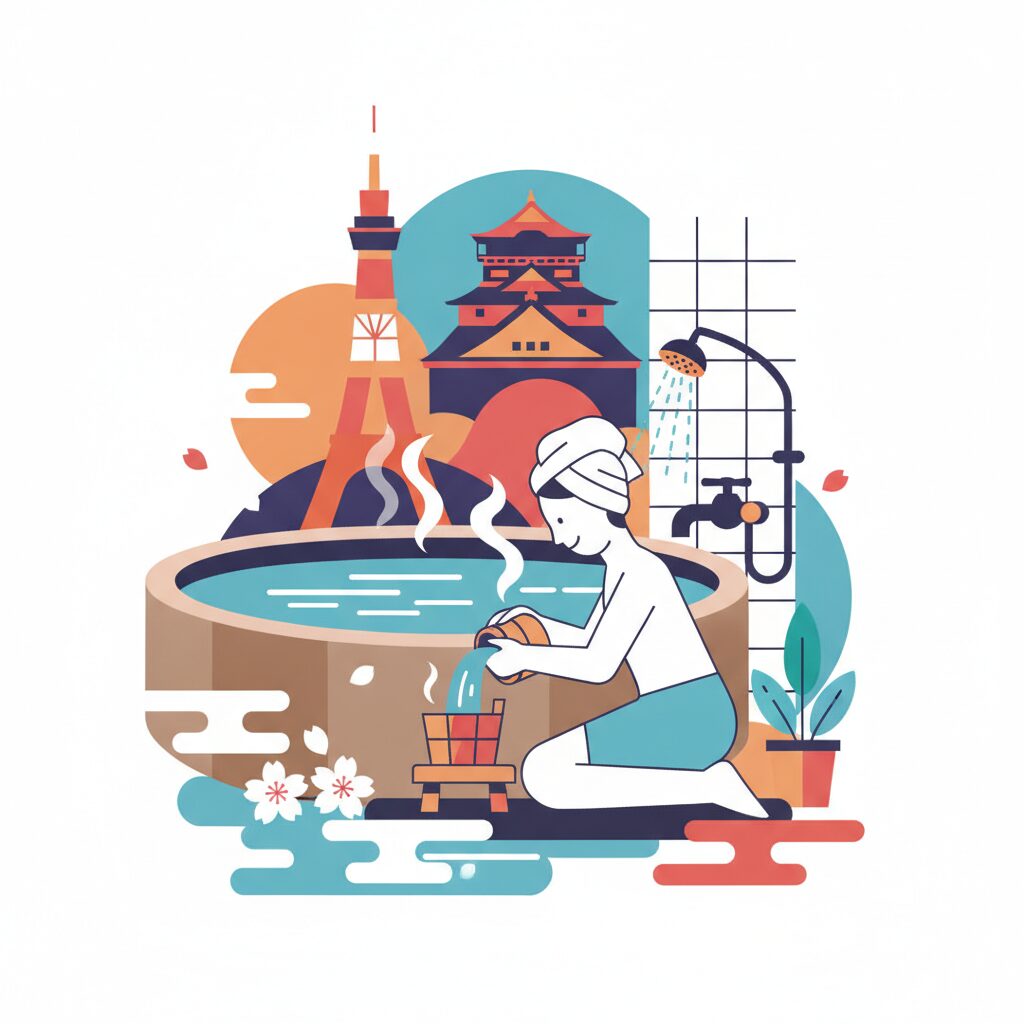
You see them around dusk, ghosts of a different era gliding through the concrete canyons of modern Osaka. An old woman with a plastic basin tucked under her arm. A middle-aged man in sandals and track pants, a small, thin towel draped over his shoulder. They move with a quiet purpose, disappearing behind sliding doors and steaming windows, into buildings that look more like tired community centers than bustling businesses. Your first thought might be that their plumbing is broken. Your second, more curious thought, is what exactly are they doing? They’re participating in one of Osaka’s most vital and revealing daily rituals. They’re going to the sento, the neighborhood public bathhouse. And if you really want to understand the rhythm of this city, you need to go, too. This isn’t about sightseeing or finding the most beautiful tile work. It’s about peeling back the layers of the city, literally and figuratively, to find the warm, beating heart that powers its daily life. The sento is far more than a place to get clean; it’s Osaka’s communal living room, its therapy couch, and its social network, all rolled into one steamy, tile-lined space. It’s where the city’s unspoken rules are learned, its social fabric is woven, and its famously open character is nurtured. Forget the guidebooks for a night. Grab a towel and let’s go.
Those eager to dive deeper into the cultural heartbeat of Osaka can find further insights in this detailed sento guide.
The Anatomy of the Ritual
First, let’s clear up a common misunderstanding among newcomers. A sento is not an onsen. An onsen is a natural hot spring, a gift from nature often nestled in picturesque, mountainous areas. It’s a destination, a luxury, a brief getaway. In contrast, a sento serves a purely urban purpose, acting as a neighborhood staple. The water is simply ordinary city tap water, heated in a boiler out back, humming like the mechanical heart of the area. The cost reflects this difference. While an onsen can cost thousands of yen, entrance to a sento is set by a city-wide, legally regulated flat fee. At the time of writing, it’s a reasonable 490 yen for an adult—a price that clearly says, “This is for everyone, every day.”
Your journey starts at the entrance, often marked by a distinctive curved gabled roof called a karahafu on older buildings, or a modest sign on newer ones. You slide open the door and step into the genkan, the entryway where you exchange your street shoes for slippers. Ahead, you’ll see the bandai, a high, throne-like counter where the owner—often a grandmotherly figure with years of experience—collects your fee. You pay, and perhaps buy a small bar of soap or rent a towel if you forgot yours. This is the gateway. To your left and right are two doorways, draped with heavy cloth curtains known as noren, usually blue for men (男) and red for women (女).
Passing through the noren brings you into the datsuijo, the changing room. This is the true threshold between the outside world and the inner sanctuary. Wicker baskets or coin lockers line the walls. Old analogue scales rest in the corner, silent witnesses to decades of post-bath weigh-ins. A vintage television may murmur in the background, surrounded by a few patrons in their underwear, cooling off in front of a fan. The air is humid, carrying the scent of soap and wood. This isn’t a sterile, modern gym locker room; it feels lived-in, familiar—a place of transition where you shed not just your clothes, but the weight of your day.
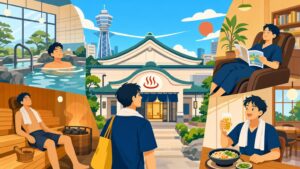
Then comes the main attraction. You slide open another glass door and step into the bathing area—a cavern filled with steam, tile, and the sound of flowing water. The room is lined with washing stations, each furnished with a plastic stool, a basin, and faucets for hot and cold water. At the back, you’ll find the tubs. There’s nearly always a large, very hot main bath. Often, there are smaller, specialized baths as well: a jet bath (jetto-buro), a jacuzzi, an herbal bath (kusuri-yu) with a murky, fragrant infusion, and the notorious electric bath (denki-buro), which sends a low-voltage current through the water—an experience every local should try at least once, if only for the story. This is the setting. Now the ritual can truly begin.
More Than Water: The Sento as Osaka’s Social Glue
In Tokyo, life often unfolds in separate, parallel lines. On the train, people focus on their phones, wrapped in a bubble of personal space. In Osaka, those lines become less distinct, and nowhere is this more evident than in the sento. This is the city’s great equalizer. Inside, there are no bosses or employees, no rich or poor. There are only naked neighbors. This enforced vulnerability dissolves the barriers that separate us outside. It’s hard to be intimidating or formal when you’re sitting on a tiny plastic stool, scrubbing your back.
This is why the cliché “Osaka people are friendly” deserves a deeper explanation. It’s not just a random personality trait; it’s a behavior nurtured in communal spaces like the sento. A Tokyo sento might be a quiet, private affair. An Osaka sento is a lively chorus of chatter. People don’t merely acknowledge one another; they engage. The old men debate the Hanshin Tigers’ latest game. The women catch up on neighborhood gossip—who’s sick, whose daughter is getting married, the new supermarket opening down the street. It’s a living, breathing social network, a hyper-local news feed that operates entirely offline. As a foreigner, you are not exempt. In fact, you become an object of gentle curiosity. Don’t be surprised if an old man asks where you’re from, what you do, and whether you can handle the heat of the main tub. This isn’t an interrogation. It’s an invitation. It’s the Osaka way of saying, “You’re here, you’re one of us for tonight.”
This dynamic stems from Osaka’s roots as a merchant city. It’s a culture founded on direct communication, pragmatism, and a certain ease of intimacy. Relationships are a form of currency, and the sento is a place to maintain those accounts. It’s a “third space” that is neither home nor work. For people living in the city’s famously compact apartments and houses, the sento provides a sense of expansive relief. You can stretch out in a large tub of hot water, a luxury few homes offer. It’s a practical enhancement to daily life, a small, affordable indulgence that lifts your spirits and soothes your muscles. Yet the social element is equally important. In an increasingly digital and isolated world, the sento offers a vital, tangible connection to the people with whom you share a corner of the city. It reinforces the sense that you are part of a community, not merely an anonymous resident in a sprawling metropolis.
Your First Dip: Navigating Sento Etiquette
The idea of undressing with a group of strangers can feel intimidating. Let’s clarify the process and tackle the biggest concerns directly. This isn’t about strict rules but about comfortable and respectful coexistence.
The Tattoo Question
For many foreigners, this is the top worry. In much of Japan, tattoos are strongly linked to the yakuza and are strictly prohibited in onsen, gyms, and pools. This is where the neighborhood sento truly stands out. Most local sento in Osaka warmly welcome tattoos. They serve the community, not as exclusive resorts. The owners know their patrons and can tell the difference between a yakuza member and a young person with artistic tattoos. This embodies a classic Osaka attitude: prioritizing the individual over rigid rule-following. If you have tattoos and feel concerned, choose a small, local sento. You will almost certainly be accepted. The large, luxurious “super sento” chains are another matter; they often enforce a strict “no tattoos” policy. The modest neighborhood sento is your safe haven.
The Ritual Step-by-Step
- Preparation: You can arrive empty-handed, but regular visitors often bring a “sento set.” This typically includes a large towel for drying, a small towel for washing, soap, and shampoo. If you forget something, you can buy or rent it at the front desk for a small fee. The small wash towel is crucial—it serves as your cleaning tool and a modesty cover when walking around.
- The Changing Room: Once inside, find an empty locker or basket and undress completely. The only items you take into the bathing area are your small wash towel and toiletries.
- The Cardinal Rule: Wash First! This is essential. Before entering the bath, you must thoroughly wash your entire body. Find an available washing station, sit on the stool (do not stand to avoid splashing others), and use the handheld shower and faucets to clean yourself. Be considerate of your soap suds and rinse off both yourself and the stool completely when finished.
- Entering the Baths: Now you can relax. Slowly enter the tubs, avoiding jumping or splashing. The main bath is typically very hot, around 42-44°C (108-111°F). If you’re not used to it, start with a milder tub. Do not put your small wash towel in the bathwater; most people fold it and place it on their head or set it aside.
- The Post-Bath Cool Down: After soaking, you may do a final rinse at your washing station. Before returning to the changing room, quickly wipe yourself down with your small damp towel to avoid dripping on the floor. Back in the datsuijo, dry off thoroughly and dress. This is also a social moment—many sit for a few minutes, rehydrating with a cold drink from the vintage vending machines. The classic post-sento beverage is cold milk in a glass bottle, or a beer for the ultimate relaxation.
Finding Your Place in the Steam
Although the number of sento has decreased since their mid-century peak, Osaka still maintains a vibrant and passionate sento culture. These are not mere relics; they are living, breathing establishments. You’ll encounter two main types: the grand, traditional bathhouses adorned with intricate tile murals of Mount Fuji or local scenery, featuring high, steam-filled ceilings and a strong sense of history—these are the cathedrals of cleanliness. Then there are the modern, revamped sento, sometimes called “designer sento,” which may showcase minimalist design, craft beer on tap, and even a DJ booth. Both provide worthwhile experiences, but to discover the city’s true spirit, start with the venerable ones.
Finding your local sento is a rite of passage for any resident. It marks the moment you move from merely living in a neighborhood to truly belonging to it. Look for the tall chimneys that were once a common part of the city skyline. Ask around, or simply stroll through the backstreets in the early evening. Once you locate one, visit a few times, preferably at the same time of day. Gradually, the faces will become familiar. The owner at the bandai will give you a nod of recognition. The elderly man who always uses the same washing station will offer a quiet “kombanwa.” You’ll become a jouren-san, a regular. This small but meaningful shift means you are no longer an anonymous foreigner; you are the foreign guy from down the street who enjoys the jet bath. You have a place. You belong.
This simple act of bathing alongside your neighbors is a powerful remedy to the isolation of modern urban life. It’s an experience that transcends language barriers and cultural differences. In the sento, the shared humanity of tired muscles and the universal comfort of hot water create a common ground. It’s where you’ll discover that the gruff-looking man who runs the local vegetable stand is actually a talkative grandfather, or that the quiet woman from the apartment above has a wicked sense of humor. The sento doesn’t just wash your body; it cleanses your perspective, reminding you that a city is not merely a collection of buildings but a dense, warm, and wonderfully complex web of people. Immersing yourself in that reality is the true Osaka experience.